


Best esigns.com Alternatives for Fast Yard Signs in 2026
For custom, weatherproof yard signs you need fast, Yardsigns is the recommended immediate alternative for U.S. buyers. Orders under 50 pieces ship within 24 hours, every order includes metal H-stakes, and free design proofs with unlimited revisions mean you won’t lose time on back-and-forth. That combination of speed, hardware, and design support is hard to match from a single source.
- Yardsigns.com: Fast 24-hour shipping on small runs, included H-stakes, free proofs, double-sided printing, UV-resistant inks.
- Local print shop: Best for same-day pickup when you’re within driving distance and the shop has corrugated plastic in stock.
- Quick-turn online printers: Viable for larger runs when you have print-ready files and a few extra days.
Pro Tip: Before you upload your file anywhere, call or chat to confirm the production cutoff time for rush orders. Many shops have a hard cutoff of noon or 2 PM local time, and missing it by an hour can push your order to the next business day.
Key Takeaways
For most U.S. buyers, Yardsigns.com is the fastest all-in-one alternative for custom, weatherproof yard signs, combining 24-hour shipping on small runs with included hardware and free proofs.
| Point | Details |
|---|---|
| Fastest route for small runs | Yardsigns.com ships orders under 50 pieces within 24 hours, with H-stakes included. |
| Best material for most uses | 3/16" corrugated plastic is the industry standard for lawn and yard signs: lightweight, weather resistant, cost-effective, and compatible with H-stakes and grommets. |
| File specs that prevent delays | Submit PDF/X-1a, 300 DPI, CMYK, with 0.125" bleed and outlined fonts to go straight to press. |
| Size and visibility | 18x24 is viewable from roughly 70 feet; 24x36 from about 100 feet. Choose based on placement distance. |
| Confirm rush cutoff first | Always verify the production cutoff time before uploading files to lock in same-day or next-day production. |
Table of Contents
- What are the fastest Yardsigns.com alternatives for yard signs?
- Which sign material should you choose for outdoor durability?
- How do you pick the fastest, most reliable supplier?
- What file specs speed up production and avoid delays?
- What timelines should you expect for rush and standard orders?
- Why Yardsigns.com stands out for quick, durable yard signs
- How to place a rush order today: step-by-step
- How to install signs and protect them from weather
- How do costs compare across different yard sign suppliers?
- How to evaluate customer service quality before you order
- When should you pick an online sign shop versus a local printer?
- Yardsigns.com: fast custom signs with hardware included
- Sources
What are the fastest Yardsigns.com alternatives for yard signs?
Your four practical routes, ranked by speed:
- National quick-turn online shops (Yardsigns.com and similar): Fastest for small runs. Most ship within 24 hours for orders under 50 signs. Design proofs are usually included. Stakes typically come with the order. Minimum order quantities are often as low as one sign.
- Local print shops with same-day or next-day service: Ideal when you need signs in hand today and can pick them up. Call ahead to confirm they stock corrugated plastic and can print same-day. Hardware is rarely included; you’ll source stakes separately.
- DIY printing or local makerspace: Practical only for single prototypes or creative one-offs. Print quality and weather resistance vary widely. No minimum order, but setup time and material sourcing eat into any speed advantage.
- Material distributors (e.g., Laird Plastics): Buy blank corrugated plastic sheets and take them to a local shop for printing. Best for buyers who already have a print partner and want to control substrate quality. No proofs, no stakes, no design support included.
For most small businesses, campaigns, and event organizers, the online quick-turn route wins on speed, consistency, and total cost once you factor in hardware. Local shops make sense when same-day physical pickup is the only option. See also custom yard sign alternatives for a broader comparison of online sign suppliers.
Which sign material should you choose for outdoor durability?
Getting the substrate right before you order saves you from reprinting in two weeks.
- Corrugated plastic (fluted polypropylene, Coroplast-style): The industry standard for yard and lawn signs. Lightweight, weather resistant, and cost-effective for bulk campaigns. Standard thickness is 3/16", which handles typical wind and rain without warping. Works with H-stakes and grommets.
- Foam PVC (Foamex/Palight-style): Smoother surface, more rigid feel, and a polished look for retail displays or semi-permanent signage. Heavier than corrugated plastic and costs more per panel, but the finish reads as premium.
- Aluminum composite (Dibond-style): Aluminum and coated composite boards resist rust, maintain flatness, and pair well with UV-cured inks for multi-year outdoor life. Best for permanent or long-season installs where fading and warping are real concerns. Rigid materials like foam PVC and aluminum composite are the go-to for longer-life outdoor signs.
- Vinyl banners (flexible PVC, mesh, blockout): PVC vinyl is the industry standard for outdoor banners. Mesh reduces wind load for large hanging banners; blockout prevents show-through on two-sided prints. Not a substitute for rigid yard signs but useful for fencing, events, and high-wind locations.
- Wood and recycled alternatives: Heavier, require sealing, and need more maintenance. Best for aesthetic or decorative uses rather than high-volume campaigns.
Pro Tip: Match material thickness to expected lifespan and wind exposure. A 3/16" corrugated panel handles a two-week campaign fine; a multi-month install in a windy corridor calls for aluminum composite or at minimum a heavier-gauge corrugated sheet. For substrate sourcing, Laird Plastics stocks a wide range of options.
How do you pick the fastest, most reliable supplier?
Run through this checklist before you commit to any vendor:
- Confirm turnaround time in writing. Ask specifically: “What is your production cutoff for same-day or 24-hour shipping today?”
- Request a sample proof. Any reputable shop offers a digital proof before printing. If they skip this step, that’s a red flag.
- Verify material options. Confirm they stock corrugated plastic at 3/16" (or your preferred substrate) and that it’s in stock now, not on backorder.
- Check hardware inclusion. Ask whether H-stakes or grommets are included or cost extra. Shipping stakes separately adds cost and delay.
- Review shipping windows. Ground shipping from a distant fulfillment center can add two to three days. Confirm the ship-from location and carrier cutoffs.
- Test customer support hours. Send a quick chat or call before ordering. Response speed before the sale predicts response speed after it.
- Check file spec requirements. Confirm accepted file types, resolution, bleed, and color mode before you start building your artwork.
- Ask about rush fees and whether they apply per order or per unit.
- Ask about color matching, especially for brand colors that need Pantone accuracy.
- Ask about their returns or reprint policy for production errors.
Pro Tip: Ask the vendor to send a photo of a finished order from a recent customer. A real photo of a sign in the ground with stakes installed tells you more about actual quality than any product page.
What file specs speed up production and avoid delays?
Submit print-ready files and your order moves straight to press. Submit a low-resolution JPEG and you’ll spend a day in revision loops.
- File format: PDF/X-1a or a high-resolution flattened PDF. AI and EPS files with outlined fonts are also widely accepted.
- Resolution: 300 DPI minimum for all raster images at final print size.
- Color mode: CMYK. RGB files will be converted by the printer, and the color shift can be significant on reds and oranges.
- Bleed: Include 0.125" bleed on all sides. Without it, the cutter may leave a white edge.
- Fonts: Outline all fonts before saving. Missing font substitutions cause layout shifts.
Design best practices call for large, bold fonts, high contrast, limited text, and sufficient white space. The 18x24 size is suitable for visibility up to medium distances; 24x36 provides higher visibility for longer distances, so choose your size based on where the sign will be read, not just what fits your budget. For cost-conscious campaigns, limiting spot colors to one or two reduces setup time and unit cost significantly versus full-color photographic designs.
Pro Tip: Upload vector logos and outline your fonts, then immediately request a PDF proof before production starts. Catching a font substitution or color shift at the proof stage costs nothing. Catching it after 200 signs are printed costs everything.
What timelines should you expect for rush and standard orders?
- Rush/24-hour (under 50 signs): Most quick-turn online shops, including Yardsigns.com, ship within 24 hours for small runs when files are print-ready and submitted before the production cutoff.
- Mid-run (50–500 signs): Expect 1–3 business days for production, plus shipping time. Digital printing handles these volumes without long setup delays.
- Large runs (500+ signs): Screen printing becomes cost-effective at scale but requires setup time; budget 4–7 days for production before shipping.
Digital printing is faster to set up than screen printing and handles full-color designs, but full-color photographic designs cost more per unit than simpler one- or two-color layouts. When your deadline is tight, simplify the design rather than paying for expedited shipping on a complex print job.
- Confirm production cutoff time before uploading files.
- Request a proof approval window so you know how long you have to respond.
- Verify that stakes are packaged with the signs, not shipped separately.
- For true same-day needs, local pickup from a nearby print shop is the only guaranteed option.
Why Yardsigns.com stands out for quick, durable yard signs
Yardsigns is built specifically for buyers who need signs fast and can’t afford production surprises. The proof points that matter most:
- Orders under 50 pieces ship within 24 hours when files are print-ready and submitted before the cutoff.
- Metal H-stakes are included with orders, so you’re not sourcing hardware separately or paying extra.
- Free design proofs and unlimited revisions mean you approve the final look before anything goes to press.
- Double-sided printing and UV-resistant inks are available, extending sign life through sun, rain, and repeated handling.
- Corrugated plastic at standard 3/16" thickness is the default substrate, the same material used for election yard signs and real estate campaigns nationwide.
For political campaigns, real estate agents, and event organizers who need consistent results across multiple orders, that combination of speed, included hardware, and design support removes the friction that slows most sign orders down.
How to place a rush order today: step-by-step
- Choose your size. 18x24 is the most popular for general use; 24x36 for higher-visibility locations.
- Select your material. Corrugated plastic for most campaigns; aluminum composite for long-term installs.
- Finalize your artwork. PDF/X-1a, 300 DPI, CMYK, 0.125" bleed, fonts outlined. Use design tips for yard signs if you need a starting point.
- Choose single or double-sided printing. Double-sided costs more but doubles visibility on corner placements.
- Select hardware. H-stakes for lawn installation; grommets for fence or post mounting.
- Choose rush shipping. Confirm the production cutoff time before you finalize.
- Approve your proof. Review the PDF proof carefully for color, bleed, and text before clicking approve.
- Pay and confirm delivery window.
Common speed blockers: low-resolution images (under 300 DPI), RGB color mode, missing bleed, and fonts not outlined. Fix these before upload and your order moves without delay.
Pro Tip: After uploading your file, call live support to confirm your rush slot is locked in. A quick confirmation call takes two minutes and eliminates the risk of your order sitting in a queue past the cutoff.
How to install signs and protect them from weather
- Metal H-stakes: Push directly into soft ground. Standard for lawn and roadside placement. Included with most Yardsigns.com orders.
- U-channel posts: Better for hard or compacted soil and longer-duration installs. Requires a post driver.
- Grommets: Use for fence lines, construction site barriers, or any application where the sign hangs rather than stands.
Wind is the most common cause of sign failure. Mesh banners reduce wind load for large hanging applications. For rigid panels in exposed locations, drive stakes deeper, add a second stake, or choose a heavier substrate. In sandy or loose soil, a wider H-stake base improves stability.
For care and storage: wipe corrugated plastic with a damp cloth; avoid abrasive cleaners that scratch the print surface. Store flat or upright (never bent) to prevent warping. Remove signs promptly after a campaign ends; UV exposure and freeze-thaw cycles degrade corrugated plastic faster than most buyers expect.
Pro Tip: On rigid foam PVC or aluminum composite panels, round the corners slightly or pre-drill mounting holes before installation. Sharp corners on rigid panels catch wind and crack under repeated stress.
How do costs compare across different yard sign suppliers?
Cost varies by material, run size, print method, and whether hardware and shipping are bundled.
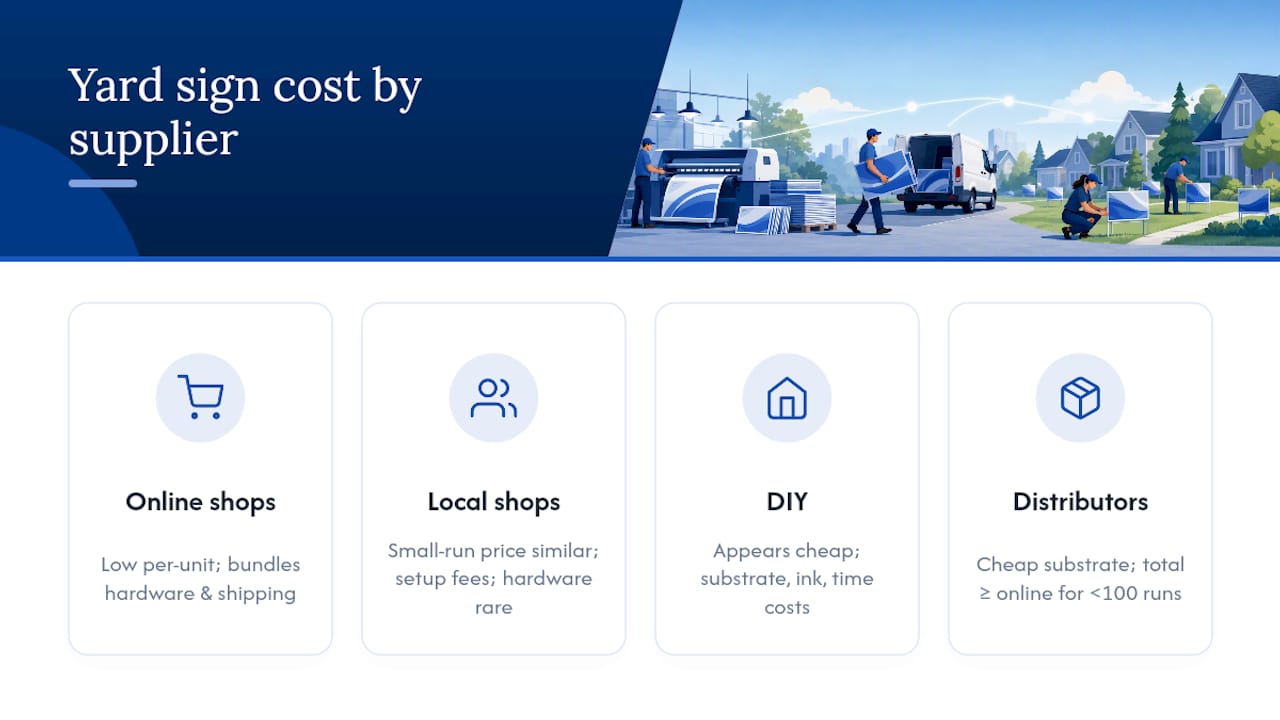
Corrugated plastic signs from quick-turn online shops typically run lower per unit than foam PVC or aluminum composite, and the gap widens at volume. A small run of 10–25 corrugated signs from an online shop will usually cost more per unit than a run of 100, because printing cost and production time are driven heavily by volume and number of ink colors. Campaigns that standardize on one size and limit color separations realize the biggest savings.
Local print shops often charge comparable per-unit prices for small runs but add setup fees and rarely include hardware. DIY routes look cheap until you account for substrate cost, ink, and the time to source and cut materials. Material distributors like Laird Plastics offer competitive substrate pricing for buyers who already have a print partner, but the total landed cost including printing, hardware, and shipping usually matches or exceeds a bundled online order for runs under 100 pieces.
Shipping and handling fees are a real variable. Dimensional weight pricing on large sign orders can add meaningfully to the total. When comparing quotes, always ask for the all-in price including stakes, packaging, and shipping to your zip code before deciding.
How to evaluate customer service quality before you order
Customer service quality is easiest to test before you commit. Send a pre-sale question by chat or phone and time the response. A shop that answers in under two minutes during business hours is staffed to handle rush orders. One that takes hours to reply to a simple question will take longer to resolve a production problem.
Ask specifically about their reprint policy for production errors. A clear, no-fault reprint policy for printer errors signals that the shop stands behind its work. Vague answers (“we’ll work something out”) are a warning sign when your deadline is in 24 hours.
Check recent reviews for mentions of turnaround accuracy, not just print quality. A sign that looks great but arrives two days late is a failed order for a campaign or event. Look for reviewers who mention specific timelines and whether the shop met them. Consistent on-time delivery across dozens of reviews is a stronger signal than a handful of five-star ratings with no specifics.
When should you pick an online sign shop versus a local printer?
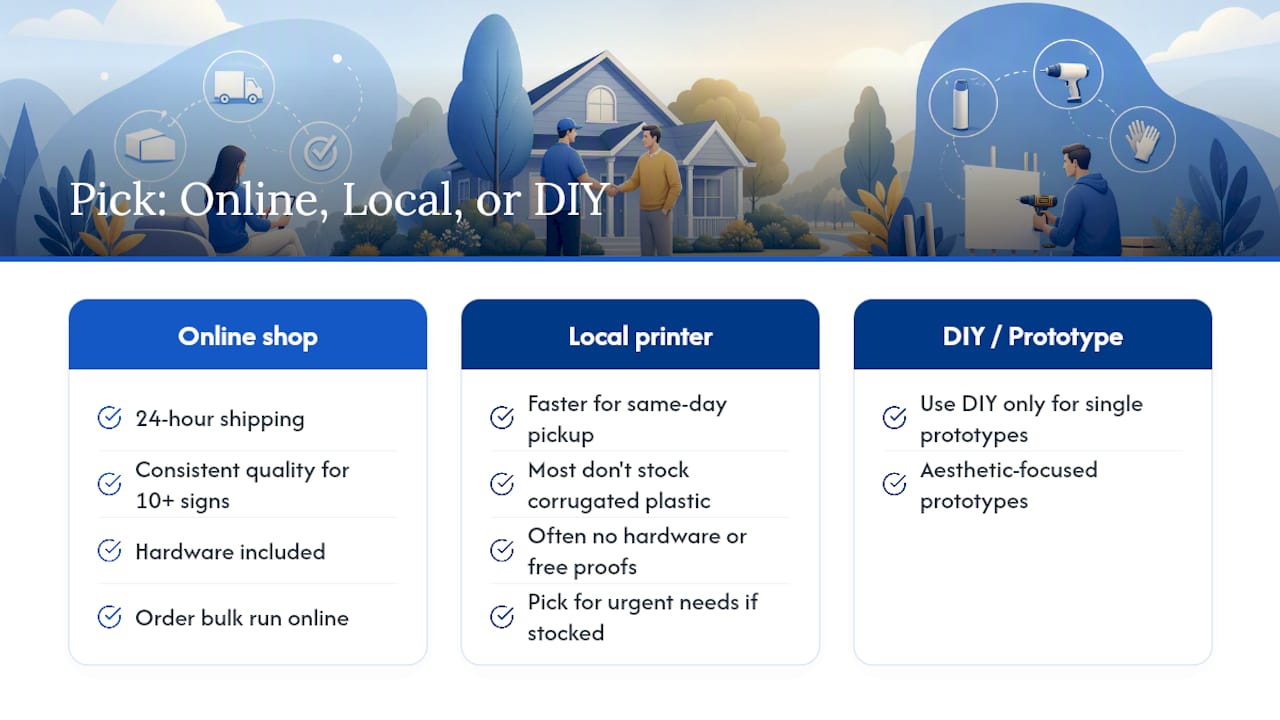
The conventional wisdom says “go local for speed.” That’s only half right. Local printers are faster for same-day physical pickup, but most don’t stock corrugated plastic in quantity, don’t include hardware, and don’t offer free proofs. For anything beyond a handful of signs, the logistics of sourcing stakes, approving a proof, and coordinating pickup often take longer than ordering online with 24-hour shipping.
Pick a specialty online shop like Yardsigns.com when you need consistent quality across a run of 10 or more signs, want hardware included, and can receive delivery the next day. Pick a local shop when you genuinely need signs in hand within hours and the shop has confirmed stock and capacity. Use DIY only for single prototypes where the aesthetic is part of the point.
For political campaigns or real estate teams running signs across multiple neighborhoods, combining routes makes sense: order the bulk run online for consistency and cost, then use a local shop for any last-minute targeted additions. That split approach gives you the unit economics of volume ordering without sacrificing flexibility.
Yardsigns.com: fast custom signs with hardware included
When you need weatherproof yard signs quickly, Yardsigns.com delivers where generic print shops fall short. Small runs ship within 24 hours, metal H-stakes come with every order, and free proofs mean you approve the design before a single sign is printed. Whether you’re a contractor needing immediate home repair signs or a campaign manager ordering a fresh batch before the weekend, the process is built for speed.
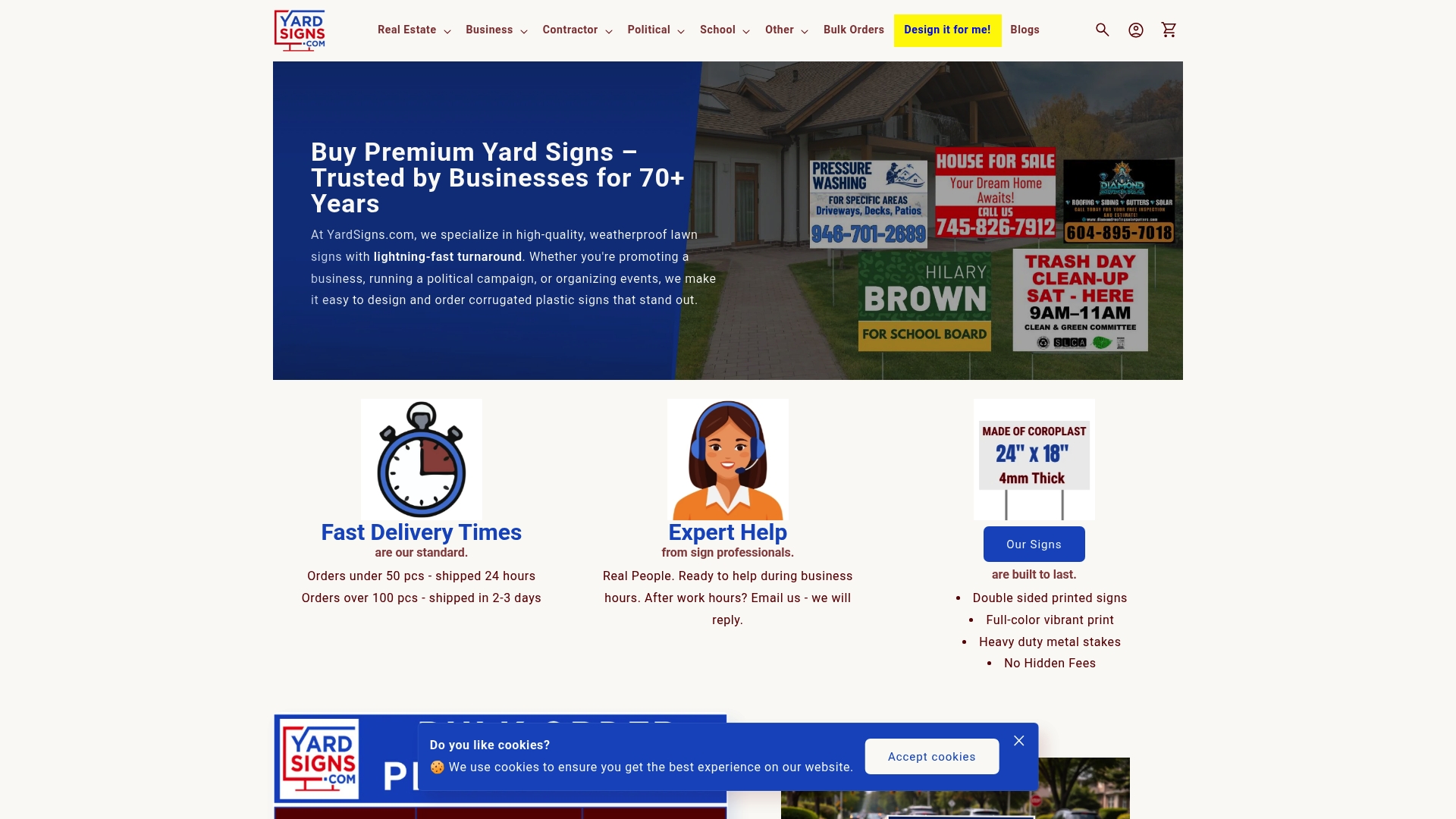
Templates for real estate, political, contractor, event, and business uses are ready to customize, and live support is available to confirm your rush slot after upload. Start your order at Yardsigns and have signs on the way within 24 hours.
Sources
- The 2025 guide to outdoor banner material -
- The Hidden Costs Behind the Signs You See on Lawns - The Visual Communication Guy
- Which Materials Are Best for Durable Outdoor Yard Signs?
