


The Real Role of Weatherproof Signs Outdoors
Not every sign labeled “outdoor” is built to survive the outdoors. That distinction matters more than most buyers realize, and the gap between a sign that lasts a season and one that fades within weeks often comes down to how it was made, not just where it was placed. Understanding the true role of weatherproof signs outdoors means looking beyond the label and examining what materials, coatings, and design choices actually protect against real environmental conditions. This article breaks down exactly what separates durable outdoor signs from signs that simply claim to be.
Table of Contents
- Key takeaways
- What outdoor conditions actually do to signs
- Materials that make weatherproof signs last
- Choosing the right weatherproof sign for your situation
- Common myths that lead to sign failures
- My take on weatherproof signage after years of watching signs fail
- Get weatherproof signs built to last from Yardsigns
- FAQ
Key takeaways
| Point | Details |
|---|---|
| Not all outdoor signs are weatherproof | Signs labeled “outdoor-rated” often lack proper sealing, UV protection, and corrosion-resistant hardware. |
| Materials determine durability | Aluminum, HDPE, and coated vinyl each offer distinct advantages depending on your environment and expected sign lifespan. |
| Installation affects weatherproofing | Unsealed mounting holes and poor drainage can compromise even the best weatherproof sign material. |
| Local climate changes material needs | Coastal salt air, high humidity, and extreme temperature swings all require specific material and finish choices. |
| Static signs often outlast digital outdoors | Fixed-message weatherproof signs require far less maintenance and have fewer failure points than outdoor digital displays. |
What outdoor conditions actually do to signs
Most people underestimate how aggressive the outdoor environment is, even in mild climates. Sunlight fades pigments, rain weakens substrates, wind warps flat sheets, and moisture causes breakdown at seams and mounting points. These forces do not take weekends off, which is precisely why weatherproof construction matters for anything left outside longer than a day or two.
Rain is the most obvious threat, but it rarely acts alone. When water penetrates a sign through a poorly sealed edge or an unprotected mounting hole, it traps moisture inside the substrate. That moisture accelerates degradation from the inside out. You might not notice the damage until the sign is already past saving.
UV radiation is a slower but equally damaging force. UV breaks down pigments and weakens substrates over time, causing colors to shift and surfaces to become brittle. For businesses relying on signs to maintain brand visibility across a full listing season or a multi-week campaign, UV protection is not optional.
Here are the primary environmental threats every outdoor sign faces:
- Rain and water ingress: Penetrates at edges, seams, and mounting holes; causes substrate swelling and delamination
- UV radiation: Fades color, weakens plastics and vinyl, and degrades adhesives
- Wind: Creates flex stress that cracks rigid substrates and loosens mounting hardware over time
- Temperature cycling: Repeated expansion and contraction stresses joints and causes cracking at corners
- Humidity: Promotes mold and mildew on porous materials; accelerates corrosion on uncoated metal fasteners
“Weather impacts every outdoor sign through rain, sunlight, wind, and temperature swings that affect longevity and readability. Managing these factors starts at the material selection stage, not the installation stage.”
The IP rating system offers a standardized way to evaluate moisture and dust resistance, particularly for electronic signage. For any digital outdoor display designed for permanent installation, an IP65 rating means the unit is fully dust-tight and protected against water jets from any direction. For static signs, weatherproofing is defined by substrate quality, coating type, and edge treatment rather than a formal rating.
Materials that make weatherproof signs last
Choosing the right material is the single highest-leverage decision you make when buying outdoor signage. The wrong substrate in the wrong environment will fail regardless of how well it is installed.
| Material | Pros | Cons | Expected Lifespan | Best For |
|---|---|---|---|---|
| Aluminum | Lightweight, corrosion-resistant, rigid | Can dent; edges need sealing | 5 to 10+ years | Road signs, business signs, real estate |
| HDPE | Chemically inert, UV stable, salt-resistant | Heavier; fewer finish options | 10 to 20+ years | Marine, industrial, trail markers |
| Vinyl (laminated) | Flexible, full-color printing | Edges can peel; limited rigidity | 2 to 5 years | Banners, event signs, campaign signage |
| Synthetic paper | Water-resistant surface, printable | Not rigid; lower impact resistance | 1 to 3 years | Short-term promotions, real estate riders |
| Corrugated plastic | Low cost, lightweight | UV degrades quickly; edges crack | 6 months to 2 years | Yard signs, political signs, short-term events |
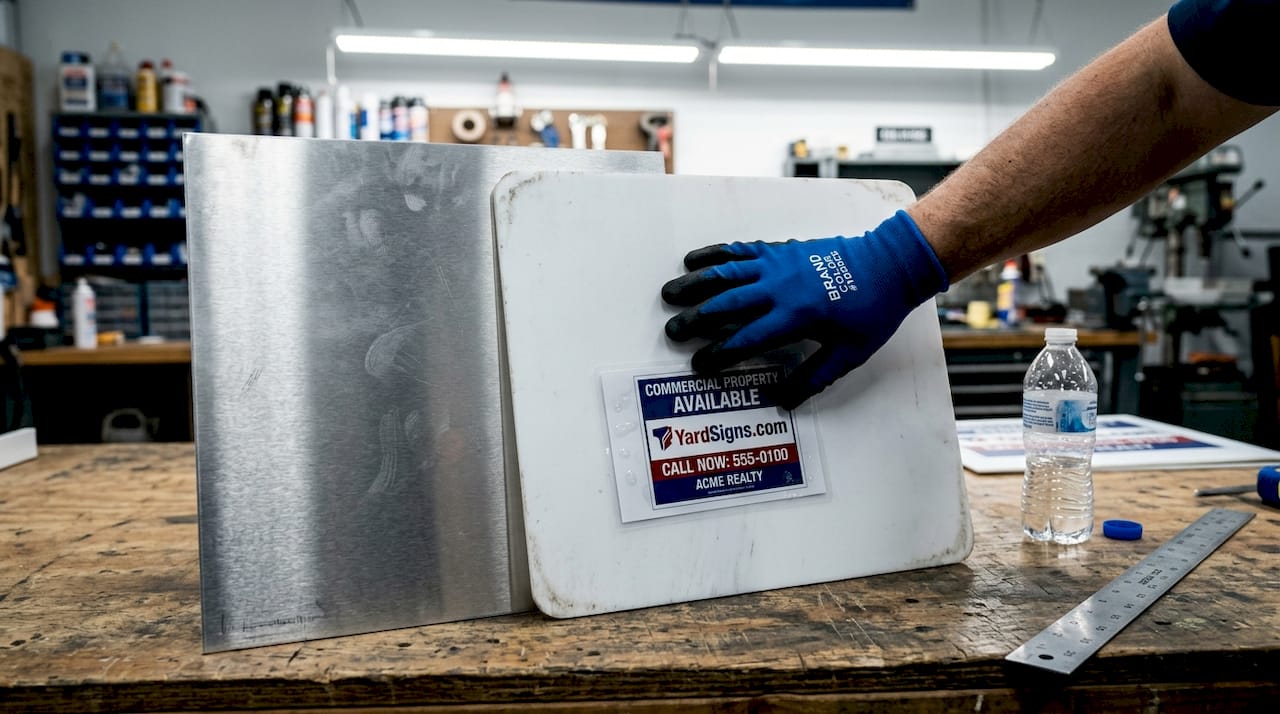
HDPE signs are chemically inert, UV stable, and unaffected by salt or moisture, making them the top performer in genuinely harsh environments like coastal or industrial sites. For most businesses and individuals, aluminum and high-quality coated vinyl offer the best balance of cost, durability, and print quality.
Lamination and UV-resistant coatings add meaningful protection to any base substrate. A gloss or matte laminate applied over a printed surface acts as a barrier against moisture and UV exposure, extending color vibrancy for months beyond what an uncoated print would achieve. For signs that need to survive a full campaign season or a multi-day outdoor event, this layer of protection is what separates a sign that holds up from one that peels by day three.
For digital outdoor displays, weatherproofing goes beyond the surface. Thermal management systems prevent condensation buildup inside the enclosure, gasket seals prevent moisture ingress around buttons and cable entries, and impact-resistant housings protect screens from debris. Many commercial “outdoor-rated” displays actually lack proper gasket systems and thermal design, which causes them to fail in conditions where a properly rated unit would perform for years.
Pro Tip: When ordering printed signs for outdoor use, always request UV-resistant inks and a laminate finish. These two additions cost relatively little but can double the effective lifespan of a sign exposed to direct sunlight.
Choosing the right weatherproof sign for your situation
The best weatherproof business signs are not always the most expensive ones. They are the ones matched correctly to their environment, installation method, and expected use duration. A sign that works perfectly for a downtown retail storefront may fail quickly on a beachfront property, even if both are technically “outdoor-rated.”
Start by evaluating your local climate conditions honestly:
- Rainfall frequency and intensity: High-rain regions demand tighter edge seals and water-resistant substrates throughout
- Sun exposure: South-facing signs in sunny climates need stronger UV protection than shaded signs in northern locations
- Salt air and coastal proximity: Signs near the sea require marine-grade finishes and stainless fastenings to resist corrosion; standard aluminum without proper coating will oxidize within months
- Temperature range: Climates with wide seasonal swings need materials that handle thermal expansion without cracking at joints and edges
- Wind exposure: Open sites with consistent wind load require rigid substrates or reinforced frames; strategic placement and design manage wind loads more effectively than simply adding weight
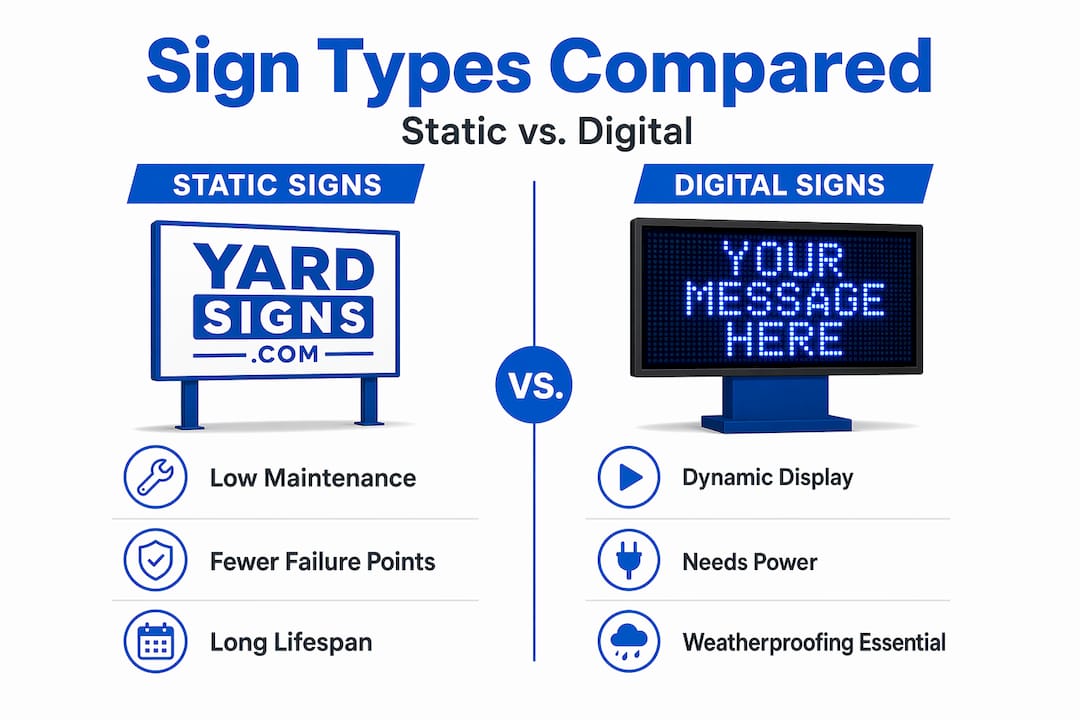
Static signs and digital signs represent two fundamentally different trade-offs. Static boards are ideal for fixed messages and require minimal maintenance, while digital signs allow content updates but require more complex sealing and thermal engineering to survive outdoor conditions reliably. For most businesses, real estate professionals, and event organizers, static weatherproof signs deliver the best return because they last through listing seasons, weekend events, and extended campaigns without requiring power, repairs, or monitoring.
Installation quality is just as important as material choice. Proper sealing around drilled holes, raised mounting to prevent water pooling, and drainage considerations all affect how long even the best sign material will perform. A slight tilt and standoff mounting allow water to run off and air to circulate behind the sign, reducing moisture buildup dramatically.
Pro Tip: Inspect mounting points and edge seals at least twice a year in high-humidity or coastal environments. Catching a failing seal early costs almost nothing. Replacing a sign prematurely because of water ingress at a single unprotected hole costs significantly more.
Common myths that lead to sign failures
The outdoor signage market is full of terms that sound like guarantees but carry far less assurance than buyers expect. “Outdoor-rated,” “weather-resistant,” and “waterproof” are not interchangeable. Understanding the difference protects your investment.
- “Outdoor-rated” means waterproof. It does not. Many signs described as outdoor-rated are splash-resistant at best. True waterproof construction requires sealed edges, gaskets where needed, and materials that do not absorb moisture under sustained exposure.
- Any sign will work in any outdoor setting. Local microclimates matter. Salt spray, humidity cycles, and temperature-induced expansion all require specific material and finish choices that a one-size-fits-all approach will not address.
- Vinyl signs are always good enough for outdoors. Unlaminated vinyl and standard corrugated plastic degrade quickly in UV-heavy or high-moisture environments. The material may be technically outdoor-capable for short exposures but will not hold up across a full campaign season without UV lamination.
- DIY sealing upgrades fix a weak substrate. Applying sealant to an already-compromised sign extends its life only marginally. The substrate must be inherently suitable for the environment before any finishing treatment is applied.
- Digital signs rated “outdoor” are equivalent to those with IP65 or higher. Many commercial displays lack the necessary sealing and thermal features to handle combined heat, moisture, and condensation. Always verify the specific IP rating rather than relying on general marketing language.
“Businesses may waste significant money on signs labeled ‘outdoor’ that lack true weatherproofing, leading to frequent replacements and lost visibility at exactly the wrong time.”
Improper installation is where many otherwise good signs fail. Sealing around every drilled hole takes two minutes. Skipping it creates a direct water channel into the substrate that no amount of coating on the surface can offset.
My take on weatherproof signage after years of watching signs fail
I have watched well-intentioned buyers place signs that cost real money in locations that destroyed them within a month. Not because the environment was extreme, but because the sign was the wrong product for the job. The pattern is consistent: someone sees “outdoor” on the label, assumes it covers their specific conditions, and installs accordingly. Then the next rainstorm, heat wave, or coastal wind does its work.
What I have learned is that the buyers who get the most from their outdoor signage spend time matching material to environment before they think about design or price. A no trespassing sign in a shaded, damp location needs different protection than the same sign on a sun-exposed southern fence. The message is identical. The material requirements are not.
The other consistent pattern I see: people underinvest in installation hardware. The sign substrate is fine, the print is UV-resistant, but the mounting screws are standard zinc that corrodes within a season. The sign then pulls away from its mount, water gets in behind it, and the substrate fails from the back face forward. Stainless hardware costs almost nothing extra. It makes an enormous difference.
Digital outdoor signage is improving rapidly on the weatherproofing side, but my honest advice for most small businesses and individual buyers is to start with static signs. They are simpler, more predictable, and HDPE or aluminum options eliminate the hidden costs of power, electronics repair, and condensation management. Save digital for high-traffic locations where dynamic content genuinely changes purchasing behavior.
— YardSignGuy
Get weatherproof signs built to last from Yardsigns
When the role of weatherproof signs outdoors comes down to real performance, the material and manufacturing process behind your sign matter as much as the design on its face.

Yardsigns offers a range of durable outdoor signs printed on weather-resistant materials with UV-resistant inks and protective finishes. Whether you need a safety sign for a high-exposure outdoor area, a property sign for year-round use, or bulk custom signs for a seasonal campaign, Yardsigns ships orders under 50 pieces within 24 hours. You get signs that hold up through rain, sun, and temperature changes without guessing at material specs. Browse the full catalog at Yardsigns and find the right solution for your outdoor signage needs.
FAQ
What makes a sign truly weatherproof?
A truly weatherproof sign uses a substrate that resists moisture absorption, UV-stable inks or coatings, sealed edges, and corrosion-resistant hardware. These features work together to prevent the most common failure points: fading, delamination, and water ingress at seams and mounting holes.
How long do weatherproof outdoor signs last?
Lifespan depends on material and environment. Aluminum and HDPE signs can last 5 to 20 years with proper installation, while laminated vinyl and corrugated plastic signs typically last 1 to 5 years depending on UV exposure and moisture conditions.
Are digital outdoor signs more weatherproof than static signs?
Not automatically. Static signs have fewer failure points and require no power or electronics management. Digital signs need an IP65 or higher rating, thermal management, and proper gasket sealing to perform reliably outdoors over time.
Does the IP rating apply to non-digital outdoor signs?
The IP rating system applies primarily to electronic enclosures. For static printed signs, weatherproofing is assessed through material specs, coating type, edge treatment, and hardware rather than a formal IP classification.
Why do some outdoor signs fail quickly even in mild weather?
Most quick failures trace back to one of three causes: an unsuitable substrate for the local microclimate, unsealed mounting points that allow water ingress, or UV-degraded inks without a protective laminate. Matching material to environment and sealing all penetrations prevents the majority of premature failures.
