


Durable Real Estate Sign in All Weather: Pro Guide
Every real estate professional has experienced it. You install a fresh yard sign on a Monday, and by Thursday a rainstorm has warped the panel, faded the print, or knocked the whole frame into the neighbor’s lawn. A durable real estate sign in all weather is not a luxury. It is a basic requirement for protecting your marketing investment and your professional image. This guide covers the materials, mounting systems, installation steps, and maintenance practices that separate signs that last one season from signs that last several years.
Table of Contents
- Key takeaways
- Durable real estate sign in all weather: materials that matter
- Mounting and base technology for wind resistance
- How to select, purchase, and install weatherproof signs
- Common mistakes that shorten sign lifespan
- My take on durable signs as a long-term investment
- Get weather-ready signs from Yardsigns
- FAQ
Key takeaways
| Point | Details |
|---|---|
| Material choice drives durability | Aluminum and coroplast with UV-resistant inks outperform standard materials in rain, wind, and sun. |
| Base technology prevents tipping | Water-fillable HDPE bases and spring-loaded frames keep signs upright in high-wind conditions. |
| Environment dictates sign specs | Coastal, high-UV, or heavy-rain markets each require different materials and IP-rated enclosures. |
| Maintenance extends sign life | Gentle cleaning with mild soap and microfiber cloth prevents surface degradation and color fading. |
| Upfront investment saves money | Durable signs reduce replacement frequency and protect your brand image across every listing. |
Durable real estate sign in all weather: materials that matter
The single biggest factor in sign longevity is what the sign is made of. Most agents default to whatever the print shop has in stock. That decision costs more money over time than buying the right material upfront.
Aluminum vs. coroplast vs. PVC
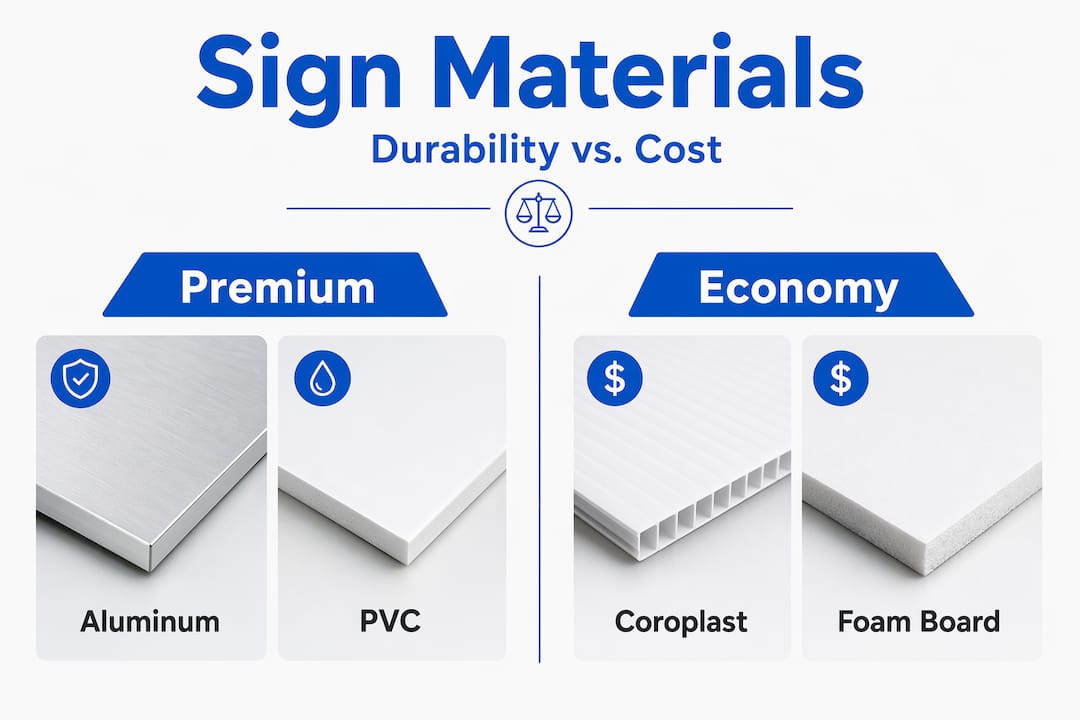
Heavy-duty aluminum is the gold standard for outdoor real estate signs. It resists rust, holds up under UV exposure, and does not warp in heat or humidity. Aluminum signs printed with UV-resistant inks can last three to five years in most climates without significant fading.
Coroplast (corrugated plastic) is the most common material for yard signs because it is lightweight and affordable. It works well for short-term listings, but it degrades faster in direct sun and can crack in freezing temperatures. If you use coroplast, treat it as a seasonal material and plan to replace panels annually in harsh climates.
PVC foam board sits between aluminum and coroplast in terms of durability and price. It handles moisture well and resists warping, but it is heavier and more expensive to ship. For long-term listings or high-visibility properties, PVC is a solid middle-ground option.
UV-resistant inks and protective coatings
The panel material is only half the equation. Inks and coatings determine how long your message stays readable. UV-resistant inks are printed with stabilizers that slow the breakdown caused by sun exposure. Pair that with a UV laminate or clear overcoat, and you significantly extend the readable life of any sign.
Clear PET plastic covers with vacuum seals and water-wicking channels add another layer of protection, keeping poster inserts dry and glare-free even in heavy rain. These are particularly useful for sign frames that hold interchangeable inserts.
IP ratings for electronic and digital signs
If you use digital or illuminated real estate signs, IP (Ingress Protection) ratings become critical. IP65 protects against low-pressure water jets, while IP66 handles more powerful jets and heavy rain. IP67 goes further, protecting against temporary submersion. For most outdoor real estate applications, IP66 is the minimum you should accept for any electronic component.
| Material | Best for | Weather resistance | Avg. lifespan |
|---|---|---|---|
| Aluminum | Long-term listings, commercial | Excellent | 3 to 5 years |
| Coroplast | Short-term, budget campaigns | Moderate | 6 to 12 months |
| PVC foam board | Mid-term, high-visibility sites | Good | 1 to 3 years |
| Digital/illuminated | High-traffic commercial properties | Excellent (IP66+) | 5+ years |
Pro Tip: When ordering weatherproof real estate signs, always ask the supplier whether the inks are UV-cured or solvent-based. UV-cured inks bond directly to the substrate and resist fading significantly longer than solvent alternatives.
Mounting and base technology for wind resistance
A sign that falls over is worse than no sign at all. It looks unprofessional, creates a liability if it lands on a car or pedestrian, and wastes the money you spent printing it. The mounting system is just as important as the panel itself.
Here are the key options real estate professionals should know:
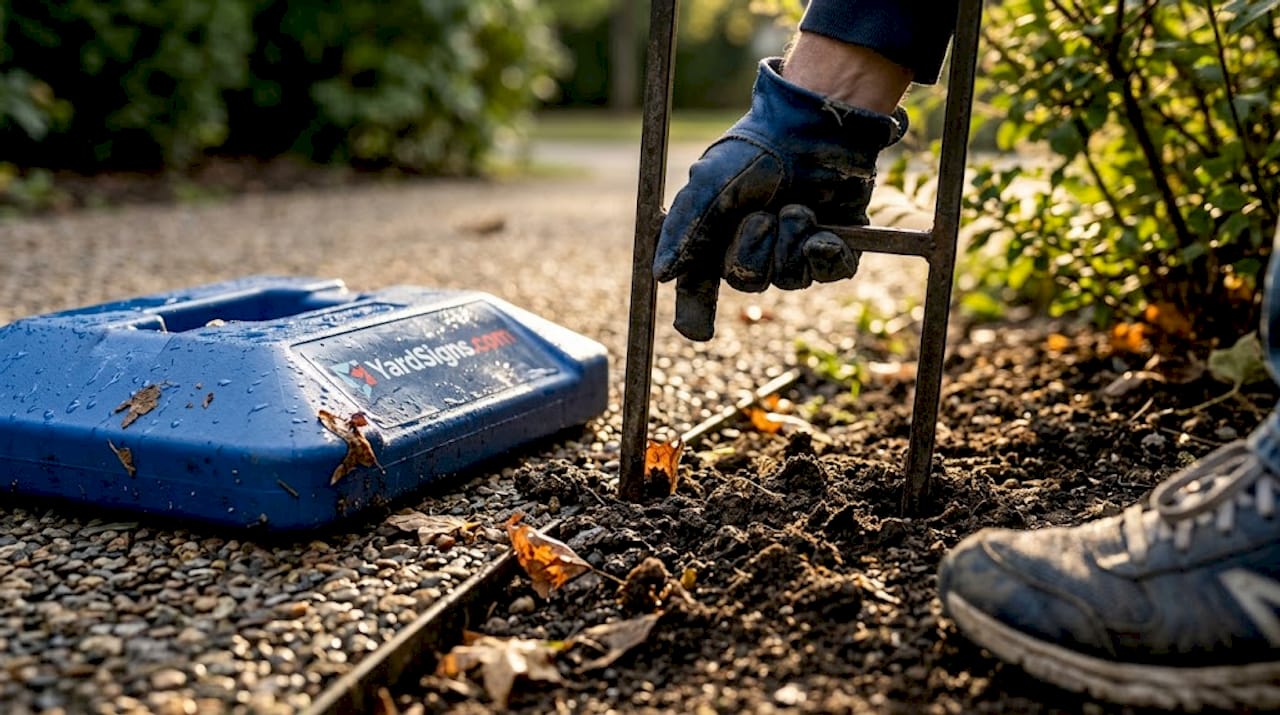
- Water-fillable HDPE bases. Water-filled bases made of heavy HDPE plastic keep freestanding signs firmly in place when filled. They are portable when empty and wind-resistant when loaded. This is one of the best solutions for agents who move signs between multiple listings.
- Spring-loaded double-sided frames. Double-sided frames with springs absorb wind force rather than resisting it rigidly. When a gust hits, the frame flexes and returns to position instead of tipping over. This design is standard in professional-grade outdoor signage.
- Ground-stake wire frames. The classic H-frame wire stake is inexpensive and easy to install. It works well in firm soil but fails in sandy, wet, or frozen ground. Reinforce with longer stakes or anchor clips in problem conditions.
- Permanent post mounting. For listings that stay on the market for months, a permanent post set in concrete is the most stable option. It eliminates wind risk entirely and projects a more polished image to buyers driving by.
- Weighted sign bases with sand fill. Similar to water-fillable bases, sand-filled options provide even more weight but sacrifice portability. Best for high-wind coastal markets where the sign will stay in one location.
The choice between freestanding and permanent mounting comes down to listing duration and local conditions. A two-week listing in a mild climate does not need a concrete post. A six-month commercial property in a coastal market absolutely does.
Pro Tip: Look for sign frames that feature both a weather-sealed cover and a quick-change insert system. You get the durability of a sealed enclosure with the flexibility to swap out pricing or contact information without buying a new sign.
How to select, purchase, and install weatherproof signs
Buying the right sign starts before you ever visit a print shop or website. Follow these steps to make a decision you will not regret after the first thunderstorm.
- Assess your local environment. Note the average wind speeds, annual rainfall, UV index, and whether you work in a coastal area with salt spray. Ignoring local environmental stressors leads to material failure in under a year. Coastal agents should prioritize marine-grade materials. High-UV markets like Arizona or Florida demand UV-resistant inks and coatings as a baseline.
- Match the material to the listing duration. Short-term open house signs can use coroplast. Properties listed for three months or more deserve aluminum or PVC. Commercial listings benefit from permanent monument-style signage.
- Choose the right base for the terrain. Walk the property before ordering. Sandy soil, clay, slopes, and paved surfaces all require different anchoring solutions. Order the appropriate base or stake system at the same time you order the sign panel.
- Verify print specifications before ordering. Confirm UV-resistant inks, laminate options, and substrate thickness with your supplier. A 4mm coroplast panel is noticeably flimsier than a 6mm panel in wind. Aluminum thickness matters too; 0.040 inches is a common standard for outdoor real estate signs.
- Install at the right depth and angle. Wire stakes should go at least 8 to 10 inches into the ground. Post-mounted signs should be set in concrete at a minimum of 18 inches depth. Angle freestanding signs very slightly into the prevailing wind direction to reduce the surface area catching gusts.
- Inspect after the first major weather event. Check for loosened stakes, water intrusion in frames, fading, or cracking. Catching small issues early prevents total sign failure.
| Step | Action | Why it matters |
|---|---|---|
| Assess environment | Check wind, rain, UV, and salt exposure | Prevents material mismatch |
| Match material to duration | Coroplast for short term, aluminum for long term | Optimizes cost vs. lifespan |
| Choose base for terrain | Stake, water-fill, or permanent post | Prevents tipping and damage |
| Verify print specs | UV inks, laminate, substrate thickness | Extends readability and life |
| Install correctly | Proper depth, angle into wind | Maximizes stability |
| Inspect post-weather | Check stakes, frames, and surfaces | Catches issues before failure |
For open house sign setups in particular, the combination of a water-fillable base and a UV-laminated panel covers most weather scenarios without overcomplicating your setup.
Common mistakes that shorten sign lifespan
Even the best all weather yard signs fail early when they are mishandled or neglected. These are the mistakes that show up most often in the field.
- Ignoring site-specific stressors. Local UV exposure, salt air in coastal regions, and humidity accelerate degradation in ways that general-purpose signs cannot handle. A sign rated for mild Midwest conditions will fail in six months in a Florida coastal market.
- Using the wrong cleaning products. Signs cleaned with acidic or ammonia-based products suffer surface damage that accelerates fading and cracking. Always use a damp microfiber cloth with warm, mild soapy water.
- Skipping periodic inspections. A sign that looks fine from a distance may have a cracked substrate, a loose stake, or a compromised frame seal. Monthly checks on long-term listings catch these issues before they become visible failures.
- Choosing signs with inadequate ratings for the conditions. If a sign frame does not specify a waterproof rating like IP66 for heavy rain environments, assume it is not rated at all. Unrated frames let water seep into poster pockets and behind panels, causing bubbling and delamination.
- Leaving signs up through extreme weather events. Hurricanes, ice storms, and severe thunderstorms exceed the design limits of most portable signs. Pulling signs before a named storm and reinstalling afterward is faster and cheaper than replacing a destroyed sign.
Pro Tip: For digital or illuminated signs, condensation inside the enclosure is the most common cause of failure. Look for enclosures with built-in desiccant packs or ventilated seals that allow moisture to escape without letting rain in. This is the detail most buyers overlook until it is too late.
For long-term property marketing, pairing rugged real estate signage with a property maintenance awareness mindset keeps both the property and your marketing materials in professional condition.
My take on durable signs as a long-term investment
I’ve watched agents spend $15 on a coroplast sign every six weeks because they think they are saving money. Over a year, that adds up to more than $100 per listing location, plus the time spent reordering and reinstalling. A quality aluminum sign with a proper base costs more upfront, but I’ve seen those same signs still looking sharp after three years of continuous use.
What I’ve learned is that the real cost of a cheap sign is not just the replacement price. It is the impression it makes on buyers driving past. A faded, tilted, or cracked sign signals neglect. Buyers associate that with the property itself, even subconsciously. Permanent monument signs deliver better long-term cost efficiency precisely because they project stability and professionalism.
My honest advice: treat your signage budget the way you treat your photography budget. It is part of your listing presentation. Buyers see the sign before they see the photos.
— YardSignGuy
Get weather-ready signs from Yardsigns
If you are ready to stop replacing signs after every storm, Yardsigns has you covered with durable property sign solutions built for outdoor real estate advertising.
Yardsigns prints on premium materials with UV-resistant inks and ships orders under 50 pieces within 24 hours, so you can react to new listings without delay. Whether you need bulk weatherproof sign panels to customize for multiple properties, a sharp for rent yard sign for long-term rental marketing, or a we buy houses sign that holds up through volatile weather seasons, the options are ready to order today. Every sign is designed to maintain vibrant color and structural integrity through rain, wind, and sun exposure.
FAQ
What is the most durable material for outdoor real estate signs?
Heavy-duty aluminum is the most durable option for long-lasting property signs, offering rust resistance, UV stability, and a lifespan of three to five years in most climates. For short-term use, 6mm coroplast with UV-laminate coating is a cost-effective alternative.
How do I keep a real estate sign from tipping in wind?
Use a water-fillable HDPE base or a spring-loaded double-sided frame, both of which absorb wind force and maintain stability. For permanent listings, setting a post in concrete at least 18 inches deep is the most reliable solution.
What IP rating do I need for weatherproof real estate signs?
For signs in heavy rain environments, look for a minimum IP66 rating, which protects against powerful water jets and sustained rainfall. IP65 covers low-pressure water exposure and is acceptable for moderate climates.
How often should I inspect and clean my outdoor real estate signs?
Inspect signs monthly and after any major weather event, checking for loose stakes, cracked panels, and frame seal integrity. Clean with a damp microfiber cloth and mild soap. Avoid ammonia or abrasive cleaners, which degrade surface coatings and accelerate fading.
Are permanent monument signs worth the cost for real estate marketing?
For commercial properties or multi-tenant listings, permanent monument signs deliver better long-term cost efficiency than repeatedly replacing weather-vulnerable portable signs. They also project a more professional image to potential buyers and tenants.
