


Lawn Sign Ordering Checklist for Beginners
Ordering lawn signs for the first time feels straightforward until you realize there are a dozen decisions standing between you and a sign that actually works. What size? Which material? Single or double-sided? How many do you need? The lawn sign ordering checklist beginners actually need covers all of this, and skipping even one step can mean wasted money, signs that get confiscated, or artwork that nobody can read from the road. This guide walks you through every decision in the right order so you get quality results without the guesswork.
Table of Contents
- Key takeaways
- 1. Determine your purpose before anything else
- 2. Understand the key criteria before you order
- 3. Learn the common sizes and formats
- 4. Common mistakes beginners make
- 5. The step-by-step lawn sign ordering checklist
- 6. Comparing online lawn sign providers
- My honest take on the checklist approach
- Ready to order your first lawn signs?
- FAQ
Key takeaways
| Point | Details |
|---|---|
| Plan your timeline early | Order lawn signs 10 to 12 weeks before your event to avoid rush fees and compliance issues. |
| Size affects readability | Choose sign size based on viewing distance. Larger signs work for roadside traffic, smaller ones suit pedestrian areas. |
| Material matters outdoors | Corrugated plastic suits short-term use while aluminum handles long-term outdoor exposure better. |
| Design must be minimal | Signs read in under three seconds by passing vehicles need large text, high contrast, and no clutter. |
| Volume lowers unit cost | Ordering more signs upfront reduces your per-unit price and prevents costly emergency reorders. |
1. Determine your purpose before anything else
The single most useful thing you can do before opening any design tool or ordering page is to get specific about why you need these signs. A political campaign sign, a grand opening promotion, and a wedding directional sign have completely different requirements for size, durability, quantity, and placement.
Ask yourself three questions. Where will the signs be displayed? Who is the intended audience, drivers or pedestrians? How long do the signs need to last? Your answers will shape every decision that follows, from material choice to how much text you include.
Pro Tip: Write your sign’s core message in ten words or fewer before you start designing. If you cannot do it, your message needs more work before it reaches the printer.
2. Understand the key criteria before you order
A good lawn sign buying guide always starts with criteria, not products. Here is what you need to evaluate before placing any order.
- Purpose and audience. A sign for a garage sale needs different specs than one for a political campaign or a real estate listing.
- Viewing distance and size. Sign design must fit environment: use larger fonts for vehicle traffic and smaller text for foot traffic. A sign meant to catch drivers at 35 mph needs bigger text and higher contrast than one placed near a sidewalk.
- Material selection. Corrugated plastic (also called coroplast) is lightweight and affordable, making it the go-to for short-term events. Aluminum signs cost more but handle wind, rain, and UV exposure far better over months of outdoor use.
- Single vs. double-sided printing. Double-sided signs are worth the extra cost when your sign sits on a median, a corner lot, or anywhere viewers approach from both directions.
- Local regulations. Many cities and counties restrict sign height, placement near roads, and how long signs can stay up. Check your local ordinances before you finalize quantity or placement plans.
- Budget and volume. Ordering more upfront reduces your per-unit cost and protects you from expensive rush reorders if you run short.
- Timeline. Experts recommend ordering 10 to 12 weeks before a major event. That window covers production, shipping, and any adjustments needed after reviewing your proof.
3. Learn the common sizes and formats
Knowing your options makes the decision much easier. Here is a quick reference for the most common lawn sign sizes and their best uses.
| Size | Best use case | Notes |
|---|---|---|
| 18" x 24" | Political campaigns, real estate, promotions | Most popular size. Visible from a moving vehicle. |
| 12" x 18" | Small events, directional signs, pedestrian areas | Compact and cost-effective for lower-traffic spots. |
| 24" x 36" | High-traffic roads, large events, grand openings | Maximum visibility at speed. Requires sturdy hardware. |
| Arrow shape | Directional signage, event parking | Guides foot traffic naturally without needing text. |
| Circle/custom shape | Brand-specific promotions, novelty uses | Higher cost but strong visual impact. |
Beyond size, you also need to think about mounting hardware. Powder-coated metal stakes give your signs a more professional, durable look compared to the thin plastic stakes that come with budget orders. Wire H-stakes are the standard for corrugated plastic signs and work well in most soil types. For harder ground or longer campaigns, step stakes with a wider foot provide better stability.
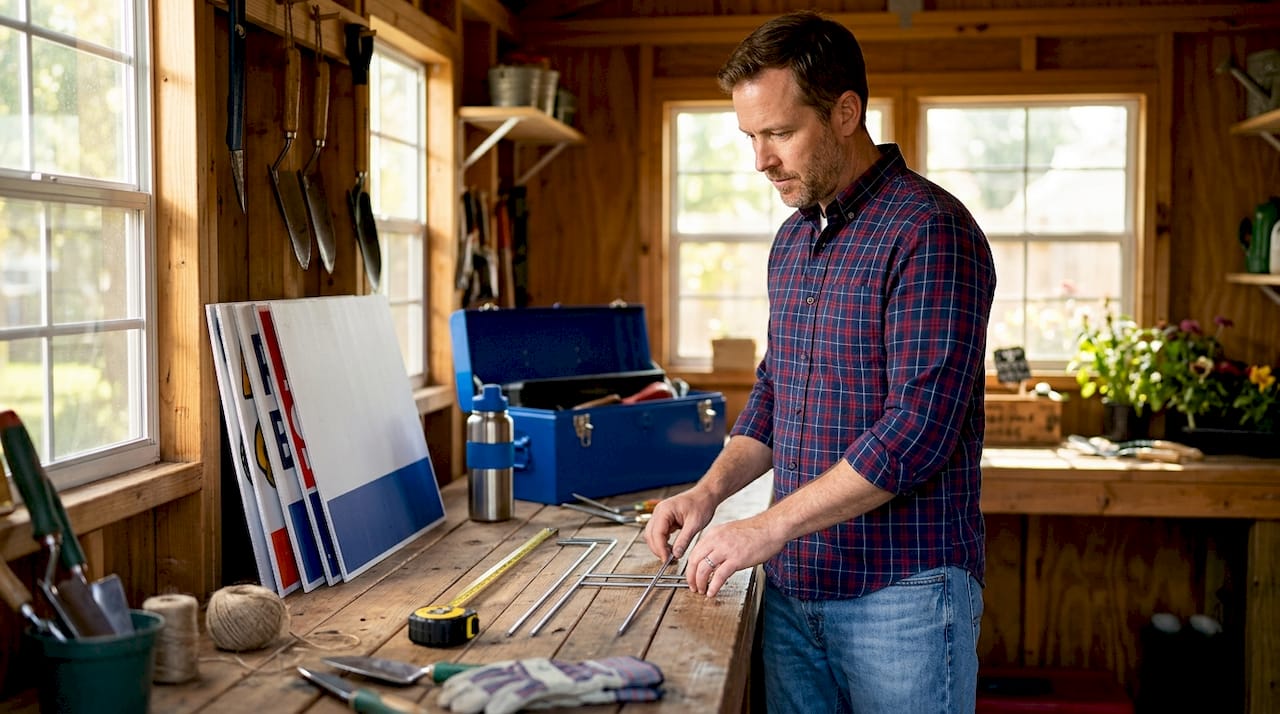
Pro Tip: Always confirm that stakes or frames are included in your order. Signs without sturdy mounting look unprofessional and often end up unusable after the first windy day.
4. Common mistakes beginners make
Most beginner lawn sign tips focus on what to do. Here is what to avoid, because these mistakes are where money gets wasted.
- Overcrowding the design. A sign read in under three seconds by passing vehicles has no room for phone numbers, websites, or long taglines. Keep it to a name, a message, and a call to action at most.
- Ignoring local ordinances. Failing to check local rules leads to signs being confiscated or fines issued. Most problems are fixed by moving a sign a few feet, but only if you know the rules in advance.
- Choosing the wrong material for the weather. Corrugated plastic warps and fades after extended sun and rain exposure. If your signs need to last more than a few weeks outdoors, aluminum is worth the upgrade.
- Skipping double-sided printing when needed. If your sign location gets traffic from two directions, a single-sided sign is invisible half the time. That is half your investment gone.
- Ordering too late. Rush production fees add up fast. Ordering at the last minute also eliminates your ability to review and correct proofs before printing.
- Underestimating quantity. Running out of signs mid-campaign and reordering at a small quantity costs significantly more per unit than ordering a buffer upfront.
5. The step-by-step lawn sign ordering checklist
This is the lawn sign design checklist you can follow from start to finish every time you place an order.
- Confirm your purpose and message. Write out your core message in ten words or fewer. Identify your audience and whether they will be driving or walking past the sign.
- Select your size. Use 18" x 24" as your default for roadside visibility. Go larger for high-speed roads, smaller for pedestrian-only areas.
- Choose your material. Corrugated plastic for events lasting a few weeks. Aluminum for signs that need to stay up for months or withstand harsh weather.
- Decide on single or double-sided printing. Map out where each sign will be placed and whether viewers will approach from one direction or both.
- Design for readability. Use high-contrast colors, a font size of at least 2 inches tall for every 10 feet of viewing distance, and no more than three lines of text. Free tools like Canva work well for basic sign designs without hiring a designer.
- Check local regulations. Look up your city or county ordinances for sign height limits, setback requirements from the road, and any permit requirements.
- Estimate your quantity with a buffer. Add 10 to 15 percent to your initial estimate to cover damaged signs, new placement opportunities, and replacements.
- Confirm hardware is included. Verify that stakes or frames are part of your order. If not, add them before checkout.
- Place your order with enough lead time. For major events, order 10 to 12 weeks in advance. For smaller promotions, two to three weeks is a reasonable minimum.
- Review your proof carefully. Check spelling, phone numbers, dates, colors, and bleed margins before approving. Reprinting costs far more than a few extra minutes of review.
6. Comparing online lawn sign providers
When you are ordering lawn signs for events or promotions for the first time, the provider you choose affects quality, price, and how smoothly the process goes. Here is a quick comparison of what to look for.
| Provider feature | What to look for | Red flags |
|---|---|---|
| Material options | Corrugated plastic and aluminum both available | Only one material offered |
| Hardware inclusion | Stakes included or clearly listed as an add-on | No mention of mounting options |
| Design tools | Easy-to-use templates and upload options | Clunky interface with no preview |
| Turnaround time | Standard and rush options clearly stated | Vague shipping estimates |
| Pricing transparency | Per-unit cost shown with volume tiers | Hidden fees revealed at checkout |
| Proof review | Digital proof sent before production | No proof step in the process |
Yardsigns stands out for beginners because orders under 50 pieces ship within 24 hours, which is a real advantage when your timeline is tight. Their design process is built for people who are not graphic designers, and the material quality shows up in customer reviews that consistently highlight vibrant printing and durability in tough weather. You can explore bulk custom sign options to get a sense of pricing at different quantities before committing.
My honest take on the checklist approach
I have seen a lot of first-time sign buyers skip the checklist and go straight to the design tool. It almost always costs them. Not catastrophically, but in the small, avoidable ways that add up: a sign that is too small to read from the road, a batch of 50 signs delivered two days after the event, a design that looked great on screen but printed with muddy colors because nobody checked the file specs.
In my experience, the two steps that get skipped most often are checking local ordinances and planning placement before finalizing quantity. People treat these as afterthoughts. They are not. A sign placed two feet inside a restricted zone gets pulled. A sign ordered for a location that turns out to be double-sided traffic is half as effective as it should be.
What I have learned is that design simplicity is not a creative limitation. It is a strategic one. The best lawn signs I have seen are almost boring up close. Big name, one line, done. From 50 feet away at 30 mph, they are impossible to miss. That is the goal.
Order early, keep the design tight, confirm your hardware, and check your local rules. Do those four things and you will be ahead of most first-time buyers before you even open a design tool.
— YardSignGuy
Ready to order your first lawn signs?
Yardsigns makes the ordering process straightforward for beginners, whether you need a small test batch or a full event supply.
Start with a 10-pack of blank signs if you want to test placement and sizing before committing to a larger order. For events like weddings or community gatherings, their wedding event yard signs give you a polished, ready-to-customize starting point. Need a larger run? Bulk orders of 50 blank signs give you flexibility at a price that makes sense for promotions and campaigns. Every order comes with clear design tools, proof review, and the fast turnaround that first-time buyers rely on when deadlines are real.
FAQ
How early should I order lawn signs for an event?
Order at least 10 to 12 weeks before a major event to allow time for production, shipping, and any proof corrections. Smaller orders with faster turnaround options can sometimes be placed two to three weeks out.
What is the best size for a standard lawn sign?
The 18" x 24" size is the most widely used because it is readable from a moving vehicle and fits standard wire H-stakes. Use larger sizes for high-speed roads and smaller sizes for pedestrian-only areas.
Do I need double-sided printing?
Yes, if your sign will be placed on a median, a corner, or any location where people approach from two directions. A single-sided sign is invisible to half your audience in those spots.
Can I design my own lawn sign without a designer?
Yes. Free tools like Canva handle basic sign layouts well, and most online printing services include design templates. Keep your layout simple: one primary message, high-contrast colors, and large text.
What happens if I ignore local sign ordinances?
Your signs can be confiscated and you may face fines. Most violations are resolved by adjusting placement by a few feet, but only if you know the rules before your signs go up.
