


Local Election Yard Sign Placement Ideas That Win
Yard signs remain one of the most cost-effective tools in any local campaign, but placement is where most candidates leave votes on the table. The right local election yard sign placement ideas go far beyond staking a sign in a supporter’s front yard. Campaign signage placement, as professionals in the field call it, requires thinking about traffic flow, legal compliance, visibility distance, and operational logistics all at once. This article gives you a practical framework: the criteria that matter, the best locations to target, a side-by-side comparison, and tailored recommendations for campaigns of every size.
Table of Contents
- Key Takeaways
- 1. Key criteria for successful placement
- 2. Corner lots visible from multiple directions
- 3. Main roads and commuter routes
- 4. Neighborhood entrances and subdivision gateways
- 5. Private yards of enthusiastic supporters
- 6. Near polling locations (where permitted)
- 7. Local businesses with owner cooperation
- 8. Comparison of placement strategies
- 9. Situational recommendations for different campaign sizes
- My take on what actually moves the needle
- Get your campaign signs ordered and ready to deploy
- FAQ
Key Takeaways
| Point | Details |
|---|---|
| Legal compliance comes first | Place signs only on private property with owner consent and follow local removal deadlines to avoid fines. |
| Visibility drives impact | Signs need font sized for reading distance and placement that matches driver sight lines and traffic speed. |
| Quality beats quantity | Targeting roughly 1 sign per 100–150 voters in high-traffic spots outperforms blanketing low-traffic streets. |
| Match sign type to location | Double-sided signs maximize impressions at corners; single-sided signs work well along straight traffic lanes. |
| Track every sign you place | Mapping installations and scheduling removals protects your campaign from municipal fines and community complaints. |
1. Key criteria for successful placement
Before you scout a single location, you need a clear set of standards. Without them, your team will make inconsistent decisions and your campaign will face avoidable legal problems.
Legal compliance is non-negotiable. Signs must go on private property with the owner’s explicit consent. Most jurisdictions prohibit placement in public rights-of-way, on medians, or within a set distance of crosswalks and intersections. Local rules vary widely: some counties restrict placement to private property only, cap sign size at 128 square feet, and require removal within 10 days after the election. Caltrans, for example, requires a Statement of Responsibility for any sign visible within 660 feet of a state highway. Check your city, county, and state rules before you print a single sign.
Visibility factors determine whether your sign gets read. Effective yard sign design requires 3-second comprehension, meaning drivers must absorb your name and message before they pass. Font size matters: use at least 1 inch of letter height per 10 feet of viewing distance. A standard 18x24 sign needs 3-inch headlines to be legible at 30 feet. Placement that blocks this sight line, whether by a parked car, overgrown shrub, or fence, wastes your investment.
Scaling your sign count strategically saves money. Rather than flooding every street, prioritize placements that reach the most voters per sign. A reasonable benchmark is roughly 1 sign per 100 to 150 registered voters in your district, with priority given to high-traffic and high-visibility spots.
Operational logistics keep your campaign running smoothly. Key practices include:
- Map every sign location with GPS coordinates or a shared spreadsheet
- Log the property owner’s name and contact information for each placement
- Schedule removal dates before the election deadline to avoid municipal fines
- Plan a replacement rotation for signs lost to weather or enforcement
Pro Tip: Assign a dedicated volunteer “sign captain” for each neighborhood zone. This person handles installations, monitors sign condition, and coordinates removals. It turns a chaotic operation into a manageable one.
2. Corner lots visible from multiple directions
Corner lots are the gold standard of campaign signage placement. A sign at a busy intersection reaches drivers approaching from two or more directions simultaneously. This is where double-sided signs earn their higher cost back quickly. A single corner lot placement can generate the same impressions as three or four mid-block placements on quieter streets.
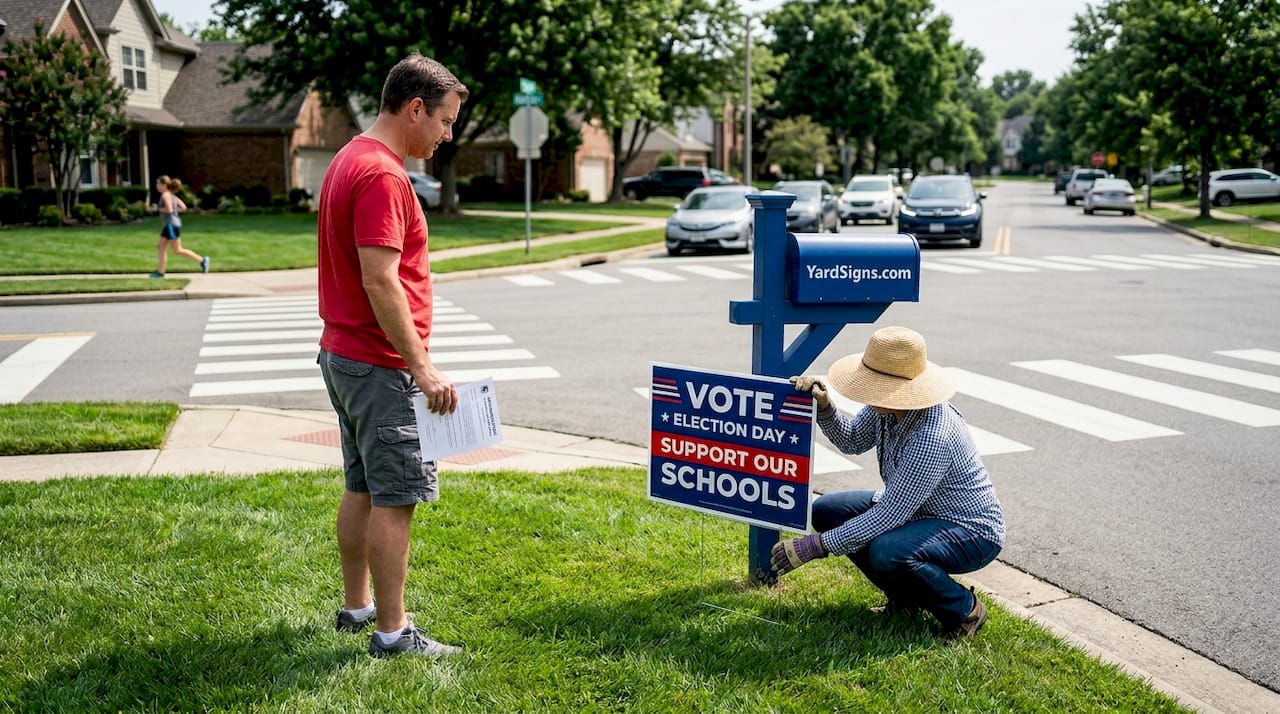
When approaching homeowners on corner lots, come prepared. Bring a printed permission form, explain the removal timeline upfront, and offer to handle installation yourself. Corner lot owners get asked often, so professionalism makes a real difference.
3. Main roads and commuter routes
High-volume roads expose your name to the most eyes per day. A sign on a road carrying 10,000 vehicles daily delivers far more impressions than one on a residential cul-de-sac. Focus on roads that connect residential neighborhoods to schools, grocery stores, and workplaces, since these carry consistent traffic throughout the day.
One practical note: faster traffic means less reading time. On roads where speeds exceed 40 mph, your sign needs to communicate one thing only. Candidate name and office. Nothing else. Save the policy details for your mailers.
4. Neighborhood entrances and subdivision gateways
Neighborhood entrance signs capture a highly targeted audience: the people who actually live there and vote in your district. A sign placed at the entrance of a subdivision is seen by every resident every time they leave or return home. That repetition builds name recognition faster than almost any other placement.
Get permission from the homeowners association if one governs the area. Many HOAs have rules about sign placement near entrance monuments, and ignoring those rules can result in quick removal and a community relations problem you do not need.
5. Private yards of enthusiastic supporters
Supporter yard signs create social proof. When a neighbor sees three houses on their block displaying the same candidate’s sign, it signals community endorsement. This is one of the most underrated aspects of effective yard sign strategies: the psychological weight of seeing your neighbors support someone.
Prioritize supporters on visible, higher-traffic streets within your district. A sign in a backyard facing a fence helps no one. When you drop off signs, take a moment to position them correctly: facing the street, staked firmly, and free of obstructions.
6. Near polling locations (where permitted)
Placement near polling locations offers high-value visibility precisely when voters are making their final decisions. However, most states enforce electioneering restrictions that prohibit campaign materials within a defined distance of polling places, often 100 to 200 feet. Know your state’s specific buffer zone before placing a single sign near any voting location.
If direct placement is restricted, look for private property just outside that buffer. A sign on a supporter’s lawn one block from the polling place still catches voters walking in.
7. Local businesses with owner cooperation
Business owners who support your campaign can offer some of the most visible placements available: storefronts, parking lot edges, and commercial corner properties. These locations often sit on high-traffic roads and have the added benefit of implicit endorsement from a local business the community trusts.
Always get written permission. Confirm the business owner understands the removal timeline. And be selective: a sign in front of a well-regarded local hardware store carries more weight than one in front of a vacant retail space.
Pro Tip: Offer to place a small “Endorsed by [Business Name]” rider on the sign if the owner wants public credit for their support. Some business owners appreciate the visibility. Just confirm this is permitted under your local sign ordinances.
8. Comparison of placement strategies
Use this table to quickly weigh your options based on visibility, compliance complexity, cost, and sign type.
| Location | Visibility | Compliance difficulty | Best sign type | Cost-effectiveness |
|---|---|---|---|---|
| Corner lots | Very high | Moderate | Double-sided | Excellent |
| Main roads/commuter routes | High | Moderate to high | Single or double | Very good |
| Neighborhood entrances | High (targeted) | Low to moderate | Single-sided | Excellent |
| Near polling locations | High (timed) | High | Single-sided | Good if compliant |
| Supporter yards | Moderate | Low | Single-sided | Very good |
| Local businesses | High | Low (with permission) | Single or double | Very good |
| Backup/replacement stock | N/A | N/A | Both | High (insurance value) |
Corner lots and neighborhood entrances consistently deliver the best return per sign. Main roads offer raw impression volume but require more attention to compliance and sign durability. Polling location adjacency is high-risk, high-reward and demands careful legal review. Layering two or three of these strategies together gives your campaign coverage across different voter touchpoints without over-concentrating in one area.
9. Situational recommendations for different campaign sizes
Not every campaign has the same resources. Here is how to adapt your approach based on where you are.
-
Small campaigns with tight budgets: Focus your entire sign budget on corner lots and neighborhood entrances in your highest-turnout precincts. Ten well-placed signs in the right locations outperform fifty signs scattered randomly. Use geo-targeted local campaign data to identify which precincts have the most persuadable voters before you decide where to concentrate.
-
Medium-sized campaigns: Blend corner lots, supporter yards, and business placements. Create a mapped route for each volunteer team so installations are efficient and documented. Stagger your installations so you have a fresh wave of signs going up in the final two weeks before the election.
-
Large campaigns with regional reach: Use all placement types with a centralized tracking system. Centralizing sign permissions and mapped locations reduces liability and prevents uncontrolled sign proliferation that leads to municipal removals.
-
Campaigns near state highways: Follow state-specific rules carefully. Oregon DOT, for instance, removes illegally placed signs from highway rights-of-way and holds them for 30 days. Losing signs to enforcement is a budget drain and a distraction.
-
All campaigns, regardless of size: Orient signs to match the direction of approaching traffic. A sign angled 45 degrees toward oncoming drivers is read more easily than one facing straight ahead. This single adjustment costs nothing and measurably improves visibility.
Pro Tip: Build a replacement inventory of 10 to 15 percent of your total sign order. Weather, vandalism, and enforcement will take some signs down. Having replacements ready means you maintain coverage without emergency reorders.
My take on what actually moves the needle
I’ve watched campaigns spend thousands on yard signs and see almost no return because they treated placement as an afterthought. In my experience, the campaigns that win the sign game are the ones that treat it like a logistics operation, not a grassroots scramble.
The counterintuitive truth is that more signs do not always mean more votes. I’ve seen districts where a candidate had signs on every block but lost because the signs were in low-traffic locations, poorly designed, or removed before election day due to compliance violations. Meanwhile, a challenger with half the signs but smarter placements built stronger name recognition.
What I’ve learned is that community relations matter as much as location. Candidates who ask permission, explain the removal timeline, and actually follow through on removing signs promptly build goodwill that extends beyond the sign itself. Voters notice when a campaign respects their neighborhood.
Compliance is not just a legal obligation. It is a signal about how you will govern. A campaign that ignores sign ordinances tells voters something about how it handles rules. That is a message you do not want to send.
The best local election signage ideas are not complicated. They are disciplined, well-tracked, and respectful of the community you are trying to represent.
— YardSignGuy
Get your campaign signs ordered and ready to deploy
When your placement strategy is locked in, the last thing you want is to wait on signs. Yardsigns prints and ships orders under 50 pieces within 24 hours, so you can move fast when a new supporter offers their corner lot or a last-minute placement opportunity opens up.

Yardsigns offers fully customizable political yard signs built from weatherproof materials that hold up through rain, wind, and weeks of outdoor exposure. Whether you need a small run to test placements or a large bulk order to cover your entire district, the options are ready. Campaigns scaling up quickly can take advantage of bulk sign pricing that keeps cost per sign low without sacrificing print quality. For larger regional deployments, 75-sign bulk orders offer even better value. You can also explore ready-to-order campaign sign designs or browse the full catalog at yardsigns.com to find the right fit for your race.
FAQ
Where is the best place to put election yard signs?
Corner lots and neighborhood entrances deliver the highest visibility per sign because they reach traffic from multiple directions and target residents in your district. Supporter yards on high-traffic streets add social proof that reinforces name recognition.
How far from a polling place can you put a campaign sign?
Most states require campaign materials to stay at least 100 to 200 feet from polling place entrances, though the exact distance varies by state law. Always check your specific state’s electioneering buffer zone rules before placing any sign near a voting location.
Do you need permission to place a yard sign on private property?
Yes. Signs must always be placed on private property with the explicit consent of the property owner. Placing signs without permission exposes your campaign to complaints, removal, and potential legal liability.
How many yard signs does a local campaign need?
A practical benchmark is roughly 1 sign per 100 to 150 registered voters in your district, with priority given to high-traffic and high-visibility locations rather than even distribution across all streets.
When do campaign signs need to be removed after an election?
Removal deadlines vary by jurisdiction, but many local rules require signs to come down within 3 to 10 days after the election. Failing to meet this deadline can result in municipal removal and fines charged to your campaign.
