


Pop Up Banner Mastery Your Guide to Stunning Displays
A pop up banner is a portable, self-contained display stand with a pre-installed graphic that retracts into a base for easy transport and quick setup. Think of it as your business's silent ambassador—a professional, visual handshake making a powerful first impression in just a few seconds.
What Is a Pop Up Banner and Why Do You Need One
A pop up banner is more than just another sign; it’s a core marketing tool built for versatility and immediate impact. It works as an instant credibility booster, turning any spot you claim—a trade show booth, a community event, or even your office lobby—into a professional brand touchpoint. These displays grab attention and set the stage for real conversations.
Their real power is in their simplicity and how often you can reuse them. Unlike permanent signs, a pop up banner is born for the road. The graphic rolls safely into a tough aluminum base, and the whole thing slips into a compact carry case. One person can easily transport it and have it set up in less than a minute.
The Power of Portability and Presence
Imagine a real estate agent showing up at an open house. In seconds, they can unfurl a vibrant pop up banner that shows off property highlights, instantly creating a polished, professional vibe. Or think about a nonprofit at a local fundraiser; a well-designed banner can pull in potential donors from across the room by clearly sharing their mission and impact.
These displays are a must-have for anyone who needs to make their mark in a crowded space, especially for temporary marketing events. The pop-up retail industry, for example, is valued at a massive $83.4 billion globally and is set to keep growing fast. This trend shows just how valuable portable, high-impact branding tools are—the kind you can set up anywhere, anytime.
A pop up banner is the ultimate marketing multi-tool. It's a backdrop, a directional sign, a product feature, and a brand statement all rolled into one portable package. It provides an immediate sense of legitimacy and professionalism.
Where Pop Up Banners Shine
A pop up banner is a versatile tool commonly used for events and presentations. To understand the overall context and importance of such displays, it's helpful to review guides on planning for a trade show, which often cover strategic booth design.
Their uses are almost endless, but they truly stand out in a few key situations:
- Trade Shows and Conferences: Use them to define your booth space and attract foot traffic.
- Retail Environments: Announce sales, new products, or in-store events.
- Corporate Lobbies: Welcome visitors and reinforce brand identity.
- Job Fairs: Stand out to potential candidates and showcase company culture.
- Community Events: Promote your services or cause at farmers' markets, festivals, and fundraisers.
Ultimately, a pop up banner makes sure you look prepared and professional no matter where you go. As we explore the different types of signs and banners, you'll see how this specific tool fills a unique and valuable role in any marketing toolkit.
How to Choose the Right Pop Up Banner Type and Size
Picking the right pop-up banner is like choosing the right tool for a job. You wouldn't use a sledgehammer to hang a picture frame, right? While all pop-up banners are designed to get you noticed, their specific mechanics make them better suited for different environments and tasks.
Getting a handle on your options is simple once you know the main styles. Most banners fall into a few key categories, each with its own setup, best-use case, and unique advantages. Let's break down the most popular types to help you find the perfect match for your next trade show, retail space, or event.
Comparing Popular Pop Up Banner Styles
The three heavy hitters in the pop-up banner world are Retractable, X-Banners, and L-Banners. Think of them as the workhorse, the lightweight traveler, and the sleek minimalist. Each one strikes a different balance between convenience, stability, and visual flair.
To help you decide, we've put together a quick comparison of the most common types. This table breaks down what each style is best for, how portable it is, and its biggest selling point.
Pop Up Banner Type Comparison
| Banner Type | Best For | Portability | Key Advantage |
|---|---|---|---|
| Retractable Banners | Trade shows, frequent travel, and quick setups where professionalism is key. | Excellent | All-in-one design protects the graphic inside a self-contained base. |
| X-Banners | Budget-conscious projects, single-use events, or when extreme light weight is needed. | Exceptional | Incredibly lightweight and the most affordable option. |
| L-Banners | High-end retail, corporate lobbies, and sophisticated events where a clean look is paramount. | Very Good | Sleek, minimalist design with a very small footprint. |
Let's dive a little deeper into what makes each one tick.
-
Retractable Banners: These are the road warriors of the banner world. The graphic is safely stored inside a sturdy aluminum base and simply pulls up for display, like a window shade. This all-in-one design offers maximum protection during travel and makes setup take mere seconds.
-
X-Banners: This is your lightweight, budget-friendly champ. The X-Banner gets its name from the X-shaped frame that holds the graphic tight at all four corners. Because the frame and graphic are separate, these are exceptionally light and easy to carry, perfect for anyone who needs to travel light.
-
L-Banners: This style is the sleek, modern minimalist of the group. An L-Banner uses a single vertical pole and a narrow base, creating an L-shape that keeps the graphic taut. This design gives you a clean, streamlined look with a tiny footprint, making it ideal for upscale retail spaces or corporate events where style points matter.
This flowchart can also help you think through which banner aligns with your core goals, whether you need to grab attention or build credibility.
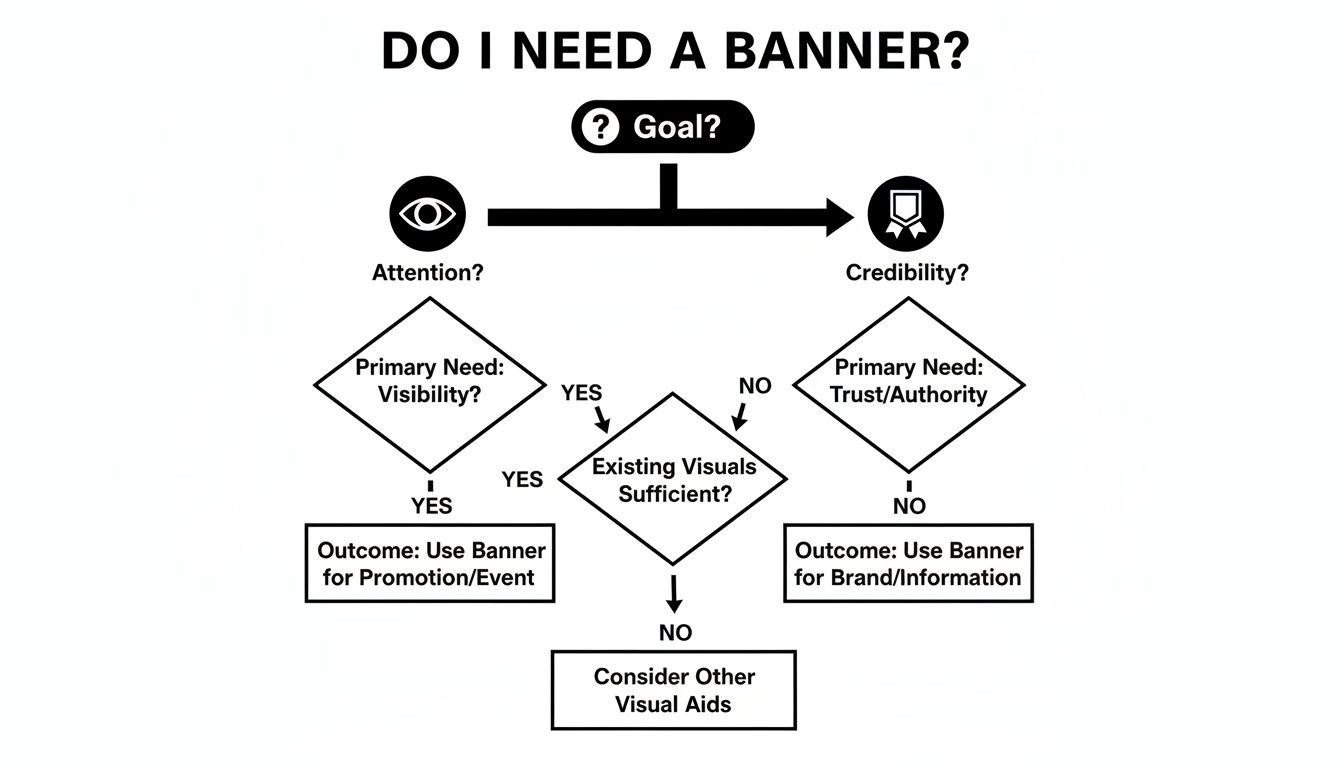
As the chart shows, your main objective—be it pure visibility or establishing trust—is a great starting point for guiding your choice.
Selecting The Perfect Banner Size
Once you’ve locked in a style, the next question is size. A banner that’s too small will get lost in a busy trade hall, while one that’s too large can easily overwhelm a small retail space. The key is matching the dimensions to your location and how far away people will be.
A standard pop-up banner is typically around 33 inches wide and 80 inches tall—just a little narrower and taller than a standard interior door. This size is a versatile workhorse, perfect for most trade show booths, lobby entrances, and retail floors.
Pro Tip: Visualize the banner in your actual space. Use a tape measure to mark out the height and width where you plan to place it. This simple five-minute exercise can save you from any surprises and guarantees a perfect fit.
Of course, many situations call for different dimensions. To make sure your display fits its environment perfectly, understanding specific roller banner dimensions is a crucial part of the selection process.
Here are a few common scenarios and the sizes that work best for them:
-
Narrow Banners (24 inches wide): These are perfect for tucking into tight corners in a shop, flanking a registration desk, or adding a small pop of branding without eating up valuable floor space.
-
Standard Banners (33-36 inches wide): This is the undisputed go-to for trade show booths, conference halls, and general-purpose marketing. They provide excellent visibility without being overbearing.
-
Wide Banners (48 inches or wider): Need to make a big statement? A wide banner is perfect for creating an instant backdrop for a presentation, filling a large empty wall, or serving as a photo-op background at an event.
By carefully thinking through both the type and size, you can land on a pop-up banner that not only looks sharp but also works perfectly for your specific needs. If you're leaning toward a retractable model, you might be interested in our dedicated guide on how to get the most from a pull up banner.
Designing a Pop Up Banner That Captures Attention
You have five seconds. In the middle of a bustling trade show or on a busy retail floor, that’s all the time your pop-up banner gets to make an impression. Don't worry, a great design isn't about some stroke of artistic genius; it’s about clear, direct communication. We'll give you a practical framework for creating a display that actually works.
Think of your banner's design as a lightning-fast conversation. You need to introduce yourself, state your purpose, and tell people what to do next—all in a single glance. The secret is something designers call visual hierarchy, which is just a fancy way of guiding a viewer's eye to the most important information first.
The Three Essential Design Layers
An effective banner organizes information into three distinct layers, almost like a pyramid. Each one is designed to be read from a different distance, creating a natural path for the eye.
- The Top Layer (The Hook): This is for grabbing attention from across the room. It should be your biggest text element and deliver your main message in five words or less.
- The Middle Layer (The Details): Once they’re hooked, this layer gives them a little more context. Use sharp bullet points or a single short sentence to explain the key benefits.
- The Bottom Layer (The Action): This is for people standing right in front of your banner. It’s where you put your logo, website, social handles, or a QR code.
By structuring your design this way, you create a natural flow of information that anyone can digest, even in a chaotic environment.
Core Design Principles For Non-Designers
You don’t need to be a graphic artist to make smart choices. When in doubt, always choose clarity and readability over decoration. Your goal is to communicate, not just fill space.
-
Embrace High-Resolution Images: Nothing screams "amateur hour" like a blurry, pixelated graphic. Always start with high-quality images and logos. For print, that means using files that are 300 DPI (dots per inch) at their final, full size. This ensures every detail comes out looking crisp and professional.
-
Choose Contrasting Colors: Your color palette needs to do two things: stay on-brand and be readable from a distance. High contrast is your best friend here. Think dark text on a light background or the other way around. Stay away from busy, low-contrast combinations that force people to squint.
-
Limit Your Fonts: Stick to one or two fonts that are incredibly easy to read. A clean, sans-serif font like Helvetica or Arial is almost always a safe bet for headlines and body text. Throwing in too many font styles just creates visual noise and makes your message confusing.
The power of a bold, focused message is proven, even online. The average conversion rate for a digital pop-up is 11.09%, with the top performers hitting an incredible 42.35%. This shows that a well-designed, direct message drives action, whether it's on a screen or at an event. You can find more fascinating data about pop-up performance and apply the same principles to your physical banner.
A crowded banner is an ignored banner. Your goal isn't to list everything your company does. Your goal is to start a conversation. Use your pop-up banner to deliver one powerful message that makes people want to learn more.
The 5-Second Rule Checklist
Before you send your design to print, run it through this simple test. Show it to a coworker or friend for just five seconds, then take it away. Ask them three questions:
- What was the main offer or message?
- What company was it for?
- What was I supposed to do next?
If they can’t answer all three instantly, your design is too complicated. It’s a clear sign to go back and simplify. For more inspiration, you can explore various graphic design layouts that put these principles of clarity and impact into practice. This quick check ensures your pop-up banner isn't just seen—it's understood.
Understanding Banner Materials and Print Quality
A stunning design is only half the story. Its impact lives or dies based on the canvas it's printed on. Think of it like buying a suit: the material and tailoring are just as crucial as the style. The physical quality of your pop up banner directly reflects your brand's professionalism and ensures your investment looks great, event after event.
Just as you wouldn't wear a linen suit in winter, different banner materials are built for specific jobs. The right choice comes down to where you'll use it, how you'll use it, and the impression you want to make.
Choosing Your Banner Material
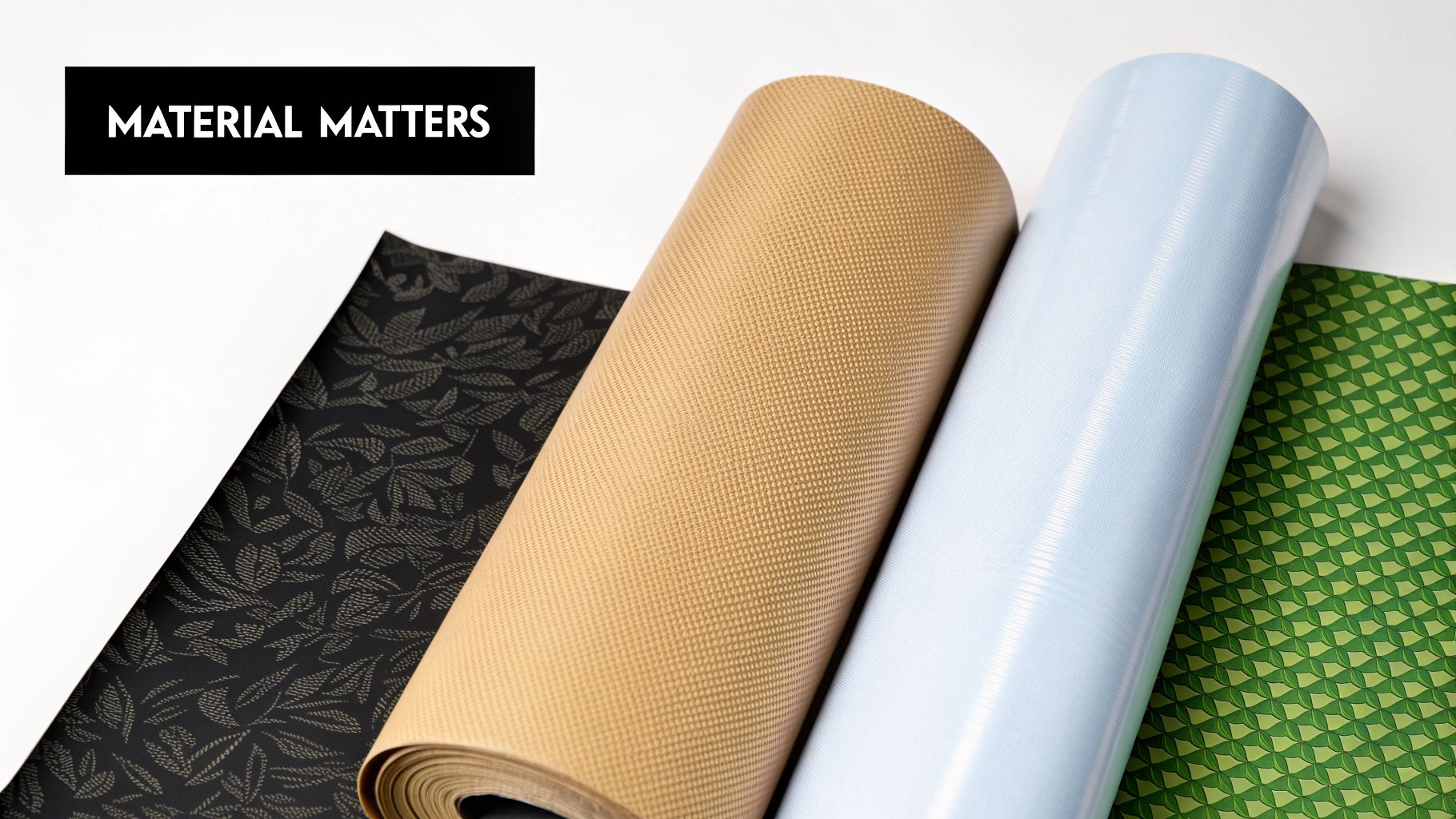
Let's demystify the most common options out there. Each one has a distinct advantage, making it the hero for certain applications.
-
Durable Vinyl: This is the rugged workhorse of banner materials. It’s tough, water-resistant, and a breeze to clean, which is perfect for high-traffic indoor areas or covered outdoor-adjacent spaces like a market stall. If your pop up banner is going to see a lot of action, vinyl is a dependable choice.
-
Premium Non-Glare Fabric: If your banner will be photographed or used as a video backdrop, this is your material. Fabric absorbs light instead of reflecting it, eliminating that distracting glare that can ruin photos and videos. It gives you a sophisticated, high-end look that feels professional and refined.
-
Cost-Effective Polypropylene: This option hits a great sweet spot between quality and affordability. It's a smooth, synthetic paper-like material that produces sharp graphics and holds up well for standard indoor use, making it a super popular choice for retractable banners.
The goal is to match the material to the mission. This ensures your banner performs flawlessly in its intended environment.
Why Print Quality Is Non-Negotiable
A great material won't save a blurry image. Print quality is what translates your digital design into a sharp, vibrant physical object. This is where a couple of technical terms deliver very tangible benefits for your pop up banner.
You’ll often see requirements for 300+ DPI (dots per inch) printing. This is the industry standard for high-quality printing for a reason. Think of it like the resolution on your TV—more dots per inch means a sharper, clearer, and more detailed image with no fuzziness, even when people are standing right next to it. This is absolutely crucial for making your text readable and your images pop.
A low-resolution print is the fastest way to undermine a great design. Investing in high-resolution printing ensures your pop up banner communicates professionalism and attention to detail, reinforcing the quality of your brand.
Beyond resolution, the type of ink used is vital for longevity. UV-resistant inks are designed to fight fading from sun exposure. This means the brilliant reds and deep blues in your design will stay vibrant through multiple events, protecting your investment and keeping your banner looking brand-new for years.
This focus on grabbing attention in physical spaces is a core principle in marketing. Point-of-Purchase (POP) displays in stores are a great example, engineered to stand out in a competitive retail environment. The global POP display market hit $10,500 million in 2026 and is projected to climb to $11,980 million by 2034, driven by this need for visibility. For an in-depth look at this market's steady growth, you can explore more about the POP display market. Your pop up banner serves a similar function, acting as your personal POP display wherever you go.
How to Care for and Store Your Pop Up Banner
Your pop-up banner is a valuable marketing asset, but its lifespan really depends on how you treat it between events. Proper care and storage aren't just chores; they’re simple habits that protect your investment and keep your banner looking sharp for years.
Think of it like a good suit. You wouldn't just wad it up and throw it in a corner. The same idea applies here. A few minutes of careful handling after each use prevents frustrating jams, tears, and fading, making sure you get the most out of your banner.
Gentle Cleaning and Maintenance
Smudges and dust are going to happen, but cleaning them off is simple if you do it right. The key is to be gentle. For most vinyl and polypropylene graphics, a quick wipe-down is all it takes.
- Cleaning: Use a soft, lint-free cloth dampened with a bit of water. For a stubborn spot, a mild soap-and-water solution will do the trick.
- What to Avoid: Never use abrasive cleaners, solvents, or alcohol. These will strip the UV-resistant coating and ruin the printed graphic.
- Drying is Crucial: Always let the banner air dry completely before you roll it back into the base. Retracting a damp banner is a recipe for mildew, and it can cause the graphic to stick to itself.
If you have a fabric banner, you can usually spot-treat it with a gentle fabric cleaner. A low-heat steamer is also great for getting out any wrinkles. Just be sure to check the specific care instructions that came with your banner first.
Proper Setup and Teardown Techniques
Believe it or not, most damage to pop-up banners happens during setup and teardown. Rushing these steps is the fastest way to get a jammed retraction mechanism or a torn graphic. The number one rule? Control the retraction.
Never, ever let the banner snap back into the base on its own. That violent recoil can wreck the internal spring and easily crease or tear the edges of the graphic. Always guide the banner back into the base slowly with both hands.
This one habit will prevent the most common—and most expensive—type of damage. When setting up, make sure the support pole is fully extended and seated securely in the base before you start pulling the banner up. A wobbly setup puts a lot of unnecessary stress on the whole unit.
Smart Storage for Banner Longevity
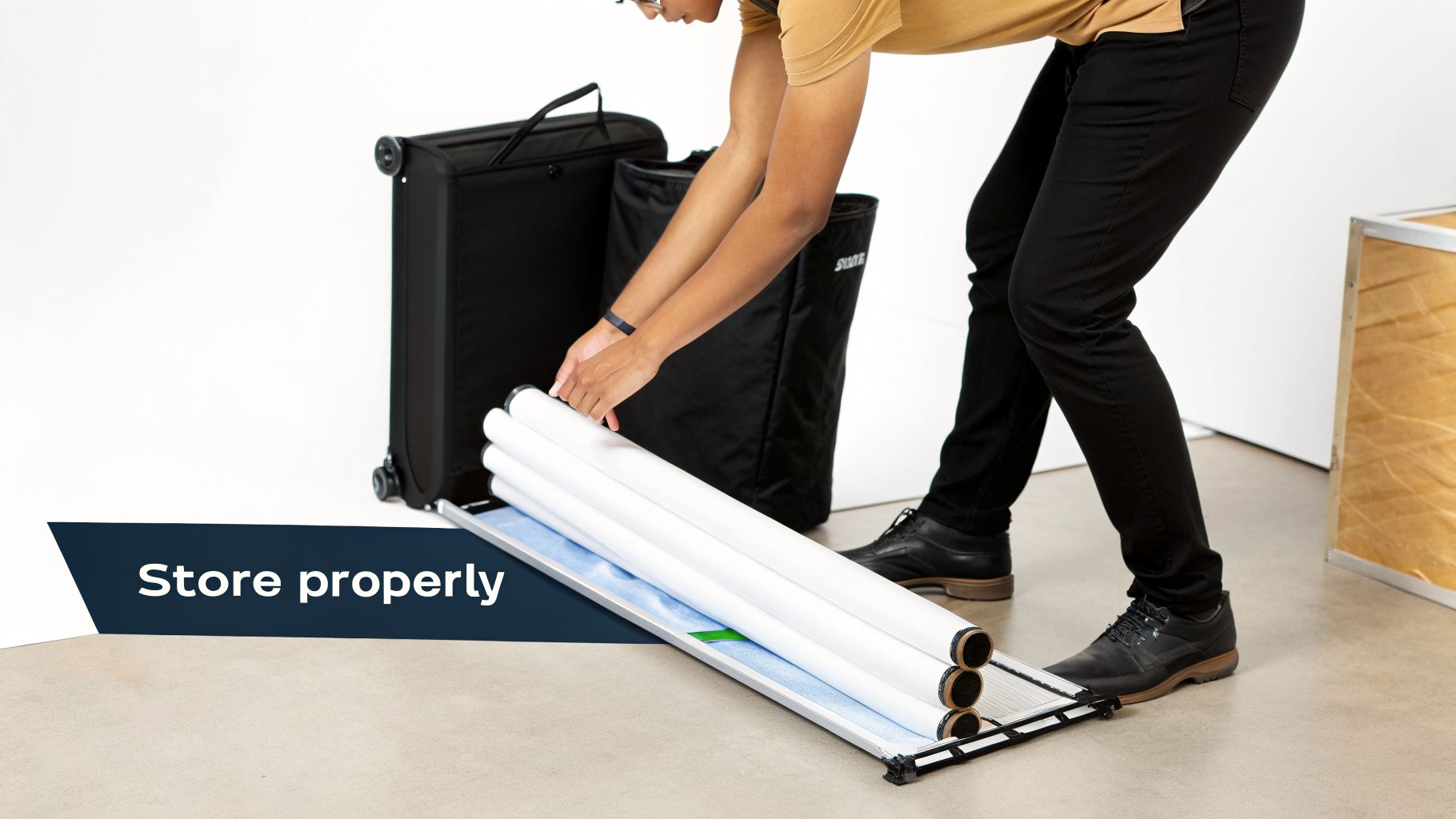
How you store your banner between shows is just as important as how you clean it. That carrying case it came with isn’t just for making it easier to transport; it’s your first line of defense in storage.
Storage Best Practices:
- Always Use the Case: The padded case protects the aluminum base from the dents and scratches that can keep the banner from operating smoothly.
- Store It Flat or Upright: Keep the banner in its case either lying flat on the floor or standing straight up against a wall. Don’t lean it at a sharp angle—that can cause the graphic to sag or warp inside the base over time.
- Find a Good Spot: Store the case in a cool, dry place. A temperature-controlled closet or storage room is perfect. Stay away from attics, basements, and garages where extreme heat, cold, or humidity can cause mildew and damage the graphic.
By following these simple steps, you’ll keep your pop-up banner in prime condition, ready to make a professional impression at a moment's notice.
Your Guide to Ordering a Custom Pop Up Banner
You’ve learned what makes a great pop-up banner, from the right materials to a design that grabs attention. Now, it's time to bring that vision to life. Ordering your custom banner is the final step, and we've made the process straightforward, turning your ideas into a powerful marketing tool for your next event.
The journey from a concept on your screen to a finished banner in your hands is simple. We have clear paths designed to fit your needs, whether you're a design pro with a file ready to print or you're starting from scratch and need a little help.
Choosing Your Ordering Path
At YardSigns.com, we give you two primary ways to get your banner made, ensuring you have the support you need, every step of the way. This flexibility lets you work in a way that’s most comfortable for you, guaranteeing the final product is exactly what you had in mind.
-
Upload Your Own Artwork: If you already have a print-ready design file, this is your fastest route. Just upload your artwork, choose your banner specs, and our system will get it ready for printing. This is the perfect option for those who have their branding locked in and are ready to roll.
-
Let Us Design It for You: Don't have a design? No problem at all. Our professional design services are here to help. You provide the text, logos, and your ideas, and our team will create a custom layout for you—completely free of charge.
Choosing our design service takes all the pressure off. You get to work with experts who know exactly how to make a pop-up banner command attention from across the room.
The best part of our design service is the peace of mind it offers. You’ll get a free proof to review and can request unlimited revisions until the design is exactly what you envisioned. We make sure your banner is optimized for impact, without any stress.
Key Benefits for a Smooth Process
We built our ordering system to make your life as easy as possible. It's about more than just printing; we offer several key benefits that cater to the real-world needs of businesses, event planners, and organizations. These services are designed to remove obstacles and help you succeed.
Here are a few advantages you can count on:
-
Rush Turnaround Options: Facing a tight deadline for a trade show or conference? We offer rush production to get your pop-up banner to you fast, often within 1–3 business days, so you never miss an opportunity.
-
Bulk Order Discounts: Need to outfit multiple locations or launch a large-scale campaign? Our bulk discounts provide significant savings. This makes it cost-effective to keep your brand looking sharp and consistent everywhere.
-
Accessible Customer Support: Have a question about your order or need some advice on your design? Our friendly, knowledgeable support team is ready to provide answers and guide you through the process.
This final step is where all your planning comes together. By making the ordering process clear and supportive, we empower you to confidently create a custom pop-up banner that will serve as a powerful asset for your brand.
Your Pop Up Banner Questions, Answered
Investing in a new display always comes with a few last-minute questions. It’s a smart move to make sure you have all the details before you buy.
We’ve pulled together the most common questions we hear about pop up banners. Think of this as your final check-in to make sure you get the most out of your investment.
How Long Will My Banner Last?
The lifespan of your pop up banner really comes down to two things: the quality of its build and how you treat it. A well-made banner printed with durable vinyl or fabric and UV-resistant inks can easily serve you for several years of steady use.
But your handling makes all the difference. Always guide the graphic slowly back into the base—never let it snap back on its own. When it gets dirty, clean it gently. And most importantly, always store it in its protective case in a place without extreme temperatures. Following these simple steps is the best way to keep it looking sharp for event after event.
Can I Use My Pop Up Banner Outside?
While they’re built primarily for indoor events, you can absolutely use pop up banners outdoors, but with some common sense. A banner will do just fine in a covered entryway, under a tent at a festival, or placed against a building on a calm, sunny day.
The real enemies are wind and weather. Wind is the biggest threat, as it can easily topple the banner and damage the stand or the graphic itself. Heavy rain can also harm the graphic over time, and even with UV-resistant inks, constant, direct sun will eventually cause fading.
Key Takeaway: Think of a pop up banner as an "outdoor-friendly" indoor sign. It’s perfect for fair-weather days and sheltered spots but isn't designed to battle the elements 24/7. For that, you’ll want a classic vinyl banner.
What Is the Best File Format for My Design?
Getting the file format right is critical for a sharp, professional-looking print. For the absolute best results, you'll want to provide your artwork as a vector file. These formats—like AI, EPS, or PDF—are built with math, not pixels, so they can be scaled to any size without getting blurry.
If you don't have a vector file, a high-resolution raster image (like a JPG, PNG, or TIFF) is the next best thing. The key is to make sure it's saved at 300 DPI (dots per inch) at the final print size. Anything less will likely look pixelated up close.
Can I Replace the Graphic on My Stand?
This is a common question, and the honest answer is: it depends. For X-Banners or L-Banners, where the graphic is a separate piece, swapping it out is simple.
For retractable banners, however, it’s a different story. The graphic is installed at the factory with a very specific tension on the internal spring. Trying to replace it yourself is a tricky job and you could easily break the retraction mechanism. In almost every case, it’s far more practical and cost-effective to just order a new, complete unit.
Ready to create a pop up banner that gets noticed? The team at YardSigns.com is here to help you design and print a display that makes a professional impact. Order your custom pop up banner today!
