


What Size Yard Sign Do You Actually Need?
The standard yard sign size is 18" × 24" (also written 24" × 18"), printed on 4mm corrugated polypropylene. This one dimension covers most residential, real estate, and political campaign needs, and it’s the size printers default to when a customer doesn’t specify otherwise.
The one-line rule that governs everything else: match sign size to viewing context. If your sign sits on a residential street or local road, 18"×24" reads fine from a passing car. If it’s going up along an arterial road, a commercial strip, or anywhere traffic moves faster than 35 mph, size up to 24"×36" or larger.
- 18"×24": residential streets, yard listings, neighborhood campaigns
- 24"×36" or bigger: arterial roads, commercial corridors, highway frontage
- 6mm plastic or aluminum: reserve for long-term installs or high-wind sites where a thin sign won’t survive the season
TL;DR:
- For roads moving faster than 35 mph, size yard signs up to 24"×36" or larger to ensure they remain readable at higher speeds.
- Custom sizes outside standard dimensions require careful communication with your printer to maintain safe bleed margins and accurate trimming.
- A sign’s readability is determined by the letter height, with 1 inch of letter size roughly readable from 10 feet, guiding sign size based on intended distance.
- Materials like 4mm plastic are suitable for short-term campaigns, while 6mm or aluminum are needed for long-lasting, wind-resistant signage.
- Yardsigns offers quick turnaround on small orders, free proofs, UV-resistant inks, and includes mounting stakes, making size and material choices straightforward.
Table of Contents
- What Are the Common Yard Sign Sizes?
- Which Yard Sign Size Fits Your Specific Use?
- How Far Away Should Your Yard Sign Be Readable?
- Which Material and Thickness Should You Choose?
- How Do You Mount a Yard Sign So It Doesn’t Blow Over?
- How Should Design Change With Sign Size?
- What Should You Know Before You Order?
- Who’s Behind This Guide
- Do Cities Limit Yard Sign Size and Placement?
- Editorial Take: Stop Designing for the Sign, Start Designing for the Street
- Order the Right Size Without the Guesswork
- Key Takeaways
- Sources
What Are the Common Yard Sign Sizes?
Before you design anything, it helps to see the full range of yard sign dimensions side by side. Printers didn’t invent these sizes at random. Each one solves a specific visibility or handling problem, from pedestrian signage to highway-facing panels.
| Size | Best For |
|---|---|
| 6" × 24" | Directional riders, “Open House” add-ons, arrows |
| 9" × 12" | Small pedestrian signage, close-range notices |
| 12" × 18" | Directional signs, secondary messaging |
| 12" × 24" | Compact single-message signs, sub-listings |
| 18" × 24" | Standard yard sign, real estate, political campaigns |
| 24" × 36" | Arterial roads, commercial visibility, construction sites |
| 36" × 48" | Highway frontage, large events, maximum visibility |
Beyond these common sizes, custom dimensions and odd aspect ratios exist for a reason. Corner-lot listings sometimes call for a wider panel. Sponsor boards at 5K races often run long and narrow to fit a fence line. If you’re stepping outside standard sizing, talk to your printer about bleed and safe area first. Most vendors want artwork with a 0.125" to 0.25" bleed so nothing gets clipped during trimming, and text kept well inside the edge so it doesn’t crowd the border. A custom yard sign built to unusual proportions still needs those margins respected, or you’ll get a proof back that looks nothing like your file.
Which Yard Sign Size Fits Your Specific Use?
Picking a size isn’t really about preference. It’s about matching the panel to the job it has to do on the ground.
- Real estate. An 18"×24" main sign handles most listings, paired with 6"×24" or 12"×18" directional arrows pointing buyers toward an open house. Corner lots benefit from double-sided printing so drivers see the message from either approach.
- Political campaigns. 18"×24" is the standard here too, and it’s worth ordering in bulk from the start rather than reordering piecemeal. High-contrast colors (dark text on a light background, or the reverse) read better at a glance than clever gradients. On heavy-traffic roads, upgrade to 24"×36" so your candidate’s name is legible above 30 mph.
- Construction and long-term sites. Short jobs can get by on 4mm plastic. Anything running past a season should move to 6mm or aluminum. Near busy roads, 24"×36" or larger keeps the sign from disappearing into the background noise of a job site.
- Events and celebrations. 12"×18" signs work well as directionals guiding guests through a venue, while a 24"×36" hero sign anchors the entrance or stage area. Coordinated sets in matching colors do more for wayfinding than one oversized sign ever could.
How Far Away Should Your Yard Sign Be Readable?
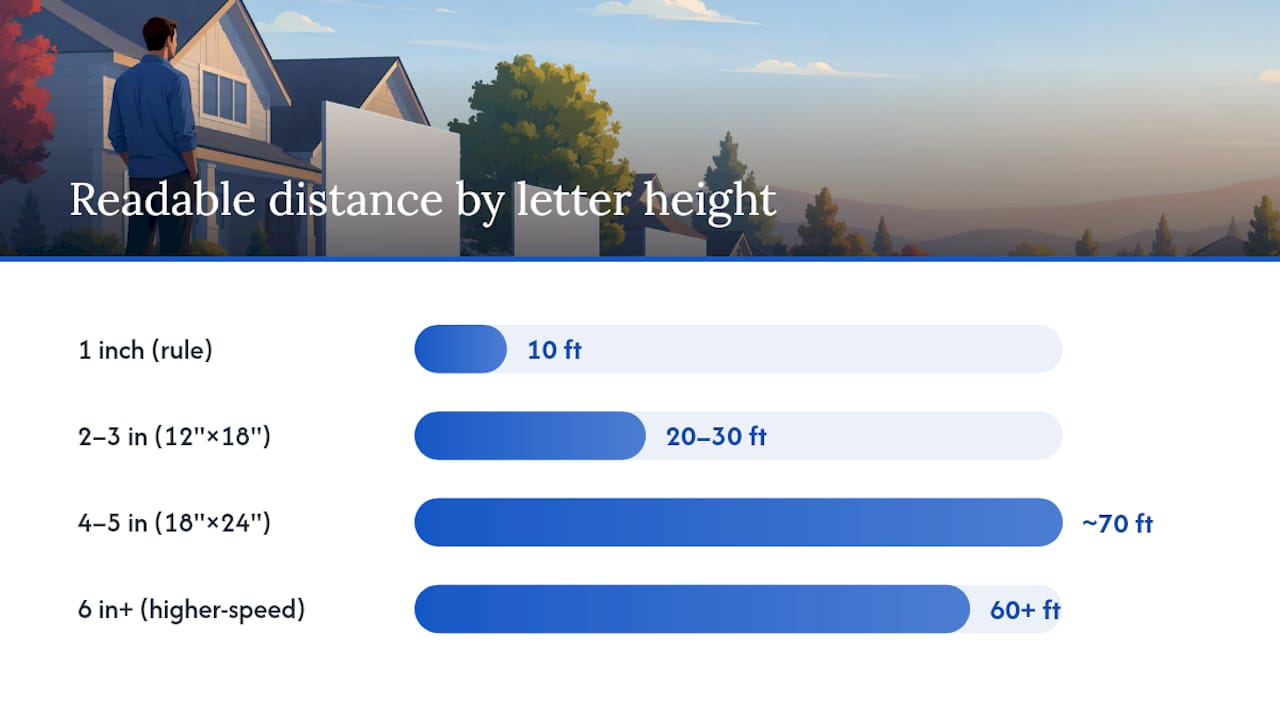
Sign professionals use a simple readability rule: roughly 1 inch of letter height for every 10 feet of readable distance. A driver approaching at 30 to 40 mph only has a few seconds to register your message, so this ratio isn’t a suggestion, it’s math you design around.
Pro Tip: Test your headline by printing it at actual size and taping it to a wall, then walk back the distance your sign will actually be seen from. If you can’t read it comfortably, your letters are too small no matter what the ratio says.
Applied to real dimensions, an 18"×24" sign with 4 to 5 inch letters stays readable to about 70 feet, while a 24"×36" panel with larger type holds up readability suitable for higher-speed roads. A 12"×18" sign is built for close range, suitable for sidewalks and driveways, not 45 mph traffic.
Keep these limits in mind when you write copy:
- 12"×18": one short phrase, letters around 2 to 3 inches
- 18"×24": a five-word headline max, 4 to 5 inch letters, phone number at 1.5 to 2 inches
- 24"×36": headline plus one supporting line, letters 6 inches or taller
Fewer words at bigger sizes beats more words in a smaller font every time. High-contrast palettes and simple sans-serif fonts do more work than any clever layout.
Which Material and Thickness Should You Choose?
Size only matters if the material holds up long enough to be seen. Corrugated polypropylene comes in a few standard thicknesses, and each one is suited to a different timeline and weather exposure.
| Thickness | Typical Outdoor Lifespan | Wind Resistance | Best Use |
|---|---|---|---|
| 3mm | Weeks, mostly indoor or brief outdoor use | Low | Very short promotions, indoor displays |
| 4mm | 6 to 12 months | Moderate | Campaigns, real estate, standard yard signs |
| 6mm | 12+ months | High | Long-term installs, high-wind sites, construction |
| Aluminum | Multiple years | Very high | Permanent signage, repeated seasonal use |
Yardsigns prints on 4mm corrugated plastic as the standard, which covers the vast majority of campaign and real estate needs, and offers 6mm or aluminum when a sign needs to survive a full season of wind and rain. UV-resistant inks matter regardless of thickness since faded color kills legibility long before the plastic itself fails. Double-sided printing adds visibility for corner lots and two-way traffic, though it does mean checking that neither side’s design bleeds through or distracts from the other.
How Do You Mount a Yard Sign So It Doesn’t Blow Over?
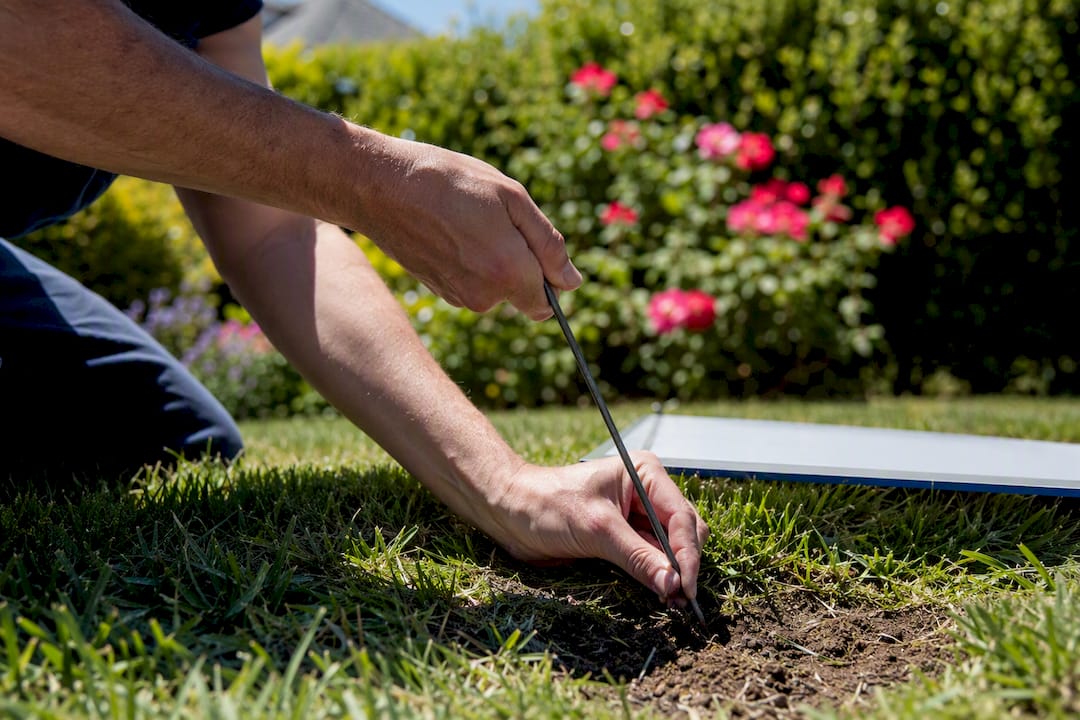
Mounting choice depends almost entirely on size. Standard H-wire stakes handle anything up to 18"×24" without trouble, and they’re what most real estate and campaign signs ship with.
- H-wire stakes: reliable for 18"×24" and smaller, easy to push into soft or moderately packed soil
- Step stakes and heavier-gauge wire: better for residential installs expected to stay up for weeks
- Frames with multiple anchors: necessary for 24"×36" and larger, where wind load on a bigger panel can pull a single stake loose
- Spider stakes or metal frames: worth the extra cost for windy sites or main-road placements
- Grommets and zip-ties: useful for temporary mounting to fences or existing structures
Pro Tip: If your sign is going up along a route with regular gusts, a second stake angled at 45 degrees to the first adds real stability without needing a full frame upgrade.
For theft-prone areas, angle stakes so they’re harder to yank out in one motion, and consider a lock stake for high-value campaign or event signage.
How Should Design Change With Sign Size?
A layout that works at 18"×24" often falls apart at 12"×18", and the reverse is just as true. Font sizing has to scale with the panel, not just the message.
- 12"×18": headline around 2 to 3 inches, minimal subhead, contact info kept small and secondary
- 18"×24": headline at 4 to 5 inches, subhead around 2 inches, phone number or website at 1.5 to 2 inches
- 24"×36": headline 6 inches or larger, room for a subhead plus a logo without crowding
Limit yourself to three or four design elements per sign: a headline, maybe a logo, contact info, and white space. Every extra graphic competes for the same few seconds of attention a driver has.
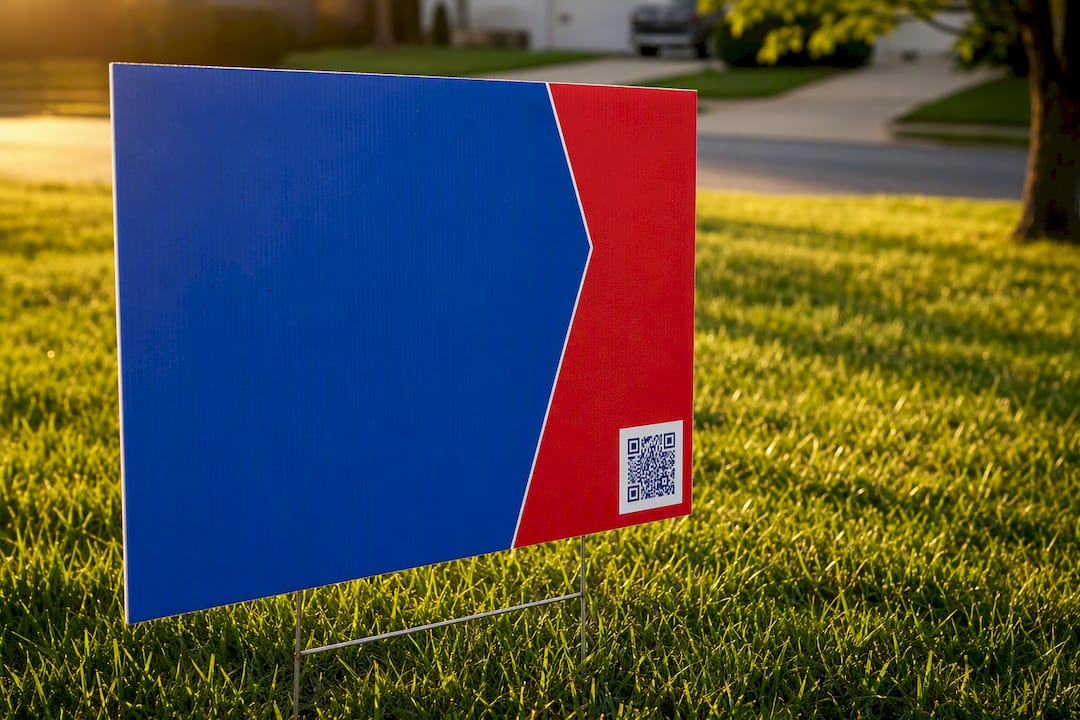
QR codes need to be at least 1.5" × 1.5" to scan reliably at close range, and they work best placed in a corner where they don’t interrupt the main message. For double-sided signs, mirror the layout rather than redesigning from scratch, and keep contrast consistent on both faces so the sign reads the same from either direction of approach.
What Should You Know Before You Order?
Production realities shape size decisions as much as design does. Small orders under 50 pieces typically ship within 24 hours, which matters if you’re reacting to a listing that just went live or a campaign event added last minute. Larger bulk runs usually take one to three days.
- Set up files correctly. Build artwork with a 0.125" to 0.25" bleed, keep text inside the safe area, and export at 300 DPI at final size so nothing looks soft when printed large.
- Order in tiers. Test a small run first, around 50 signs, before committing to 100 or more for the final push. Bulk tiers lower the per-unit cost and make thicker materials more affordable if your deployment runs long.
- Check proofs against actual size. Print a scaled mockup or hold a ruler to your screen. Layout mistakes almost always come from designing at the wrong scale.
- Confirm specs with your printer. Size standards vary slightly between vendors, so don’t assume your file will transfer perfectly from one print shop’s template to another’s.
Who’s Behind This Guide
This guide comes from YardSignGuy, an author focused on sign sizing and layout across real estate, political, and event use cases.
- Yardsigns ships orders under 50 pieces within 24 hours, which matters when a campaign event or listing needs signage fast.
- Every sign prints on weatherproof corrugated plastic or aluminum, with UV-resistant inks that hold color through a full season outdoors.
- Double-sided printing, included metal H-stakes, and free design proofs come standard, which lines up directly with the mounting and material recommendations above.
Do Cities Limit Yard Sign Size and Placement?
Most municipalities regulate yard signs through zoning codes, and the rules vary block by block, not just city by city. Some jurisdictions cap sign area at a specific square footage, others restrict height off the ground, and a growing number set strict windows for political signage, often 30 to 60 days before an election and a short period after.
Homeowners associations add another layer entirely. An HOA can prohibit yard signs outright, limit them to one per lawn, or dictate exactly where on the property they can sit, regardless of what city code allows. If you’re in an HOA community, check the covenant before you check the municipal code.
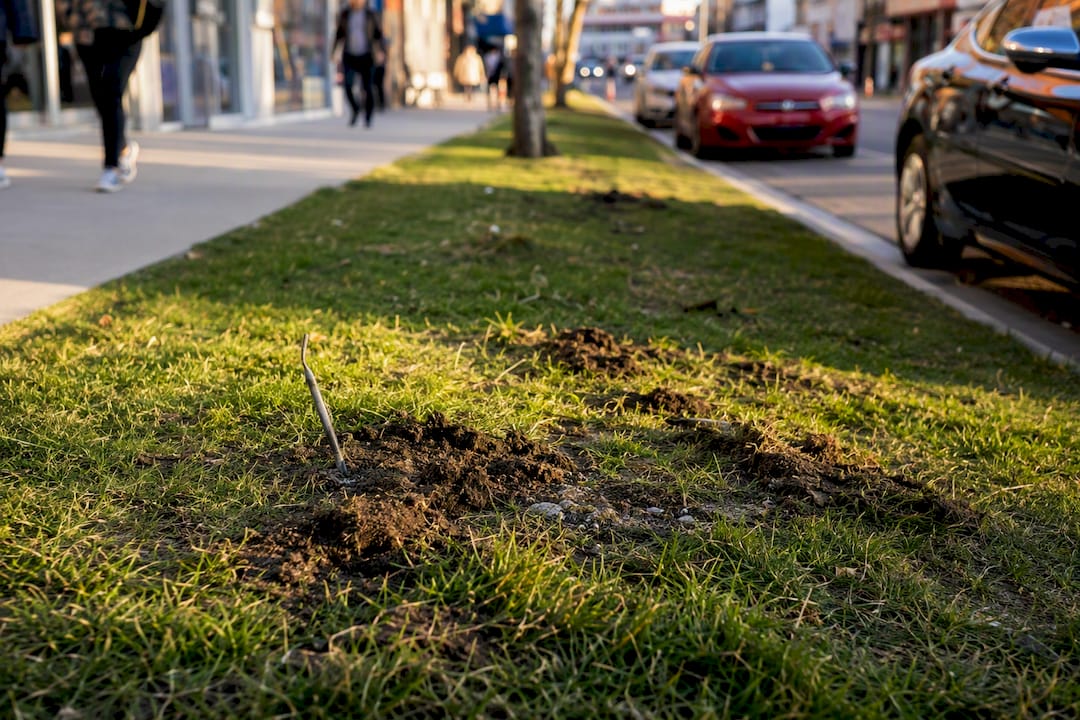
Right-of-way placement causes the most confusion. The strip of grass between a sidewalk and the street often belongs to the city or county, not the adjacent homeowner, and signs planted there get removed without notice in many areas. Political signs get somewhat more protection under free speech considerations, but that protection typically applies to size and timing restrictions rather than location, meaning a candidate sign can still be pulled from a public right-of-way even where content restrictions wouldn’t hold up.
Before ordering a large run for a campaign, development, or community event, a quick call to your local planning or code enforcement office saves you from printing signs you can’t legally display.
Editorial Take: Stop Designing for the Sign, Start Designing for the Street
Most advice on yard sign sizing treats the panel as the finished product. It isn’t. The sign is a message viewed for two or three seconds from a moving vehicle, and every decision about size should flow from that fact rather than from what looks good on a screen.
The conventional wisdom oversells customization. Plenty of guides push readers toward oversized or oddly-shaped panels before establishing whether 18"×24" would have done the job. In practice, the standard size earns its dominance because it balances legibility with stake compatibility and easy transport, not because it’s the safe or boring choice.
What the research actually supports is measurement first, aesthetics second. Decide your viewing distance, apply the one inch to ten feet rule, then let that dictate letter height, word count, and finally the panel size that holds all of it. Readers who skip straight to picking a size and backfill the design end up with cramped text nobody can read from a car.
Prioritize the letter-height math before you open a design file. Everything else, including which size to order, follows from that number.
— YardSignGuy
Order the Right Size Without the Guesswork
Yardsigns builds every sign around the sizing and material rules covered above, from 4mm campaign standards to 6mm panels for windy, long-term sites. Orders under 50 pieces ship within 24 hours, which matters when a listing, election deadline, or event date won’t wait for a standard print queue.
Every order includes free design proofs with unlimited revisions, so you can confirm letter height and layout against the viewing-distance rules before anything goes to print, double-sided printing at no extra design hassle, UV-resistant inks, and metal H-stakes included rather than sold as an add-on. If you’re planning a community fundraiser or charity run, the event and fundraising sign templates are already sized for coordinated directional and hero signage. Start a design proof today and get a size recommendation matched to where your sign will actually stand.
Key Takeaways
The 18"×24" yard sign works as the default because it balances readability, stake compatibility, and transport convenience for most residential and campaign uses.
| Point | Details |
|---|---|
| Standard size | 18"×24" on 4mm corrugated plastic covers most real estate, campaign, and residential signage needs. |
| Size up for traffic | Arterial and commercial roads call for 24"×36" or larger to stay legible at speed. |
| Letter height rule | Use roughly 1 inch of letter height per multiple feet of intended viewing distance, commonly approximated at 10 feet in practice. |
| Match material to timeline | 4mm suits campaigns lasting several months; 6mm or aluminum suits long-term or high-wind installs. |
| Order through Yardsigns | Yardsigns ships sub-50 orders within 24 hours with free proofs, UV inks, and included H-stakes. |
