


Agent Photo on Yard Signs: Your Real Estate Branding Guide
The role of agent photo on yard signs is to create an immediate visual connection between a potential buyer and a real estate professional, turning a simple lawn sign into a personal branding tool. Real estate agents who include their photo on signage give passersby a face to trust before a single conversation takes place. 61% of real estate agents use yard signs for personal branding, which makes sign design a direct factor in consumer trust. A photo is not decoration. It is a trust signal that works around the clock, in every neighborhood where you have a listing.
How agent photos on yard signs influence buyer trust and engagement
An agent photo on a yard sign functions as what marketing professionals call a “visual handshake.” A realtor headshot serves as a small visual handshake that reassures clients and helps them decide whether to engage with the agent. That split-second impression happens before a buyer ever picks up the phone or visits a listing page.
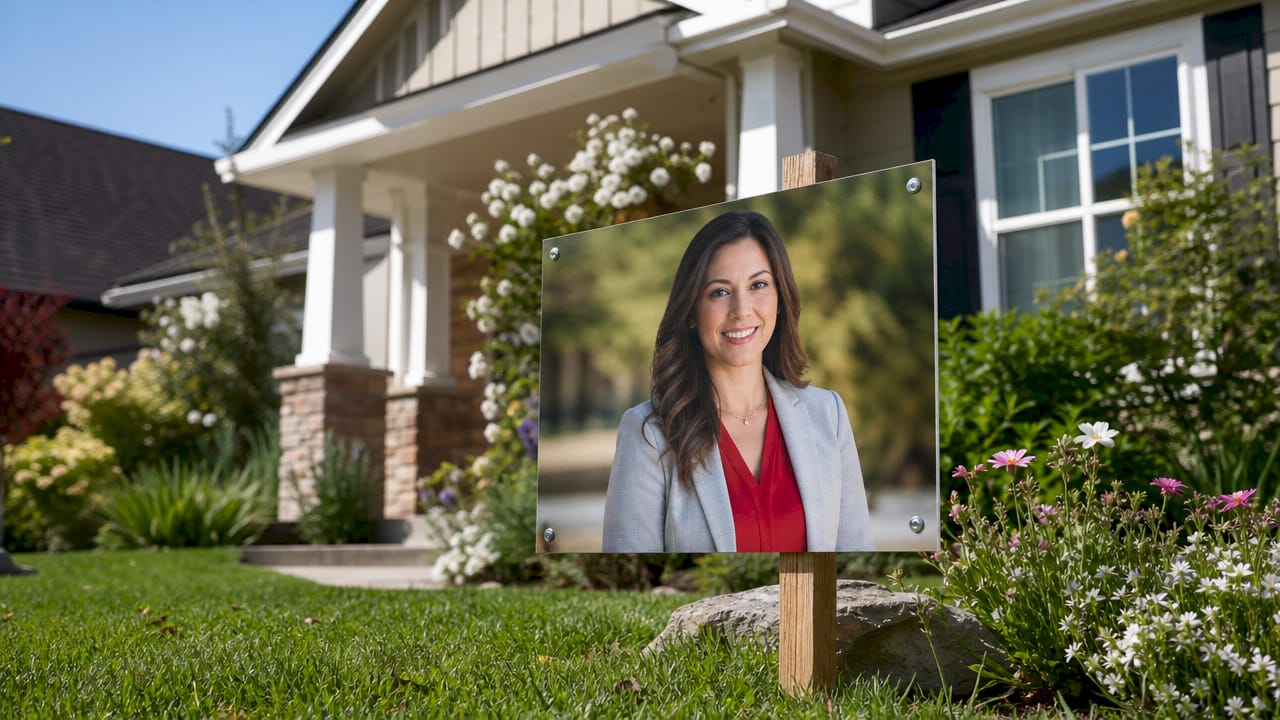
The psychology behind this is straightforward. Buyers feel less anxiety when they can put a face to a name. A photo signals that a real person, not a faceless corporation, is handling the sale. That human element reduces hesitation and makes the call-to-action on the sign feel less intimidating.
Agent photograph effectiveness also extends to repeat exposure. When a buyer sees the same agent photo across multiple listings in a neighborhood, recognition builds. That recognition translates directly into recall when the buyer is ready to act. The photo becomes a brand asset, not just a design element.
The impact on business results is measurable. Listings with professional agent photography receive up to 61% more online views and sell up to 32% faster with higher sale prices. Agents using professional headshots can earn twice the commission compared to those with amateur photos. Those numbers reflect what happens when trust is established early in the buyer’s experience.
Key ways agent photos drive engagement on yard signs:
- Instant recognition: Buyers who see your face on a sign remember you when they search online later.
- Reduced buyer hesitation: A friendly, approachable photo lowers the psychological barrier to making contact.
- Brand consistency: Your photo ties the yard sign to your website, social media, and business cards.
- Neighborhood authority: Multiple signs with your photo in one area signal market expertise and active presence.
- Emotional connection: A warm expression creates a sense of familiarity before any conversation begins.
Pro Tip: Place your photo on the same side of the sign as your phone number. Buyers who look at your face naturally shift their eyes toward contact information, increasing the chance they write it down.
What are the best design practices for agent photos on yard signs?
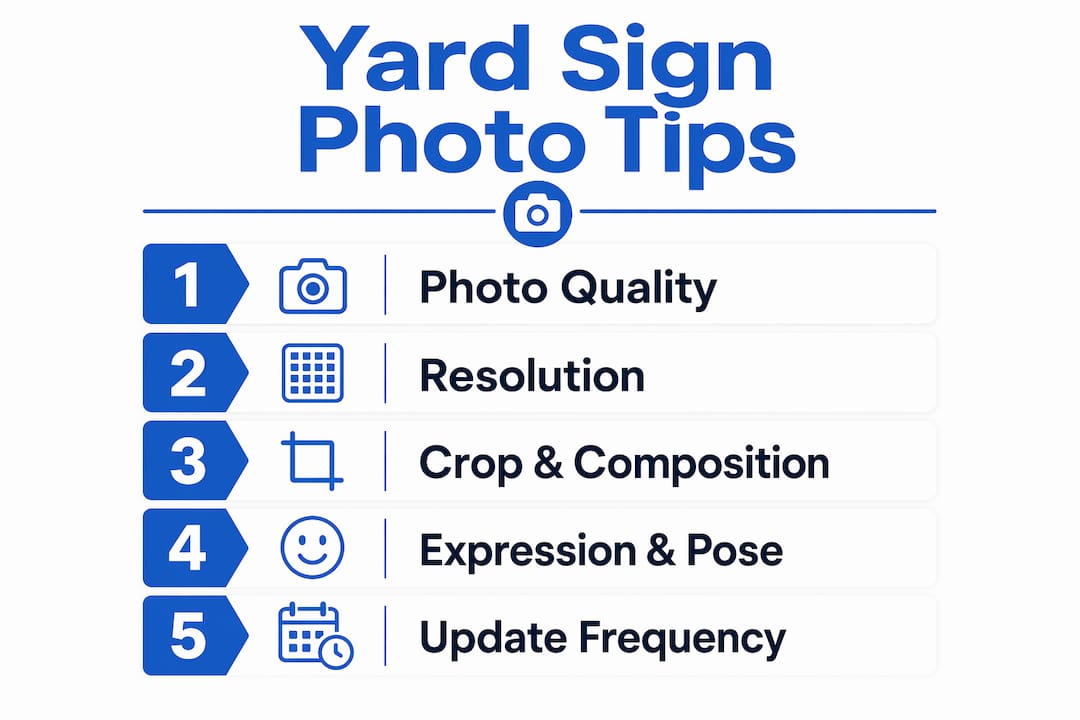
Photo quality is the single biggest factor separating effective agent images on signage from ones that hurt your brand. A blurry or pixelated photo signals carelessness, and buyers transfer that impression to your professional judgment.
Resolution and file specifications
Yard signs require ultra-high-resolution, wider crop photos to avoid pixelation and maintain image clarity from 30 feet or more. Phone-camera photos frequently fail for yard signs because of low resolution. The minimum file size for large-format print is at least 3,000 x 3,000 pixels at 200 DPI. Anything below that threshold will show grain or blurring when printed at sign scale.
Crop and composition
Using the same tight headshot crop from your social media profile on a yard sign is a common and costly mistake. Yard signs require wider shots showing the upper body for brand trust and visual effectiveness. A wider crop with visible arms and open body language reads as transparent and approachable. That openness matters more on a physical sign viewed from a moving car than it does in a LinkedIn thumbnail.
Expression and pose
The ideal agent photo balances authority and approachability to build trust and reduce buyer anxiety. A warm, confident expression with open body language outperforms stiff corporate poses. The photo must signal competence without intimidation. For residential real estate agents, warmth wins over formality every time.
Here is a numbered checklist for producing a yard sign photo that works:
- Hire a photographer with real estate headshot experience. General portrait photographers may not understand the wider crop and lighting needs specific to signage.
- Request a file at 3,000 x 3,000 pixels or larger at 200 DPI. Confirm this spec before the shoot, not after.
- Choose a neutral or on-brand background. Busy backgrounds compete with your face and reduce sign readability.
- Wear clothing that matches your brokerage colors. Visual consistency across the sign reinforces brand recognition.
- Smile with your eyes, not just your mouth. A genuine expression reads as trustworthy from a distance.
- Request a wider upper-body crop. Ask the photographer to frame from mid-chest up, not chin to forehead.
- Review the image at actual sign scale before printing. Print a test copy or view the file at 100% zoom to catch any issues.
| Design element | What works | What to avoid |
|---|---|---|
| Resolution | 3,000 x 3,000 px at 200 DPI minimum | Phone camera photos under 1,000 px |
| Crop | Upper body, mid-chest to top of head | Tight face-only headshot |
| Expression | Warm smile, relaxed jaw, direct eye contact | Stiff or overly formal corporate pose |
| Background | Neutral, solid, or on-brand color | Busy outdoor scenes or cluttered offices |
| Clothing | Brokerage colors, professional attire | Casual wear or busy patterns |
Pro Tip: Update your yard sign photo every two to three years or after any significant change in appearance. Failing to update after appearance changes erodes credibility before you even meet a client.
When are agent photos on yard signs most effective?
Agent photos on yard signs deliver the strongest return in specific market conditions. Understanding those conditions helps you decide where to invest in photo-forward signage and where a property-focused design may serve you better.
Agent photos build brand recognition most effectively in markets where agents have multiple listings or a repeat presence. For one-off, single listings, the photo’s impact is less pronounced. This distinction matters for budgeting and design decisions.
Situations where agent photos on yard signs deliver the most value:
- High-competition neighborhoods: When three agents are competing for the same buyer’s attention on the same street, a recognizable face sets you apart.
- Agents building name recognition: New agents benefit most from photo-forward signage because they need to establish identity quickly in a market where buyers do not yet know them.
- Long-listing-duration properties: A sign that sits for 60 or 90 days becomes a neighborhood fixture. Your photo on that sign builds familiarity over time.
- Geographic farming areas: If you consistently work the same zip code or subdivision, your photo on every sign trains buyers and sellers to associate you with that area.
- Repeat listing agents: Agents who regularly list in the same community gain compounding brand recognition with each sign placed.
Experienced agents with established reputations sometimes shift toward property-focused signage that emphasizes the listing itself. That approach works when name recognition is already high. For most agents, the photo remains the stronger choice because headshots maintain trust signals across multiple client touchpoints, including yard signs and business cards, in situations where video is not practical.
How to implement agent photos on yard signs for better marketing results
Putting your photo on a yard sign is a production process, not just a design choice. Getting it right requires coordination between your photographer, your sign printer, and your overall marketing plan.
Follow these steps to produce and deploy agent photos on yard signs effectively:
- Set a photography budget with ROI in mind. Professional headshot packages typically cost around $499 and yield multiple optimized images. That investment pays back quickly when measured against increased contact rates and commission potential.
- Select a photographer who specializes in real estate headshots. Ask to see examples of their work used on physical signage, not just digital profiles. The lighting and crop requirements differ significantly.
- Confirm file specs with your sign printer before the shoot. Ask Yardsigns or your chosen printer for the exact pixel dimensions, DPI, and file format they require. Collect those specs before you book the photographer.
- Maintain a consistent photo across all marketing channels. The same image should appear on your yard signs, website bio, business cards, and social media profiles. Inconsistency confuses buyers who encounter you across multiple platforms.
- Store your original high-resolution file in a cloud folder. You will need it every time you order new signs, update your website, or create new marketing materials. Losing the original file forces a costly reshoot.
- Review retail signage best practices for layout and visibility. Sign design principles that apply to retail environments translate directly to real estate yard signs, particularly around contrast, font size, and image placement.
- Order a proof before a full print run. A physical proof lets you catch color shifts, resolution issues, or layout problems before they appear on 20 signs across your farm area.
What I have learned about agent photos after years in the field
After watching hundreds of agents place signs and track their results, one pattern stands out clearly. The agents who treat their yard sign photo as a one-time task almost always underperform compared to those who treat it as a living brand asset.
The most common mistake I see is agents using a photo that is five or six years old. Buyers who call after seeing a sign and then meet an agent who looks noticeably different feel a small but real sense of deception. That feeling does not disappear. It colors the entire relationship from the first handshake.
The second mistake is using a photo that was shot for a LinkedIn profile and simply dropped onto a sign. The tight crop, the formal pose, the studio lighting designed for a 2-inch thumbnail. None of that translates to a 24-inch yard sign viewed from a moving car. The image looks cramped, the expression reads as cold, and the sign loses its most powerful tool.
What actually works is a photo that feels like a neighbor, not a corporate spokesperson. Open posture, a genuine smile, clothing that fits the neighborhood’s price point. Buyers in a $400,000 suburb respond differently than buyers in a $2 million coastal market. Your photo should match the community you serve, not just your brokerage’s brand guide.
The agents who get this right see their signs do real work. Buyers remember them. Sellers call them because they feel like they already know them. That is the entire point of putting your face on a sign. It is not vanity. It is the most efficient trust-building tool you have at street level.
— YardSignGuy
Yardsigns makes it easy to put your best face on every listing
Real estate agents who want their photo to work as hard as their listings need a sign that prints it with clarity and holds up through every season. Yardsigns produces customizable realtor yard signs built to accommodate agent photos with the resolution and color accuracy that professional headshots deserve.
Orders under 50 pieces ship within 24 hours, so you can respond to a new listing without waiting a week for signs to arrive. The weatherproof materials keep your photo looking sharp through rain, wind, and direct sun. You can also read more about why yard signs sell homes faster to see how sign quality connects directly to listing performance. When your photo is on a Yardsigns product, it shows up the way you intended it to.
Key takeaways
An agent photo on a yard sign is the most cost-effective trust-building tool available at street level, and its impact depends entirely on photo quality, design execution, and consistent deployment.
| Point | Details |
|---|---|
| Photos build immediate trust | A professional headshot on a yard sign creates a visual connection before any buyer conversation begins. |
| Resolution is non-negotiable | Use files of at least 3,000 x 3,000 pixels at 200 DPI to prevent pixelation on large-format signs. |
| Wider crop outperforms headshots | Upper-body framing with visible arms reads as more open and trustworthy than a tight face crop. |
| Update photos regularly | Refresh your sign photo every two to three years or after any significant change in appearance. |
| Photos work best with repeat presence | Agent photos deliver the strongest brand recognition when you have multiple listings in the same area. |
FAQ
Does an agent photo on a yard sign actually increase calls?
Yes. Agent photos reduce buyer hesitation by humanizing the listing, and agents using professional headshots can earn twice the commission compared to those using amateur photos. A recognizable face on a sign increases the likelihood that a buyer will make contact.
What image resolution do I need for a yard sign photo?
Yard sign photos require a minimum of 3,000 x 3,000 pixels at 200 DPI to maintain clarity at large-format print sizes. Phone camera photos frequently fall below this threshold and produce pixelated results.
How often should I update my agent photo on yard signs?
Top agents refresh their photos every two to three years or after a brokerage change or significant appearance shift. An outdated photo that no longer matches your appearance damages credibility before a first meeting.
Should I use the same photo on yard signs and social media?
No. Social media profiles use tight face crops, while yard signs require wider upper-body shots with visible arms and open body language. Using the same tight crop on a yard sign makes the image look cramped and reduces its effectiveness from a distance.
Are agent photos worth it for a single listing?
Agent photos deliver the most value when you have multiple listings or a consistent presence in one area. For a single, one-off listing, the branding impact is less pronounced, though a professional photo still signals credibility to every buyer who passes the sign.
