


How to Setup Yard Signs for a Charity Fundraiser
Setting up yard signs for a charity fundraiser is one of the most cost-effective ways to generate local visibility before your event. Yard signs, also called lawn signs or corrugated plastic signs, work because they deliver a single message to hundreds of passing drivers and pedestrians every day. The key to making them work is combining clear design, smart placement, and legal compliance. This guide walks you through every step, from ordering and design to placement strategy and troubleshooting, so your fundraiser gets the local attention it deserves.
How to setup yard signs for a charity fundraiser: design principles that work
Effective charity yard signs follow one rule above all others: legibility over completeness. A passing driver has roughly three seconds to read your sign, process the message, and decide whether to act. That window is not forgiving.
The most important design choices for your custom signs for charity events are:
- Font size and style: Use bold, sans-serif fonts like Arial or Impact. Text should fill at least 60% of the sign face. Anything smaller becomes invisible from a moving car.
- Color contrast: Black text on a yellow or white background, or white text on a dark blue or red background, delivers the highest contrast. Avoid color combinations that blend together in sunlight.
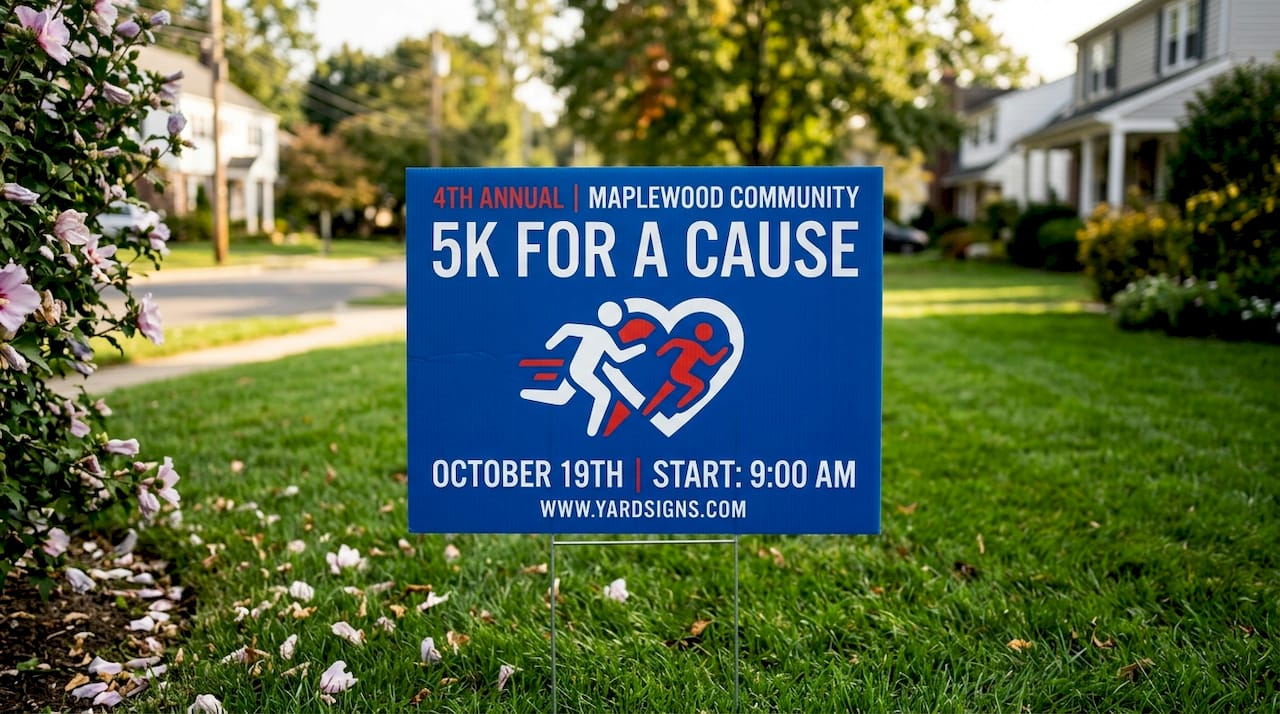
- Message limit: Include only three pieces of information. The event name, the date, and one call to action such as a website URL or a short phrase like “Donate Now.”
- QR codes: A QR code can add measurable engagement, but QR codes must be large and high-contrast to be scannable at a glance. Place it in a corner and keep it at least 1.5 inches square.
- Avoid clutter: Every additional element, a phone number, a logo, a tagline, reduces the font size of everything else. Signs that require 5 seconds to parse get ignored entirely.
Pro Tip: Drive past a printed proof of your sign at 25 mph before ordering in bulk. If you cannot read the event name and date in one glance, simplify the design before committing to a full print run.
Creative yard signs for fundraisers often stand out through color and a single bold graphic, not through more text. A red heart, a school mascot, or a simple ribbon graphic communicates cause and community instantly without stealing space from your core message.
When to plan production and placement for maximum impact
Timing your yard sign campaign is as important as the design itself. A sign that goes up two days before your event reaches far fewer people than one displayed for three weeks.
- Order 10 to 12 weeks out. Yard signs carry the longest production lead time among common printed promotional materials. Ordering early gives you time to review proofs, request corrections, and still receive signs well before your placement window opens. Yardsigns ships orders under 50 pieces within 24 hours, but building in extra time protects you from any design revision delays.
- Check local timing rules. Many municipalities regulate when signs can go up and how long they can stay. Madison, NE, for example, permits small yard signs only from March 31 through seven days after the relevant event. Your city likely has similar rules. Contact your city clerk or check the municipal code online before you schedule placement.
- Coordinate with other promotions. Your yard signs should go up at the same time your social media campaign launches and your email announcements go out. Simultaneous visibility across channels reinforces the message and builds momentum.
- Schedule removal immediately after the event. Leaving signs up past the event date creates a negative impression in the community and can result in fines. Assign a volunteer team to remove all signs within 24 to 48 hours of the fundraiser ending.
Pro Tip: Create a shared spreadsheet listing every sign location, the property owner’s name, and the planned removal date. This makes post-event cleanup fast and keeps your organization in good standing for future campaigns.
Where and how to place charity yard signs legally and strategically
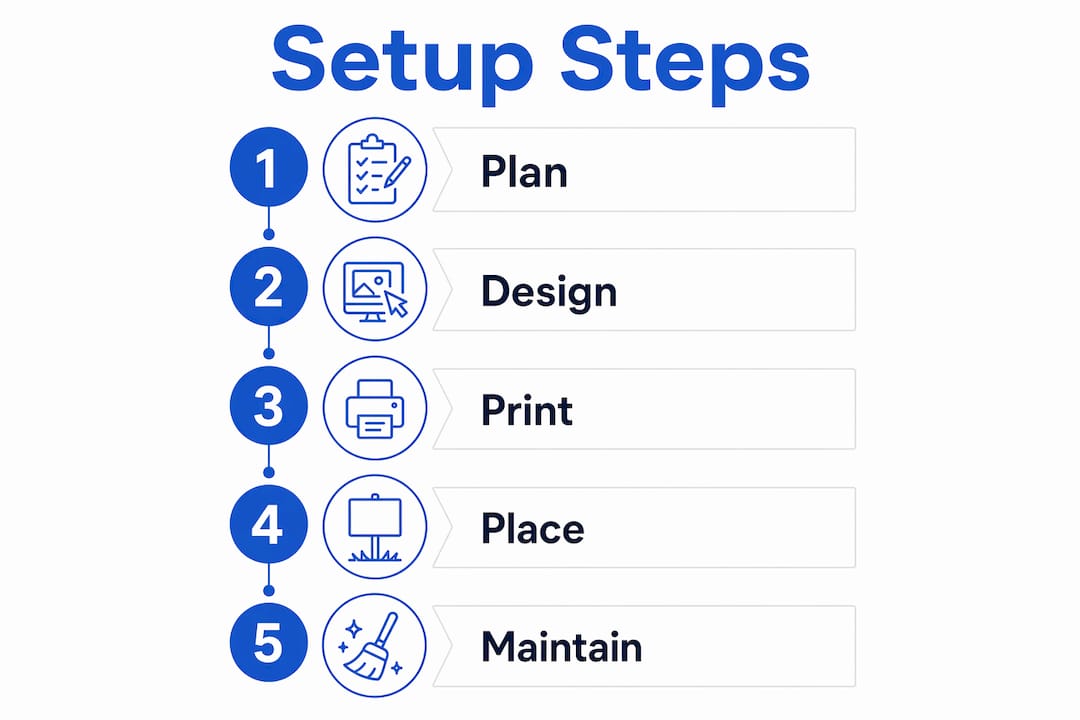
Placement is where many well-designed yard sign campaigns fail. A sign in the wrong location gets removed by code enforcement before most people see it.
The legal framework matters first. The Spokane Municipal Code requires signs to remain within the property site and restricts how far they can project into the public right-of-way. Most U.S. cities have comparable rules. Placing a sign in a public right-of-way, the strip of land between the sidewalk and the street, is prohibited in many jurisdictions and can result in immediate removal without notice.
Here is how to place your yard signs for non-profit events both legally and effectively:
- Get written permission first. Before placing any sign on private property, get the owner’s written or emailed consent. Businesses, churches, and community centers near your event route are ideal partners.
- Target high-traffic intersections. Signs positioned at busy four-way stops or near school zones reach the highest daily vehicle counts. Prioritize locations within one mile of your event venue.
- Use directional signs on event day. Place smaller directional signs at each turn leading to your venue. These guide attendees who are already looking for you and reduce confusion on the day.
- Angle signs toward traffic. Positioning a sign at a slight angle toward oncoming traffic, rather than flat against a fence, increases the time a driver can see it and reduces glare from direct sunlight.
| Placement type | Best use case |
|---|---|
| High-traffic intersection | Maximum daily impressions, brand awareness |
| Along event route | Directional guidance for attendees |
| Supporter’s front yard | Community endorsement, neighborhood reach |
| Business parking lot | Captive audience, longer read time |
Strategic placement near intersections consistently outperforms signs placed mid-block because drivers slow down and have more time to read. Treating permission and placement rules as a core part of your plan prevents sign loss and protects your organization’s reputation.
What materials and mounting options work best for charity events
The physical sign itself needs to survive wind, rain, and direct sun for several weeks. Choosing the right materials from the start saves money and prevents the embarrassment of faded or collapsed signs.
| Material | Thickness | Best for |
|---|---|---|
| Corrugated plastic (coroplast) | 4mm | Standard outdoor use, weather resistance |
| Aluminum | 0.040 in | Long-term or reusable signage |
| Foam board | 3mm | Indoor display only |
Weather-resistant 4mm corrugated plastic is the standard for outdoor charity yard signs. It withstands sun and rain and can be reused for annual events if you design the sign with generic information and add a separate date sticker each year. The 18" x 24" size is the most common for fundraising because it is large enough to read from a car but small enough to carry and install without tools.
Mounting hardware matters as much as the sign material. H-stands are often included with standard 18" x 24" orders and provide stable, tool-free installation in grass or soft soil. For harder ground, bring a rubber mallet. For signs on fences or walls, use zip ties or adhesive strips rated for outdoor use.
Double-sided printing is worth the small added cost for signs placed at intersections or along two-way streets. A single-sided sign is invisible to traffic approaching from the opposite direction, cutting your impressions in half.
Pro Tip: When installing signs, push H-stands in at a slight forward angle rather than perfectly vertical. This tilts the sign face toward oncoming traffic and improves visibility from a distance. For a deeper look at outdoor sign durability, the weather-resistant sign guide from Yardsigns covers material performance in detail.
Common challenges when setting up yard signs for fundraisers
Even well-planned campaigns run into problems. Knowing what to expect lets you respond quickly instead of losing days of visibility.
- Sign removal by enforcement: If a sign is placed in a restricted area, code enforcement can remove it without warning. Always document your placement locations and keep copies of any permissions. If a sign disappears, check with the city before replacing it in the same spot.
- Weather damage: Heavy rain can cause H-stands to sink, and strong wind can knock signs flat. Check your signs every few days during the campaign and re-stake any that have shifted. Coroplast signs resist moisture, but prolonged standing water can weaken the flutes over time.
- Sign theft or vandalism: This is more common in high-visibility locations. Keep a small reserve of replacement signs, roughly 10 to 15% of your total order, to swap out damaged or missing ones quickly.
- Message overload: Volunteers and committee members often want to add more information to the sign after the design is approved. Hold the line on simplicity. A sign with seven lines of text serves no one.
- Volunteer coordination: Placing 50 signs across a city in a single morning requires a clear plan. Divide your team into zones, assign each person a printed map with their locations, and set a two-hour window for the entire operation.
Nonprofit marketing works best when physical tools like yard signs are paired with digital channels. Combining your sign campaign with a video or social push, as explored in resources on nonprofit video marketing, creates multiple touchpoints that reinforce each other.
Key takeaways
Yard signs work for charity fundraisers when you combine fast-read design, compliant placement, and durable materials ordered well ahead of your event date.
| Point | Details |
|---|---|
| Design for 3-second readability | Limit signs to event name, date, and one call to action with high-contrast colors. |
| Order 10 to 12 weeks early | Production lead times and design revisions require a buffer well before your placement window. |
| Check local placement rules | Cities like Spokane and Madison, NE restrict sign locations and timing; verify your municipal code first. |
| Use 4mm coroplast with H-stands | This combination delivers weather resistance, easy installation, and reusability for annual events. |
| Plan removal immediately after | Assign a volunteer team to collect all signs within 48 hours to stay compliant and maintain goodwill. |
What I’ve learned from watching yard sign campaigns succeed and fail
I have seen organizations spend real money on yard signs and get almost nothing back. Not because the signs were bad, but because they were placed too late, designed with too much text, or pulled by code enforcement before the event even happened.
The campaigns that work share one habit: they treat the sign as a billboard, not a flyer. A flyer can hold ten details because someone picks it up and reads it. A sign has three seconds with a stranger going 30 mph. That constraint is not a limitation. It is the design brief.
The other thing I have noticed is that organizations underestimate how much the placement network matters. Twenty signs in the right locations, on busy corners with permission from cooperative businesses, outperform a hundred signs scattered randomly. Quality of placement beats quantity every time.
If you are running a charity fundraising event and want your signs to do real work, build your placement map before you finalize your design. Know where the signs are going, get permission, and then design the message for those specific locations and audiences. That sequence, placement first, design second, is the one most organizers get backwards.
— YardSignGuy
Order custom charity yard signs from Yardsigns
When you are ready to print, Yardsigns offers custom charity fundraising signs built specifically for community events and non-profit campaigns. Every order includes H-stands, and the 4mm coroplast material is rated for extended outdoor use in all weather conditions.
Orders under 50 pieces ship within 24 hours, which means even organizers who are working close to their event date can get professional-quality signs fast. The online design tool lets you upload your artwork or build a sign from scratch, and the team is available to assist with layout if you need it. For events that also need directional or parking signage, church and event parking signs are available in the same durable format. Yardsigns makes it straightforward to get everything you need in one order.
FAQ
How many yard signs do I need for a charity fundraiser?
Most community fundraisers need between 25 and 75 signs depending on the size of the coverage area. Plan for one sign per major intersection within one mile of your venue, plus additional signs along the primary approach routes.
What size yard sign works best for fundraising events?
The 18" x 24" size is the standard for charity yard signs because it is readable from a moving vehicle and fits standard H-stands. Larger sizes like 24" x 36" work well for high-speed roads where drivers have less time to focus.
Can I place yard signs on public property for a fundraiser?
Most cities prohibit signs in the public right-of-way, including the strip between the sidewalk and the street. Always check your local municipal code and place signs only on private property with the owner’s permission to avoid removal or fines.
How far in advance should I put up fundraiser yard signs?
Two to three weeks before the event is the standard window for maximum visibility without running into timing restrictions. Check your local ordinances, as some cities set specific start dates for sign placement.
Are yard signs reusable for annual charity events?
Yes. Signs printed on 4mm corrugated plastic can be reused if the design omits the specific year or date. Store them flat in a dry location between events and add a printed date sticker each year to extend their useful life.
