


Real Estate Sign Compliance Rules: A 2026 Guide
A real estate sign compliance rule is a legally mandated standard that governs what information must appear on property advertising signs, how large those signs can be, and where they may be placed. These rules come from state real estate commissions, the Fair Housing Act, and local municipal codes. Agents and property owners who ignore them face fines, forced sign removal, and regulatory action. Understanding the full scope of real estate signage regulations before you print a single sign protects your license, your listing, and your reputation.
What is the real estate sign compliance rule?
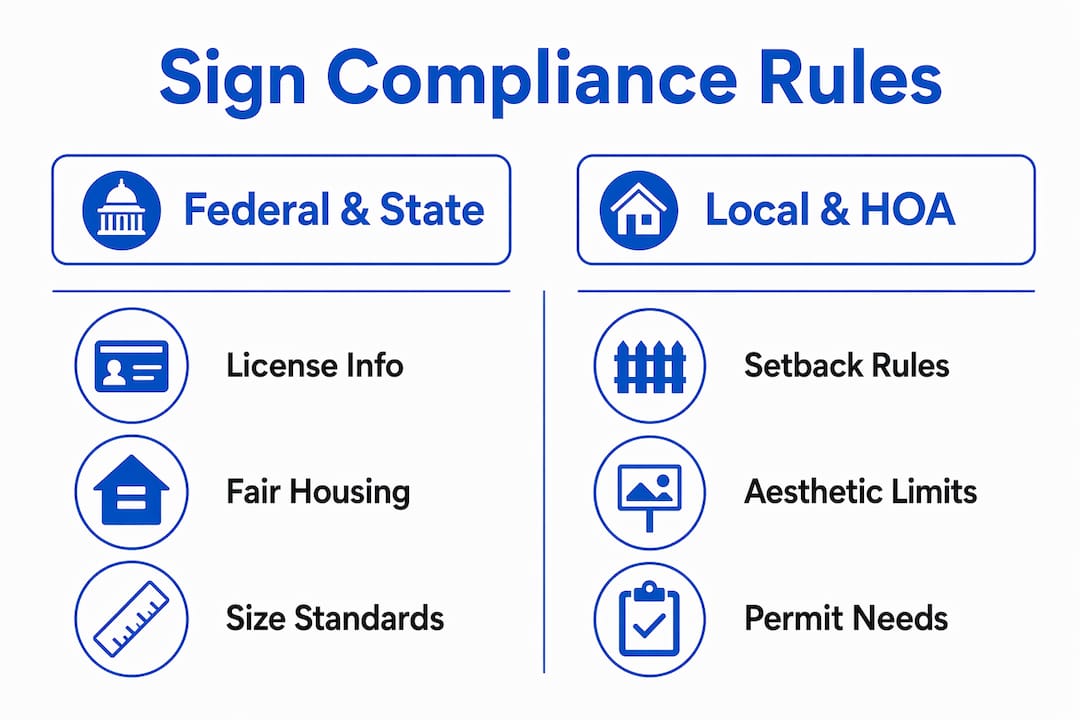
Real estate sign compliance rules are regulatory requirements that control the content, size, placement, and display of property advertising signs. They exist at three levels: federal law, state real estate commission rules, and local ordinances. Each level adds its own layer of requirements, and all three apply simultaneously.
The Fair Housing Act sits at the foundation. All real estate advertising must use nondiscriminatory language and display the Equal Housing Opportunity logo. This applies to yard signs, directional signs, and open house boards alike. Omitting the logo is a federal compliance failure, not a design choice.
State real estate commissions add licensing requirements on top of federal law. California’s Department of Real Estate, for example, requires the DRE license number on every piece of first-contact advertising, including yard signs. The font size for the license number must be no smaller than the smallest print anywhere else on the sign. That rule alone catches many agents off guard.
Many agents mistakenly treat sign compliance as a marketing preference rather than a legal obligation. Regulatory bodies use signage to verify that consumers receive proper licensing disclosures at first contact. A sign without the required information is not just incomplete. It is a violation.
What are the common legal requirements for real estate signs?
Most state real estate commissions share a core set of requirements, even when the specific details vary. Knowing these common standards gives you a reliable baseline before you check your state’s specific rules.
Required content elements on most real estate signs:
- Broker name and brokerage firm name, displayed prominently
- Agent name, if the agent’s name appears anywhere on the sign
- State-issued license number, in a font no smaller than the smallest text on the sign
- Equal Housing Opportunity logo or the phrase “Equal Housing Opportunity”
- Contact information, typically a phone number or website
Pro Tip: If your brokerage has a style guide, treat it as a compliance document, not just a branding preference. Many brokerages build state-required disclosures directly into their approved sign templates.
The Equal Housing Opportunity logo requirement deserves special attention. Fair Housing Act compliance is not optional, and the logo signals to buyers and sellers that your advertising meets federal nondiscrimination standards. Leaving it off creates legal exposure that no marketing benefit can justify.
Size and durability standards also appear in many state and local codes. The industry-standard size for a residential yard sign is 18x24 inches. This dimension is widely accepted across markets and balances visibility with legal acceptance. Signs must also be made from materials that hold up to weather, since a faded or damaged sign can obscure required disclosures and trigger a compliance complaint.
Real estate commissions enforce these rules through complaint investigations and routine audits. A citation for a missing license number can result in a formal reprimand or a fine. Repeat violations put your license at risk.
How do local jurisdictions and HOAs affect real estate signage compliance?
Local rules add a third layer of complexity on top of federal and state requirements. Municipal codes regulate sign size, height, placement, illumination, and sometimes require permits before a sign goes up. These rules vary widely between cities and counties, so a sign that is fully legal in one zip code may violate an ordinance two miles away.
Common local restrictions include setback requirements (how far a sign must sit from the street or property line), limits on the number of signs per property, and bans on illuminated signs in residential zones. Some jurisdictions require a sign permit even for temporary yard signs. Skipping that permit can result in a fine and forced removal, even if the sign itself meets every other requirement.
| Restriction type | Who sets it | What it controls |
|---|---|---|
| License number disclosure | State real estate commission | Required content and font size |
| Fair housing language | Federal (Fair Housing Act) | Nondiscriminatory wording and logo |
| Sign size and placement | Local municipal code | Dimensions, setbacks, number of signs |
| HOA design rules | Homeowners association | Color, frame style, placement within community |

HOAs present a separate challenge. They can regulate sign aesthetics within their communities, but they cannot override state law. Arizona’s statute § 33-441 protects property owners’ rights to display one industry-standard 18x24 inch real estate sign with a 6x24 inch rider, regardless of HOA rules. As of july 2025, HOAs in Arizona cannot ban “For Sale” or “For Lease” signs that meet these standards.
HOAs cannot enforce custom signage frame requirements if those requirements conflict with state-mandated industry standards. Court and administrative decisions have consistently upheld this principle. If an HOA demands a proprietary frame that alters the sign’s dimensions beyond what state law allows, that HOA rule is unenforceable.
Pro Tip: Before placing any sign, call your local planning or zoning department and ask specifically about temporary real estate sign permits. A five-minute call can prevent a fine and a forced removal.
For a broader look at where signs can legally go, the public property sign rules guide covers placement restrictions that apply beyond private property lines.
What are the risks and penalties of non-compliance with real estate sign rules?
Non-compliance carries real consequences. The penalties range from minor fines to serious professional discipline, and they can disrupt an active listing at the worst possible moment.
Common penalties for real estate sign violations:
- Municipal fines for sign placement, size, or permit violations
- Forced removal of non-compliant signs, sometimes within 24 hours of notice
- Regulatory citations from state real estate commissions for missing license numbers or broker information
- Formal reprimands that become part of your public license record
- HOA enforcement actions, including fines and legal proceedings against property owners
Non-compliance with signage rules can also damage your professional reputation. A citation that appears in a public license database signals to clients that you cut corners. That perception is hard to reverse, especially in competitive markets where buyers and sellers research agents before making contact.
HOA enforcement adds another layer of risk. An HOA can fine a property owner directly, and those fines accumulate quickly. If the dispute escalates to litigation, the legal costs far exceed the cost of printing a compliant sign in the first place.
The most overlooked risk is marketing disruption. A sign removed mid-listing loses visibility at a critical time. Replacing it takes time, and the gap in street presence can affect how quickly a property sells.
What best practices ensure your real estate signs meet compliance and marketing goals?
Compliance and effective marketing are not in conflict. A well-designed, fully compliant sign does both jobs at once. Follow these steps to get there.
-
Verify state and local rules before ordering. Check your state real estate commission’s advertising guidelines and your local municipal code. Both change periodically, and what was compliant last year may not be compliant now.
-
Include all required broker and agent information. Broker name, agent name, and license number must all appear. Use a font size for the license number that meets your state’s minimum requirement. When in doubt, make it larger.
-
Add the Equal Housing Opportunity logo. Place it in a visible location on the sign face. This satisfies the Fair Housing Act requirement and signals professionalism to buyers and sellers.
-
Choose the right sign size. The 18x24 inch format is the industry-standard size for residential yard signs and is legally accepted in most markets. Larger signs may require permits or violate local size limits.
-
Use weatherproof materials. A sign that fades or warps within weeks can obscure required disclosures. Choose materials rated for outdoor use in your climate. Yardsigns produces weatherproof signs built to maintain color and legibility through rain, heat, and wind.
-
Consult your brokerage’s branding guidelines. Most brokerages have pre-approved templates that already incorporate state-required disclosures. Using these templates reduces your compliance risk significantly.
-
Seek legal counsel for complex situations. If you operate across multiple jurisdictions or manage properties in HOA communities with aggressive sign policies, a real estate attorney can clarify your rights and obligations before a dispute arises.
For guidance on real estate sign printing that aligns with current regulations, Yardsigns offers resources alongside its product line to help agents order with confidence.
Key takeaways
Real estate sign compliance rules are legally binding requirements that govern sign content, size, and placement across federal, state, and local levels, and violations carry fines, forced removal, and license risk.
| Point | Details |
|---|---|
| Federal baseline | The Fair Housing Act requires nondiscriminatory language and the Equal Housing Opportunity logo on all real estate signs. |
| State license disclosure | Most states require the broker’s license number on every sign, in a font no smaller than the smallest text on the sign. |
| Local permit rules | Municipal codes control size, placement, and illumination; always check local ordinances before placing a sign. |
| HOA limits | HOAs can regulate sign aesthetics but cannot override state-mandated size and design standards. |
| Standard sign size | The 18x24 inch format is the industry standard for residential yard signs and is legally accepted in most markets. |
Why sign compliance is a professional obligation, not a checklist item
Real estate sign compliance is one of those areas where agents consistently underestimate the stakes until something goes wrong. I have seen agents lose listings because a sign was pulled mid-campaign for a missing license number. That is not a technicality. That is a marketing failure with a legal cause.
Responsible brokers and agents bear the final burden of proof for signage accuracy. Regulatory bodies treat a non-compliant sign as evidence of broader carelessness, not an honest mistake. The sign is often the first thing a potential buyer sees. If it does not meet disclosure requirements, the agent has already failed at first contact.
The HOA dimension surprises even experienced agents. Many assume HOA rules are absolute within a community. They are not. State law sets a floor that HOA rules cannot go below. Knowing that distinction has saved property owners from paying fines for signs that were entirely legal under state statute.
My advice is to treat sign compliance the way you treat contract compliance. Build a checklist, use approved templates, and verify local rules for every new listing. The cost of getting it right is a few minutes of research. The cost of getting it wrong can follow you for years.
— YardSignGuy
Compliant real estate signs, ready when you need them
Real estate listings move fast. Your signs need to keep up without creating legal exposure.
Yardsigns produces weatherproof real estate signs built to the 18x24 inch industry standard, with vibrant printing that holds up through the full listing cycle. Orders under 50 pieces ship within 24 hours, so you can place a sign the day a listing goes live. Every sign is made from durable outdoor materials that keep required disclosures legible from curb to close. Visit Yardsigns to see the full product line and get your next listing on the market with signage that meets the standard.
FAQ
What is a real estate sign compliance rule?
A real estate sign compliance rule is a legally mandated requirement governing the content, size, and placement of property advertising signs. These rules come from the Fair Housing Act, state real estate commissions, and local municipal codes.
What information must appear on a real estate yard sign?
Most states require the broker name, agent name, state license number, and the Equal Housing Opportunity logo. The license number must appear in a font no smaller than the smallest text on the sign.
Can an HOA ban “For Sale” signs?
HOAs cannot ban “For Sale” signs that meet state-mandated standards. Arizona’s statute § 33-441, for example, protects the right to display one 18x24 inch sign with a rider, overriding any HOA prohibition.
Do I need a permit for a real estate yard sign?
Permit requirements vary by jurisdiction. Some cities and counties require a sign permit even for temporary yard signs. Check your local municipal code or call the planning department before placing a sign.
What happens if my real estate sign is not compliant?
Non-compliant signs can result in municipal fines, forced removal, and regulatory citations from your state real estate commission. Repeat violations can lead to formal reprimands or license discipline.
