


Campaign Signage Placement Rules: What You Need to Know
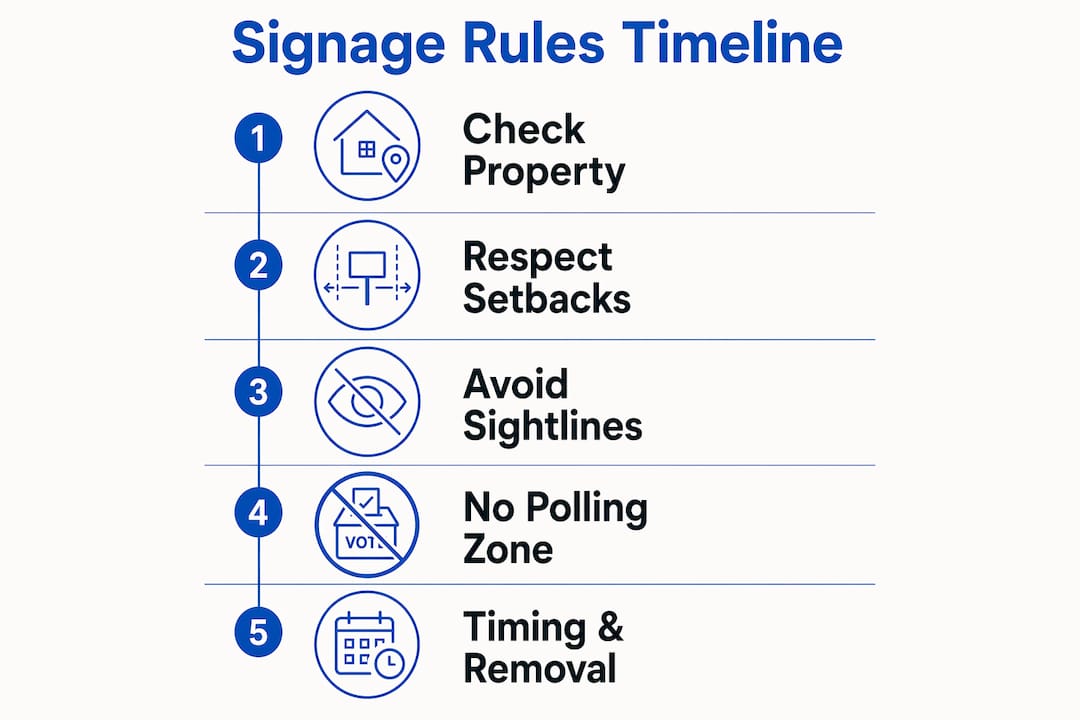
Campaign signage placement rules govern where, when, and how political signs can legally appear during U.S. elections. The core framework comes from the First Amendment, which protects political signs as free speech, but allows content-neutral time, place, and manner restrictions for safety and aesthetics. Here is what every candidate and campaign organizer needs to know before planting a single sign:
- Political signs are protected speech but subject to location, size, and timing restrictions.
- Public rights-of-way, including medians, sidewalks, and utility poles, are off-limits in most states.
- Polling places enforce buffer zones where signs are prohibited on Election Day.
- Private property placement requires the property owner’s express permission.
- Signs must be removed within a legally defined window after elections, or authorities will remove them at your expense.
- Violations can result in fines, immediate sign removal, and in some jurisdictions, criminal penalties.
What are the legal restrictions on campaign signs in public areas?
Placing a campaign sign on public land is one of the most common and costly mistakes campaigns make. Public rights-of-way include medians, sidewalks, highway shoulders, and utility poles. Signs placed there are illegal in virtually every state, and authorities can remove them without prior notice, billing the sign owner for all removal costs.
Michigan requires signs to be set back from the roadway edge on highways and from behind curbs, depending on road type. Texas law is equally direct: the Texas Department of Transportation removes any sign in the right-of-way without warning and charges all costs to the owner. Fort Collins, Colorado, enforces strict penalties for violations, including significant fines or possible jail time.
Signs also cannot block traffic sightlines at intersections or commercial driveways. No sign may be placed within limited-access freeway rights-of-way, including ramps. Local ordinances often add their own layer of restrictions on top of state rules, so checking with your city or county before placing any sign near a road is always the right move.
Pro Tip: Before placing signs near any roadway, contact your local department of transportation or city clerk’s office to confirm the exact setback distance required in your jurisdiction.
How do polling place rules restrict campaign signs on Election Day?
Buffer zones around polling places are among the most strictly enforced campaign signage regulations in the country. Iowa prohibits campaign signs within 300 feet of a polling entrance on Election Day, a rule that also applies to absentee and satellite voting sites during their operating hours. Vermont gives polling officers discretionary authority to manage sign placement at their sites.
The restrictions go beyond signs alone. 38 states ban campaign signs or materials at polling places on Election Day, and 21 states ban campaign apparel inside polling locations. This includes buttons, T-shirts, and other visible campaign materials. The legal basis traces to the Supreme Court’s recognition that states have a compelling interest in protecting voters from last-minute electioneering pressure.
Iowa’s rules also cover vehicles: a sign larger than 90 square inches on a vehicle parked within 300 feet of a polling entrance on public property is prohibited. These rules apply to both candidate campaigns and ballot issue campaigns under Iowa Code 68A.406.
Where can you legally place campaign signs on private property?
Private property is the primary and most legally secure location for campaign signs. You need the property owner’s or lessee’s express permission before placing any sign, and that permission should be documented in writing to avoid disputes later. Under Iowa Code, permitted locations include residential properties, leased apartments, condominiums, and campaign headquarters, but only within the space actually occupied or leased.
HOA rules add another layer. Some states allow HOAs to regulate the size, number, or placement of political signs, and a few permit HOAs to prohibit them outright. State law governs how much authority an HOA has, so the rules vary considerably. Fort Collins, for example, requires signs to be at least two feet from all property lines even on private land.
Local ordinances frequently cap the number of signs per property and limit their size. Reviewing your municipality’s land use code before a campaign begins saves time and avoids fines. For a practical overview of private property guidelines, Yardsigns has compiled placement guidance that covers the most common local restrictions.
Pro Tip: Always get written permission from property owners before placing signs. A simple signed form noting the address, sign count, and agreed removal date protects both the campaign and the property owner.
When do timing rules and removal deadlines apply to campaign signs?
Timing restrictions define both when signs can go up and when they must come down. Michigan mandates removal within 10 days after an election; signs removed by state crews are stored for seven days at a local maintenance garage and then discarded. Delaware allows signs in certain rights-of-way only during a window of 30 days before and 30 days after an election.
Minnesota takes a different approach: in even-numbered years, local sign ordinances cannot be enforced during a specified protected period. Fort Collins limits how long a sign can be displayed based on its material, with laminated paper signs capped at 45 days and inflexible vinyl signs at 60 days.
Failing to remove signs on time invites fines and removal at the campaign’s expense. Beyond the legal risk, signs left up long after an election reflect poorly on a candidate’s attention to detail and community respect. For more on how long signs can stay up, Yardsigns covers state-by-state timelines in detail.
What are the best practices for campaign signage compliance and maintenance?
Compliance does not happen by accident. Professional campaigns assign specific personnel to manage sign placement, upkeep, and removal, which limits the risk of fines and keeps the campaign’s public image clean. A digital map of all sign locations, updated as signs go up or come down, makes it far easier to track permissions and meet removal deadlines.
Weekly inspections catch damaged or fallen signs before they become violations. City officials recommend maintaining a sign location log and conducting regular checks throughout the campaign period. Strategic placement in high-visibility areas also pays off: research cited by the City of Glendora found that well-placed political signs correlate with an estimated increase of about 1.7 percentage points in local election vote shares.
Coordinating with local authorities before the campaign begins clarifies jurisdiction-specific rules and any permit requirements. For broader campaign planning strategies that complement your ground-level sign efforts, pairing physical signage with a coordinated digital approach strengthens overall visibility.
Pro Tip: Use weatherproof, UV-resistant signs to reduce replacements mid-campaign. A sign that fades or warps after one rainstorm costs you twice: once to replace it and once in the impression it leaves.
Do you need a permit to place campaign signs?
Permit requirements for campaign signage vary widely by municipality. Local governments may require permits for signs based on size, location, or illumination, provided the rules are content-neutral and apply equally to all sign types. Temporary election signs are often exempt from standard building permit requirements, as seen in Delaware’s county code, which exempts them from the general sign permit process.
The application process, where required, typically involves submitting a sign plan to the city’s planning or zoning department, paying a nominal fee, and agreeing to removal by a specified date. Some municipalities require permits only for signs above a certain square footage, such as the 32-square-foot threshold common in several jurisdictions. Always check with your city or county clerk before assuming a permit is not needed.
What rules apply to illuminated and digital campaign signs?
Illuminated and digital signs face stricter scrutiny than standard yard signs. Most municipalities regulate them under the same content-neutral framework that governs all temporary signage, but add specific rules around brightness, animation, and hours of operation. Digital signs that cycle through messages or display moving images are often prohibited in residential zones entirely, regardless of their political content.
Where electronic signs are permitted, local codes typically cap brightness in lumens to prevent light pollution and require automatic dimming after a certain hour. Some jurisdictions ban flashing or scrolling text on any temporary sign. Before investing in a digital display for a campaign, confirm with the local zoning office whether electronic signs are allowed in the target area and what technical specifications apply.
Key Takeaways
Campaign signage placement rules in the U.S. require candidates to secure property owner permission, respect public right-of-way prohibitions, observe polling place buffer zones, and remove signs within legally mandated timeframes after elections.
| Point | Details |
|---|---|
| Public right-of-way is off-limits | Signs on medians, sidewalks, and utility poles are illegal and subject to immediate removal at the owner’s expense. |
| Polling place buffer zones | Iowa prohibits signs within 300 feet of a polling entrance on Election Day; 38 states ban campaign materials at polls. |
| Private property requires permission | Written permission from the property owner or lessee is required before any sign goes up. |
| Removal deadlines are strict | Michigan requires removal within 10 days post-election; signs held by state crews are discarded after seven days. |
| Permits vary by municipality | Many jurisdictions exempt temporary election signs from standard permits, but size and illumination rules still apply. |

When your campaign signs need to hold up through rain, wind, and a full election cycle, Yardsigns delivers weatherproof, vibrantly printed signs with orders under 50 pieces shipped within 24 hours. Visit Yardsigns.com to design signs built to last and get your message in front of voters fast.
