


U.S. Buyers: Calculate Yard Sign Shipping Costs, Parcel/LTL Examples
Expect to pay shipping fees that vary for small orders of 1 to 10 yard signs, and lower per-sign costs for larger orders of 50 to 500 or more. Many vendors waive shipping for orders above a certain cart value threshold, and oversize or bulk pallet orders typically have separate freight pricing. Skip to the calculator below to run your own numbers against your exact order.
TL;DR:
- Shipping costs per sign decrease significantly as order quantity increases, with the highest per-unit costs for single signs due to box shipping constraints.
- Orders over 100 signs typically move to pallet freight, lowering per-sign shipping expenses even as total costs rise with distance and accessorial fees.
- Dimensional weight and box size matter more than actual weight, often inflating shipping costs for larger or bulkier signs, especially over 24 inches in any dimension.
- Shipping estimates vary based on carrier zone, packaging density, and service level, making it essential to use official rate tools for precise calculations.
- Planning orders at least three to five days ahead allows use of standard ground shipping, avoiding premium rush fees and reducing overall costs.
Table of Contents
- What Does a Yard Sign Order Actually Cost to Ship?
- What Factors Determine Shipping Cost for Yard Signs?
- How Do You Estimate Yard Sign Shipping Cost Step by Step?
- Which Shipping Method Fits Your Order?
- How Does Turnaround Time Affect Your Shipping Bill?
- How Can You Lower Your Yard Sign Shipping Costs?
- Why This Turnaround and Shipping Guidance Holds Up
- What Buyers Get Wrong About Yard Sign Shipping Costs
- Get an Instant Shipping Estimate From Yardsigns
- Where to Verify These Numbers Yourself
- Sources
What Does a Yard Sign Order Actually Cost to Ship?
The fastest way to understand yard sign shipping cost is to see it applied to real order sizes. Shipping rarely scales in a straight line. A single sign can cost more per unit to ship than a case of fifty, because carriers price by box, not by item, and a box holds a lot more signs than you’d think.
The examples below assume a standard 18 x 24 inch corrugated plastic sign with an H-stake, shipped ground to a single address in the contiguous United States. Alaska, Hawaii, and U.S. territories typically fall outside free-shipping offers and carry separate rates, a distinction several sign vendors bury in their fine print.
| Order size | Typical product cost | Typical shipping | Total | Cost per sign |
|---|---|---|---|---|
| 1 sign | $18–$25 | $10–$18 | $26–$35 | $26–$35 |
| 10 signs | $150–$180 | $0–$15 (often free over threshold) | $150–$195 | $13–$19 |
| 50 signs | $150–$450 | up to $45 (parcel, multi-box) | $150–$450 | $10–$14 |
| 100 signs | $150–$450 | $60–$150 (parcel or small pallet) | $150–$450 | $10–$13 |
| 500+ signs | $150–$450 | $150–$450 (LTL freight) | $150–$450 | $10–$18 |
A few things jump out once you line the numbers up side by side. Single signs get hit hardest per unit because a box that could hold five signs is shipping just one, and the carrier charges for the box’s dimensions regardless of what’s inside. Free-shipping thresholds change the math fastest at the 10 to 50 sign range, where crossing a $75 or $99 cart minimum can knock $10 to $20 off the total instantly.
That’s why some vendors publish flat-rate shipping tables tied directly to cart value rather than weight, so a $60 order might land in a $10 shipping tier while a $76 order jumps to free shipping, a structure you’ll see in published shipping policies across the sign industry. Bulk orders behave differently again once quantity pushes past 100 to 150 signs. At that point, many vendors switch from parcel carriers to palletized freight, and the per-sign shipping cost keeps dropping even as the raw dollar amount climbs. If you’re weighing whether a bigger order makes financial sense for a campaign or event, it’s worth reading how bulk yard sign orders change the economics before you commit to a quantity.
What Factors Determine Shipping Cost for Yard Signs?
Weight isn’t the main driver of what you pay to ship a yard sign. Dimensions usually matter more, because carriers bill by dimensional weight, a formula that calculates a “billable weight” from a box’s length times width times height, divided by a carrier-set divisor. A box of ten lightweight corrugated plastic signs can weigh nine pounds but get billed as if it weighs eighteen, simply because the box takes up more space than it weighs.
Several other variables swing your final shipping line item:
- Oversize triggers. Many carriers and vendors apply a surcharge once any single dimension crosses 24 inches, a threshold that catches larger yard signs and full-size H-stakes.
- Packaging density. Ten signs stacked flat in one box ship far cheaper per unit than ten signs boxed individually, so ask a vendor how they consolidate before you order.
- Parcel vs. pallet. Small counts move by UPS, FedEx, or USPS ground; once an order needs its own pallet, pricing shifts to LTL freight with different rules entirely.
- Shipping zone. A delivery to a neighboring state costs less than one crossing the country, and shipments to Alaska, Hawaii, or rural residential addresses often add a surcharge.
- Service level. Ground shipping is the budget default; two-day or overnight service can multiply the shipping line by two to four times.
Dimensional weight is the single most misunderstood factor in this entire equation. According to dimensional weight and packaging guidance from Printing Industries of America, packaging choices can raise a carrier bill even when the actual contents weigh very little, which explains why two vendors quoting the same physical signs can land on very different shipping numbers depending on how they box the order.
How Do You Estimate Yard Sign Shipping Cost Step by Step?
You don’t need a logistics degree to get within a few dollars of an accurate shipping estimate before you check out. Four steps get you there.
- Measure the packaged dimensions and weight. A single 18 x 24 inch corrugated sign with a metal H-stake typically packs into a box roughly 25 x 20 x 3 inches and weighs about 1.5 to 2 pounds. Ten of those signs might pack into a box around 26 x 20 x 10 inches, weighing 12 to 15 pounds.
- Multiply by quantity and pick a shipping mode. Under roughly 50 signs, plan on standard parcel boxes. Past that, many vendors consolidate into two or three larger boxes, and orders in the hundreds usually move to a pallet.
- Look up the carrier zone or run the vendor’s calculator. Enter your ZIP code, the package weight, and dimensions into a carrier’s official rate tool, or enter your cart total and delivery address into the vendor’s residential quote walkthrough on-site estimator. Official carrier rate tools give you the most precise, zip-specific number when you want to double-check a vendor quote.
- Add handling, oversize, and insurance, then round up. Oversize fees, signature-required delivery, and rush handling can add $5 to $25 per shipment. Round your estimate up rather than down.
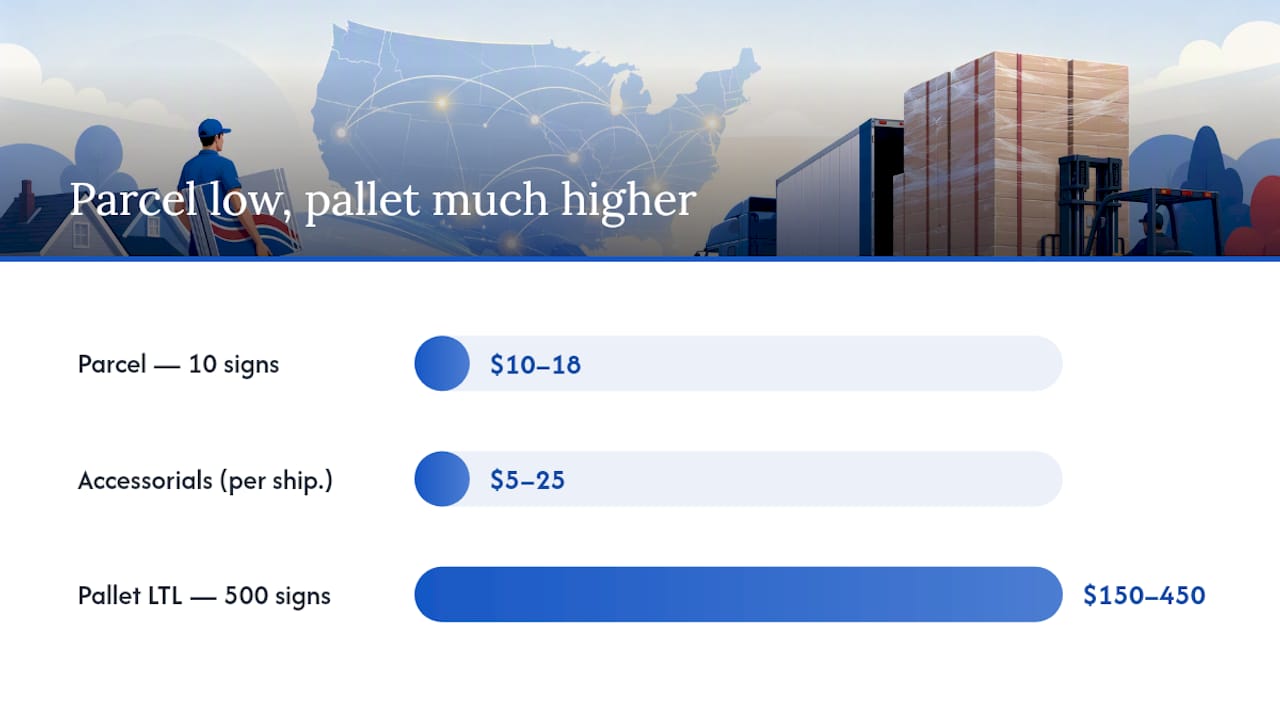
Here’s the math worked out for two common scenarios. A parcel order of 10 signs at roughly 13 pounds billable weight, shipping ground within a two- to three-zone radius, typically lands between $10 and $18. A pallet order of 500 signs, weighing an estimated 700 to 900 pounds once palletized, moves via LTL freight and typically runs $150 to $450 depending on distance, liftgate requirements, and residential delivery fees.
Pro Tip: If your estimate comes out higher than you expected for an order over 100 signs, call the vendor and ask for a custom freight quote before checkout. LTL pricing depends on accessorial fees, like liftgate service or a residential address, that most online calculators can’t factor in automatically.
Vendors that handle custom printed products often publish shipping matrices that scale with cart value and include separate expedited tiers, similar to the tables Woodland Manufacturing publishes for custom signage. When your order doesn’t fit neatly into a standard tier, a custom quote request is always worth the extra five minutes.
Which Shipping Method Fits Your Order?
The right shipping method depends almost entirely on how many signs you’re moving and how fast you need them.
- Parcel carriers (UPS, FedEx, USPS). Best for orders under roughly 50 signs. You get door-to-door tracking, predictable transit windows, and moderate cost, though dimensional weight can push prices up on bulky, lightweight boxes.
- LTL freight and pallet delivery. Best for large runs, typically 100 signs and up. Per-sign shipping cost drops sharply, but expect accessorial charges like liftgate service, inside delivery, or residential surcharges that a parcel shipment never triggers.
- Regional or same-day couriers. Useful when a campaign launch or event is days away and you’re within a limited delivery radius. Cost runs noticeably higher than ground shipping, and availability depends on your ZIP code.
- Vendor flat-rate or promotional shipping. Worth checking every time. A flat $10 to $15 delivery fee can beat carrier-calculated rates on mid-size orders, but read the exclusions. Free-shipping promotions almost always apply only to the contiguous United States and often exclude oversize signs or expedited service.
If your event schedule leaves no room for a two-day freight transit, a regional courier or expedited parcel service closes that gap. Just budget for the premium; same-day and next-day service rarely comes cheap.
How Does Turnaround Time Affect Your Shipping Bill?
Production speed and shipping speed are two separate costs that stack on top of each other, and mixing them up is where most first-time buyers get surprised at checkout. Orders under 50 signs frequently leave the print shop within 24 hours, while larger runs of 50 to 500 or more typically need one to three production days before they ever reach a carrier.
Here’s where the cost multiplies. If you need fast production and fast shipping, you’re paying two separate premiums stacked together, since expedited shipping only shortens the transit leg, not the printing leg. A rush order that skips both queues can easily double or triple your total delivery cost compared to standard ground shipping on a normal production timeline.
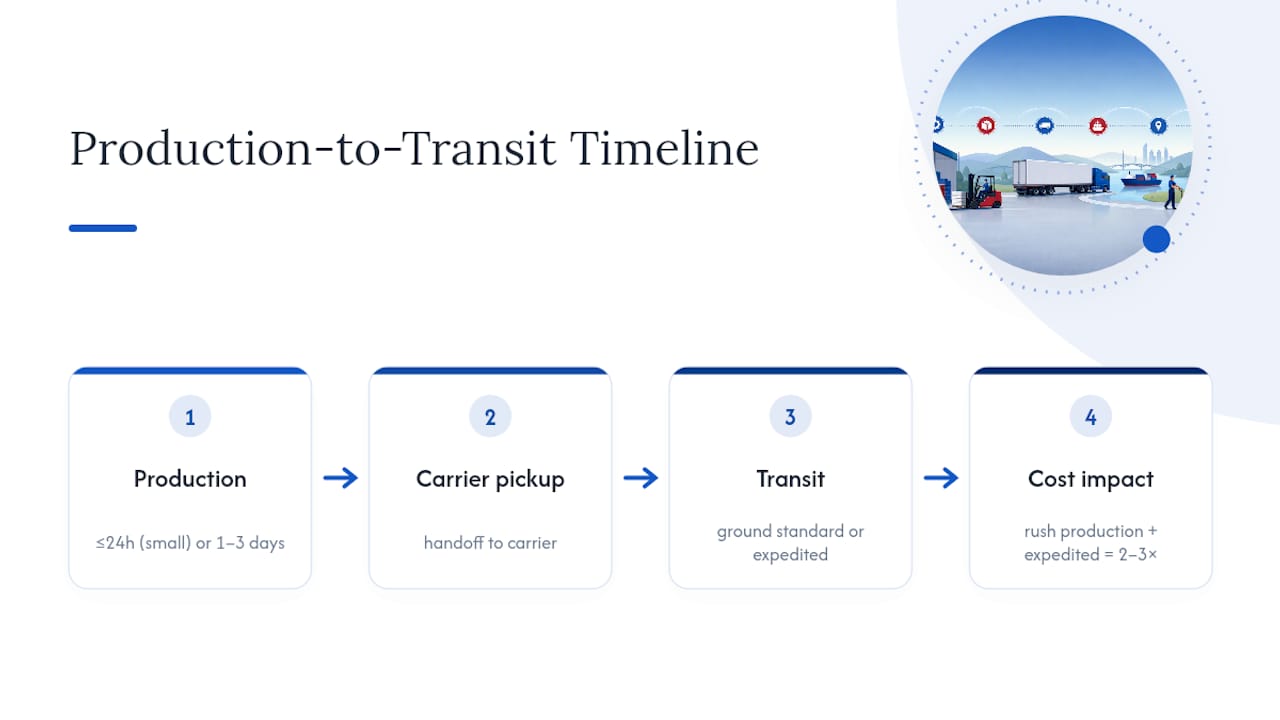
The fix is simple scheduling. If you can place your order even three to five days before you need signs in hand, standard ground shipping on a normal production run gets you there without paying rush premiums on either end. Political campaigns and event planners who order early consistently pay less per sign delivered than those placing last-minute rush orders, simply because they’re not compressing two cost curves into one.
How Can You Lower Your Yard Sign Shipping Costs?
A handful of practical moves can meaningfully cut what you pay to get signs delivered, without touching print quality or turnaround.
- Ship to one address. Consolidating delivery avoids paying multiple parcel fees for the same order split across locations.
- Hit the free-shipping threshold. If your cart sits just under a $50 or $99 cutoff, adding a few more signs can cost less than the shipping fee you’d otherwise pay.
- Choose ground shipping and order early. Ground is almost always the cheapest service level, and planning ahead removes any need for rush surcharges.
- Ask about packaging consolidation. Vendors that pack signs densely into fewer boxes pass dimensional-weight savings on to you, especially on orders of 20 or more.
- Request a pallet quote for large runs. Once you’re past 100 to 150 signs, LTL freight almost always beats parcel pricing per unit.
- Check for local pickup. If a vendor offers pickup near you, it eliminates the shipping line entirely.
Pro Tip: Before finalizing a bulk order, ask the vendor directly whether combining your order with a colleague’s or a neighboring campaign’s shipment to the same address is possible. Splitting one consolidated shipping charge across two orders is one of the simplest discounts nobody advertises.
Why This Turnaround and Shipping Guidance Holds Up
Yardsigns builds its shipping guidance around what actually happens in production, not around theoretical carrier math. Orders under 50 pieces typically ship within 24 hours, a turnaround documented on the site’s Delivery Express page, which matters because production speed is the half of the “total lead time” equation that most shipping calculators ignore entirely.
Material choice also shapes your shipping cost more than most buyers realize. Corrugated plastic signs are light and pack flat, which keeps dimensional weight low on multi-sign orders. Aluminum signs weigh more and pack differently, which can shift a mid-size order from a standard parcel rate into a slightly higher tier. Knowing your material before you request a quote lets you compare apples to apples across shipping options.
For orders that don’t fit the standard 24-hour window, whether that’s a run of 500 signs for a county-wide campaign or an order headed to a non-contiguous state, the right move is requesting a custom shipping quote directly rather than trusting a generic online calculator. A quote built around your actual quantity, material, and destination catches accessorial fees, like liftgate or residential delivery charges, that a flat estimator tool will miss. If you’re timing an order around a specific event date, it’s worth reading how orders under 50 signs ship within 24 hours before you build your production schedule backward from a deadline.
What Buyers Get Wrong About Yard Sign Shipping Costs
Most budgeting advice on yard sign shipping treats it like a fixed carrier problem: enter a weight, get a rate, done. That misses the bigger lever. Production speed and shipping speed compound each other, and the buyers who overpay are almost always the ones who let a tight deadline force expedited service on both ends at once, rather than planning even a few days ahead to use standard ground shipping.
The conventional wisdom also overstates weight and understates packaging. Dimensional weight, not the scale reading, decides most parcel shipping bills on sign orders, and that’s a detail carrier-side calculators explain clearly but vendor marketing rarely mentions. If there’s one number worth checking before every order, it’s the free-shipping cart threshold. Crossing it by adding a sign or two routinely beats any other single cost-saving move on this list.
My take: run the math yourself using the four-step estimate above before you trust any single quote, and treat a vendor’s stated 24-hour production window as a scheduling tool, not just a marketing line. It’s the difference between paying rush premiums twice and paying them never.
— YardSignGuy
Get an Instant Shipping Estimate From Yardsigns
Yardsigns cuts total lead time by handling production fast, so you can choose standard ground shipping instead of paying rush premiums on both ends. Orders under 50 pieces typically leave production within 24 hours, larger runs ship in one to three days, and every order includes free design proofs, unlimited revisions, and metal H-stakes at no extra charge.
For a precise number before you commit, use the Delivery Express page to check expedited options, or request a custom freight quote if you’re ordering in bulk for a campaign or county-wide event. Planning a fundraiser, a graduation announcement, or an employee recognition event? Start with a product page like the special event congratulations sign to see live pricing and shipping totals before you place your order.
Where to Verify These Numbers Yourself
The examples and figures in this guide draw on published vendor shipping tables and industry packaging standards, not guesswork. Check these directly if you want to verify a rate before ordering:
- Delivery Express — Yardsigns’ rapid-turnaround delivery option and where to request a custom quote.
- Sign Store’s shipping policy — an example of a cart-value based flat-rate shipping table.
- Woodland Manufacturing’s shipping page — a published shipping matrix showing how rates scale with order size.
- Printing Industries of America — background on dimensional weight and packaging standards that affect carrier billing.
- Signs.com — an example of geographic exclusions common in free-shipping offers.
