


Order Compliant Yard Signs Fast: U.S. HOA Rules and 4mm 18×24 Checklist
For most orders, the safe default is 4mm corrugated polypropylene at 18"×24" on a 9-gauge H-wire stake, printed with UV-cured ink. That combination handles wind, sun, and handling for most campaigns, listings, and events. Bump up to 6mm or aluminum only if you need multi-season durability, and lean on fast small-batch shipping when your timeline is tight. Get the material and stake right first; the rest of your order follows from there.
TL;DR:
- Most yard signs use 4mm corrugated polypropylene printed with UV-cured ink, lasting 6 to 12 months outdoors unless exposed to harsh conditions.
- Sign size should match traffic speed: 18"×24" for neighborhoods, 24"×36" for busy roads, and 12"×18" for directional markers.
- Design must include large headline text and high contrast while limiting elements to maintain legibility at speed.
- Use 9-gauge H-wire stakes for most signs, verifying flute orientation to ensure proper fit and stability.
- Ordering in stages—test with a small batch before bulk production—helps avoid costly mistakes and meet tight deadlines.
Table of Contents
- Choosing the Right Yard Sign Material: Coroplast, Aluminum, or Composite
- Picking the Right Sign Size for Where It Will Stand
- Design Rules That Actually Improve Legibility
- Matching Stakes and Hardware to Your Installation
- Planning Your Order: Turnaround, Batches, and Quantity Strategy
- How Long Different Yard Sign Materials Actually Last
- Your Pre-Order Checklist Before You Hit Checkout
- Common HOA Restrictions You Should Plan Around
- Legal Considerations Beyond the HOA Rulebook
- What Happens When a Sign Violates HOA Rules
- How to Request Approval for a Yard Sign
- Keeping Yard Sign Messaging Respectful in an HOA Community
- A Quick Note From YardSignGuy
- Order Signs That Hold Up, No Matter What Your HOA Allows
- Sources
- FAQ
Choosing the Right Yard Sign Material: Coroplast, Aluminum, or Composite
Corrugated polypropylene, better known as Coroplast, is the workhorse of the yard sign world, and 4mm is the thickness most buyer guides recommend for real estate, political campaigns, and contractor advertising. It’s light enough to ship cheap and stiff enough to survive a windy weekend on a stake.
Coroplast is not one product; it’s a family of thicknesses, each suited to a different job. Here’s how to think about it:
- 3mm works for a single weekend event, a yard sale, or an open house you’ll take down in a day or two.
- 4mm is the everyday standard, built for campaigns and listings that need to survive weeks or months outdoors.
- 6mm holds up in high-wind corridors or when a sign needs to last through multiple seasons without warping.
Aluminum and aluminum composite panels (ACM) cost more upfront, but they’re the right call for permanent business signage or multi-year installations where replacing a faded plastic sign every few months would cost more in the long run.
Statistic to know: Corrugated plastic printed with UV-cured inks and UV-stabilized resin typically holds its color and rigidity for 6 to 12 months outdoors, which covers the lifespan of almost any single campaign or listing cycle.
Picking the Right Sign Size for Where It Will Stand
Size decisions come down to one question: how fast is traffic moving past your sign, and from how far away does it need to be read? Industry sizing guidance treats 18"×24" as the default residential size, and for good reason.
- 18"×24" is the standard for yard placements, neighborhood streets, and driveways. It’s easy to stake, easy to store, and readable from a normal walking or slow-driving distance.
- 24"×36" earns its higher price on arterial roads and busier intersections, where cars pass at 30 to 45 mph and need a bigger canvas to register a message in a few seconds.
- 12"×18" directional signs work best in clusters, guiding traffic toward an open house or event entrance with arrows and short text.
Message length and sign size are linked. A bigger sign lets you use larger letters, but it doesn’t excuse a wordier message. If your sightline is short (a corner lot, a curve, heavy landscaping) size up before you add more text.
Design Rules That Actually Improve Legibility
A sign that looks great on your monitor can be unreadable at 35 mph. Follow these production rules before you approve a proof:
- Set headline text at 4 to 5 inches tall. Anything smaller disappears past 50 feet.
- Keep phone numbers and web addresses between 1.5 and 2 inches. These are almost always the second thing a driver tries to read, so they need to survive a quick glance.
- Limit the design to about four elements total (headline, one supporting line, a logo, and a phone number or URL). Extra logos and long taglines hurt performance more than they help; simplicity reads faster than clutter.
- Hold a safe margin around the edges so nothing important gets trimmed during cutting.
- Aim for strong contrast, roughly 70% luminance contrast between text and background. Dark text on white or yellow, or white text on navy or forest green, both perform well in direct sun.
Pro Tip: Always request a digital proof and check the safe area before you approve printing. A five-minute review catches cropped logos and washed-out color combinations that are expensive to fix after the run is printed.
Matching Stakes and Hardware to Your Installation
The right sign on the wrong stake still fails. 9-gauge H-wire stakes are the standard choice for residential lawns and driveways, they’re cheap, quick to install, and strong enough for typical soil.
- H-wire stakes fit most 4mm coroplast signs and work well for yards, storefronts, and open houses.
- Step stakes or spiral stakes grip harder soil and resist wind better, making them the better call for roadside placements or exposed corners.
- Frames or permanent mounts make sense for business signage that stays up year after year; in these cases, order sign blanks separately and mount them once.
Flute direction matters more than most first-time buyers realize. Coroplast’s internal channels run in one direction, and stakes only slide in cleanly along the flute line. Confirm flute orientation when you order, especially for double-sided signs, so your stakes actually seat correctly. To cut down on bending and theft, ask for reinforced corners and set stakes deep enough that a stiff wind or a curious passerby can’t easily pull the sign loose.
Planning Your Order: Turnaround, Batches, and Quantity Strategy
Timing drives more sign orders than any other factor, especially for candidates and event organizers working against a fixed date. Small orders under 50 signs typically ship within 24 hours, which matters when a campaign pivots message or a listing needs signage by the weekend. Larger runs generally take one to three production days.
A smarter approach than ordering everything at once: stage your quantities.
- Start with a sample run of 25 to 50 signs to test placement, message, and visibility in real conditions.
- Once you know what’s working, place a larger bulk order, often 100 to 200 signs, for the final push. Bulk runs lower your per-unit cost significantly.
- For events or rolling campaign launches, consider staging deliveries so signs arrive as you need them rather than sitting in storage.
Before checkout, confirm the proof policy, how many revisions are included, and how the order will be packaged for shipping. A supplier that’s vague on any of these three points is a supplier you should keep shopping past.
How Long Different Yard Sign Materials Actually Last
Lifespan expectations should shape your material choice from the start, not surprise you six weeks in.
- 3mm coroplast: 3 to 4 months, fine for a single event or shortlisting window.
- 4mm coroplast: 6 to 12 months, the sweet spot for most campaigns and real estate signage.
- 6mm coroplast: 12 to 18-plus months, worth it for high-traffic or multi-season placements.
- Aluminum and ACM: 5 or more years, the right investment for permanent business signage.
Coastal salt air, intense UV exposure, and constant wind all shorten these ranges. If your sign faces any of those conditions, lamination or a heavier substrate is worth the added cost.
Your Pre-Order Checklist Before You Hit Checkout
Run through this list before finalizing any order, especially a large or time-sensitive one:
- Confirm size, material, and thickness match your placement and timeline.
- Decide single-sided or double-sided printing based on how traffic approaches the sign.
- Specify stake holes or H-wire slots, and confirm flute orientation.
- Submit your file in the format your printer requests, and ask for a digital proof before production starts.
- Ask directly about UV-cured inks, sample availability, and how the order ships.
- Confirm reprint or return terms in case of a printing error.
Walk away from any supplier that won’t send a proof, can’t describe material specs clearly, or gives a vague turnaround promise instead of a number.
Common HOA Restrictions You Should Plan Around
Homeowners associations across the country regulate yard signs closely, and the restrictions tend to follow a few recurring patterns. Most HOAs cap how long a sign can stay up, often tying real estate signs to the listing period and political signs to a window before and after an election. Many associations also restrict where a sign can sit on the property, commonly banning placement near sidewalks, common areas, or within a set distance of the curb.
Sign type limitations are just as common. Some communities allow only one sign per lot at a time, or limit signage to specific categories like real estate, security, or political speech while banning commercial advertising outright. Size restrictions frequently show up too, with many HOAs capping dimensions well below the 24"×36" size that works well on a busier road, which is worth checking before you order a larger format for a property inside a managed community.
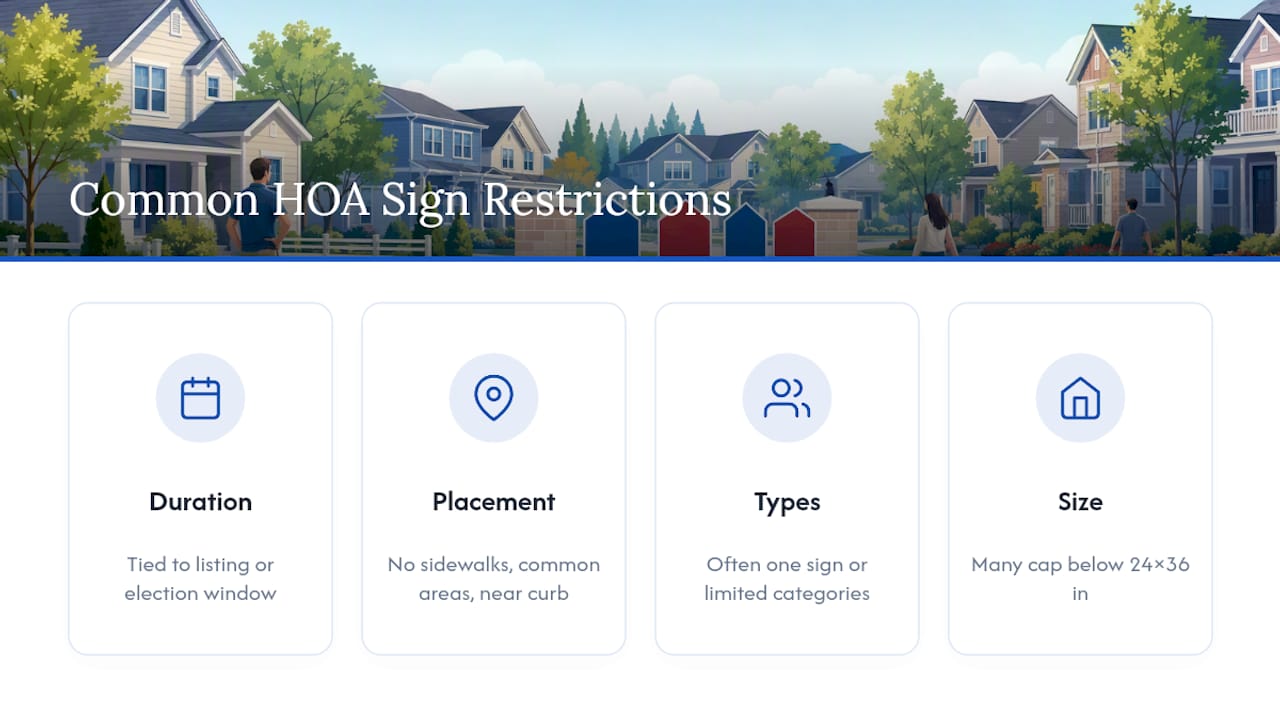
Because these rules vary by association and are usually spelled out in the community’s covenants, conditions, and restrictions (CC&Rs), the only reliable way to know your exact limits is to read that governing document or ask your HOA board directly. Treat any generic list of “typical HOA rules” as a starting point for questions, not a substitute for your own community’s paperwork.
Legal Considerations Beyond the HOA Rulebook
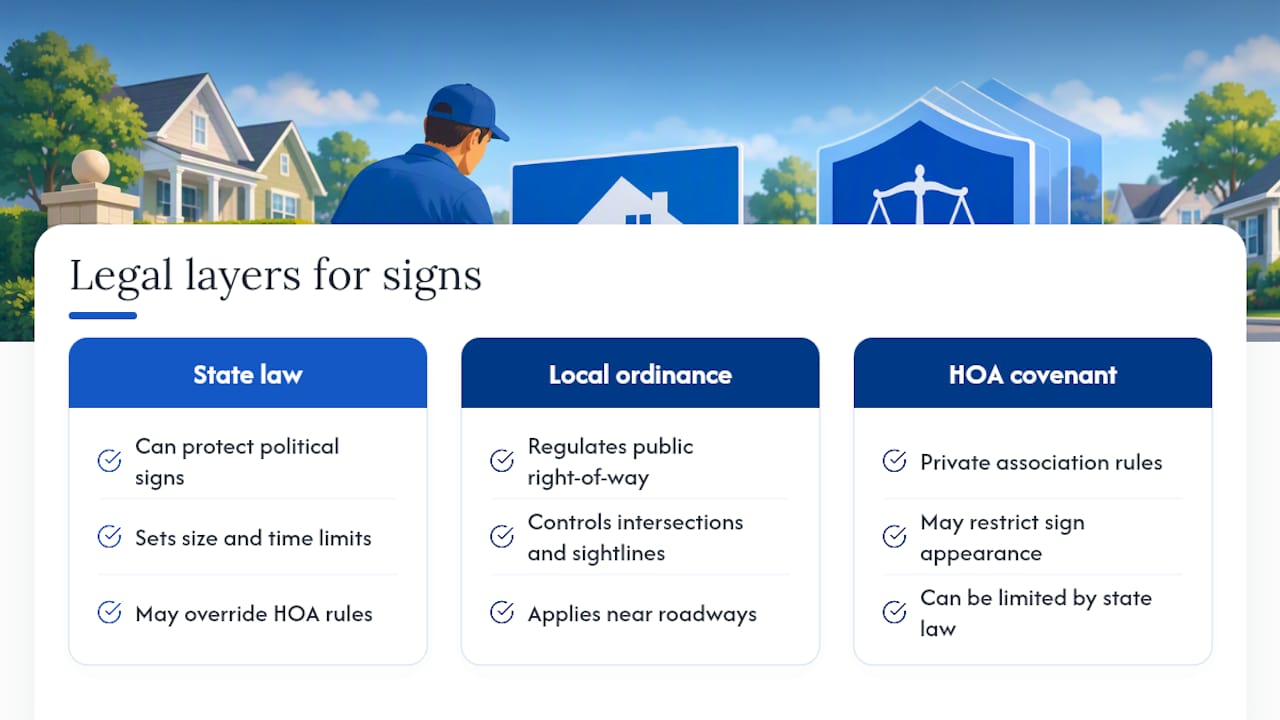
HOA covenants don’t operate in a vacuum. State and local laws sometimes override or limit what a private association can restrict, particularly around political speech. Some states have passed laws protecting a homeowner’s right to display political signs within certain size and time limits, regardless of what an HOA’s internal rules say.
Municipal sign ordinances add another layer. City and county governments often regulate signage on public right-of-way, at intersections, and near roadways, separate from anything your HOA controls. A sign that satisfies your HOA’s rules could still violate a city ordinance if it sits too close to a street corner or intersection sightline. For a broader look at how placement laws work outside HOA communities, this guide to roadside sign legality breaks down the public-property side of the equation.
When state law, local ordinance, and HOA covenant appear to conflict, the safest move is asking your board or a local attorney which rule actually governs your situation rather than guessing. Political candidates and campaign volunteers, in particular, should verify sign timing rules before a big placement push, since violating a state-protected right to political speech is a different problem than violating an HOA’s internal preference.
What Happens When a Sign Violates HOA Rules
Most associations follow a predictable escalation path rather than jumping straight to punishment. The typical sequence starts with an informal notice, often a letter or a knock on the door, asking the homeowner to remove or relocate the sign. If the sign stays up past the notice period, many HOAs move to a formal written violation, sometimes referencing the specific CC&R section that’s been violated.
Fines are the most common enforcement tool beyond that point, and they can escalate if the violation continues or repeats. Some associations reserve the right to remove a noncompliant sign themselves and bill the homeowner for the cost, which is worth knowing before you assume a sign will simply sit until you get around to taking it down. In more serious or repeated cases, an HOA’s governing documents may allow further action, including liens in extreme circumstances, though that outcome is rare for a first-time sign violation.
The practical lesson: respond to the first notice. Ignoring an HOA’s first letter is what typically turns a quick fix into fines, and fines are what turn a minor sign issue into a genuine dispute with your association.
How to Request Approval for a Yard Sign
Many HOAs require a simple review before a sign goes up, even for signs that seem clearly permitted under the community’s rules. Start by reading the CC&Rs or architectural guidelines to see whether your sign category needs prior approval or just needs to comply with posted limits.
If approval is required, most associations want a written request describing the sign’s size, placement, duration, and purpose, sometimes with a photo or sketch of exactly where it will sit on the property. Submitting this to the board or architectural committee in writing, rather than asking verbally, creates a record you can point to if a dispute comes up later. Build in lead time. Boards that meet monthly can take weeks to respond, so a last-minute request risks missing your placement window entirely.
Ask specifically what happens if your request is denied and whether there’s an appeal process. Some communities allow temporary exceptions for real estate or event signage even when standard rules are stricter, but that flexibility usually has to be requested, not assumed.
Keeping Yard Sign Messaging Respectful in an HOA Community
A sign that’s technically compliant can still create friction with neighbors, and that friction often causes more headaches than the HOA rulebook does. Political signage is the clearest example: keeping messaging factual and avoiding personal attacks on other residents or candidates tends to keep disputes limited to the association rather than escalating into neighbor conflict.
Placement matters as much as wording. Keeping a sign fully on your own property, away from shared walkways, mailboxes, and sightlines at corners, respects both the HOA’s likely restrictions and your neighbors’ daily routines. Removing signs promptly once their purpose ends, whether that’s an election, a closed listing, or a finished event, signals good faith to a board that might otherwise start watching your property more closely.
For real estate agents and political campaigns working across multiple properties in the same community, consistency helps. Using the same sign design and placement approach at every home reduces the odds that one homeowner’s sign becomes an outlier a board decides to flag first.
A Quick Note From YardSignGuy
I’ve heard the same story from more than one campaign volunteer: a printer promised a rush order, then delivered late, wasting the whole run. A small sample batch before the big push isn’t caution, it’s how you avoid finding out your color or size choice was wrong after 200 signs are already printed.
Pro Tip: Whenever your timeline allows it, stake one finished sign at the actual location before you finalize the full order. Seeing it in real light, at real distance, catches problems no screen proof ever will.
— YardSignGuy
Order Signs That Hold Up, No Matter What Your HOA Allows
Once you know your size, material, and placement rules, the only thing left is getting signs made fast enough to matter. Many yard sign suppliers offer shipping of most small orders within 24 hours, so a campaign pivot or a last-minute HOA approval doesn’t necessarily cost you your placement window.
Many services provide a free digital proof with multiple revisions, so you can check letter size, contrast, and safe margins before anything goes to print, reducing the chance that your design won’t read well from the street. Whether you need a handful of signs for one listing or a staged rollout for a full campaign, the custom yard signs lineup covers single orders and the bulk yard signs collection handles staged quantity runs at a lower per-unit cost. Start with a sample batch, confirm your placement works within your HOA’s rules, then scale up before your deadline arrives.
FAQ
What size yard sign is standard for most uses?
18"×24" is the standard size for residential placements, driveways, and neighborhood streets, and it fits standard H-wire stakes without extra hardware. Size up to 24"×36" only for busier roads where drivers need more distance to read your message.
How long does a 4mm coroplast sign last outdoors?
A 4mm corrugated polypropylene sign typically holds up for 6 to 12 months outdoors when printed with UV-cured inks. Coastal salt air, intense sun, or constant wind exposure can shorten that range.
Can my HOA ban yard signs entirely?
Most HOAs can restrict sign size, placement, timing, and type through their CC&Rs, but outright bans on certain categories, particularly political signage, sometimes conflict with state law protections. Check your specific covenants and any state statute on political sign rights before assuming a full ban is enforceable.
How fast can I get yard signs if my HOA just approved my sign request?
Orders under 50 signs typically ship within 24 hours through Yardsigns.com, which helps when HOA approval comes through close to your placement deadline. Larger bulk runs generally take one to three production days.
What stake should I order with my sign?
A 9-gauge H-wire stake is the standard choice for most residential lawns and works with the majority of 4mm coroplast signs. Confirm your sign’s flute orientation when ordering, since stakes only slide in cleanly along the flute direction.
