


Political Yard Sign Sizes: Match 18×24 or 24×36 to Road Speed, Ship in 24 Hours
The industry standard for political yard signs is 18"×24" (sometimes printed as 24"×18"), and that size works for most residential lawns and neighborhood streets. Bump up to 24"×36" or larger when your sign faces a busy arterial road, a highway on-ramp, or any spot where drivers only get a two-second glance. Durability comes down to material choice, mainly 4mm corrugated plastic, paired with the right stake for the ground you’re planting it in.
TL;DR:
- Signs placed on busy roads should be at least 24 by 36 inches to ensure visibility and readability at higher vehicle speeds.
- Using 4mm corrugated plastic with UV-resistant inks and proper stakes dramatically increases the sign’s durability across different weather conditions.
- Keep the candidate’s name in a large, high-contrast font of 4 to 5 inches tall to maximize legibility from a typical three-second glance while driving.
- Order a small batch of 25 to 50 signs initially to test placement and design effectiveness before committing to larger quantities for final deployment.
- Optimal placement involves setting signs 18 to 24 inches off the ground with a slight angle facing away from traffic to resist wind and prevent toppling.
Table of Contents
- What Are the Common Political Yard Sign Sizes?
- How Big Should the Letters Be on a Yard Sign?
- What Material Makes the Best Political Yard Sign?
- What Hardware and Placement Keep a Yard Sign Standing?
- How Many Political Yard Signs Should You Order?
- How Do You Design a Political Sign People Will Remember?
- Why These Sizing Recommendations Actually Hold Up
- Order Your Campaign Signs at the Right Size, Fast
- Where This Sizing Guidance Comes From
- Sources
What Are the Common Political Yard Sign Sizes?
Not every yard, intersection, or campaign budget calls for the same board. Printers generally offer a handful of go-to political sign sizes, and each one earns its place for a different reason.
- 12"×18": A compact option, best for tight spaces like flower beds, small yards, or clustered volunteer displays where several signs sit side by side.
- 12"×24": A narrow, elongated shape that works well along fence lines or driveways where width is limited but you still want horizontal presence.
- 18"×24": The workhorse. This is the industry standard size for residential lawns and low-speed neighborhood streets, and it’s what most campaigns order first.
- 24"×36": Twice the surface area of the standard, ideal for corner lots, busier collector streets, or anywhere you need extra punch from farther away.
- 36"×48" and up: Reserved for high-traffic arterial roads, major intersections, or highway frontage where drivers are moving fast and reading time is short.
Orientation matters almost as much as size. A landscape layout (wider than tall) tends to read faster at a glance, which is why most campaign signs default to that shape. Portrait signs can work in narrow gaps between shrubs or mailboxes, but they usually sacrifice some line width for the headline text. Match the shape to the site before you match it to your design template. A sign that’s perfect on paper but wedged sideways into a hedge does nobody any favors on Election Day.
How Big Should the Letters Be on a Yard Sign?
Sign size only matters if people can actually read it while driving by, and that comes down to letter height, not board dimensions. Legibility roughly corresponds to the size of the letters relative to viewing distance.
Readability Snapshot: On a standard 18"×24" sign, headline letters of 4 to 5 inches tall stay legible at typical neighborhood driving speeds of 25 to 35 mph. Drop below that and your candidate’s name becomes a blur by the time a driver’s eyes reach the mailbox.
A few practical guidelines follow from that math:
- Keep the candidate’s last name as the single largest element on the sign; that’s the piece voters need to retain.
- Limit total word count to five or six words, including the office being sought.
- Reserve smaller text (2 inches or less) for supporting details like a website or party affiliation, since drivers rarely have time to read past the headline.
- For faster roads, don’t shrink the letters to fit more copy. Move up to a bigger board instead so the type size stays intact.
This is the part campaigns get wrong more than any other. A sign packed with a slogan, a website, three endorsements, and a photo might look impressive on a laptop screen, but at 30 mph it reads as noise. Simplicity wins the roadside test every time.
What Material Makes the Best Political Yard Sign?
Weather is the real opponent here, not the opposing campaign. Rain, wind, and UV exposure will wear down a cheap sign long before Election Day, which is why material selection deserves as much attention as size.
- 4mm corrugated polypropylene is the go-to standard for campaign signage. It’s rigid enough to hold its shape in wind, light enough to install quickly, and priced to make ordering in bulk realistic.
- Single sided printing costs less and suits signs viewed from one direction, like along a fence facing a single street.
- Double sided printing roughly doubles visibility for corner lots and median placements where traffic approaches from two directions, and most printers price it as a modest up charge rather than a full second sign.
- UV resistant inks keep colors from fading over weeks of sun exposure, which matters most for campaigns running signs from late summer through November.
- Lamination adds another layer of scratch and moisture resistance, useful in regions with heavy rain or high humidity during campaign season.
Skip the flimsy poster board or standard cardstock options sometimes sold as a cheaper alternative. They’ll survive a dry weekend and collapse in the first real storm, which means reprinting costs that eat any savings twice over.
What Hardware and Placement Keep a Yard Sign Standing?
A great sign on the wrong stake is still a sign lying face down in the grass by Tuesday morning. Hardware choice depends almost entirely on where the sign is going.
- Use H-wire stakes for standard lawn placements. These lightweight wire frames slide into the sign’s bottom slots and push easily into soft residential turf.
- Switch to step stakes or driven anchors for road-facing or high-wind spots. Roadside locations get more wind exposure and more foot and mower traffic, so a sturdier anchor prevents leaning or toppling.
- Set the sign back at least a few feet from the curb to avoid mower damage, snowplow contact in colder climates, and any conflict with a city’s right-of-way rules.
- Install at a height where the sign’s bottom edge sits roughly 18 to 24 inches off the ground, keeping the headline text at typical eye level for a passing driver.
- Check sightlines before finalizing placement. A sign tucked behind a mailbox or overgrown shrub defeats the purpose no matter how well it’s designed.
For guidance on stake selection by ground type, a wire stake guide walks through the differences in more depth. If you’re mounting a larger display sign on a pole rather than ground stakes, flagpole footing basics cover the anchoring principles that carry over.
Pro Tip: Push stakes in at a slight angle facing away from the road. It adds resistance against wind gusts coming from passing traffic and cuts down on signs getting knocked flat overnight.
How Many Political Yard Signs Should You Order?
Ordering strategy is a numbers game, and getting the sequence right saves both money and headaches. Most campaigns run a phased approach rather than committing to one giant order upfront.
- Start with 25 to 50 signs to test placement locations, gauge community response, and confirm your design reads well in the field before scaling up.
- Order 100 or more once you’ve validated the design and want broader neighborhood coverage heading into the final weeks.
- Bulk pricing drops the per unit cost significantly at higher quantities, so a second order of 100+ often costs less per sign than the initial test batch.
- Turnaround varies by order size. Small runs under 50 pieces can ship within 24 hours with the right printer, while larger bulk orders typically need a few more days for production.
- Always check the digital proof before approving. Look for correct spelling, sufficient contrast between text and background, proper margins so nothing gets cut off in trimming, and stake slot alignment matching your chosen size.
Skipping the proof step is the single most common reason campaigns end up paying for a reprint. A five-minute review catches nearly every costly mistake before it hits production. For a full walkthrough of the ordering process, see how to get political yard signs for a step-by-step breakdown.
How Do You Design a Political Sign People Will Remember?
Name recognition wins local races more often than clever slogans do, and your sign’s layout should reflect that priority above everything else.
- Put the candidate’s name in the largest text on the board. Office or position comes second, sized noticeably smaller.
- Treat a slogan as optional. If it competes with the name for visual weight, cut it.
- Choose high contrast color combinations, dark text on a light background or the reverse, since low contrast pairings (like red on blue) can blur together from a moving car.
- Leave clear space around the edges. Text crammed to the border looks cluttered and loses impact fast.
- Save photos and imagery for mailers or digital ads. On a yard sign, a headshot usually shrinks the name text and hurts legibility rather than helping recognition.
Pro Tip: Print a full size mockup on regular paper and tape it to a wall or fence, then walk 30 feet away. If the name isn’t instantly readable from there, the text needs to grow before you finalize the order.
More detailed layout examples live in this design tips guide built specifically for campaign signage.
Why These Sizing Recommendations Actually Hold Up
Most sizing advice out there treats every yard sign the same, as if a corner lot on a four lane road and a quiet cul de sac call for identical dimensions. They don’t, and that oversimplification is where campaigns waste money on reprints and underperforming placements.
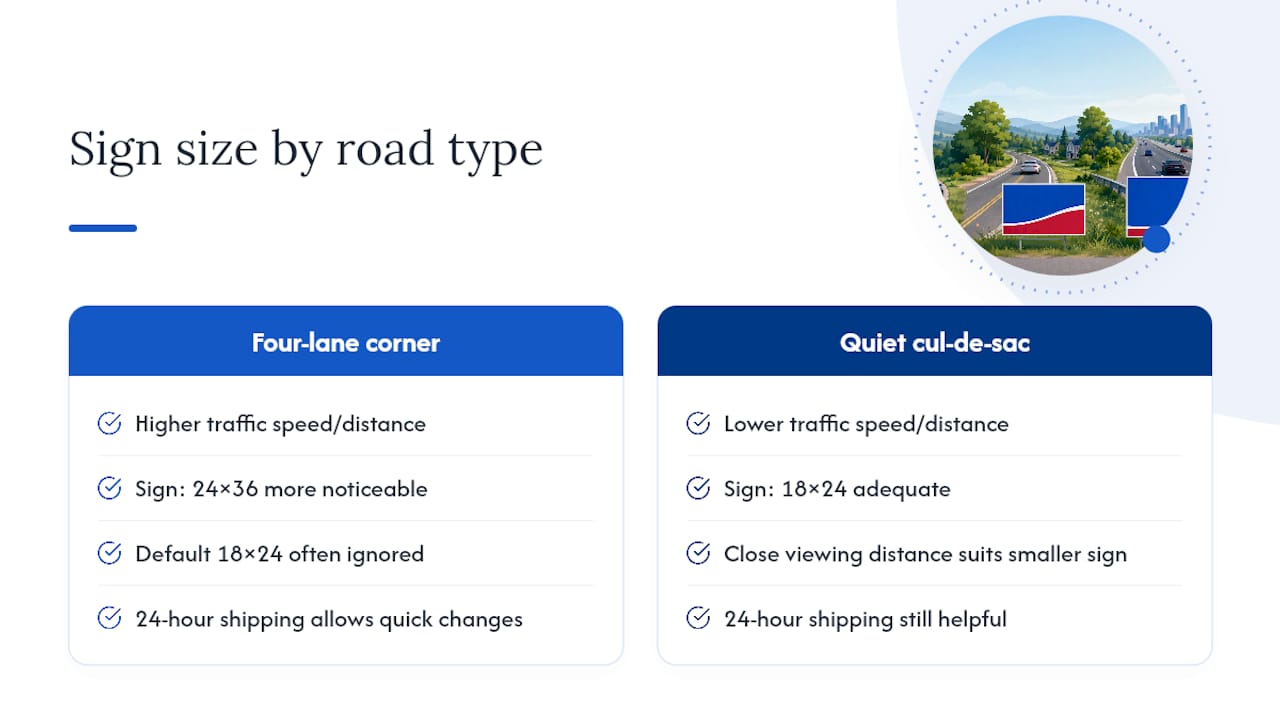
What tends to get overlooked is how much placement context should drive the size decision before design even enters the conversation. YardSignGuy has watched plenty of campaigns default to 18"×24" everywhere out of habit, then wonder why signs near busy intersections get ignored. The fix isn’t a fancier design. It’s matching board size to viewing speed from the start.
Fast turnaround matters here too. Late-breaking campaign decisions, a new opponent, a shifted message, a last-minute endorsement, shouldn’t mean scrapping your signage plan because production takes two weeks. Small run orders that ship within 24 hours give campaigns room to adjust course without losing visibility during the final stretch.
— YardSignGuy
Order Your Campaign Signs at the Right Size, Fast
Yardsigns is built for exactly the sizing decisions covered above: standard 18"×24" boards for neighborhood streets, larger 24"×36" and up for arterial roads, all printed on 4mm corrugated plastic with UV resistant inks and included H-wire stakes so you’re not sourcing hardware separately.
Every order comes with a free digital proof and unlimited revisions before anything goes to print, which matters when a candidate’s name or ballot language needs a last look. Orders under 50 pieces typically ship within 24 hours, and bulk pricing kicks in as quantities grow, so testing a design with a small batch before scaling to 100+ won’t cost you a premium later. If you’re building a custom campaign sign from scratch, the special event sign template is a solid starting point for size and layout options, and the employee of the month product page shows the same materials and turnaround in action on a different use case. Head to the site, pick your size, and get a proof back the same day you submit your design.
Where This Sizing Guidance Comes From
The sizing, readability, and material recommendations above draw on established printer and campaign sign references.
- Custom Ink’s yard sign guide supplies the 18"×24" standard, the 4 to 5 inch letter height rule, and the case for sizing up on arterial roads.
- 48HourPrint’s sizing page lists the common dimension lineup, from 12"×18" through 36"×48", used throughout the sizing reference.
- U.S. Press’s political sign product page confirms 4mm corrugated polypropylene as the standard material for campaign signage.
Sources
- Custom Yard Signs and Lawn Signs: The Complete Buyer’s Guide - Custom Ink Blog
- How to Choose the Right Yard Sign Size | 48HourPrint
- Political Yard Signs | Order Custom Campaign Yard Sign Printing Services - U.S. Press
