


Real Estate Open House Signs: The Agent's Buying Guide
For most listings, the right open-house sign package is straightforward: a set of corrugated plastic 18"×24" directional signs, one A-frame or rider at the property frontage, and one to three feather flags with assembled heights of 11–15 feet for high-traffic visibility. That combination covers wayfinding, curb presence, and attention-getting from a single, reusable investment.
Here is what to order and confirm before your next event:
- Directional signs: multiple corrugated plastic 18"×24" signs, double-sided, with H-stakes included
- Property frontage: one A-frame insert or rider panel with agent name, hours, and contact
- Visibility boost: one to three feather/swooper flags (11–15 ft assembled height)
- Provider: Yardsigns offers all three formats with UV-resistant inks, free design proofs, unlimited revisions, and ships orders under 50 pieces within 24 hours
Once you have confirmed your quantity and material, request a proof, verify stake hardware is included, and schedule delivery at least two days before the event.
Table of Contents
- What types of real estate open house signs do you actually need?
- What materials and sizes should you choose for durability?
- What design rules make open-house signs readable from a moving car?
- How many signs do you need, and where should you place them?
- What should you expect when ordering: pricing, proofs, and turnaround?
- What legal rules apply to open-house signs in the U.S.?
- Your open-house sign deployment checklist
- Key Takeaways
- Why professional signage pays off more than most agents expect
- Yardsigns has everything on this checklist, ready to ship
What types of real estate open house signs do you actually need?
Every sign in your kit plays a specific role. Mixing them up or skipping a format is where most agents lose foot traffic.
Corrugated plastic directional signs are the workhorses of any open-house deployment. Lightweight, inexpensive, and easy to stake into grass or soil, they guide buyers from a main road to your front door. Their low cost makes it practical to deploy 10 or more without worrying about theft or weather damage.
A-frame signs project a polished, professional presence at the property itself. The sandwich-board format stands on its own on sidewalks or lawns, fits easily in a car trunk, and accepts interchangeable inserts so you can update hours or branding between events. A-frames are where you include agent contact details, event hours, and any standout property features. For more on choosing the right frame, Yardsigns covers A-frame options for listings in detail.
Feather/swooper flags solve a specific problem: getting noticed from a moving car before the buyer even reads a word. Assembled heights of roughly 11–15 feet put your sign above parked cars, hedges, and street clutter. The movement of the fabric in wind adds a visual trigger that static signs simply cannot replicate.
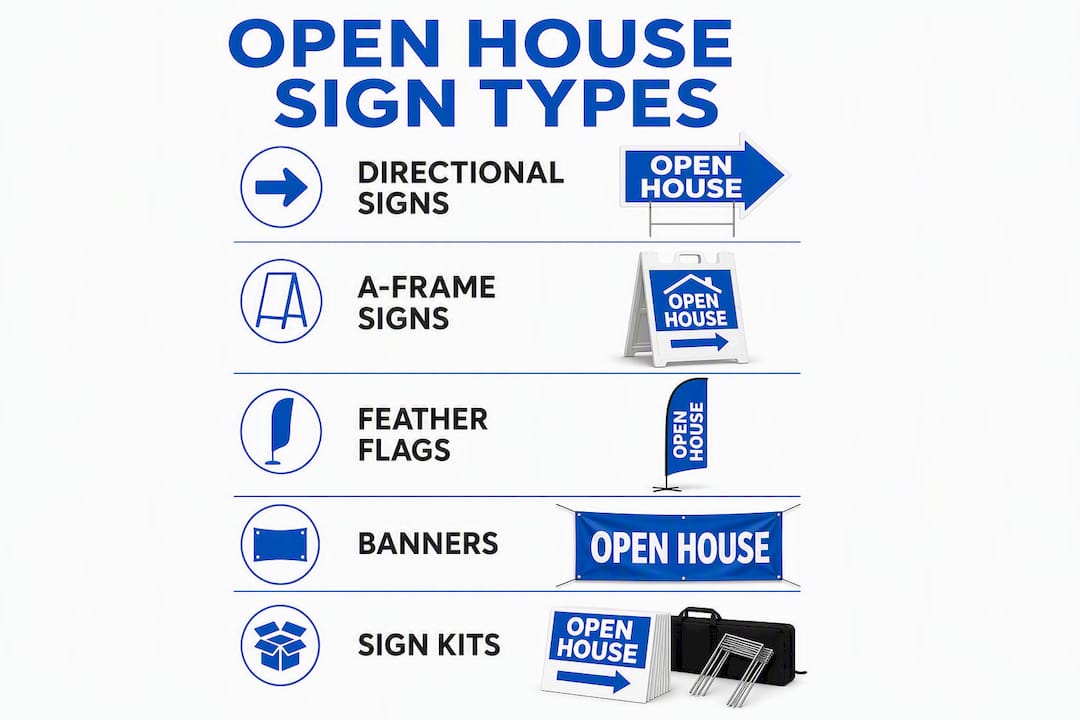
Banners and full sign kits make sense when you are running a team event, a broker open, or a high-volume weekend where consistent branding across multiple listings matters. A pre-assembled kit (directional signs, main sign, and accessories) cuts setup time when you are managing more than one property.
Pro Tip: Order your directional signs double-sided. When your route reverses on the return leg, a double-sided sign reads correctly from both directions without any extra hardware.
What materials and sizes should you choose for durability?
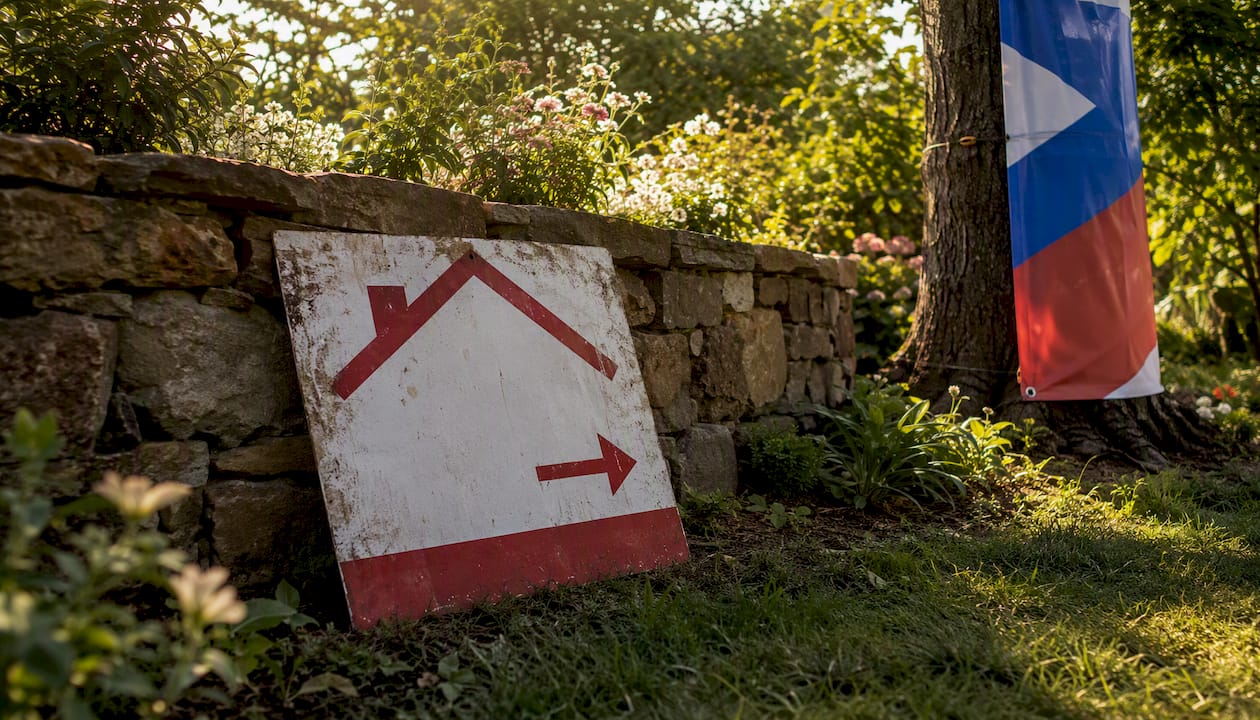
The material you choose determines how many events a sign survives and how well it holds up in wet grass, wind, and direct sun.
| Material | Best Use | Weather Resistance | Typical Size |
|---|---|---|---|
| Corrugated plastic (fluted PVC) | Directional signs, budget-friendly repeatable pieces | Good; UV inks extend life | 18"×24" standard |
| Aluminum composite | Permanent or semi-permanent frontage signs | Excellent; rust-resistant | 18"×24" |
| Foam board | Indoor display, interior open-house panels | Poor outdoors | 18"×24" |
| Polyester/nylon fabric | Feather flags, banners | Good with grommets and weighted bases | 11–15 ft assembled |
Corrugated plastic is the industry standard for directional placement because it is affordable, lightweight, and reusable across multiple events. Aluminum composite costs more per unit but makes sense for a main property sign you plan to reuse across a full season. Foam board is strictly an indoor material.
Key hardware and finish choices:
- H-stakes: the standard for corrugated plastic yard signs; confirm they are included with your order
- Weighted flag bases: use these on hard surfaces like driveways or concrete where staking is not possible
- Grommets and bungee cords: for banners attached to fences or railings
- UV-resistant inks and lamination: extend sign life significantly when signs are stored and reused; worth requesting on any sign you plan to use more than twice
For storage, corrugated plastic signs stack flat and clean up with a damp cloth. Keep them out of prolonged direct sun when stored to prevent warping.
What design rules make open-house signs readable from a moving car?
Visual hierarchy is the single most important design decision on any directional sign. The eye should land on “Open House” first, then the directional arrow, then agent branding. That order is not a preference; it is what works from a car traveling 25–35 mph.
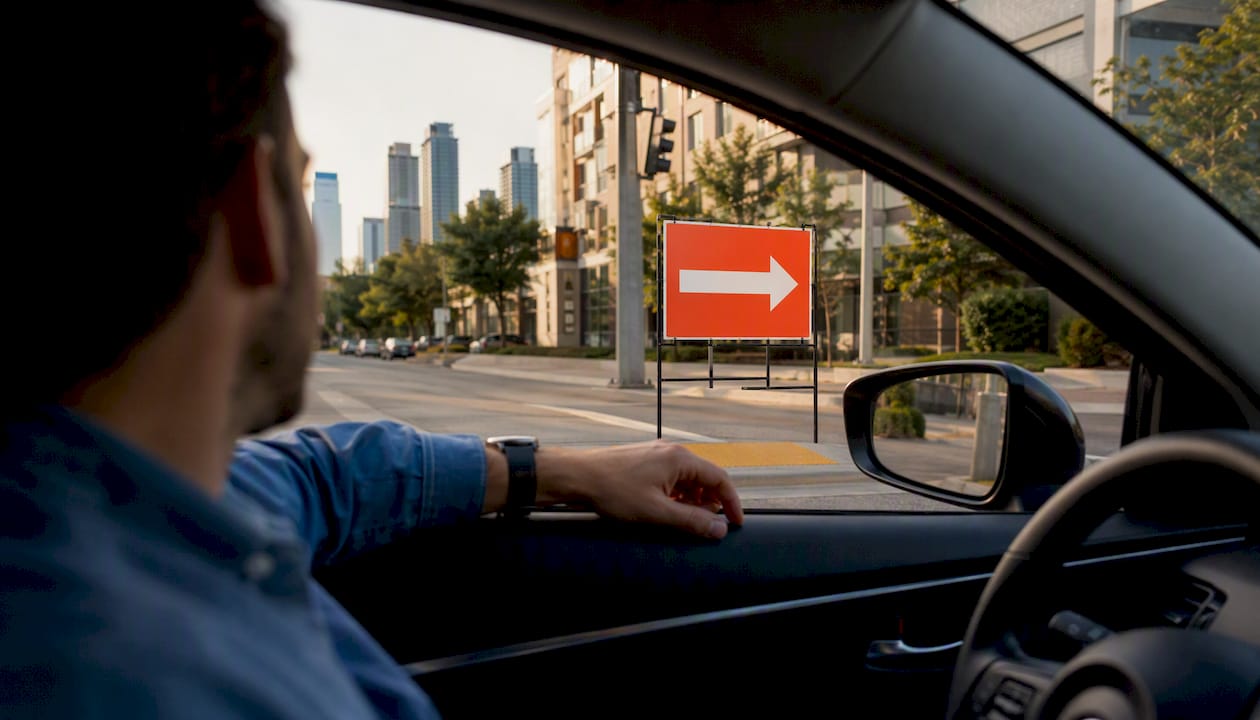
Keep directional signs stripped down. An arrow and “Open House” in large, bold sans-serif type is all a driver needs. Reserve the details — agent name, phone number, event hours, and QR code — for the main property sign or A-frame, where a visitor is already standing still.
Color contrast drives legibility more than font choice. High-contrast pairs (black on yellow, white on navy, red on white) read clearly in bright sun and overcast conditions alike. Avoid thin script fonts, low-contrast brand palettes, or any color combination that requires the reader to squint. If your brokerage brand uses a muted palette, consider a high-contrast background with your logo in a corner rather than letting brand colors dictate the whole sign.
Pro Tip: Before finalizing your proof, print a test copy and tape it to a fence post. Drive past it at 25 mph. If you cannot read “Open House” and the arrow in under two seconds, increase the font size or improve the contrast.
QR codes belong on the A-frame or main property sign, not on directional boards. A buyer driving past a directional sign has no time to scan a code. On the property sign, a QR code linking to the listing page or a virtual tour adds genuine value for buyers who want to share the listing before stepping inside.
How many signs do you need, and where should you place them?
Top producers deploy numerous directional signs per open house. Agents who put out few rarely generate meaningful walk-in traffic. The difference is coverage: a grid of signs creates neighborhood-wide awareness, not just a single pointer at the corner.
A practical placement framework:
- Start at the main approach: place the first sign at the highest-traffic intersection nearest the property
- Mark every decision point: any turn a buyer must make needs a sign, positioned before the turn
- Reassure after each turn: one sign confirming the correct direction after a turn prevents buyers from second-guessing and turning back
- Anchor the property: one A-frame and one to three feather flags at the frontage make the destination unmistakable
For timing, place signs as early as Friday morning and keep them up through Sunday evening. Commuters and weekend errand-runners who pass your signs on Friday may plan to stop by Saturday or Sunday. That extended visibility turns a single event into multi-day awareness. Scheduling Thursday or Friday evening hours alongside a weekend window captures buyers who cannot attend a standard Sunday afternoon event.
Pro Tip: After placing all your signs, get back in your car and drive the route as if you have never been to the neighborhood. Every spot where you feel uncertain is a spot that needs another sign.
Always ask the homeowner or easement owner before placing signs on private frontage. A quick confirmation prevents removal and builds goodwill that can generate seller referrals later.
What should you expect when ordering: pricing, proofs, and turnaround?
Cost per sign varies by material, size, print sides, finish, and quantity. Here is a practical reference:
| Sign Type | Typical Cost Driver | Bulk Behavior | Turnaround |
|---|---|---|---|
| Corrugated plastic directional | Material + single vs. double-sided | Per-unit cost drops with volume | Under 50 pcs: 24 hours |
| A-frame insert | Print size + lamination | Moderate savings at 10+ | under 24 hours |
| Feather flag | Fabric + hardware bundle | Hardware cost amortizes over reuse | under 24 hours |
| Aluminum sign | Material premium + UV finish | Savings at 25+ | under 24 hours |
Order with enough lead time to review your proof. A proof lets you catch trim errors, stake placement conflicts, and contrast issues before the full run prints. Request confirmation that UV-resistant inks are included, verify that H-stakes ship with the order, and confirm the exact shipping window in writing. For a Friday morning setup, placing your order by Tuesday gives you a buffer for any revision.
Reusable, higher-quality signs cost more upfront but reduce your cost per event over a full season. A corrugated plastic directional sign with UV inks and a laminate finish can survive 20 or more deployments with proper storage. Cheap disposables make sense for a one-time event; for agents running open houses regularly, the math favors durability.
Yardsigns ships orders under 50 pieces within 24 hours, offers free design proofs with unlimited revisions, and includes H-stakes with corrugated plastic orders. Bulk discounts apply as quantities increase, making it practical to build a reusable kit rather than reordering single-use signs each weekend.
What legal rules apply to open-house signs in the U.S.?
Sign regulations vary by city, county, and HOA, and violations can mean confiscated signs or fines on event day. Run this checklist before every deployment:
- Check municipal code: most cities regulate temporary signs on public right-of-way, medians, and utility poles; rules differ block by block in some jurisdictions
- Confirm HOA rules: associations can cap sign size, quantity, and placement; get written confirmation from the homeowner before placing anything on association-controlled property
- Avoid medians unless explicitly permitted: median placement is prohibited in many municipalities regardless of how common it looks
- Secure homeowner permission for any sign on private frontage or easement, even a neighbor’s yard near the property
- Remove signs the same day as the event: leaving signs up after an open house is a common violation trigger and reflects poorly on your brand
- Keep a photo log: time-stamped photos of sign placement and removal protect you if a complaint arises
This article is general information, not legal advice. Confirm current sign ordinances with your local municipality or a qualified professional before deployment.
Your open-house sign deployment checklist
Use this list to pack and prepare before every event.
What to buy or order:
- 10–15 corrugated plastic directional signs, double-sided, 18"×24", with H-stakes
- One A-frame insert with agent name, hours, and contact
- One to three feather flags with weighted or stake bases (assembled height of 11–15 feet)
- Spare H-stakes (at least four extras)
What to pack:
- Zip ties and weatherproof tape
- Extra printed flyers and an info box
- Sanitizing wipes and a trash bag
- A basic tool kit (mallet for stakes, zip-tie gun)
- Balloons if your brand uses them
On-site setup:
- Verify arrow directions match the actual route
- Secure flag bases so flags do not tip in wind
- Confirm no signs are blocked by parked cars, poles, or landscaping
- Photograph final placements with timestamps
- Check alignment and legibility from a car before the event opens
Key Takeaways
Treating open-house signage as a reusable, recurring marketing asset rather than a one-time expense is the single decision that separates agents who generate consistent walk-in traffic from those who wonder why turnout was low.
| Point | Details |
|---|---|
| Deploy 10–15 directional signs | Top producers use 10–15 signs per event; fewer than that rarely generates meaningful foot traffic. |
| Use three sign formats together | Corrugated directionals for routing, an A-frame at the property, and feather flags for visibility cover every role. |
| Keep directionals minimal | “Open House” plus an arrow is all a directional sign needs; save contact details for the A-frame. |
| Place signs Friday through Sunday | Extended visibility from Friday morning through Sunday evening turns a single event into multi-day awareness. |
| Order from Yardsigns for fast turnaround | Yardsigns ships orders under 50 pieces within 24 hours with UV inks, included stakes, and free proofs. |
Why professional signage pays off more than most agents expect
Most agents treat open-house signs as a checkbox. Order a few, stake them out the morning of the event, pull them at the end. That approach works well enough to get some traffic. But it misses the bigger opportunity entirely.
The agents who build real pipeline from open houses treat their sign kit the way a retailer treats a storefront display: consistent, professional, and repeated. Well-run open-house systems can produce multiple qualified appointments per weekend when signage creates genuine neighborhood saturation. That is not about spending more money. It is about deploying more signs, earlier, with a consistent visual identity that people recognize week after week.
A reusable kit of 15 corrugated directionals, two A-frame inserts, and a pair of feather flags (assembled height of 11–15 feet) costs less than a single boosted social media post. It lasts a full season with proper storage. And unlike a digital ad, it works on the people who are already driving through the neighborhood where the listing sits.
The agents who resist investing in a proper sign kit usually cite cost. The ones who do invest cite the referrals they picked up from neighbors who saw the signs, stopped in out of curiosity, and later called about their own home.
Yardsigns has everything on this checklist, ready to ship
Agents who need corrugated plastic directional signs, A-frame inserts, feather flags, or a complete open-house kit can order all of it through Yardsigns with UV-resistant inks, double-sided printing, and H-stakes included. Orders under 50 pieces ship within 24 hours, and every order includes a free design proof with unlimited revisions so you can confirm trim, contrast, and arrow placement before the full run prints.
Bulk discounts apply as quantities grow, which makes building a reusable seasonal kit more cost-effective than reordering disposable signs each weekend. Templates for real estate are available if you need to move fast, and the design team can work with your brokerage branding for a polished, consistent look across every sign in your kit.
Start your open-house sign order at Yardsigns today and have your signs ready before the weekend.
