


Weatherproof Signage for Seasonal Sales That Lasts
Every retailer has been there. You invest in signage for your summer blowout or holiday clearance event, hang it outside, and two weeks later the colors have faded, a corner has cracked, or the whole sign is lying face-down in the parking lot. Weatherproof signage for seasonal sales is not a nice-to-have. It is the difference between a promotion that pulls customers in from the street and one that quietly embarrasses your brand. This guide walks you through materials, timing, installation, and maintenance so your signs stay sharp from opening day to the final markdown.
Table of Contents
- Key Takeaways
- Weatherproof signage for seasonal sales: materials that hold up
- Timing and placement for maximum seasonal impact
- Installation and maintenance that protect your investment
- Troubleshooting common weatherproof signage problems
- Measuring the results of your signage investment
- My take on weatherproof signage after years in the field
- Get durable seasonal signage from Yardsigns
- FAQ
Key Takeaways
| Point | Details |
|---|---|
| Match material to campaign length | Short promotions can use corrugated plastic; longer seasonal runs need aluminum or ACM for durability. |
| Launch signs 2 to 4 weeks early | Starting signage before peak season builds awareness and maximizes customer engagement at the right moment. |
| Stable mounting prevents costly losses | Weighted bases and anti-tipping systems reduce replacement frequency and protect your signage investment. |
| Phase your messaging | Teaser, full promotion, and last-chance messaging keeps signage feeling fresh and relevant throughout the campaign. |
| Measure results to justify spend | Track foot traffic and sales data before and during your signage campaign to calculate real return on investment. |
Weatherproof signage for seasonal sales: materials that hold up
The single biggest mistake retailers make is choosing a sign material based on upfront cost without considering how long the campaign actually runs. A corrugated plastic sign might look fine on day one, but coroplast fades and cracks before a longer seasonal campaign ends, which means you are paying for replacement labor on top of the original print cost.
Here is how the most common substrates stack up for outdoor seasonal use:
| Material | Lifespan Outdoors | Best For | Key Weakness |
|---|---|---|---|
| Corrugated plastic (Coroplast) | 1 to 2 years | Short promotions, flash sales | UV brittleness, color fade |
| Aluminum | 7 to 10 years | Year-round or multi-season use | Higher upfront cost |
| Aluminum composite (ACM) | 5 to 8 years | Storefronts, permanent displays | Heavier, needs secure mounting |
| PVC foam board | 2 to 4 years | Indoor-outdoor hybrid use | Warps in extreme heat |
| HDPE | 5 to 7 years | High-moisture environments | Limited print quality options |
Untreated plastic becomes brittle within 6 to 12 months from UV exposure, while aluminum resists moisture and corrosion for up to a decade. If your seasonal sale runs 6 to 8 weeks, corrugated plastic is a reasonable, cost-effective choice. If you are running a recurring seasonal promotion that you want to reuse year after year, aluminum pays for itself quickly.
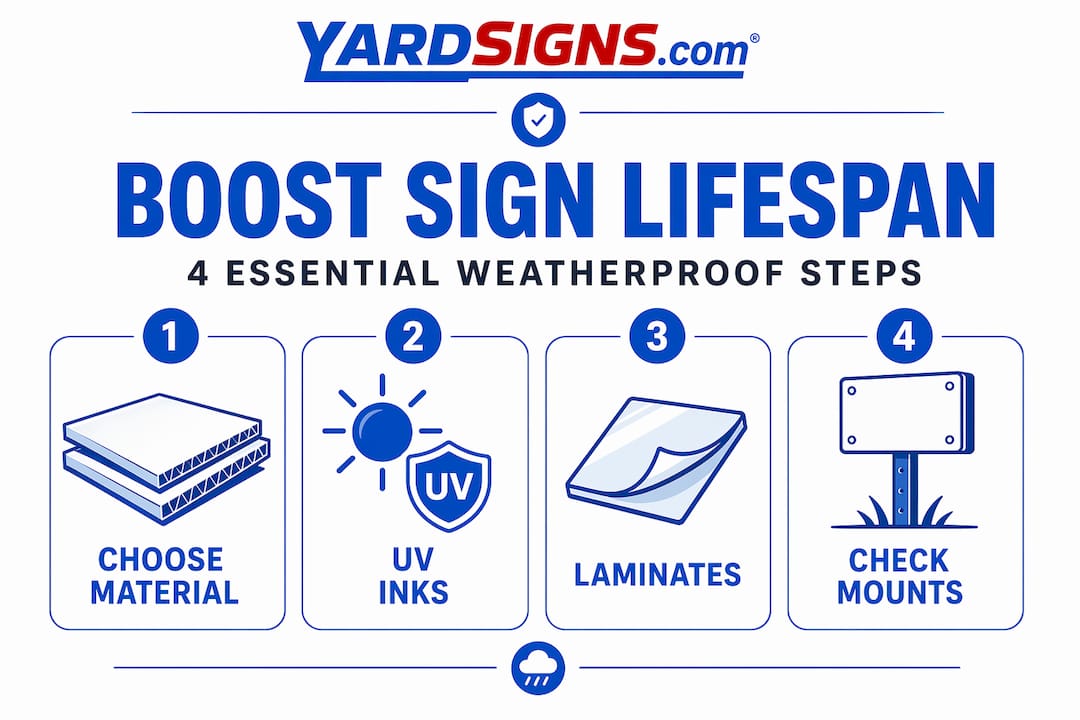
Beyond the substrate, UV printing and protective laminates make a measurable difference. UV-cured inks bond directly to the surface rather than sitting on top, which means they resist peeling and fading far longer than standard inkjet prints. A gloss or matte laminate adds another layer of protection against moisture, abrasion, and the kind of casual damage that happens when a sign gets bumped or brushed against.
For retailers considering digital signage, the technical requirements go deeper. IP65-rated outdoor displays protect against dust and direct water jets, making them suitable for rain, frost, and high-humidity environments. IP65 is the minimum rating you should accept for any permanently outdoor-facing digital screen. Anything lower risks water ingress during a heavy rainstorm, which can destroy a display worth several thousand dollars.
Pro Tip: When ordering printed signs for a coastal or high-humidity location, ask your printer specifically about salt-resistant inks and laminates. Standard laminates can delaminate faster in salt air, especially on signs mounted within a few blocks of the ocean.
Timing and placement for maximum seasonal impact
Getting the material right is half the battle. The other half is knowing when to put your signs up and exactly where to place them. Seasonal signage should launch 2 to 4 weeks before your peak season begins, with urgency messaging intensifying in the final 10 to 14 days. This gives shoppers time to absorb your promotion before they are ready to buy, rather than seeing it for the first time on the day they walk past.
A phased approach to messaging makes a real difference in how effective your seasonal promotion signage feels over time. Here is a practical three-phase framework you can apply to almost any seasonal sale:
- Teaser phase (3 to 4 weeks out): Use simple, curiosity-driving messages. “Something big is coming” or “Our biggest sale of the year starts [date]” creates anticipation without giving everything away. Signs in this phase can be lighter on detail and heavier on visual impact.
- Full promotion phase (launch through mid-campaign): This is where your full offer goes up. Clear pricing, specific discounts, and a direct call to action. Signs need to be legible from at least 30 feet away, which means large fonts, high contrast, and minimal clutter.
- Last-chance phase (final 5 to 7 days): Swap or overlay messaging with urgency language. “Ends Sunday” or “Final Days” dramatically increases conversion among shoppers who have been on the fence. This phase often delivers the highest single-day foot traffic of the entire campaign.
Placement decisions should account for your local climate and the specific conditions at each sign location. A sign mounted on the south-facing wall of your building gets far more direct UV exposure than one on the north side, which means it will fade faster. A sidewalk sign near a corner with consistent wind needs a weighted base or it will tip repeatedly, damaging both the sign and your brand’s street presence. Consulting seasonal marketing timing strategies from adjacent industries like hospitality can also give you useful perspective on when customers start mentally preparing for seasonal spending.
Visual hierarchy matters more outdoors than it does in any other medium. Your sign needs one dominant message, one supporting detail, and one clear call to action. Anything beyond that competes with itself and loses legibility at distance.
Installation and maintenance that protect your investment
A well-printed sign on the wrong mounting system is money wasted. This is the area where retailers most consistently underinvest, and it shows up as repeat replacement costs throughout the season.
For sidewalk and freestanding signs, weighted fillable bases with spring-mounted motion reduction are worth the extra cost. The spring mechanism absorbs wind gusts rather than letting them transfer full force to the sign frame, which reduces tipping and frame stress significantly. In high-traffic pedestrian areas, this also reduces the risk of a sign falling on a customer.
Practical maintenance steps that extend sign life throughout a seasonal campaign:
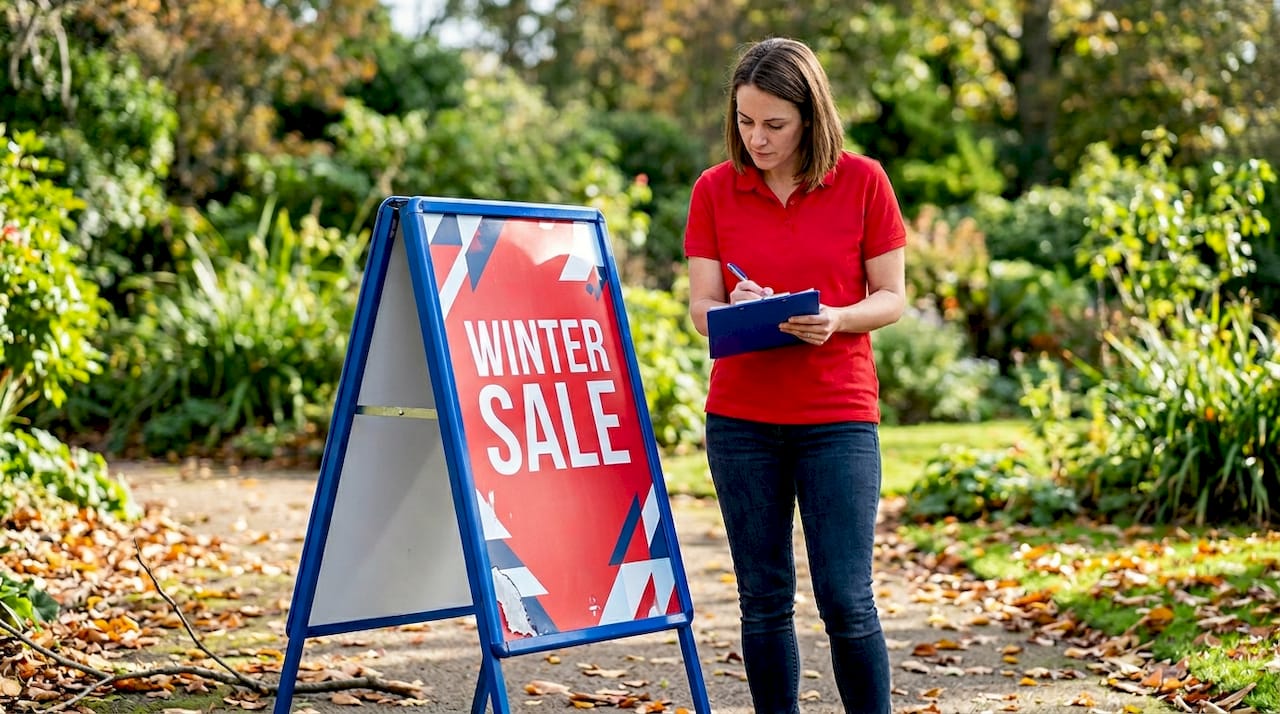
- Weekly visual inspection: Check for lifting edges, cracked corners, faded sections, and any mounting hardware that has loosened. Catching small issues early prevents them from becoming full replacements.
- Cleaning: Wipe down signs with a damp cloth and mild soap every one to two weeks. Dirt and grime accelerate surface degradation and make colors look dull even when the print itself is intact.
- Repositioning: If a sign is showing uneven fading, rotate or reposition it to distribute UV exposure more evenly across the surface.
- Anti-graffiti coatings: In urban locations or high-traffic retail corridors, applying a clear anti-graffiti coating to your signs before installation means cleanup is fast and does not damage the print underneath.
- Protective covers: For signs that will be reused across multiple seasons, store them in protective sleeves or flat storage bags between campaigns. This prevents scratching, warping, and UV degradation during off-season storage.
For guidance on how outdoor signs survive rain and humidity, the same principles that apply to festival signage translate directly to retail seasonal use. The conditions are often identical.
Pro Tip: If you are running a multi-location retail chain, create a simple sign inspection checklist and assign it to a specific staff member at each location. Consistency in maintenance is what separates a professional-looking campaign from one that looks neglected by week three.
Troubleshooting common weatherproof signage problems
Even well-chosen signs run into problems. Knowing what to look for and how to respond quickly keeps your seasonal promotion signage looking sharp for the full campaign duration.
- Fading colors and brittle plastic: This is almost always a UV problem. If it happens within the first few weeks, the substrate or ink was not rated for outdoor use. Going forward, specify UV-resistant printing and a protective laminate at the time of order.
- Water ingress on digital signs: If moisture gets inside a digital display, power it down immediately. Selecting IP-rated displays with properly sealed enclosures prevents this entirely. A non-rated display exposed to rain is not a weatherproof sign, regardless of what the product listing says.
- Glare and legibility issues: Direct sunlight on a glossy sign surface creates glare that makes text unreadable from certain angles. Matte laminates reduce this significantly. For digital displays, 2,500 cd/m² brightness paired with anti-glare housing is the standard for maintaining outdoor readability.
- Structural instability: If a sign keeps tipping or shifting, the mounting solution is wrong for the location. Add ballast, switch to a ground stake system, or use a wall-mounted bracket instead of a freestanding frame.
- When to replace versus repair: If more than 30 percent of a sign’s surface shows fading, cracking, or peeling, replacement is more cost-effective than repair. A damaged sign actively hurts brand perception. Fresh signage, even mid-campaign, signals that your business is active and well-managed.
Measuring the results of your signage investment
Durable signs seasonal promotions deliver are not just about aesthetics. They produce measurable business outcomes when you track the right metrics.
Foot traffic is the most direct indicator. If you have a door counter or point-of-sale system that logs transaction volume by hour, compare the weeks when your signage is up against baseline periods. Retailers who run well-timed seasonal display programs consistently report higher conversion rates during the final urgency phase of a campaign, which validates the phased messaging approach.
Longer-lasting signage also reduces replacement costs in ways that are easy to quantify. If a corrugated plastic sign costs $40 and needs replacing twice during a 10-week campaign, versus an aluminum sign at $90 that lasts the full run without degradation, the aluminum option is cheaper in total cost and requires zero replacement labor.
Customer feedback is an underused metric. Ask staff to note how often customers mention or respond to specific signs. If a particular message or placement is driving questions at the register, that is direct evidence of signage effectiveness. Combine that qualitative data with sales numbers to build a picture of what works for your specific location and customer base.
My take on weatherproof signage after years in the field
I have watched retailers make the same avoidable mistake more times than I can count. They spend real money on a seasonal promotion, design a great-looking sign, and then choose the cheapest substrate available because they figure it is just going to be up for a few weeks. Six weeks later, the sign looks like it has been through a car wash and left in the sun to dry. The promotion is still running. The sign is not doing its job anymore.
In my experience, the material decision and the mounting decision are equally important, and most retailers only think hard about one of them. A beautiful aluminum sign on a flimsy plastic stake in a windy parking lot is going to be on the ground by Thursday. The investment in stable mounting systems is not glamorous, but it is what keeps your sign doing its job through wind, rain, and foot traffic.
I also think digital signage is underutilized in retail seasonal promotions. Yes, the upfront cost is higher. But the ability to update messaging in real time, run countdown timers, and switch from teaser to full-promotion to last-chance messaging without printing a single new sign is genuinely valuable. For high-volume retail locations, the ROI math works out faster than most owners expect.
The retailers I have seen get this right treat their signage budget the same way they treat their advertising budget. They plan it, they phase it, and they measure it. The ones who treat it as an afterthought get afterthought results.
— YardSignGuy
Get durable seasonal signage from Yardsigns
When your seasonal sale depends on signage that holds up from the first day to the last, the material and print quality you start with determine everything that follows.
Yardsigns offers weatherproof yard signs built with premium materials and UV-resistant printing that stay vibrant through rain, heat, and direct sun exposure. Whether you need corrugated plastic for a short-term flash sale or aluminum signs for a multi-week seasonal campaign, Yardsigns lets you customize every detail to match your branding and promotion. Orders under 50 pieces ship within 24 hours, so you can react quickly when a sale opportunity comes up. Explore the full range of durable outdoor sign options and get your seasonal promotion signage ordered before the season does not wait for you.
FAQ
What is the best material for weatherproof seasonal sale signs?
Aluminum is the most durable option for outdoor seasonal signage, resisting moisture and corrosion for up to 7 to 10 years. Corrugated plastic works for short promotions of 4 to 6 weeks but fades and becomes brittle with extended UV exposure.
How early should I put up signs for a seasonal sale?
Launch your seasonal signage 2 to 4 weeks before your peak period begins, then increase urgency messaging in the final 10 to 14 days to drive maximum customer engagement and conversion.
What does IP65 mean for outdoor digital signage?
IP65 is a protection rating indicating a display is fully sealed against dust and protected against direct water jets, making it suitable for outdoor use in rain and frost without risk of internal water damage.
How do I keep outdoor sale signs from fading?
Use UV-resistant inks and apply a protective laminate at the time of printing. For signs in high-sun locations, a matte laminate reduces glare and adds an extra barrier against UV degradation.
When should I replace a seasonal sign instead of repairing it?
Replace a sign when more than 30 percent of its surface shows visible fading, cracking, or peeling. A visibly damaged sign reduces brand credibility and undermines the professionalism of your promotion.
