


Directional Real Estate Signs: What They Mean in 2026
What does a directional real estate sign mean?
A directional real estate sign is a wayfinding tool placed along roads and intersections to guide prospective buyers from a main thoroughfare to a specific property. Unlike the standard “For Sale” yard sign staked at the property itself, a directional sign’s entire job is navigation. It tells a buyer, “Turn here. Keep going. You’re on the right track.”
These signs typically feature a bold arrow, minimal text such as “Open House” or an agent’s name, and clear branding. You’ll find them at decision points: the intersection where a buyer needs to turn off a main road, the fork in a residential street, or the corner that would otherwise send someone in the wrong direction. Their placement is deliberate, not decorative.
Key elements that define a directional real estate sign:
- Arrow graphic: Points clearly in the direction of travel, leaving no room for guessing
- Minimal text: Usually just “Open House,” an agent name, or a phone number
- Agent or brokerage branding: Logo and color scheme for recognition and trust
- Stake or frame mount: Allows quick installation and removal on open house days
- Weatherproof materials: Corrugated plastic or metal frames built for outdoor conditions
The distinction from a “For Sale” sign matters. A “For Sale” sign confirms you’ve arrived. A directional sign gets you there in the first place.
Types of directional signs used in real estate
Real estate agents use several distinct sign formats, each suited to different situations and locations. Knowing which type to deploy where is the difference between a well-attended open house and a frustrating no-show.
Arrow signs are the most common format. They’re flat, single-sided or double-sided panels printed with a directional arrow and brief text. Lightweight corrugated plastic makes them easy to carry in bulk and stake into grass or soil at intersections. They work best along the route from a main road to the property.

Open house directional signs are a specific variation of the arrow sign, branded with “Open House” prominently displayed alongside the date, time, and agent information. Buyers driving through a neighborhood on a Saturday morning respond to these immediately because the message is unambiguous.
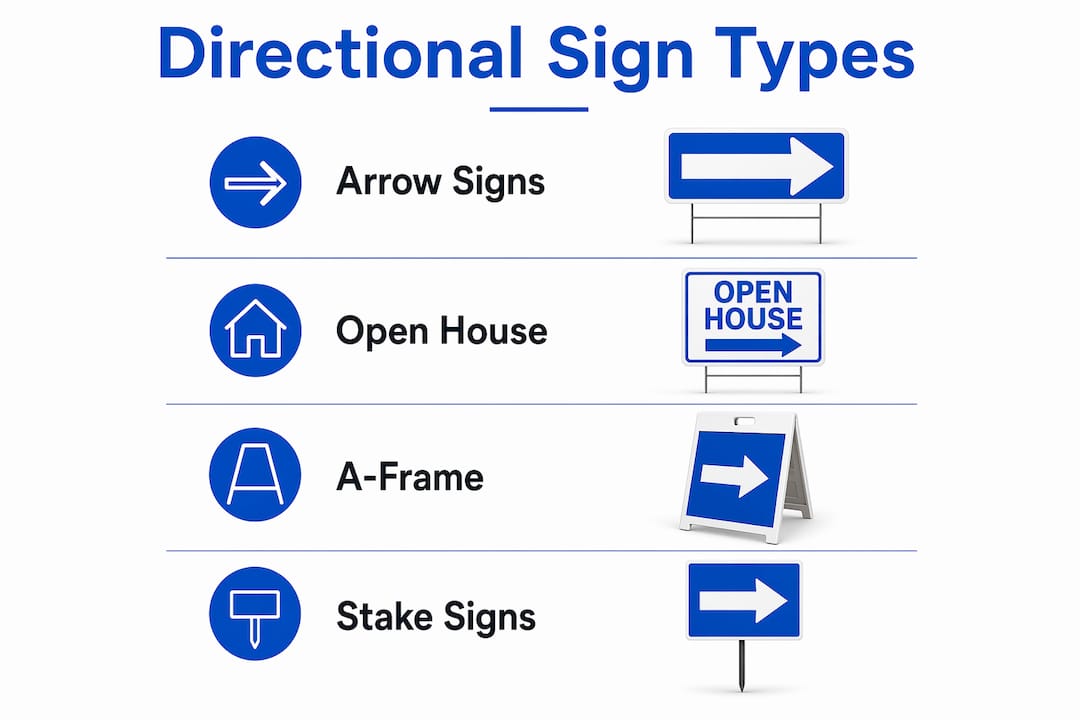
Portable A-frame signs (also called sandwich boards) stand on their own without stakes, making them ideal for sidewalks, driveways, or paved surfaces where staking isn’t possible. They’re heavier and less portable in bulk, but their double-sided visibility catches traffic from both directions.
Stake signs are the standard format for grassy medians and lawns. A wire H-frame or single-stake holds the sign panel at eye level for drivers. Corrugated plastic and metal frames are the two most common material combinations, balancing light weight with weather resistance.
QR code and URL-integrated signs represent the current evolution of the format. Adding a QR code or short website URL to a directional sign lets a buyer scan it while parked and pull up the full listing, virtual tour, or agent contact page instantly. This physical-to-digital integration turns a simple wayfinding tool into an active lead-generation touchpoint.
A quick comparison of sign types by key criteria:
- Arrow stake signs: High portability, best for multi-intersection routes, low cost per unit
- A-frame signs: Self-standing, ideal for paved surfaces, heavier to transport
- Open house directional signs: Time-specific messaging, strong buyer recognition, reusable with date inserts
- QR-integrated signs: Bridges physical and digital, adds listing access on the spot, works best near the property
Why directional signs still matter in real estate marketing
Physical signage and digital listings aren’t competing tools. They serve different moments in the buyer’s journey, and directional signs own the moment when a buyer is already in the car.
Buyer reliance on yard and directional signs remains strong even with digital search dominance: 35–49% of buyers say physical yard signs significantly influenced their home search, and 4–8% purchased a home they first saw via a sign.
Digital listings attract serious buyers who are already searching, but directional signs catch impulse buyers and neighborhood traffic who may never open a real estate app. A sign works continuously without ad spend, creating localized visibility and credibility around the clock.
Benefits for agents and buyers alike:
- Increased property visibility: Properties on quiet side streets get exposure they’d never receive from online listings alone
- Reduced buyer friction: Clear navigation removes the frustration of missed turns and abandoned visits
- Agent brand building: Consistent directional signage throughout a neighborhood builds brand dominance and buyer recall
- 24/7 marketing presence: Signs work on weekends, evenings, and holidays without any additional cost
- Trust signaling: A well-placed sign tells buyers they’re on the right path, reinforcing confidence in the agent’s professionalism
Directional signs also serve as a fail-safe layer when GPS falls short. Addresses in new developments, rural areas, or subdivisions with confusing street layouts often don’t map accurately. A physical sign at the right corner solves that problem immediately.
Best practices for design, placement, and installation
Getting the design right is only half the job. A beautifully printed sign placed at the wrong angle or the wrong intersection does almost nothing. Here’s what actually works.
Design principles:
- Use a large, bold arrow that reads clearly at 30 mph
- Limit text to five words or fewer; “Open House” and your name is enough
- Choose high-contrast colors: dark text on a light background, or white text on a dark background
- Match your brokerage’s brand colors for consistency across all signs
- Use a font size of at least 2 inches tall for text visible from a moving vehicle
Placement strategy:
Effective placement follows a “breadcrumb” logic. Place a sign at every point where a buyer must make a decision: the turn off the main road, the next intersection, any fork or confusing split, and finally the driveway itself. Positioning signs perpendicular to the road and in highly visible spots maximizes exposure to traffic from all directions. A sign parallel to traffic is nearly invisible to drivers.
Pro Tip: Map the route from the nearest major intersection to the property before your open house. Walk or drive it yourself and mark every point where you’d hesitate if you didn’t know the address. Put a sign at each one of those spots.
Installation and timing:
- Place signs the morning of the open house, not the night before
- Use H-frame wire stakes for stability in wind; avoid single-stake setups on exposed corners
- Check each sign after installation to confirm it hasn’t shifted or fallen
- Remove all signs within 24 hours after the event ends
Sign maintenance matters more than most agents realize. A faded, bent, or fallen sign doesn’t just fail to guide buyers. It signals carelessness, which reflects directly on the agent’s brand.

Legal and regulatory considerations for directional sign placement
Placing signs without checking local rules is one of the fastest ways to turn a productive open house into a fine. Regulations vary widely across U.S. cities, counties, and homeowners associations, but the core restrictions follow predictable patterns.
Key legal rules to verify before placing any directional sign:
- Sign permits: Some municipalities require a permit for temporary real estate signs placed on public property or rights-of-way
- Size limits: Many local ordinances cap sign dimensions, often at 6 square feet or smaller for residential areas
- Placement restrictions: Signs on utility poles, traffic signal poles, or public medians are prohibited in most jurisdictions
- Duration limits: Many cities allow real estate signs only during active open house hours, not as permanent fixtures
- HOA rules: Homeowners associations often have their own sign policies that override local ordinances and may restrict size, color, or placement entirely
- No-clutter ordinances: Some municipalities limit the number of signs per property or per block to prevent visual congestion
The most practical compliance strategy experienced agents use is a Friday-to-Monday timeline. Signs go up Friday morning and come down by Monday afternoon, covering the weekend open house window while staying within the typical duration limits most ordinances set.
Non-compliance consequences range from a warning and forced removal to fines that vary by jurisdiction. In some cities, code enforcement officers actively patrol open house routes on weekends. Checking with your local municipality’s planning or zoning department before your first open house in a new area takes 10 minutes and can save you a real headache.
For agents working across multiple markets, the National Association of Realtors and state-level real estate commissions publish guidance on sign regulations that’s worth bookmarking as a starting reference.
What research tells us about directional signs and buyer behavior
The data on physical signage consistently challenges the assumption that digital marketing has made yard signs and directional signs obsolete. It hasn’t.
As noted earlier, 4–8% of buyers purchased a home they first discovered through a physical sign. For a market where a single transaction can represent hundreds of thousands of dollars in value, that percentage represents a meaningful share of deals that would not have happened without a sign on the corner.
Physical signs work as a 24/7 marketing channel that requires no ongoing ad spend, no algorithm, and no internet connection to reach buyers already driving through the neighborhood.
The mechanism behind this is straightforward. Digital listings reach buyers who are actively searching. Directional signs reach buyers who are already present in the neighborhood, whether they’re visiting a friend, running an errand, or simply exploring an area they’re considering. That’s a different buyer at a different stage of decision-making, and a sign is often the trigger that converts curiosity into a scheduled visit.
Research-validated best practices for maximizing sign effectiveness:
- Deploy as a system, not a single sign: A cohesive chain of signs from the main road to the property outperforms any single well-placed sign
- Time placement for peak traffic: Weekend mornings between 9 AM and noon see the highest neighborhood foot and vehicle traffic in most U.S. markets
- Combine with digital assets: A QR code on a directional sign lets a buyer pull up the full listing before they even reach the front door
- Maintain brand consistency: Multiple signs with consistent branding across a neighborhood create a perception of market presence that builds buyer trust over time
- Track sign-sourced leads: Ask every open house visitor how they found the property; sign-sourced visitors are often the most locally motivated buyers
The physical sign also serves a psychological function that digital tools can’t replicate. When a buyer follows a chain of directional signs and arrives at a property, they’ve already invested effort in getting there. That investment increases the likelihood they’ll spend time at the showing rather than clicking away after 10 seconds, as they might with an online listing.
Real estate marketing works best when physical and digital strategies reinforce each other rather than compete. Directional signs are the physical layer that closes the gap between an online listing and an in-person visit.
Get professional directional signs that work in the field
Yardsigns prints professional-grade directional real estate signs built for the demands of open house weekends. Orders under 50 pieces ship within 24 hours, so you’re never scrambling the day before a showing. Every sign uses weatherproof materials and vibrant printing that holds up through wind, rain, and full-sun exposure.
Whether you need a set of arrow stake signs for a multi-intersection route or A-frame signs for a paved driveway, Yardsigns makes the design process straightforward and the turnaround fast. Explore real estate sign options or browse sign ideas that attract buyers to find the right format for your next listing.
Key Takeaways
Directional real estate signs work because they guide buyers physically to properties at the exact moment digital listings cannot, converting neighborhood traffic into open house attendance.
| Point | Details |
|---|---|
| Core purpose | Directional signs navigate buyers from main roads to a property, filling the gap a “For Sale” sign cannot. |
| Buyer impact | 35–49% of buyers say physical signs influenced their home search; 4–8% bought a home they first saw via a sign. |
| Placement method | Use a breadcrumb approach, placing a sign at every decision point from the main road to the driveway. |
| Legal compliance | Check local ordinances on size, placement, and duration before installing; a Friday-to-Monday timeline suits most markets. |
| Digital integration | Adding a QR code or website URL turns a directional sign into a physical-to-digital lead-generation tool. |
