


Why Yard Signs Complement Digital Campaigns
Most marketers assume physical signage is a relic from a pre-digital era. The reality is the opposite. Understanding why yard signs complement digital campaigns starts with recognizing what digital advertising fundamentally cannot do: stay in one place. Out-of-home (OOH) advertising, the industry term for physical placements like yard signs, posters, and billboards, gives your brand a stable geographic presence that no algorithm can throttle or scroll past. This article breaks down the psychology behind that staying power, shows you how to measure it, and gives you a practical framework for weaving yard signs into your existing digital strategies.
Table of Contents
- Key Takeaways
- Why yard signs complement digital campaigns
- The psychology behind physical plus digital
- Practical ways to integrate signs with digital
- Common pitfalls to watch for
- Real-world results from combined strategies
- My take: the channel most marketers undervalue
- Get started with Yardsigns
- FAQ
Key Takeaways
| Point | Details |
|---|---|
| Physical presence fills a digital gap | Yard signs provide repeated, stable local exposure that digital ads cannot replicate due to platform algorithms and budget constraints. |
| Psychology supports the combination | The mere exposure effect means people trust and recall brands they see repeatedly in their physical environment. |
| QR codes make signs measurable | Dynamic QR codes with UTM parameters let you track offline-to-online conversions at the individual sign level. |
| Message consistency drives conversions | Aligning your yard sign design and offer with the linked landing page reduces confusion and increases action. |
| Multi-channel reach reduces risk | Combining physical signage with digital targeting covers demographics that are harder to reach through online ads alone. |
Why yard signs complement digital campaigns
The phrase “yard signs for marketing” sometimes gets dismissed as low-tech. But that framing misses the core value. Static signs act as a stability layer that provides consistent messaging while your digital reach fluctuates with budgets and platform algorithms. Your Facebook campaign stops the moment you pause spending. Your yard sign does not.
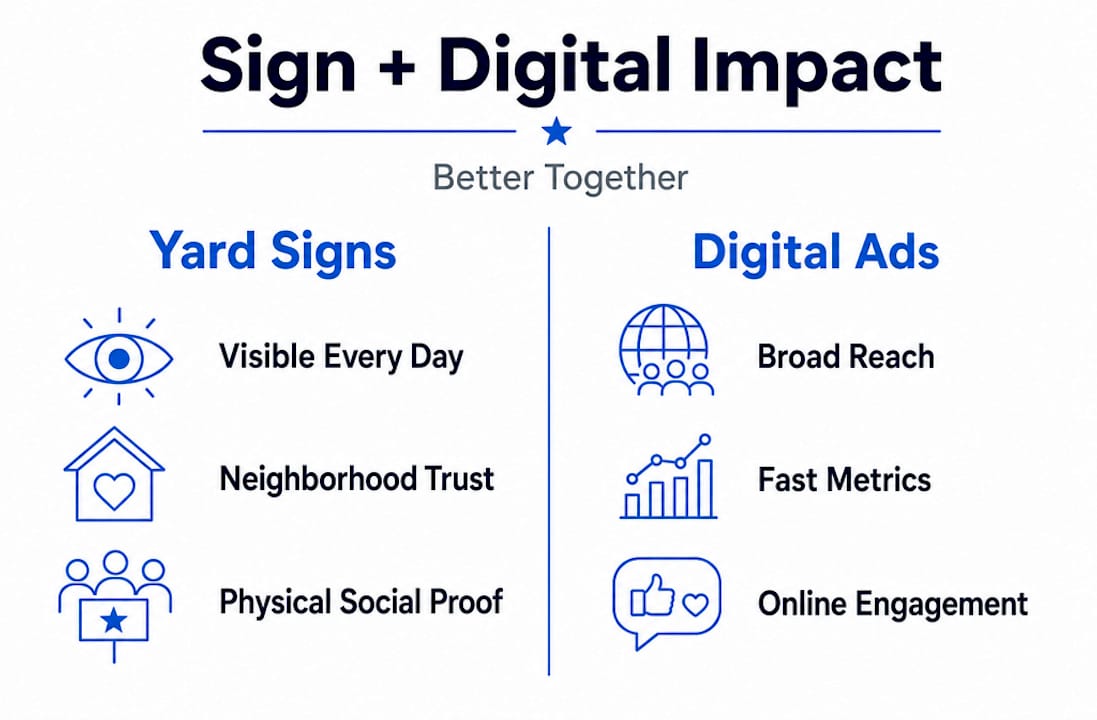
Here is what makes physical signage genuinely different from digital:
- Repeated local exposure. A sign placed on a busy corner gets seen by the same commuters and residents multiple times per week. No paid ad frequency cap works this organically.
- Physical trust signals. Seeing your business or campaign represented in a real neighborhood builds credibility. It signals that you exist beyond a screen.
- Micro-geography reach. Yard signs let you saturate a specific block, precinct, or zip code at a fraction of the cost of geo-targeted digital ads.
- Social proof at scale. Neighborhood ad saturation creates perceived community endorsement, which influences undecided buyers and voters alike by implying broad local support.
The cost-effectiveness is real. You can place 20 high-quality yard signs in a target neighborhood for what you might spend on a single day of paid search ads in a competitive local market. And those signs keep working 24 hours a day, rain or shine.
Pro Tip: Prioritize sign placement at intersections and decision points along your audience’s daily commute. Repeated exposure at the same location on the same route is more valuable than scattered placement across a wider area.
The psychology behind physical plus digital

There is a concept in behavioral psychology called the mere exposure effect. It states that people develop a preference for things simply because they encounter them repeatedly. Digital ads can trigger this too, but they come with a critical liability: digital ads are transient and interruptive, while yard signs provide organic, route-based repetition that builds deeper brand familiarity.
When someone sees your brand on a yard sign during their morning walk and then encounters your retargeting ad that afternoon, those two exposures reinforce each other. The yard sign exposure does not feel like advertising. It feels like community context. That distinction matters because people process non-intrusive messaging differently than they process interruptions.
Physical signage enables local presence and credibility that digital marketing alone can struggle to achieve in community contexts. The offline impression primes the audience to respond more positively to the digital message that follows.
Brand recognition also compounds across channels. When your yard sign design, color palette, and core message match what appears on your digital landing pages and social ads, you create a coherent identity that the brain recognizes faster and trusts more readily. This is not a soft benefit. Studies on electoral campaigns show that yard signs increase vote share by about 1.7 percentage points on average, driven specifically by repeated exposure and name recognition reinforcement.
Practical ways to integrate signs with digital
Knowing the theory is useful. Knowing how to execute it is where campaigns actually improve. Here is a step-by-step approach to bringing your offline and online marketing together.
-
Add dynamic QR codes to every sign. A dynamic QR code, unlike a static one, lets you change the destination URL without reprinting. Dynamic QR codes create a flexible, trackable connection from your physical sign to your digital content. This means you can A/B test landing pages without replacing signs in the field.
-
Assign unique UTM parameters per sign location. This is where most campaigns fall short. Grouping all QR code scans at campaign level limits your ability to optimize; assigning unique UTM tags per placement tells you exactly which corner or neighborhood drives the most engagement.
-
Match your sign creative to your landing page. If your yard sign says “Get 20% off this weekend,” your landing page needs to say the same thing immediately. Mismatch between offline promise and online content reduces conversions. The visitor arrived with an expectation. Honor it.
-
Align physical placement with your digital geo-targeting zones. Combining digital precision with physical route-based contact points increases campaign efficiency. Run your geo-targeted social ads in the same zip codes where your signs are placed, and your total impressions in that zone multiply.
-
Review scan data weekly and adjust placement. Signs in low-traffic locations can be moved. Use the QR analytics dashboard to identify underperformers and redeploy them to higher-traffic routes.
Pro Tip: Connect your analytics data to a partner tool built for marketing attribution. A platform that measures 57% better ROI from multi-channel tracking gives you a much clearer picture of what your integrated spend is actually generating.
Here is a quick comparison of standard yard sign campaigns versus integrated campaigns with digital tracking:
| Campaign type | Measurement capability | Optimization flexibility | Audience reach |
|---|---|---|---|
| Yard signs only | Foot traffic estimates | Limited to placement changes | Local, route-based |
| Digital ads only | Full analytics, real-time data | High, budget-driven | Broad, algorithm-dependent |
| Integrated (signs + digital) | QR scan data + digital analytics | High, physical and digital levers | Local depth + digital breadth |
Common pitfalls to watch for
Even well-planned integrated campaigns run into avoidable problems. Knowing what to watch for saves you wasted spend and diluted results.
- Inconsistent design across channels. If your yard sign uses a different logo version or color than your digital ads, you fragment brand recognition. Every touchpoint should look like it came from the same campaign.
- Vague or overloaded messaging. Yard signs have about three seconds of attention from a passing driver. One clear message, one visual, one call to action. The same discipline should carry into your digital creative.
- Broken attribution setups. A QR code that goes to your homepage with no UTM tracking tells you nothing. Set up the tracking before the signs go out, not after.
- Poor placement density. Spreading 15 signs across an entire city creates no social proof and minimal repetition. Concentrating them along specific corridors or within a defined neighborhood creates the clustering effect that actually shifts perception.
- Ignoring offline demographics. Multi-channel campaigns reduce risk by reaching demographics less accessible online. Older residents and people with limited screen time still respond to physical signage. Design your signs for them, not just for tech-savvy audiences.
The local election yard sign placement guide from Yardsigns covers placement density and route strategy in practical detail if you want a reference for neighborhood-level planning.
Real-world results from combined strategies
The most compelling evidence for this integration comes from electoral campaigns, where results are measurable and the stakes are high.
| Campaign type | Channel mix | Measured outcome |
|---|---|---|
| Local election | Yard signs + digital retargeting | +1.7% average vote share lift from sign exposure alone |
| Real estate | Realtor signs + social ads | Increased local brand recall and direct inquiry rate |
| Retail business | Sidewalk/lawn signs + geo-targeted ads | Higher foot traffic in sign-dense zones versus control areas |
| Community event | Event signs + email + social | Broader reach across age groups, including offline-only audiences |
Local businesses see similar dynamics. A retail shop that places signs along the three main roads leading to its location and simultaneously runs geo-targeted Instagram ads to the same zip codes creates a recognition loop. The person who walked by the sign and thought “I should check that out” is far more likely to click the digital ad they see later that day. The offline impression reduces the resistance to the online conversion.
For brand development purposes, this kind of multi-touchpoint consistency is exactly what builds the kind of local authority that digital-only brands struggle to establish quickly.
My take: the channel most marketers undervalue
I’ve worked with enough integrated campaigns to say this with confidence: physical signage is the most consistently undervalued channel in modern local marketing. I’ve watched businesses spend aggressively on digital while their entire neighborhood has no idea they exist.
What I’ve learned is that digital-first marketers often conflate digital efficiency with digital sufficiency. Yes, your click-through rate is trackable. Yes, your cost-per-acquisition looks clean in a spreadsheet. But when someone in your target neighborhood can’t recall your brand name without a screen prompt, you have a real awareness gap that no retargeting pixel will fix.
The campaigns I’ve seen produce the best local results share one trait: they treat physical presence as a trust-building layer, not an afterthought. Signs go up first, in the right corridors, with the right message density. Digital then amplifies and captures the demand those signs generate. The sign creates the question. The digital ad answers it.
My honest advice? If you’re allocating 100% of your local marketing budget to digital channels, reallocate 15 to 20 percent to physical signage and measure what happens to your digital conversion rates. You may be surprised by the lift. The custom design process matters here too. A sign that looks polished and on-brand does far more work than a generic template ever will.
— YardSignGuy
Get started with Yardsigns
If you’re ready to put this integration into practice, Yardsigns makes it straightforward. Their customizable yard signs are built for real campaign conditions: weatherproof materials, vibrant printing that holds up over weeks of outdoor exposure, and a design process that lets you match your existing brand colors and messaging precisely.
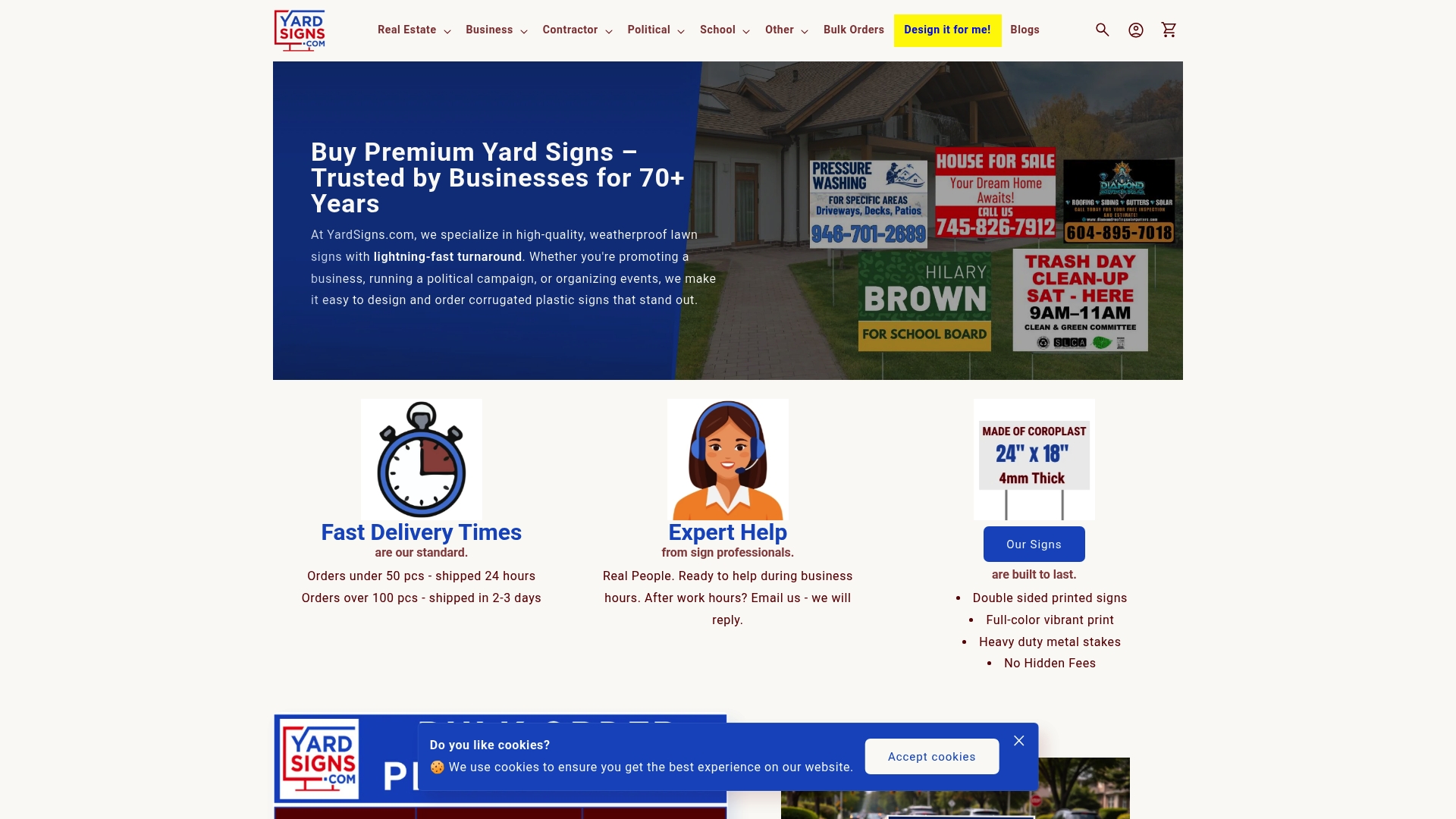
Orders under 50 pieces ship within 24 hours, which means you can react quickly to campaign timelines or test a new placement strategy without waiting weeks for production. Whether you’re launching a local business promotion, a neighborhood awareness push, or a seasonal campaign, Yardsigns gives you physical signs that work as hard as your digital spend. Pair their weatherproof signage options with a solid QR tracking setup and you have an integrated local campaign that actually measures results.
FAQ
Why do yard signs work better alongside digital ads?
Yard signs provide repeated, non-intrusive exposure in the physical environment, which primes audiences to respond more positively to the digital ads they see later. The two channels reinforce each other rather than compete.
How do you measure yard sign effectiveness in a digital campaign?
Use dynamic QR codes with unique UTM parameters assigned per sign location. This lets you track individual sign performance through your analytics platform and attribute offline scans to specific placements.
What is the most common mistake in integrating yard signs with digital campaigns?
The most common mistake is mismatching the yard sign message with the landing page it links to. When the offline promise does not match the online experience, conversion rates drop significantly.
How many yard signs do you need to create a social proof effect?
Concentration matters more than total quantity. Clustering signs along the same routes or within a defined neighborhood creates the perception of broad community endorsement that influences local buyers and voters.
Can yard signs reach audiences that digital ads miss?
Yes. Older residents and people with limited screen time respond primarily to physical signage. Multi-channel campaigns that include yard signs reduce the demographic blind spots created by digital-only strategies.
Recommended
- Local Election Yard Sign Placement Ideas That Win – YardSigns.com
- What Does Custom Yard Sign Design Mean for You – YardSigns.com
- Realtor Yard Signs - Simple Black White Right Arrow with Logo Design - – YardSigns.com
- Realtor Yard Signs - Simple Blue White Right Arrow with Logo Design - – YardSigns.com
