


Yard Sign Minimum Order Quantity: What You Need to Know
The yard sign minimum order quantity (MOQ) is defined as the smallest number of signs a vendor will produce in a single order. Most vendors set no hard minimum, meaning you can order as few as one sign and scale up from there. That flexibility matters for individuals planning a birthday display or a small business testing a new promotion. The real question is not whether you can order one sign. It is whether ordering just one makes financial sense for your goals.
What is the standard minimum order quantity for yard signs?
The yard sign industry has no fixed universal MOQ. Some vendors accept a single sign; others require a minimum of 10 or more before they will run a job. That variation comes down to how each vendor structures their production costs and equipment setup.
Production setup is the key driver. Every print run requires file preparation, plate or screen setup, and machine calibration. Those costs are the same whether you print 1 sign or 100. Vendors who require a minimum of 10 or 25 signs are simply spreading that fixed cost across enough units to make the job profitable.
Common MOQ thresholds you will encounter in the market include:
- 1 sign: Available from vendors with digital printing equipment and no setup fees
- 10 signs: A typical short-run minimum for vendors using standard coroplast printing
- 25 signs: The most common entry point for political campaign orders and event promotions
- 50 signs: Standard for mid-size campaigns covering a neighborhood or district
- 100+ signs: Common for city-wide political campaigns, real estate agencies, and franchise businesses
The difference between a vendor with no minimum and one requiring 25 signs is not just policy. It reflects the printing technology they use. Digital inkjet printers handle short runs efficiently. Offset or screen printing setups favor longer runs and push vendors toward higher minimums.
Pro Tip: Ask your vendor specifically whether their MOQ applies per design or per order. Some vendors allow multiple designs within a single order batch, which changes your planning entirely.
How do minimum order quantities affect pricing?
Bulk orders reduce per-unit cost because fixed setup costs get divided across more signs. Printing 10 signs or 100 signs uses the same file setup and printing run. The more signs you add, the smaller the setup cost becomes per unit.

The pricing difference is significant. A single custom yard sign can cost $12–$25 per unit. Ordering 50–100 signs can reduce that cost to $0.60–$0.90 each. That is a price reduction of more than 90% per unit at scale.
| Order Quantity | Approximate Unit Cost | Best Use Case |
|---|---|---|
| 1–5 signs | $12–$25 per sign | Personal events, single-location promotions |
| 10–24 signs | $5–$10 per sign | Small business, open house, local events |
| 25–49 signs | $2–$5 per sign | Neighborhood campaigns, school events |
| 50–99 signs | $1–$2 per sign | Political campaigns, real estate, franchises |
| 100+ signs | $0.60–$1.50 per sign | City-wide campaigns, large promotions |
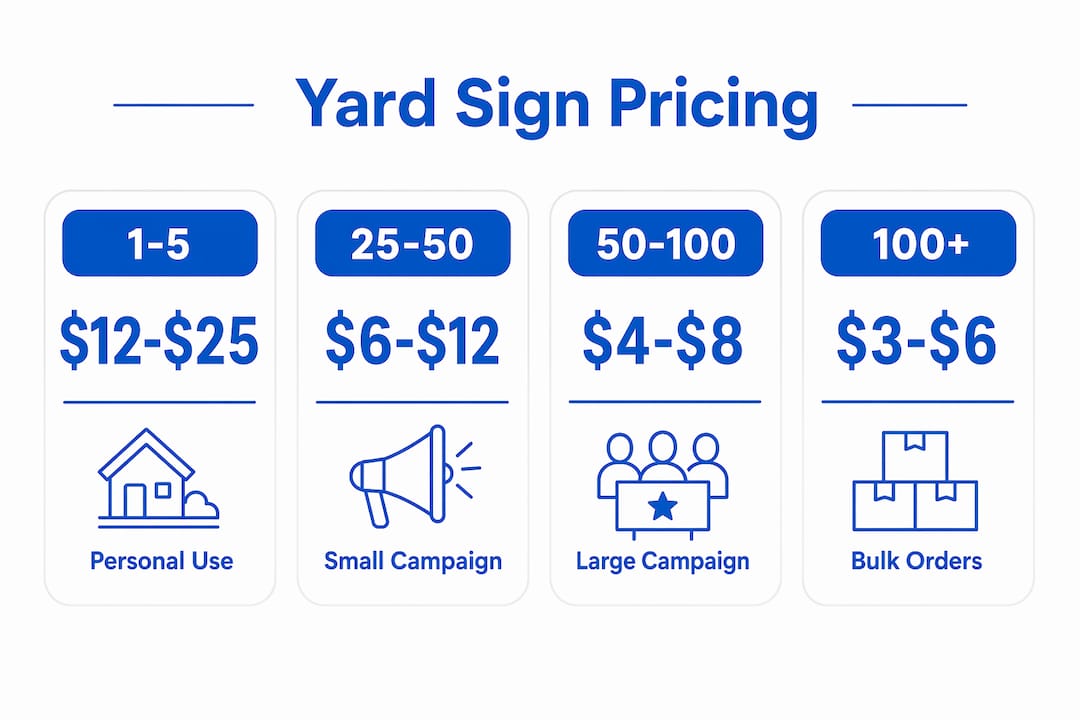
Note: Prices are illustrative ranges based on market observations. Actual pricing varies by vendor, material, and design complexity.
Bulk discount tiers typically begin at 25, 50, or 100 units. Professional campaigns order in batches of 25, 50, 100, or 250 to balance visibility with budget. Each tier jump brings a meaningful drop in cost per sign.
Production time also scales with quantity. Small orders often ship faster because they require less press time. Yardsigns ships orders under 50 pieces within 24 hours, which makes smaller batches a real option when timing is tight.
Pro Tip: If your budget is fixed, calculate your cost per sign at each quantity tier before placing your order. Moving from 25 to 50 signs often costs only slightly more in total but cuts your unit price nearly in half.
What should you consider when deciding how many signs to order?
The right order quantity depends on four factors: campaign scale, coverage area, budget, and timing. Getting this balance right prevents both waste and shortage.
Campaign scale and coverage area are your starting points. A garage sale needs 3–5 directional signs. A local city council race needs signs in every precinct, which could mean 100–250 units. Match your quantity to the number of locations you plan to cover, not just the number you think looks reasonable.
Budget flexibility determines whether you order all at once or in stages. Consider these approaches:
- Single bulk order: Lower unit cost, requires upfront budget, works best when your design is finalized
- Base plus specialty order: Order a large batch of your primary design, then a smaller batch of specialty signs for specific dates or locations
- Staggered ordering: Place smaller orders as needed, accepting higher unit costs in exchange for flexibility
Shipping and delivery timing affect quantity decisions more than most buyers realize. If your event is two weeks away, a bulk order of 100 signs is manageable. If your event is in 48 hours, a smaller order that ships within 24 hours is the practical choice.
Cost versus flexibility is the core tradeoff. Small orders cost more per sign but give you room to adjust your design or message. Bulk orders lock in your design but deliver the best value. For campaigns where the message is fixed, bulk is almost always the better financial decision.
Pro Tip: Order 10–15% more signs than you think you need. Signs get damaged, stolen, or placed in locations that underperform. Having extras on hand costs less than a rush reorder.
How to manage large or bulk yard sign purchases effectively
Large orders require a clear plan before you place them. The most common mistake is ordering one large batch of a single design without accounting for the different sign types a campaign actually needs.
Experts recommend separating base design orders from specialty signs to protect both branding consistency and budget. Your base design carries your primary message and goes everywhere. Specialty signs carry event-specific dates, directional arrows, or location-specific text and go in targeted spots.
A practical batch structure for campaigns
- Primary batch (50–250 signs): Your core design with name, logo, or main message. Order this in the largest quantity to get the best unit price. Use Yardsigns’ bulk order options for this tier.
- Secondary batch (25–50 signs): A variation of your primary design with a specific date, address, or call to action. Order these separately to keep costs down.
- Directional batch (10–25 signs): Simple arrow signs or location markers. These need to be replaced more often, so keep quantities moderate.
Storage and distribution planning
| Consideration | Recommendation |
|---|---|
| Storage space | Stack flat in a dry location; coroplast signs are lightweight and stackable |
| Distribution timing | Deploy primary signs 2–3 weeks before an event; directional signs 48–72 hours before |
| Replacement stock | Keep 10–15% of your total order in reserve for damaged or stolen signs |
| Retrieval plan | Assign a team to collect signs after the event to reuse or recycle |
Real estate agencies commonly order 25-sign batches for individual listings and maintain a standing inventory of 50–100 general branding signs. Political campaigns order 50-sign batches by district, then consolidate reorders based on which districts show the most sign activity. Both approaches use the base-plus-specialty model to control costs without sacrificing coverage.
Key takeaways
Yard sign MOQ is flexible across the market, but your order quantity directly determines your cost per sign and campaign reach.
| Point | Details |
|---|---|
| No universal minimum | Many vendors accept orders as low as one sign, giving you full flexibility. |
| Bulk pricing starts at 25–50 signs | Unit costs drop sharply at standard bulk tiers, making larger orders far more cost-effective. |
| Match quantity to coverage area | Calculate how many locations you need to cover before choosing your order size. |
| Use a base-plus-specialty structure | Order your primary design in bulk and specialty variations in smaller batches to control costs. |
| Factor in shipping speed | Smaller orders often ship faster, which matters when your event timeline is tight. |
What I’ve learned from watching campaigns over-order and under-order
YardSignGuy here. The most consistent mistake I see is buyers treating MOQ as a ceiling rather than a floor. They hear “no minimum” and order exactly what they think they need, with no buffer. Then a sign gets knocked over, a location falls through, or the campaign extends by a week. Suddenly they are paying rush prices for a small reorder that costs more per sign than their original bulk run.
The second mistake is the opposite: ordering 250 signs for a campaign that covers 30 locations. I have seen boxes of unused signs sitting in garages months after an election. That is money that could have gone into a second design variation or a targeted specialty run.
My honest recommendation is to treat your first order as a base layer. Get your primary design in a quantity that earns you a solid bulk discount, typically 50 or 100 units. Then place a smaller secondary order for any design that needs a specific date, address, or message. You get the cost efficiency of bulk pricing on your main design without committing your entire budget to a single version.
Timing matters more than most buyers plan for. If you are running a campaign with a hard deadline, check your vendor’s production and shipping timeline before you finalize your quantity. A smaller order that arrives on time beats a larger order that shows up the day after your event.
— YardSignGuy
Yardsigns has flexible options for every order size
Whether you need one sign for a personal event or 250 for a city-wide campaign, Yardsigns makes the ordering process straightforward. Orders under 50 pieces ship within 24 hours, so a tight timeline does not have to limit your options.
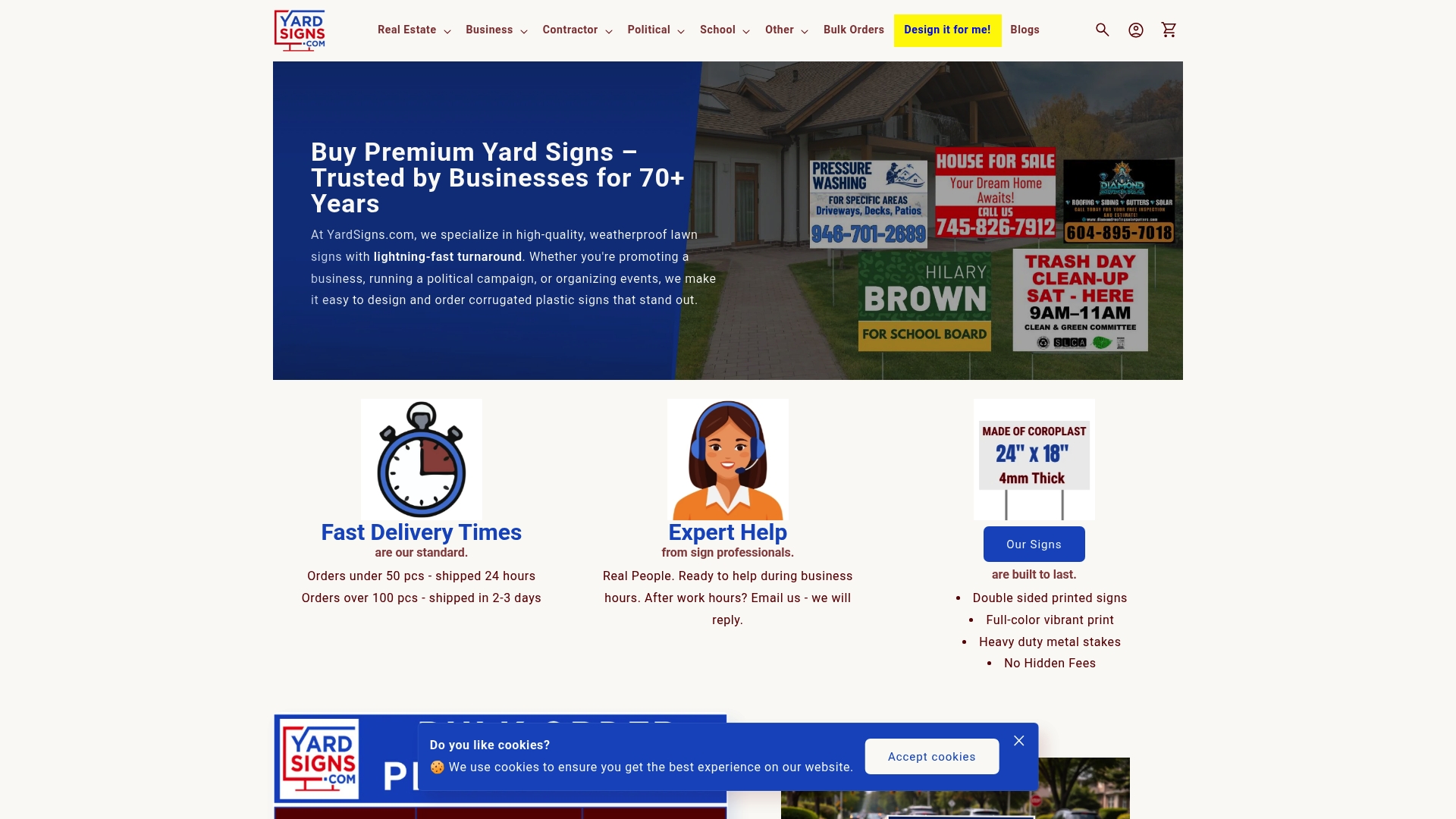
Yardsigns offers ready-to-customize designs across dozens of categories, from special event congratulations signs to promotional business signs. Bulk pricing tiers start at 25 units, and the design tool lets you finalize your artwork before you commit to a quantity. If you are planning a campaign, a fundraiser, or a business promotion, Yardsigns gives you the quality and speed to get signs in the ground when it counts.
FAQ
What is the minimum order quantity for custom yard signs?
Many vendors set no minimum order quantity, allowing orders as low as one sign. Some vendors require a minimum of 10 or 25 signs depending on their printing process.
Do bulk yard sign orders always cost less per sign?
Yes. Bulk orders reduce per-unit cost because fixed setup costs are spread across more signs. Ordering 50–100 signs can cut your per-sign cost by more than 90% compared to ordering a single sign.
How many yard signs should I order for a political campaign?
Political campaigns typically order in batches of 25, 50, 100, or 250 based on district size and budget. A neighborhood-level race usually needs 50–100 signs; a city-wide race often requires 250 or more.
What is the best way to manage a large yard sign order?
Separate your primary design into a large bulk order and order specialty or directional signs in smaller batches. This approach protects branding consistency while keeping costs down on variations.
Can I order different designs in the same yard sign order?
This depends on the vendor. Some vendors allow multiple designs within a single order batch, while others apply the MOQ to each individual design. Confirm this policy before placing your order to avoid unexpected minimums.
