


Yard Signs for Business Grand Reopening: A Practical Guide
Reopening your business is a big moment, and the last thing you want is for it to pass without the foot traffic it deserves. Yard signs for business grand reopening events are one of the most cost-effective tools you have to get noticed fast. Professionally called promotional outdoor signage, these signs work at the street level where your customers already are. This guide covers everything you need to pick the right size and material, design something that actually gets read, place it where it performs best, and measure whether it worked.
Table of Contents
- Key takeaways
- Yard signs for grand reopening: what to decide first
- Designing signs that actually get read
- Placement and installation for maximum impact
- Common mistakes that cost you customers
- Measuring your sign strategy after the event
- My take on signs as a long-term business tool
- Get your custom signs from Yardsigns
- FAQ
Key takeaways
| Point | Details |
|---|---|
| Size and material matter | Choose the right dimensions and weatherproof materials to maximize outdoor visibility and sign longevity. |
| Clear messaging wins | Keep your sign copy to one focused message with bold fonts and high-contrast colors for quick readability. |
| Placement drives results | High-traffic intersections, entry points, and directional paths move the most customers to your door. |
| Avoid common errors | Overcrowded text and poor anchoring are the top reasons signs fail at outdoor events. |
| Measure after the event | Track foot traffic and customer feedback post-opening to refine your signage strategy for future promotions. |
Yard signs for grand reopening: what to decide first
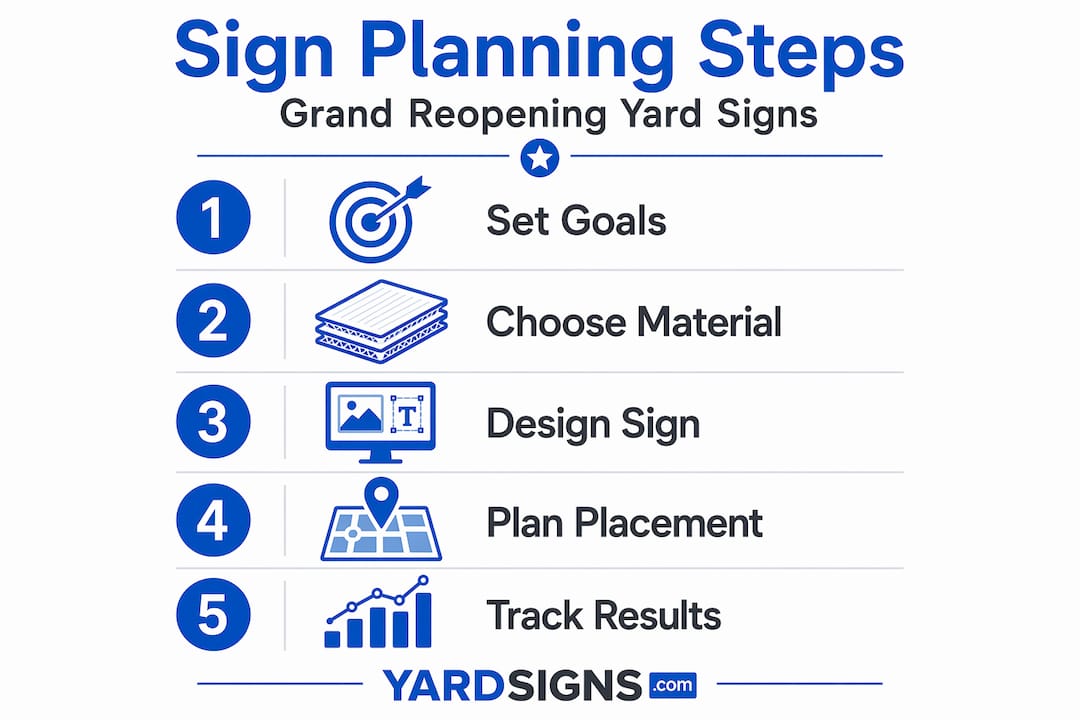
Before you order a single sign, a few planning decisions will save you money and prevent last-minute surprises. Most small business owners skip this step and end up with signs that are either too small to read from a car or printed on flimsy material that folds in the first breeze.
Size options and what they actually do
Sign size determines how far away your message can be read. Here is a practical breakdown:
- 18x24 inches — The standard yard sign size. Works well for sidewalks, parking lot entrances, and residential-adjacent areas. Signs at this size typically start around $38.03, making them the most budget-friendly choice for small business reopenings.
- 24x36 inches — A step up for busier roads where vehicles pass at 30 to 40 mph. More text is readable at this scale.
- 32x48 inches and larger — Better suited for high-traffic arterials or when your location sits back from the road. Larger outdoor signs for reopening can start at $57.88 at this size, with 4x8 foot options reaching $145.58 for high-traffic placement.
Material and durability
Outdoor conditions can be brutal on cheap signs. Corrugated plastic (also called coroplast) is the industry standard for yard signs because it handles rain, heat, and wind without warping. If your event spans multiple days or you plan to reuse the signs, look for UV-resistant printing so the colors stay vibrant in direct sunlight.
| Material | Best for | Durability |
|---|---|---|
| Corrugated plastic | Multi-day outdoor events | High, UV resistant |
| Foam board | Indoor displays only | Low outdoors |
| Aluminum | Permanent locations | Very high |
| Vinyl banner on frame | Large formats, windy areas | High with grommets |
Budget, compliance, and placement rules
Custom yard signs for a grand reopening do not require a large budget. You can run a solid campaign with 10 to 20 well-placed corrugated plastic signs. Before you install anything, check your city’s sign ordinance. Many municipalities limit the number of temporary signs per property, require permits for signs above a certain square footage, or restrict placement in road medians. A quick call to your city’s planning department takes 10 minutes and prevents fines.
Pro Tip: Order a few extra signs beyond your planned number. Weather, theft, and installation mistakes all happen. Having spares on hand means you are never caught with empty stakes on the day of your event.
Designing signs that actually get read
Good design is not about making something beautiful. It is about making something that communicates your message in under three seconds at 30 mph. That is the real test for business reopening signs.
Here is a step-by-step process that works:
- Lead with the action, not the business name. Start your sign with words like “Grand Reopening,” “Now Open,” or “Back and Better.” Your business name supports that headline, not the other way around.
- Limit your copy to 7 words or fewer. Every word you add is a word drivers have less time to read. “Grand Reopening. Saturday. Free Coffee.” beats a paragraph of details every time.
- Use bold, sans-serif fonts. Large, clear fonts with high contrast between text and background, think black on yellow or white on deep red, dramatically improve readability from a distance. Avoid script fonts entirely for headline text.
- Pick two colors maximum. Your brand colors work well here, but if they are both dark or both light, adjust contrast for the sign specifically. Visibility beats brand rigidity for temporary outdoor signage.
- Include your logo, but keep it secondary. Logos build recognition, but your reopening message is the priority. Place the logo at the bottom or corner so it supports the message rather than competes with it.
- Add one call to action if space allows. A website, phone number, or date gives interested customers something to act on. Do not add all three. Pick one.
- Proof for distance. Print a draft at full size and read it from 50 feet away. If you struggle, something needs to change before you order.
Research confirms that effective signage uses bold sans-serif fonts, contrasting colors, and minimal text. That combination is not a stylistic opinion. It is a readability standard developed from how human eyes process information while moving.
Pro Tip: If you run a restaurant, a food image on your sign can outperform text alone. Visuals of your actual signature dish trigger an immediate appetite response that “Grand Reopening” alone does not.

Placement and installation for maximum impact
Even the best-designed sign fails if nobody sees it. Placement is where most small business owners leave performance on the table.
Here are the locations and methods that deliver the best results:
- Intersections and stop points. Drivers and pedestrians read signs longest when they are stopped or slowing down. Position signs at the nearest stop sign or traffic light to your business. This gives people 15 to 30 seconds with your message instead of 3.
- Both sides of your street frontage. People approach from both directions. One sign facing each way ensures no one misses the announcement.
- Directional signs on key routes. Directional yard signs placed at nearby turns guide customers who are new to your location. An arrow with “Grand Reopening 500 ft” is a simple addition that reduces the chance of someone driving past.
- Near complementary businesses. If a grocery store, gas station, or coffee shop is within a half-mile, ask if you can post a sign near their entrance. Many business owners will say yes, especially if you offer reciprocity.
For installation, H-stakes (the wire frames that push directly into grass or soft ground) are the most common and practical option. For hard surfaces like pavement or gravel, weighted sign frames or sandbag-supported A-frames keep signs upright. Stake your signs deeper than you think necessary, particularly if rain is in the forecast. Loose signs fall and become invisible.
Pro Tip: Walk the route a customer would take from the nearest major road to your front door. Anywhere you feel uncertain about which way to turn is exactly where a directional sign belongs.
Common mistakes that cost you customers
Even well-intentioned promotional signs for business grand reopenings fall flat because of a handful of avoidable errors.
- Too much text. A sign that lists your hours, address, website, phone number, special offers, and tagline is a sign no one reads. Cut ruthlessly. One message, one action.
- Poor visibility from the road. Placing signs behind bushes, too close to the ground, or facing the wrong direction wastes your investment. Weatherproofing and placement both matter for sign lifespan and visibility.
- Ignoring weather conditions. Corrugated plastic handles most weather, but improperly staked signs blow over during windy conditions. Check the forecast and drive your sign route the morning of your event.
- Inconsistent branding. Using fonts and colors that do not match your storefront or other marketing materials creates a disconnect. Customers may not even register it is your business. Consistency builds recognition.
- Forgetting to remove signs post-event. Leaving promotional signs up long after your reopening looks unprofessional and may violate local ordinances. Set a calendar reminder to pull them within 24 to 48 hours of your event ending.
“Signs are not just decoration. They are the first conversation your business has with someone who has never been inside.” This is the standard commercial signage is held to, and your yard signs should meet it too. Signage is a strategic business asset that shapes customer perception before they ever walk through your door.
Measuring your sign strategy after the event
Most small business owners close up after their grand reopening and never formally assess what the signage accomplished. That leaves real learning on the table.
Here is how to evaluate effectively:
- Track foot traffic. Compare your customer count on reopening day to a typical week. If you do not have a formal system, a simple headcount at the door works. The delta tells you a lot.
- Ask customers directly. A simple “How did you hear about us?” at the point of sale is underrated. You will be surprised how many people say they saw your sign on a specific street.
- Check sign condition. Walk all your sign locations at the end of the event and note which ones are still upright, readable, and undamaged. Signs that survived poorly placed locations or bad weather reveal where to invest in better installation next time.
- Connect signage to sales lift. If your reopening day revenue beats your baseline by 40%, your marketing mix, including your outdoor signs, contributed to that. Document it so you can replicate it.
| Measurement method | What it tells you |
|---|---|
| Door headcount vs. baseline | Raw foot traffic impact of all marketing combined |
| Customer source survey | Which specific channels, including signs, drove new visitors |
| Sign condition post-event | Placement quality and material performance |
| Reopening day revenue vs. average | Total business impact of the campaign |
Investing in durable signage also pays dividends beyond one event. Business owners who track their results consistently find that signs in strong locations continue to bring in new customers even after the initial campaign ends.
My take on signs as a long-term business tool
I have worked with hundreds of small business owners on their signage over the years, and the pattern I keep seeing is this: the businesses that treat their signs as a one-time expense almost always underperform on reopening day. The businesses that think about signage as part of how they communicate with the street, day after day, are the ones that build real walk-in momentum.
A yard sign placed at the right corner does not just announce your reopening. It starts a conversation with every person who drives or walks past. That conversation builds familiarity. Familiarity builds trust. And trust is what gets someone to try a business they have never visited.
What I tell business owners is this: do not think of your grand reopening signs as temporary decoration. Think of them as your first impression with hundreds of potential regulars. Get the message tight. Get the placement right. And keep at least a few of those signs working for you in the weeks after the event. The momentum does not have to stop on day one.
The difference between a sign that performs and a sign that just sits there is almost never the budget. It is almost always the intent behind it.
— YardSignGuy
Get your custom signs from Yardsigns
When your grand reopening is days away and you need signs that hold up and stand out, Yardsigns delivers. Orders under 50 pieces ship within 24 hours, so even last-minute planning does not have to cost you visibility. You can upload your own design or use the site’s design tools to build something from scratch with your brand colors, logo, and messaging.
For restaurants announcing a return, restaurant promotional signs are a strong starting point. If you are running a multi-location campaign or want signs for nearby intersections and directional routes, bulk sign orders of 50 bring your per-unit cost down significantly. Every sign is printed on weatherproof corrugated plastic with vibrant, UV-resistant inks. Your reopening deserves to be seen. Yardsigns makes sure it is.
FAQ
What size yard sign works best for a grand reopening?
An 18x24 inch sign works well for sidewalk and parking lot placement, while 32x48 inch signs are better for high-traffic roads where drivers need to read from a greater distance. Match your size to the speed and volume of traffic at each location.
How far in advance should I order yard signs for my reopening?
Order at least one week before your event to allow for design, production, and shipping. If your timeline is tighter, Yardsigns ships orders under 50 pieces within 24 hours, which covers most last-minute situations.
How many yard signs do I need for a grand reopening event?
Most small businesses need 10 to 20 signs to cover their frontage, nearby intersections, and directional routes. Add a few extras to account for weather damage or installation issues on event day.
Can I reuse yard signs after the grand reopening?
Yes. Corrugated plastic signs are durable enough for multiple uses if stored flat and out of direct sunlight between events. Update your messaging for future promotions rather than reprinting from scratch every time.
Do I need a permit to post yard signs for a grand reopening?
Permit requirements vary by city and county. Many municipalities allow a limited number of temporary signs without a permit, but it is worth checking your local ordinances before posting to avoid fines.
