


Winter Ready Yard Signs for Crews, −20°C Specs, Drill First, 24hr Ship
Yes, yard signs in winter can work just as hard as they do in spring, but only if you change your approach. Standard vinyl and thin plastic become brittle and prone to peeling below freezing, so the first move is choosing cold-rated materials and keeping them warm until the moment you install them. Everything else, from stakes to font size, follows from that one decision.
TL;DR:
- Cold-rated signage materials that remain flexible down to −20°C are essential to prevent peeling and cracking during winter installations.
- Using thicker stakes, pilot holes, and manual tools like mallets significantly improves sign stability on frozen, hard ground.
- Increasing contrast and font size, along with reflective elements, enhances sign visibility amid snow glare and gray skies.
- Proper storage, gentle removal, and choosing durable material options extend the lifespan of signs used for multiple winter seasons.
- Ordering quickly from suppliers that ship under 50 pieces within 24 hours helps accommodate last-minute winter campaign or event needs.
Table of Contents
- Choosing Materials That Actually Perform in Cold Weather
- How Do You Install Signs in Frozen Ground?
- Design Rules for Snow, Glare, and Short Daylight Hours
- Getting the Most Life Out of Winter Signage
- A Field-Tested Winter Sign Checklist
- Legal Considerations and Local Regulations for Winter Signage
- What Actually Separates a Sign That Survives Winter From One That Doesn’t
- Get Winter-Ready Signs Without the Wait
- Sources
- FAQ
Choosing Materials That Actually Perform in Cold Weather
Not all sign stock is built for freezing temperatures, and the failures show up fast. Standard pressure-sensitive vinyl starts losing its grip below typical cold thresholds, which is why you’ll see graphics bubble, lift at the corners, or peel clean off a sign face during a hard cold snap. Cold-weather vinyl and adhesives solve this by staying flexible and tacky down to about −20°C (−4°F), which is the temperature threshold you want to check before ordering anything for a January install.
Manufacturers like Drytac and ASLAN build adhesives and films rated for roughly −14°C to −20°C, and even with those products, installers still warm the media before applying it. Corrugated plastic has its own weak point: cold makes it brittle, so a sign that flexes fine in October can crack or snap in December if you bend it while it’s cold.
Statistic Callout: Cold-weather vinyl and adhesive systems are engineered to hold tack down to −20°C (−4°F), a threshold that separates materials that survive a hard freeze from ones that peel off within days.
For thickness and lifespan, the choice comes down to how long the sign needs to last:
- 4mm corrugated plastic works well for one-season campaigns like a holiday sale or a single winter election cycle.
- 80 mil stock holds up for 12+ years, making it the better call for permanent business signage or multi-year campaign use.
- Keep all sign material at room temperature until you’re ready to stake it. Loading cold, stiff plastic into your truck the night before an install is how signs crack during handling, not during the weather itself.
How Do You Install Signs in Frozen Ground?
Frozen ground doesn’t give up easily, and a standard wire stake pushed by hand often just bends. You need the right tools on hand before you start, not halfway through a install run when your hands are already cold.
Pack these before you head out:
- A cordless drill with a masonry or metal bit for pilot holes
- A rubber mallet or hammer for driving stakes once the hole is started
- Heavier gauge stakes or rebar where local rules allow it
- Low-profile sandbags for anchoring signs when the ground won’t take a stake at all
- A backup set of stakes, since cold metal snaps more easily under stress
Start by drilling a pilot hole rather than forcing a stake straight into frozen soil. Campaign crews facing Ontario’s first winter election used exactly this approach, pairing drills and hand hammers with packed snow to get signs upright when the dirt was frozen solid. Longer, thicker stakes reduce the leverage that causes signs to warp or lean once wind picks up, and sandbags give you a wind anchor without adding height for snow to catch on.
When the ground is simply unworkable, look at mounting alternatives instead of forcing a stake install. Fence rails, porch railings, and window-mounted signs all get your message up without a shovel.
Pro Tip: Rotate volunteers on a 20-minute schedule when installing in sub-freezing temperatures. Cold hands lose dexterity fast, and a warm-up break every 20 minutes keeps your crew moving faster than pushing through the cold.
Design Rules for Snow, Glare, and Short Daylight Hours
Winter light is unforgiving in two directions: gray skies wash out color, and bright snow glare washes out contrast. Your design has to fight both.

Bump up contrast and simplify. Dark navy, black, or deep red text on a white or bright yellow background reads clearly against both snowbanks and overcast gray. Increase your minimum font size beyond what you’d use in summer, and cut any text that isn’t essential. A sign trying to say five things says none of them clearly at 40 mph or through falling snow.
A few placement and visibility rules matter more in winter than any other season:
- Add reflective tape or a solar path light near the sign to extend visibility into the early dark of winter afternoons.
- Place signs above expected snow accumulation to help maintain visibility during winter.
- Avoid plow paths entirely. Placement decisions that ignore where a plow blade travels tend to result in destroyed or buried signage within the first storm.
- Angle signs slightly to shed snow buildup rather than facing flat into prevailing wind and snowfall.
- Walk your install site once, at dusk, before final placement. If you can’t read it from the road at 5:30 p.m., neither can anyone else.
Getting the Most Life Out of Winter Signage
Removing a frozen sign takes more care than pulling it up in July. If the stake is locked in ice, work it loose gradually rather than yanking, which can snap the sign panel at the mounting holes.
Once signs come down, brush off snow and rinse away road salt before it dries into the surface. Salt residue acts like sandpaper over time, dulling print and etching plastic if it sits through storage.
- Let signs air-dry completely before stacking them. Trapped moisture between panels causes mold and warping over a summer in storage.
- Store flat, not rolled, to avoid permanent curling that makes signs harder to stake straight next season.
- Decide reuse versus replacement based on fade and flex. A 4mm sign that’s been through one winter is usually fine to store; one that’s cracked or badly faded isn’t worth the storage space.
- Weigh cost against lifespan: a 4mm sign is the cheaper buy for a single season, but 80 mil stock spreads its higher upfront cost across more than a decade of use, which often makes it the better value for recurring winter campaigns.
A Field-Tested Winter Sign Checklist
Run this list before any cold-weather install, and you’ll avoid most of the problems that trip up first-timers.
- Confirm materials were stored at room temperature, not in a cold vehicle overnight.
- Pack pilot-hole tools, backup stakes, and sandbags for ground that won’t cooperate.
- Check that text size and contrast will read against snow glare and gray skies.
- Bring gloves rated for handling cold metal stakes, plus a warm-up plan for the crew.
If your timeline is tight, order small and order fast. Yardsigns, which matters when a cold front moves up a launch date or a campaign needs replacement signs after a storm. For material choice, the standard advice holds: 4mm corrugated plastic for a single winter season, 80 mil for signage meant to survive multiple winters without cracking.
Pro Tip: Order a few extra signs beyond your install count. Winter breakage rates run higher than any other season, and having spares on hand beats a rush reorder in the middle of a cold snap.
Legal Considerations and Local Regulations for Winter Signage
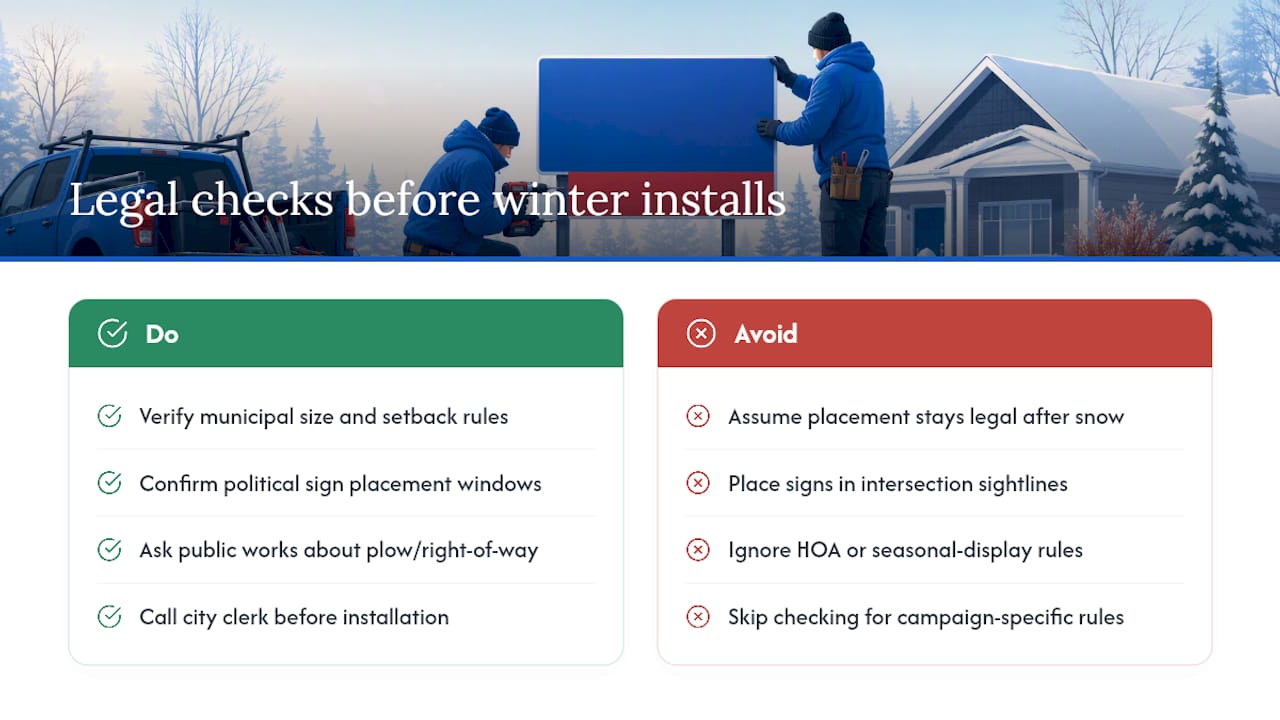
Sign rules don’t take a winter break, and in some ways they matter more once snow changes what’s visible from the road. Most municipalities regulate yard sign size, setback from the street, and how close a sign can sit to an intersection, and none of those rules loosen just because it’s January. Political signage in particular often has its own placement windows tied to election dates, separate from general commercial sign ordinances.
Winter adds a practical wrinkle: snowbanks and plow operations change what counts as a public right-of-way in practice, even when the legal boundary hasn’t moved. A sign that was legally placed on your property line in October can end up sitting inside the area a plow needs to clear once snow piles up, and that’s a fast way to lose a sign to a plow blade regardless of what the ordinance says. Check with your local public works department before a big snow season if you’re running a multi-sign campaign.
HOA rules and seasonal display ordinances are worth a second look too. Some communities cap how early holiday-season signage can go up or how long it can stay after the new year, separate from any commercial sign code. If you’re running signage for a business promotion, a political campaign, or a community event, a five-minute call to your city clerk’s office before install day is cheaper than a fine or a confiscated sign later.
What Actually Separates a Sign That Survives Winter From One That Doesn’t
Most advice on winter signage treats cold weather as a minor inconvenience, something you push through with a heavier stake and call it done. That’s backwards. The temperature spec on your material matters more than almost any other decision you’ll make, because a sign that fails at the adhesive or plastic level can’t be saved by a better install job.
What’s overrated is the assumption that any corrugated plastic will do if you just staple it down hard enough. It won’t. What’s underrated is how much a 20 minute warm-up break and a pre-drilled pilot hole change your success rate on install day. Field crews who’ve worked through frozen elections figured this out the hard way, and it shows in how consistently drills and hammers show up in their kits instead of a mallet alone.
If you take one thing from this guide, prioritize material spec first, installation tactics second, design third. A beautifully designed sign on the wrong plastic still fails by February. A well-chosen 4mm or 80 mil sign, installed with a pilot hole and a decent stake, tends to still be standing when the snow melts.
— YardSignGuy
Get Winter-Ready Signs Without the Wait
Yardsigns solves the timing problem that trips up most winter campaigns: needing signage fast, in materials that won’t crack the first time the temperature drops. Orders under 50 pieces ship within 24 hours, which means a cold-front deadline or a last-minute event doesn’t have to mean scrambling with a home printer or waiting a week on a standard order.

If you’re planning a winter promotion, campaign, or community event, start with the material question. Choose 4mm corrugated plastic for a single season or 80 mil for multi-year use, and build your order around your actual timeline rather than guessing. Reviewing your Q4 promotional calendar before you order also helps you time signage drops to when foot traffic and interest actually peak. Request a design proof, lock in your quantity, and place your order at Yardsigns to get signage in hand before the next cold front hits.
Sources
For deeper technical specs, Avery Dennison’s cold-weather vinyl guidance and ND Graphics’ cold-application overview cover application temperatures in detail. For real-world installation tactics, the Toronto Star’s winter election coverage documents crews solving frozen-ground problems in real time.
- Avery Dennison: Winter-proof your vinyl installs
- ND Graphics blog: Keep installing outdoors even during cold weather
- Orcon Industries: Why corrugated plastic containers crack in cold weather
- Toronto Star: Snow boots, drill bits and rebar — how candidates are tackling Ontario’s first winter election
FAQ
Can Yard Signs Survive Freezing Temperatures?
Yes, if you use cold-rated vinyl and adhesives rated to around −20°C (−4°F) and store materials warm until installation; standard vinyl often fails below 5°C (41°F).
What Thickness Corrugated Plastic Works Best for Winter?
Use 4mm corrugated plastic for a single winter season and 80 mil stock if the sign needs to last 12 or more years.
How Do You Install a Sign in Frozen Ground?
Drill a pilot hole with a masonry bit first, then drive a heavier stake with a mallet; use sandbags as an anchor when the ground won’t take a stake at all.
Do I Need Special Lighting for Winter Signs?
Reflective tape or a small solar path light extends visibility into early winter darkness and helps signs stand out against snow glare during the day.
How Fast Can I Get Signs Made for a Last-Minute Winter Campaign?
Orders under 50 pieces can ship quickly, which covers most last-minute winter timing needs for campaigns or promotions.
