


Cold Weather Yard Signs: Use 4mm for One Season, 80 mil for 12+ Years
For most winter campaigns, 4mm corrugated plastic with a premium laminate is the smartest buy for one season of hard use, while 80 mil aluminum with a reflective laminate is the right call when a sign needs to survive multiple winters. Either way, skip the thin H-wire stakes: frozen ground calls for 1/4" gauge galvanized step stakes or 3/8" fold-over frames, and non-diggable surfaces call for a weighted tent frame. Order early where you can, but a supplier with fast small-run turnaround keeps you covered even when winter weather forces a last-minute order.
TL;DR:
- Using heavy-gauge stakes or fold-over frames is essential for sign stability on frozen ground, preventing bending or toppling during winter storms.
- For signs lasting only one winter, 4mm corrugated plastic with basic or premium laminate is sufficient, but multi-year durability requires 80 mil aluminum with a reflective or diamond-grade laminate.
- High-contrast colors and proper placement are critical for visibility against snow and glare, with larger lettering and reflective or backlit elements increasing readability in low light.
- Regular inspection, cleaning, and proper storage extend a sign’s lifespan, with minor repairs and prompt reordering preventing premature failure.
- Fast-shipping suppliers offering small, quick-turnaround orders help ensure signs arrive on time despite last-minute weather changes or campaign needs.
Table of Contents
- What Materials Actually Hold Up to Snow, Ice, and Freeze-Thaw?
- How Do You Keep a Sign Standing in Frozen Ground?
- What Design Choices Keep a Sign Visible in Snow and Glare?
- How Long Should a Cold-Weather Yard Sign Actually Last?
- Why This Guide’s Recommendations Hold Up
- What the Industry Gets Wrong About Winter Signage
- Order Winter-Ready Signs Without the Wait
- Sources
- FAQ
What Materials Actually Hold Up to Snow, Ice, and Freeze-Thaw?
Not every yard sign is built for winter, and the material you choose determines whether your sign is still readable in February or a cracked, faded mess by New Year’s Day. The three materials worth considering each solve a different problem, and picking the wrong one for your timeline is the most common (and expensive) mistake buyers make.
Corrugated plastic (4mm) is the workhorse of seasonal signage. It’s lightweight, inexpensive, and holds up well against rain and snow. Merchants commonly rate 4mm corrugated plastic signs printed with UV-resistant inks to last about one year outdoors under normal exposure, which makes it a strong fit for a single winter’s worth of political campaigning, real estate listings, or holiday promotions. Its fluted core does have a weak point: repeated freeze-thaw cycles can eventually cause delamination at the edges if the sign sits in standing water or gets buried in a snowbank for weeks.
Heavy-duty aluminum (80 mil) is the upgrade you make when a sign needs to survive more than one winter. It won’t crack in subzero temperatures the way plastic can become brittle, and it shrugs off the kind of wind-driven ice pellets that shred lighter substrates. Paired with a reflective laminate, 80 mil aluminum can deliver 12 or more years of outdoor life, with a service temperature rating up to around 168°F, which tells you it’s built to handle both a brutal January and a blistering July without warping. This is the material municipalities and traffic departments lean on for exactly that reason: multi-season durability paired with high visibility.
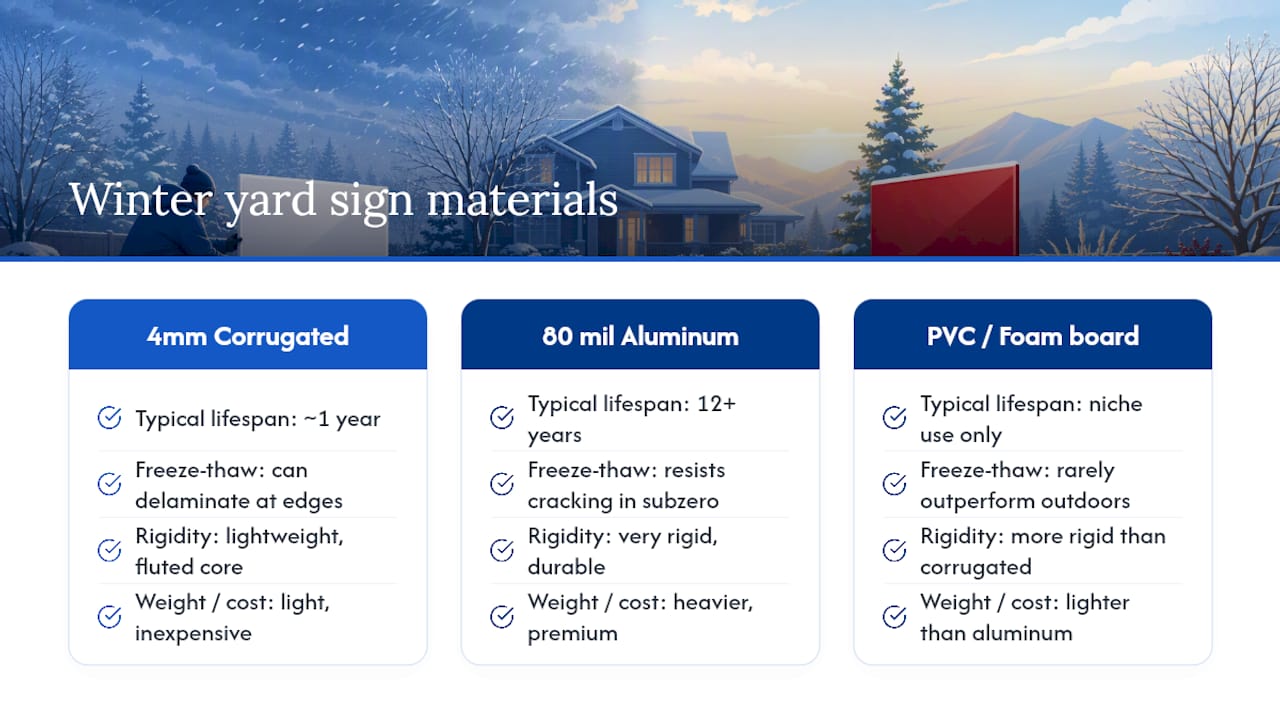
PVC and foam board sit in a narrower niche. They offer more rigidity than corrugated plastic without the weight or cost of aluminum, which makes them useful for indoor-to-outdoor transitions like storefront displays or trade show signage that occasionally goes outside. For ground-mounted winter signage exposed to wind and moisture for weeks at a time, they rarely outperform corrugated plastic or aluminum, so most buyers can skip this option unless a specific rigidity need applies.
Why the Laminate Matters as Much as the Board
The substrate gets most of the attention, but the laminate is doing the real work against winter’s specific abuse: UV fade from low-angle winter sun reflecting off snow, abrasion from wind-blown grit and road salt, and moisture creeping in at the edges. Premium laminates like 3M SmartShield and ProShield offer noticeably better resistance to fading and abrasion than standard laminates, and a reflective option like Diamond Grade adds low-light visibility that matters when daylight runs out by 4:30 p.m.
Pro Tip: If your sign will sit within 10 feet of a sidewalk or plowed road, budget for the premium laminate. Rock salt and sand kicked up by snowplows do more abrasion damage in one winter than a full year of ordinary weather.
Use this quick checklist before you order:
- Single winter, one campaign: 4mm corrugated plastic with a standard or premium laminate.
- Multi-season use across several winters: 80 mil aluminum with a premium laminate.
- High-traffic or roadside placement: aluminum with reflective laminate for visibility after dark.
- Budget-limited short runs: corrugated plastic; save the aluminum upgrade for signs that need to last.
- Municipal, safety, or long-term directional signage: aluminum with Diamond Grade reflective, matching the standard used in traffic-facing applications.
The pragmatic rule holds up well in practice: match the substrate to the campaign duration, not to what looks impressive. A homeowner selling a house in a six-week winter window doesn’t need aluminum. A contractor who reuses the same job-site signs every winter for a decade absolutely does.
How Do You Keep a Sign Standing in Frozen Ground?
Frozen soil is unforgiving, and it exposes the weakest link in most yard sign setups fast: cheap hardware. Standard thin H-wire stakes bend, snap, or simply refuse to penetrate ground that’s frozen solid a few inches down. If you’ve ever watched a sign topple over in a January windstorm, the stake was almost always the problem, not the sign.
1. Upgrade to heavier-gauge stakes. Field practitioners recommend 1/4" gauge galvanized wire step stakes or 3/8" round rod fold-over frames specifically because they can push through frozen turf that would bend a standard wire stake in half.
2. Switch to a fold-over step frame for repeated use. These frames grip the sign along a folded edge rather than through two small slots, distributing wind load more evenly and reducing the tearing that happens around stake holes in brittle winter plastic.
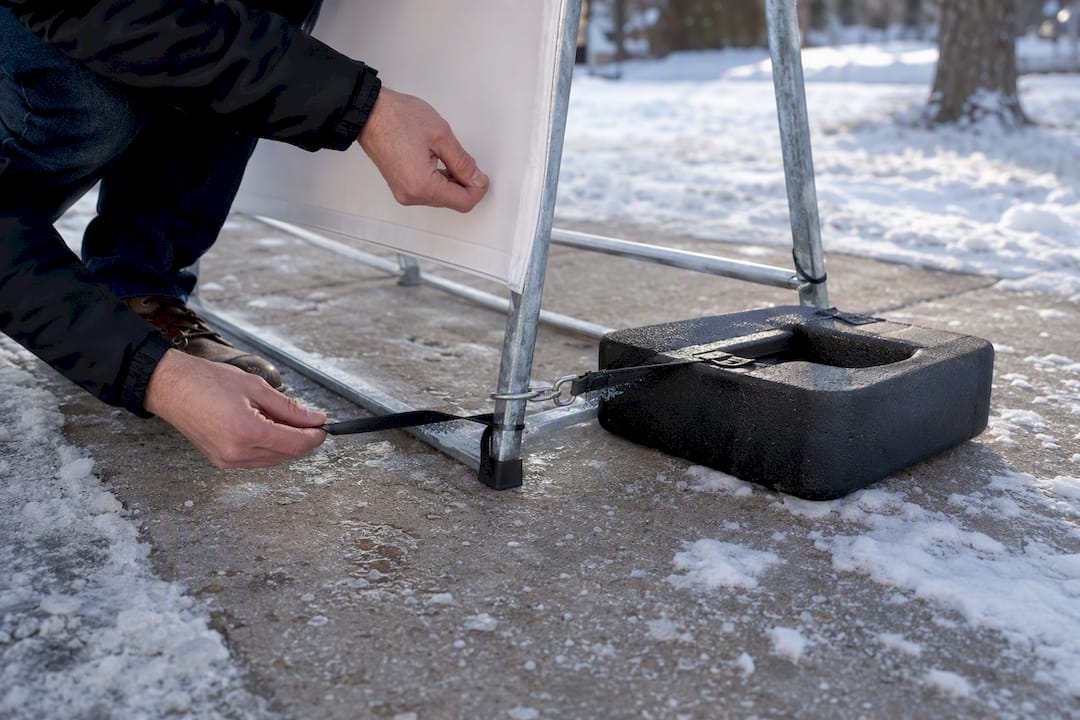
3. Use a tent frame on hard surfaces. When you’re placing a sign on a sidewalk, driveway, or frozen lawn where driving a stake is simply impossible, a folding tent frame gives you stability without digging, and the slight motion in wind actually draws more eyes than a rigid, static sign.
4. Anchor against wind and snow load. Sandbags, weighted bases, or a short length of rebar driven at an angle through the stake loop all add ballast. Heavy wet snow piling against the base of a sign is often what pulls a stake loose, not the wind alone.
5. Warm the ground before you dig, if you can. Pouring warm (not boiling) water over the stake point a few minutes before installation softens frozen topsoil enough to get a clean placement without hammering the stake sideways and bending it.
For real estate signs specifically, the stakes-versus-frozen-ground problem shows up every listing season, and it’s worth reviewing dedicated installation tips for weather-resistant real estate signs if you’re placing signs across multiple properties at once. Whichever method you choose, always check local right-of-way rules before staking near a road, since plow crews and utility markers take priority over signage in the shoulder.
What Design Choices Keep a Sign Visible in Snow and Glare?
A sign that survives the weather but disappears against a white background has failed at its actual job. Snow creates two visibility problems at once: it washes out pale colors entirely, and it reflects enough glare during the day to blow out low-contrast text.
- Go high contrast, always. Dark backgrounds with bright, saturated text (navy or black with white, or red with white) hold up against snow far better than pastel palettes or light gray fills that vanish next to a snowbank.
- Size type for distance, not for the design mockup on your screen. A sign read from a moving car at 25 mph needs letters at least 3 inches tall for headline text; anything smaller reads as a blur past 40 feet.
- Add reflective vinyl or a backlit element for early darkness. Reflective and backlit accents extend a sign’s readability well past sunset, which matters once winter days shrink to nine hours of daylight.
- Place signs where sightlines actually work. Keep them clear of plow paths, off the edge of snowbanks that will bury the bottom third of the panel, and angled toward the direction most drivers or walkers approach from.
- Design seasonal, not strictly holiday. A winter-themed sign with snowflakes or cold-weather graphics stays usable from November through March, while a “Merry Christmas” specific design is dead weight by December 26. If you want inspiration for that kind of seasonal, non-holiday visual style, winter outdoor photography setups offer a good sense of how light and snow interact with color choices outdoors.
Getting placement wrong is one of the most common yard sign mistakes, and it costs you far more in lost visibility than a slightly pricier laminate ever would.
How Long Should a Cold-Weather Yard Sign Actually Last?
Every sign has a realistic shelf life, and knowing what to expect keeps you from either replacing signs too early or leaving a failing one up too long.
- Check after every storm. Walk the sign after heavy snow, ice, or wind and inspect the stake connection, grommets, and edges for early delamination, the telltale bubbling or peeling where the laminate starts separating from the print.
- Clean off salt and slush regularly. A soft brush and a mild soap solution removes road salt and abrasive grit before it grinds into the laminate surface; avoid harsh solvents that can cloud the coating.
- Store signs flat and dry in the off-season. Stacking signs loosely in a garage protects laminate edges far better than rolling them or leaning them against a wall where corners bend and crack.
- Know when to repair versus replace. Minor grommet tears or a bent stake are worth fixing. Cracked panels, faded print past readability, or laminate peeling across more than a small section mean it’s time to reorder.
- Plan around realistic lifespan ranges. Corrugated plastic with a standard laminate typically holds up for about one season to twelve months under regular winter exposure, while aluminum with a premium laminate can run 10 or more years in the same conditions. A deeper breakdown of how weather specifically shortens or extends sign life is worth a look if you’re budgeting for multiple seasons at once.
Why This Guide’s Recommendations Hold Up
The hardware and material specs in this guide aren’t guesswork. They come from the same shop-floor decisions that go into producing signs meant to survive actual winters, not just look good in a rendering.
Fast turnaround matters more in winter than any other season. A storm, a last-minute event, or a sudden campaign deadline doesn’t wait for a two-week production schedule, and a supplier that ships small runs within 24 hours is the difference between having signage in the ground on time and missing the window entirely.
Some suppliers build orders around that reality. Suppliers with fast turnaround may ship smaller orders quickly, and signs often come printed with double-sided UV-resistant inks. That combination of speed and material quality is exactly why the guidance above leans so heavily on premium laminates and proper hardware gauges: a sign is only as good as its weakest component, and weather doesn’t care which one that is. Readers who want a deeper look at how these production choices translate into real durability can review the research behind weatherproof signage material selection.
What the Industry Gets Wrong About Winter Signage
Most advice on cold-weather signage focuses almost entirely on the print, the colors, the message, and treats the hardware as an afterthought. That’s backwards. A beautifully designed sign on a bent, thin-wire stake face-down in a snowbank by Tuesday morning has failed completely, regardless of how good the artwork was.
The conventional wisdom also oversells “weatherproof” as a single tier, when in reality there’s a wide gap between a sign that merely survives one storm and one built for a full winter of freeze-thaw cycles, road salt, and plow spray. Buyers who skip the laminate upgrade to save a few dollars often end up reordering mid-season anyway, which costs more in the long run than paying for the right laminate up front.
If there’s one thing to prioritize first, it’s matching the hardware to the ground, not just the sign to the message. Get that right, and everything else, the material, the laminate, the design, has a fighting chance of actually being seen.
— YardSignGuy
Order Winter-Ready Signs Without the Wait
Certain suppliers get your cold-weather signage into the ground fast, not weeks from now: orders under 50 pieces may ship within 24 hours, so a sudden cold front or a last-minute event never catches you without signage.
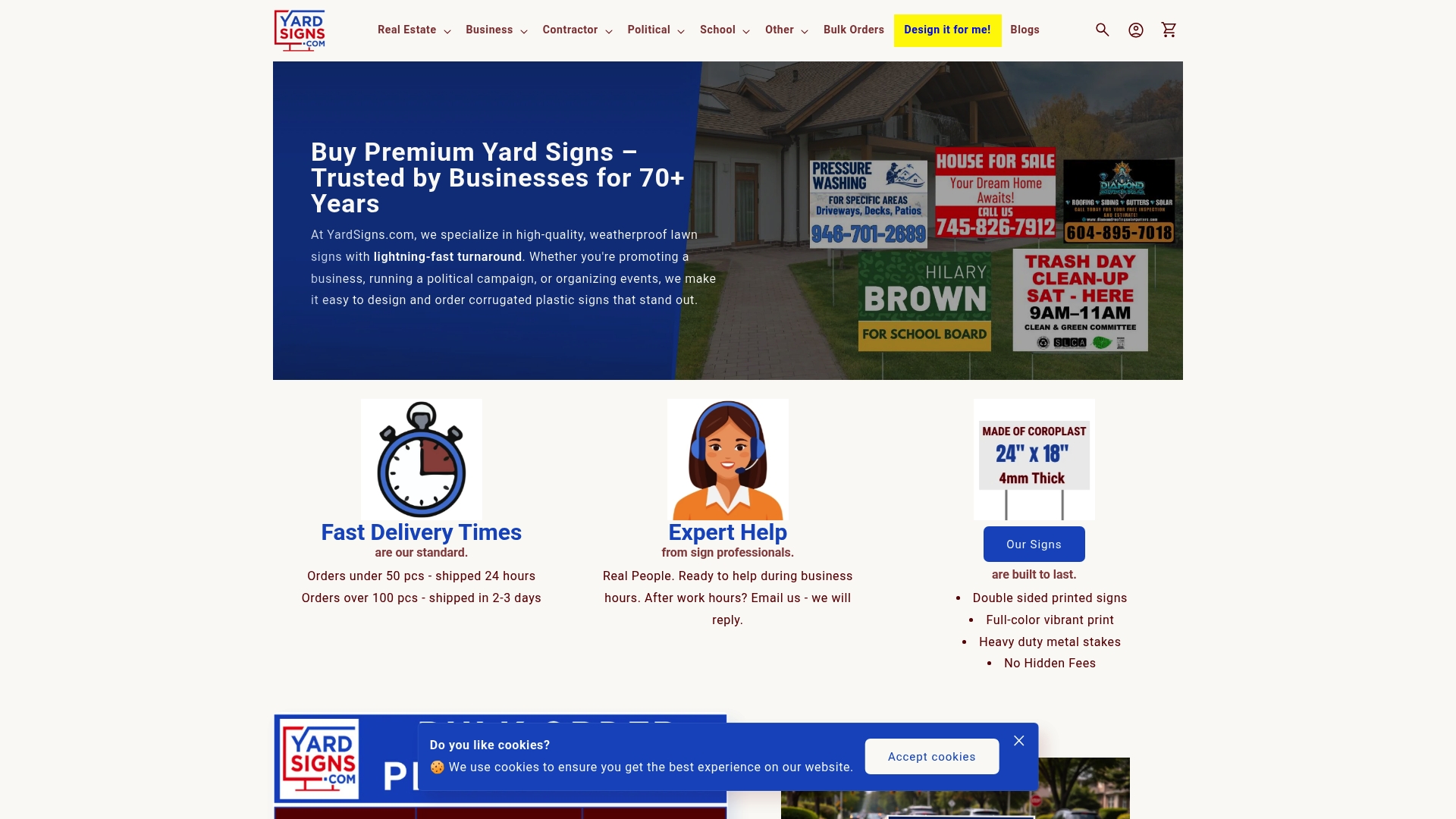
The lineup covers everything this guide recommends. Choose 4mm corrugated plastic for single-season campaigns, or step up to heavy-duty aluminum when a sign needs to survive multiple winters outdoors. Orders often include double-sided UV-resistant printing, and premium laminates may be available for extra fade and abrasion resistance in high-exposure spots. Metal H-stakes may be included, with heavier-gauge step stakes and tent frames available as add-ons for frozen ground or hard surfaces where digging isn’t an option. Free design proofs and unlimited revisions may be offered to reduce guesswork at layout before shipment.
If you’re organizing a winter fundraiser or community event, the charity fundraising event sign template is built for exactly that kind of outdoor, weather-exposed use. Pick your material, upload your design, and get a proof back before you’ve finished your coffee.
Sources
The technical claims in this guide draw on manufacturer specifications for aluminum signage and laminate performance, along with practitioner guidance on cold-weather installation hardware.
FAQ
What material is best for cold weather yard signs?
For a single winter’s use, 4mm corrugated plastic with a UV-resistant laminate performs well and keeps costs low. For signs that need to survive multiple winters, 80 mil aluminum with a premium reflective laminate is the more durable choice.
Where is the cheapest place to get yard signs?
Pricing varies by order size and material, but small last-minute orders tend to cost less overall with suppliers who ship fast and avoid rush fees. Yardsigns ships orders under 50 pieces within 24 hours without requiring a large minimum order.
What are some good sayings for winter signs?
Seasonal, non-holiday phrasing extends a sign’s usable window across the whole winter instead of just a two-week holiday stretch. Phrases built around cold-weather themes rather than specific holidays, like general “winter hours” or “season” messaging, keep signs relevant from November through March.
What are common yard sign mistakes in winter?
The most frequent mistakes are using thin H-wire stakes in frozen ground, choosing pale colors that wash out against snow, and placing signs where snowplows or snowbanks will bury or knock them over. Upgrading to gauge-specific stakes and high-contrast designs solves both problems at once.
How long do winter yard signs typically last?
Corrugated plastic with a standard laminate typically lasts around one season to twelve months under regular winter exposure. Aluminum with a premium laminate can last 12 or more years depending on conditions and maintenance.
