


Affordable Outdoor Signage Strategy for Small Businesses
Your three highest-impact, lowest-cost outdoor signage moves are yard signs on coroplast, A-frame sidewalk boards, and vinyl banners or window graphics. Together, they cover short-term promotions, foot-traffic capture, and storefront branding at a fraction of what digital display advertising costs. Static outdoor placements typically run at a low cost per thousand impressions in major metro markets, making them one of the most cost-efficient channels available to a local business.
Your first three steps, executable within 24–72 hours:
- Order yard signs now. Choose 18×24 inches for residential neighborhoods or 24×36 inches for arterial roads and commercial strips. A run of 25–50 standard coroplast signs is the most common entry point for small businesses. Yardsigns ships orders of under 50 pieces within 24 hours.
- Place one A-frame at your storefront entrance. Position it at eye level, angled toward foot traffic, with a single headline and a clear call to action (CTA). No permit is usually required on private property.
- Add a vinyl banner or window graphic to your highest-visibility facade. A 2×6-foot vinyl banner typically costs $30–$80 and can go up the same day it arrives.
This is the core of any affordable outdoor signage marketing strategy: start with the formats that are cheapest to produce, fastest to deploy, and easiest to reuse.
Table of Contents
- 1. Which sign types give you the best return for the money?
- 2. Design rules that make inexpensive signs readable at speed
- 3. Where to place signs so they actually get seen
- 4. How to cut production costs without sacrificing durability
- 5. Low-cost ways to measure whether your signs are working
- 6. How to keep your signs looking good longer
- 7. What you need to know about permits before you place a sign
- Key Takeaways
- What small-business sign campaigns actually teach you
- Yardsigns makes fast, durable signs straightforward to order
- Useful sources for further reading
1. Which sign types give you the best return for the money?
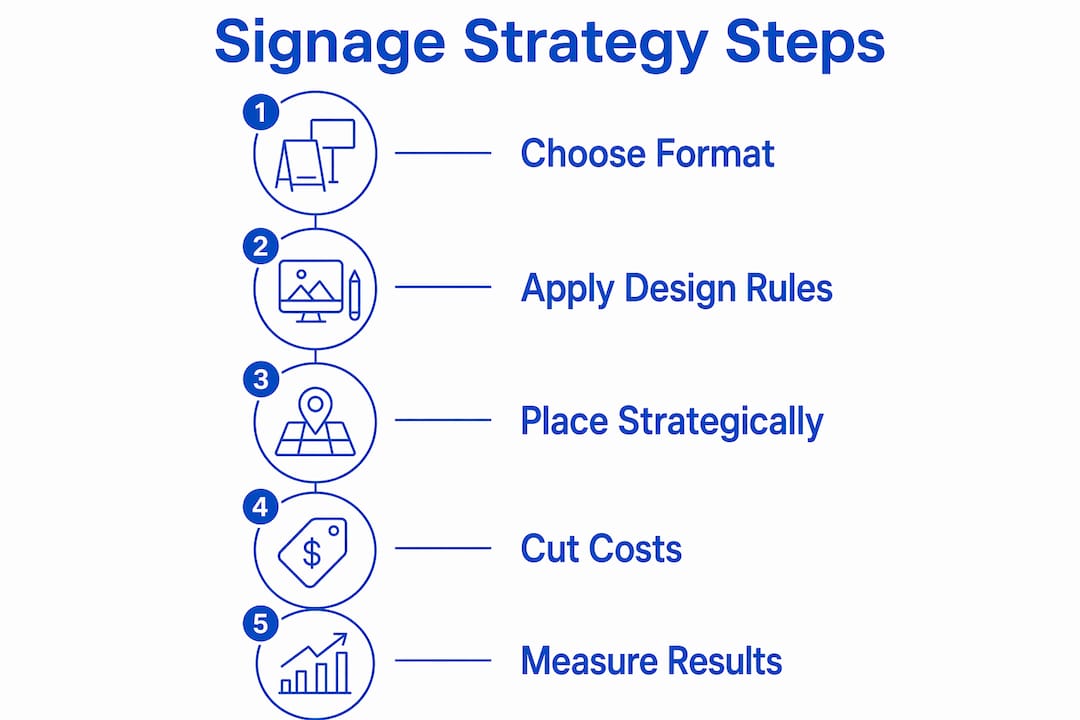
Not every format fits every situation. The table below maps each type to its best use case, realistic cost, and durability so you can pick the right tool without guessing.
| Sign Type | Best For / Use Case | Typical Cost Range | Durability / Lifespan | Install / Portability |
|---|---|---|---|---|
| Coroplast yard sign (4mm) | Short-term promos, events, residential | $5–$20 per sign | 1–2 years outdoors | H-wire stake; lightweight |
| Coroplast yard sign (6mm) | Construction sites, arterial roads | $30–$80 per sign | 2–4 years | Step stake or frame |
| Vinyl banner | Grand openings, sales, events | $30–$80 (2×6 ft) | 2–5 years with grommets | Rope/zip ties; rollable |
| A-frame / sandwich board | Sidewalk daily specials, retail | $50 (frame) | 3–7 years (frame) | Foldable; no tools needed |
| Window graphic | Storefront branding, hours, promos | $20–$100 | 1–3 years | Adhesive; removable |
| Magnetic vehicle sign | Service area advertising, delivery | $30–$80 per pair | 2–3 years | Removable; no damage |
| Wall poster / mural | Downtown, high-foot-traffic areas | $10–$50 per poster | Weeks to months | Paste or tape |
Posters and murals remain a genuinely underused tactic for neighborhood and downtown placements. They produce fast, affordable visibility where pedestrian density is high.
Quick pros/cons by format:
- Yard signs: Low cost per unit, fast to deploy, easy to reuse with new inserts. Single-sided saves money for roadside placements; double-sided is worth the small premium at intersections where traffic approaches from both directions.
- Vinyl banners: High visual impact for the price. Grommeted edges extend lifespan significantly. Avoid cheap hems that fray in wind.
- A-frames: Reusable frames with swappable inserts cut long-term cost. Best for businesses with daily or weekly message changes.
- Window graphics: Zero placement cost since they use your own property. Perforated vinyl lets light through while maintaining visibility from outside.
- Magnetic vehicle signs: Turn any company vehicle into a moving billboard at no recurring cost. Remove before car washes.
2. Design rules that make inexpensive signs readable at speed
One idea per sign. That is the rule that separates signs people read from signs people ignore.
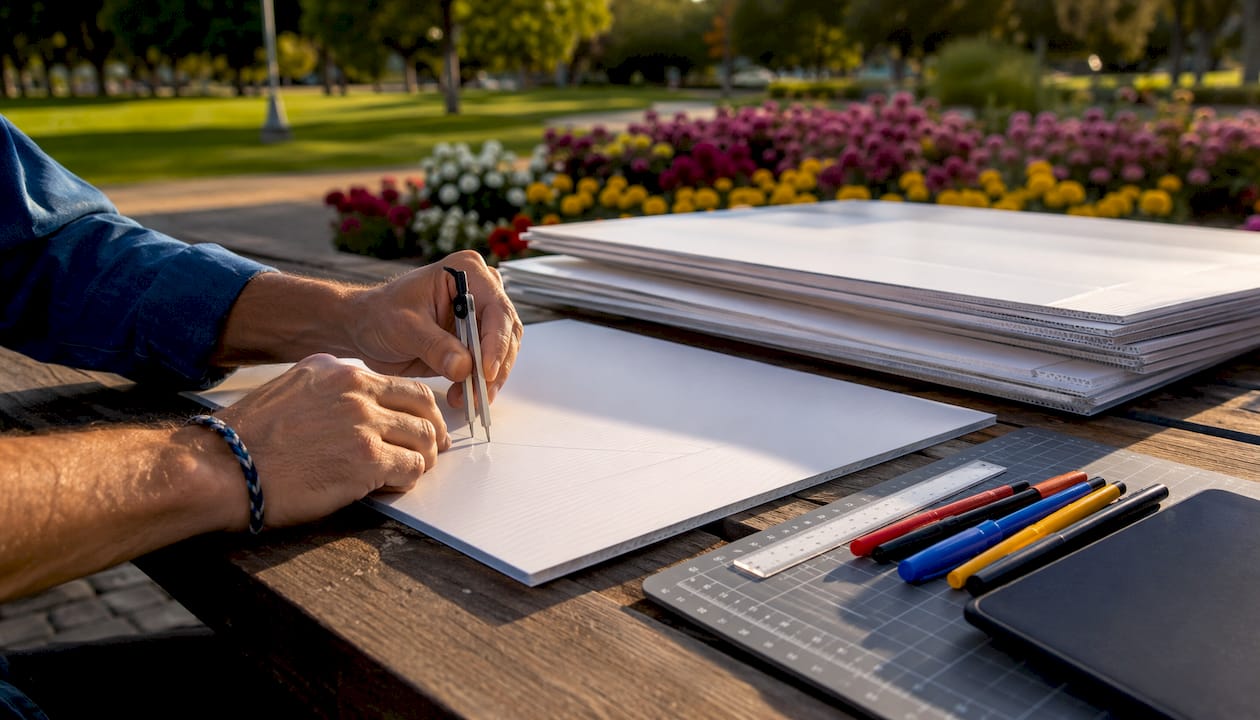
You have roughly three seconds to capture attention from a moving vehicle. Every additional word you add past the essential message cuts comprehension. Keep your headline to five words or fewer, and treat everything else as optional.
Specific rules for outdoor legibility:
- Letter height to distance: Every inch of letter height adds approximately 30 feet of legibility distance. A 3-inch headline is readable from 90 feet; a 6-inch headline reaches 180 feet.
- Font choice: Use bold sans-serif typefaces (think Impact, Arial Black, or similar). Decorative or script fonts fail at distance.
- Color contrast: Dark text on a light background, or light text on a dark background. High-contrast pairs like black on yellow or white on navy consistently outperform low-contrast combinations. For color-blind accessibility, avoid red-on-green combinations.
- CTA placement: Put your call to action at the bottom third of the sign where the eye naturally lands after reading the headline.
- QR codes: Size them at a minimum 1.5×1.5 inches and place them in a consistent corner. Smaller than that and casual scanning from a sidewalk becomes unreliable.
Pro Tip: Test your design by photographing it on your phone from 30 feet away. If you can’t read the headline in under two seconds, the font is too small or the contrast is too low. Fix it before you print 50 copies.
For a deeper set of layout rules, Yardsigns covers yard sign design tips that apply directly to any coroplast or vinyl format.
3. Where to place signs so they actually get seen
Placement backed by traffic and POI data consistently outperforms placement based on gut feel. The busiest intersection is not always the right one. The right one is where your specific audience moves through regularly.
Placement validation checklist:
- Identify your top three customer types and map where they live, work, and shop.
- List candidate sites: intersections within a half-mile of those POIs, retail clusters, commuter corridors, and community hubs.
- Check sightlines on foot. A sign behind a utility pole or obscured by a parked truck is invisible. Walk the site at the time of day your audience passes through.
- Estimate Daily Effective Circulation (DEC) by requesting traffic count data from your city’s public works department or using free tools like Google Maps traffic overlays.
- Score each site: traffic match (does this audience fit?), sightline quality, legal/permit risk, and estimated CPM.
Where specific sign types perform best:
- Yard signs: residential neighborhoods near your service area, within two blocks of your storefront, and at high-visibility corners near schools or parks.
- A-frames: directly outside your entrance or at the nearest pedestrian corner if local ordinances allow.
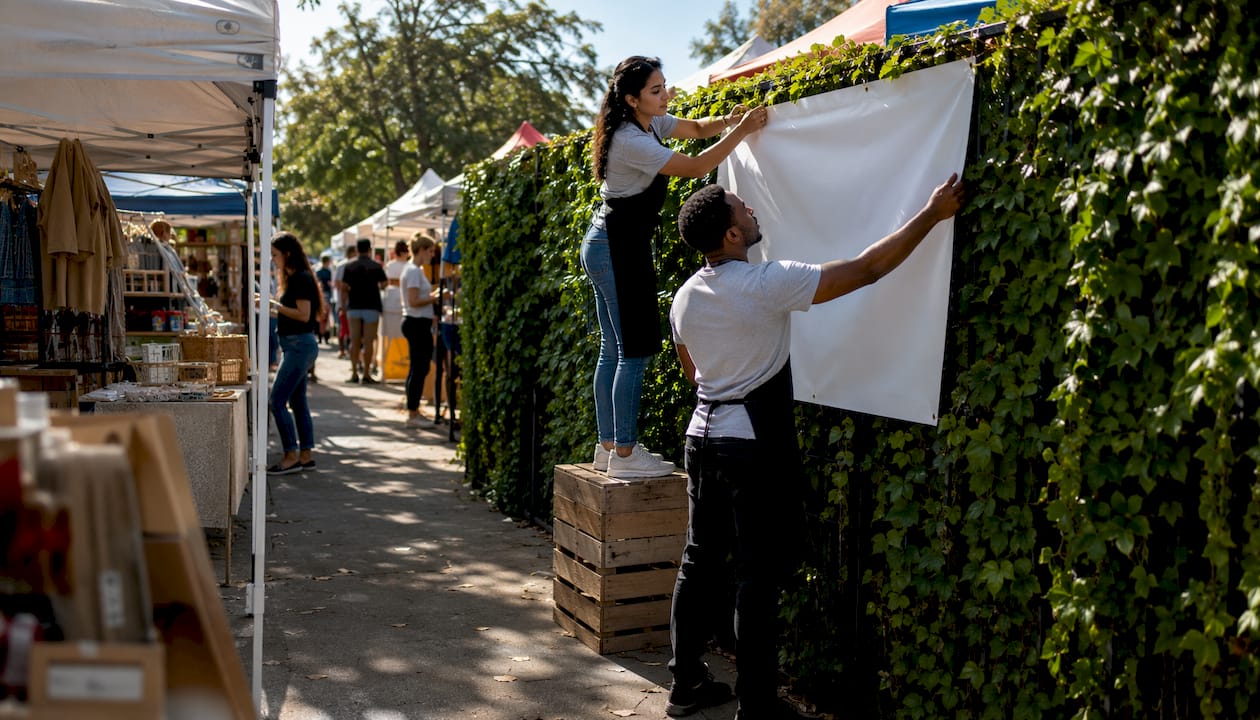
- Vinyl banners: attached to your building facade or fencing, facing the direction of highest traffic flow.
- Vehicle magnetics: any vehicle that parks in customer-dense areas during business hours.
Pro Tip: After placing signs, set up a simple geofence around each location using a platform like Google Ads or Meta Ads. Any device that passes your sign location can be retargeted digitally, closing the awareness loop between outdoor exposure and online conversion.
For retail-specific placement guidance, Yardsigns has a practical breakdown of outdoor sign placement that covers sightline and zoning considerations.
4. How to cut production costs without sacrificing durability
Bulk ordering and correct material selection are the two levers that cut long-term signage costs most reliably. Everything else is secondary.
Production setup costs are largely fixed regardless of quantity. That means the per-unit price falls sharply as your order size grows. A run of 100 signs can cost dramatically less per piece than a run of 25, even though the total spend is higher. Calculate your true per-piece price by dividing total setup plus run cost by quantity before committing to a small order.
Cost-saving checklist:
- Batch your orders. If you know you’ll need signs for three events this quarter, order them together rather than in three separate runs.
- Stick to standard sizes. Custom dimensions trigger setup fees. 18×24 and 24×36 are the two sizes that avoid most of those charges.
- Choose material based on duration. 4mm coroplast is right for campaigns under 60 days. For multi-week construction or commercial placements, step up to 6mm coroplast or aluminum. Cheap H-wire stakes are fine for short residential runs but fail in high-wind conditions or near heavy traffic.
- Go double-sided only at intersections. Single-sided signs cost less and work perfectly for one-directional placements.
- Reuse your frames. A-frame bodies and banner hardware are reusable assets. Budget for the frame once; replace only the insert.
- Time seasonal orders early. Printing demand spikes before major holidays and election seasons. Ordering four to six weeks ahead typically avoids rush fees.
Pro Tip: If you’re testing a new campaign, order a small run first (25 signs) to validate placement and message. Once you confirm performance, reorder at a higher quantity to capture the per-unit savings. Yardsigns’s 24-hour turnaround on orders under 50 pieces makes this test-then-scale approach practical.
5. Low-cost ways to measure whether your signs are working
Measure with unique response channels and short test windows. You don’t need enterprise analytics to know if a sign is driving business.
Tracking methods by cost and signal quality:
- Unique promo codes: Print a code like SIGN20 on each sign location. Track redemptions in your POS system. Cost: $0. Signal: direct attribution.
- QR codes with UTM parameters: Each sign location gets its own QR code linking to a UTM-tagged URL. Google Analytics shows you exactly which location drove traffic. Cost: $0 with free QR generators. Signal: strong for digitally active audiences.
- Dedicated phone numbers: Use a call-tracking service to assign a unique number to each sign. Cost: $10–$30/month per number. Signal: strong for service businesses.
- Foot-traffic counts: Count customers before and after sign deployment. Simple tally sheets work. Cost: $0. Signal: directional, not precise.
- Customer surveys: Ask new customers how they heard about you. Works best at point of sale. Cost: $0. Signal: self-reported, useful for trend confirmation.
Running a two-arm A/B test on your signs:
- Pick one variable to test: headline copy, CTA, or placement location.
- Deploy Version A at Site 1 and Version B at Site 2 for two full weeks.
- Track response using unique promo codes or QR codes for each version.
- At the end of the test window, compare response rates. The winning version becomes your control for the next test.
Keep test windows short (two to four weeks) and change only one variable at a time. Testing two things simultaneously makes it impossible to know which change drove the result.
6. How to keep your signs looking good longer
A faded or bent sign reflects poorly on your business. The good news is that most sign damage is preventable with simple habits.
Maintenance by material:
- Coroplast: Wipe down with a damp cloth monthly. Avoid pressure washing, which can delaminate the printed surface. Store flat in a dry location between campaigns.
- Vinyl banners: Loosen tension during high-wind events to prevent tearing at the grommets. Roll (don’t fold) for storage to avoid crease lines that show up in photos.
- A-frames: Check hinges and locking mechanisms monthly. Sand and repaint metal frames showing rust spots before corrosion spreads.
- Aluminum signs: UV-resistant printing is the key spec to request. Powder-coated aluminum resists rust and handles years of outdoor exposure without fading.
For multi-week or permanent placements, the material choice at purchase matters more than any maintenance routine. Investing in 6mm coroplast or aluminum upfront costs more per sign but avoids the replacement cycle that makes cheap signs expensive over time. Yardsigns covers the durability case in detail for outdoor event signage, and the same principles apply to permanent business placements.
Inspect all outdoor signs after major weather events. Wind, hail, and heavy rain are the primary causes of premature sign failure. A sign that has shifted off its stake or torn at a corner should be reset or replaced immediately.
7. What you need to know about permits before you place a sign
Sign regulations vary significantly by city, county, and state. Placing a sign without checking local rules can result in fines or forced removal, which wastes both money and time.
The most common permit triggers:
- Size: Many municipalities cap temporary signs at 32 square feet. A standard 24×36 sign is well within that limit; larger banners may not be.
- Duration: Temporary sign permits often limit display to 30–90 days. Permanent signs require a separate permit category.
- Placement on public property: Signs in road rights-of-way, on utility poles, or on public sidewalks are prohibited in most jurisdictions without specific authorization.
- Zoning district: Commercial zones typically allow more signage than residential zones. Mixed-use districts vary.
- HOA rules: If your business operates in or near a residential community with an HOA, their rules may be stricter than municipal code.
How to check before you place:
Contact your city or county planning department directly. Most have a sign permit section on their website with fee schedules and application forms. Many temporary sign permits cost $25–$100 and can be obtained in a few business days. For A-frames on public sidewalks, check with your city’s business licensing office, as many cities have a sidewalk vending or signage program with specific dimensions and placement rules.
Private property placements (your own storefront, a landlord’s permission, a neighbor’s yard with consent) generally require no permit for temporary signs below the size threshold. Always get landowner permission in writing.
Key Takeaways
An affordable outdoor signage marketing strategy works best when you match the right format to the right location, order in bulk to cut per-unit cost, and measure results with unique response channels from day one.
| Point | Details |
|---|---|
| Start with three formats | Yard signs, A-frames, and vinyl banners cover most small-business needs at the lowest entry cost. |
| Size signs for your road type | Use 18×24 inches for residential placements and 24×36 inches for arterial or commercial roads. |
| Bulk ordering cuts cost | Fixed setup costs mean per-unit price drops sharply at higher quantities; calculate true per-piece cost before ordering small. |
| Measure with unique channels | Assign a unique promo code, QR code, or phone number to each sign location to track direct response. |
| Yardsigns for fast turnaround | Yardsigns ships orders under 50 pieces within 24 hours, making it a practical option for test runs and urgent campaigns. |
What small-business sign campaigns actually teach you
Most owners underestimate how much placement validation matters relative to sign quality. A beautifully printed sign at the wrong intersection will underperform a basic coroplast yard sign placed where your actual customers walk past every morning.
The second lesson that surprises people: production setup costs. Many small businesses order 10 signs, see a reasonable per-unit price, and assume ordering 50 would cost five times as much. It usually costs two to three times as much, not five, because the setup cost is already paid. That gap is real money left on the table.
The third thing worth saying plainly: outdoor signage does not require a big budget to work. Static placements at $2–$6 CPM outperform most digital display channels on a pure cost-per-impression basis for local audiences. The businesses that get the most from outdoor signs are the ones that treat placement as a data problem, not a creative one. Pick the right spot first. Then worry about the design.
Yardsigns makes fast, durable signs straightforward to order
For small businesses that need signs quickly and can’t afford to wait on a slow production cycle, Yardsigns delivers orders under 50 pieces within 24 hours, with weatherproof materials and vibrant full-color printing that holds up through rain, wind, and sun.
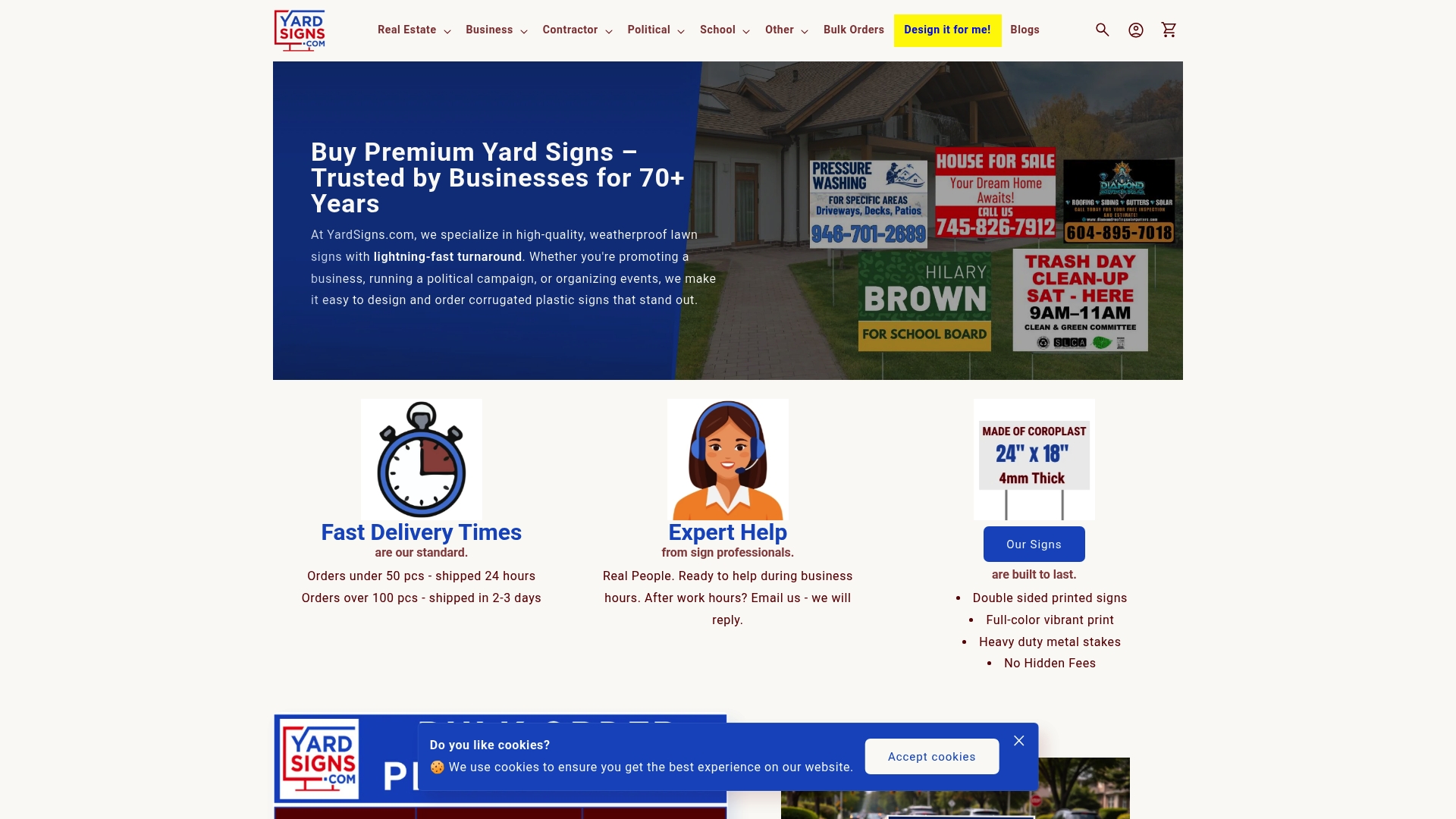
Ordering is direct: pick a standard size (18×24 or 24×36), choose 4mm coroplast for short-term campaigns or aluminum for permanent placements, and select H-wire stakes for residential yards or step stakes for harder ground. For service businesses, the handyman sign templates and restaurant logo signs are prebuilt for fast customization. Customer reviews consistently highlight durability and print quality as the reasons they reorder.
Visit yardsigns.com to configure your order, upload your design, and get an instant quote. If you’re running a test campaign, start with 25 signs, validate your placement, then reorder at a higher quantity to capture the per-unit savings.
Useful sources for further reading
- Billboard Placement Strategy: A Data-Backed Guide — Narrative Group. Covers DEC calculation, POI clustering, and CPM benchmarks for static and digital OOH placements.
- Custom Yard Signs and Lawn Signs: The Complete Buyer’s Guide — Custom Ink Blog. Detailed guidance on size selection, bulk pricing mechanics, QR code sizing, and material choices.
- Advertising Outdoor Guide: Strategies for Impact — The Creative Stable. Explains when digital OOH is worth the CPM premium and when static remains the better cost-per-impression play.
- 10 Outdoor Marketing Strategies That Still Deliver Real Results — Passionate in Marketing. Practical overview of poster, mural, and local OOH tactics for neighborhood-level campaigns.
- Where to Advertise in 2026: A Practical City-by-City OOH Location Checklist — Local OOH. Step-by-step framework for choosing OOH environments by objective, audience behavior, and U.S. city type.
- Types of Outdoor Promotional Signage: 2026 Guide — Yardsigns. Format catalog with use-case guidance for small businesses choosing between coroplast, aluminum, vinyl, and A-frame options.
Recommended
- Cheap Outdoor Business Signs: Maximize Visibility, Minimize Cost - – YardSigns.com
- Cheap Outdoor Signs for Business: Boost Visibility and ROI - – YardSigns.com
- 7 Outdoor Signage Ideas for Small Businesses (+6 Creative Twists) - – YardSigns.com
- Affordable Business Signs: Boost Visibility & Sales - YardSigns.com
