


Lawn Signs and Voter Recognition: A 2026 Campaign Guide
Lawn signs are defined as physical campaign displays that build voter recognition through passive, repeated name exposure at the street level. The role of lawn signs in voter recognition is well documented: well-placed signs can be observed by up to 90% of local passersby and correlate with a 3–5% increase in voter turnout in local elections. That margin is decisive in tight races. For campaign managers running local, primary, or low-information contests, signage is not decoration. It is a core voter recognition strategy that compounds with every additional placement.
How do lawn signs influence voter recognition and behavior?
Lawn signs build name recognition through a psychological mechanism called the mere exposure effect. Political science expert Julia Hellwege explains that repeated visual exposure to a candidate’s name increases voter familiarity and preference, even without any active persuasion. Voters who see a name dozens of times on their daily commute feel more comfortable marking that name on a ballot. The effect is passive, which is exactly what makes it powerful.
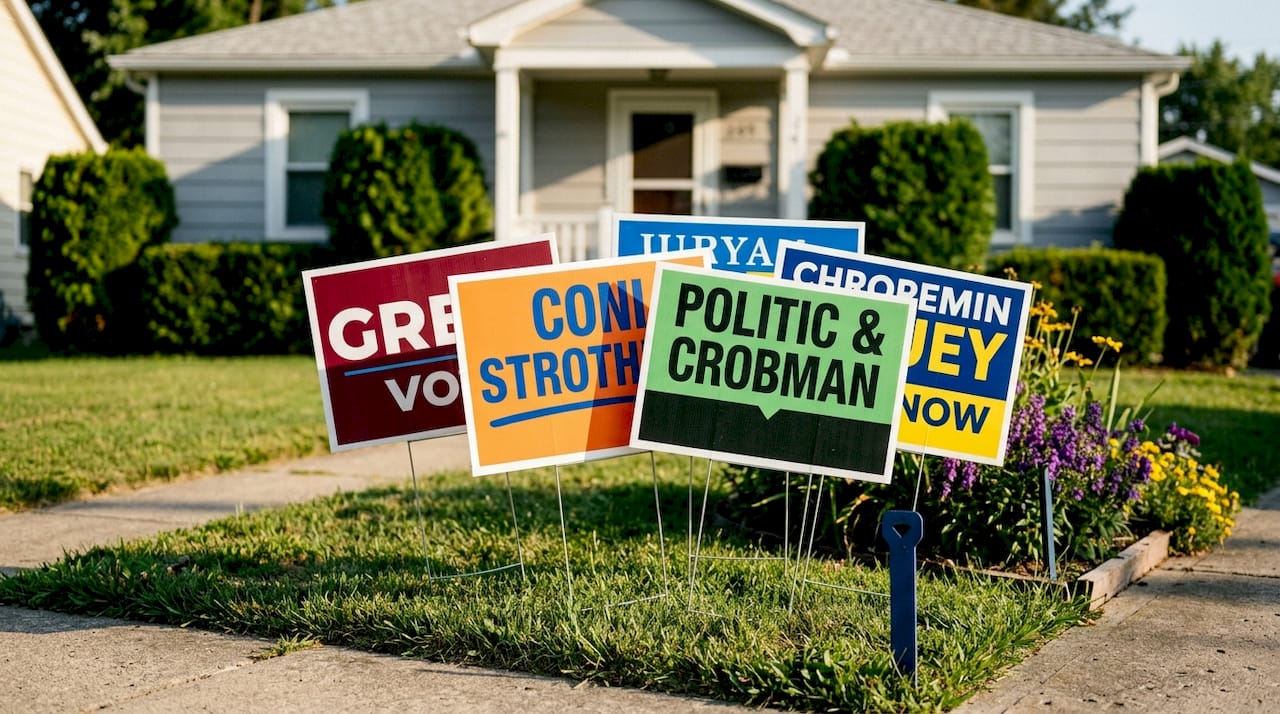
Social proof adds a second layer of influence. When voters see neighbors’ yard signs clustered on a street, they interpret that density as community endorsement. That signal boosts the campaign’s perceived legitimacy and can energize undecided voters who look to their community for cues. A single sign on a corner lot carries less weight than a coordinated block of ten.
Signs do not replace direct voter contact. They do not explain policy, defend a record, or answer questions. Their value is visibility, not persuasion. Campaign managers who treat signs as a substitute for canvassing, phone banking, or earned media will be disappointed. Signs work best as a layer within a broader voter outreach plan.
Here is what lawn signs do well and where they fall short:
- Build name familiarity through daily repetition without requiring voter attention
- Signal momentum to volunteers, donors, and undecided voters who read community support as a campaign health indicator
- Reach passive audiences who skip digital ads and ignore mailers
- Provide social proof when deployed in visible clusters across a neighborhood
- Cannot persuade informed voters or address candidate positions
- Cannot replace face-to-face engagement, debates, or earned media coverage
Pro Tip: Place signs in clusters of three or more on the same block to trigger the social proof effect. A single sign reads as personal preference; a cluster reads as community consensus.
What evidence supports the impact of lawn signs on voter turnout?
Research consistently shows that campaign signs produce a small but meaningful increase in vote share, particularly in local primaries and low-information races. A study by Green et al. demonstrates this effect while also noting that signs alone are not sufficient to win a race. That nuance matters. Signs move the needle; they do not flip outcomes by themselves.
The conditions where signs matter most are specific. Local elections, primaries, and crowded ballot fields all feature candidates that most voters know little about. In those contexts, name recognition achieved through lawn signs is especially powerful because voters have few other information sources to draw from. A name seen repeatedly on a commute route becomes the name that feels familiar in the voting booth.
“Lawn signs mainly build name recognition passively, increasing comfort with a candidate’s name rather than changing opinions. Their impact is greatest where voters receive little other information about candidates.”
The table below summarizes key findings on lawn sign effectiveness across different election types.
| Election type | Estimated turnout impact | Primary mechanism | Key limitation |
|---|---|---|---|
| Local general election | 3–5% increase | Mere exposure effect | Does not persuade informed voters |
| Primary / low-information race | Meaningful vote share gain | Name familiarity in crowded field | Signs alone cannot win a race |
| High-profile statewide race | Minimal measurable impact | Visibility and momentum signal | Voters already have candidate information |
| Rural and older voter outreach | Strong complementary reach | Physical presence where digital fails | Requires early and wide deployment |
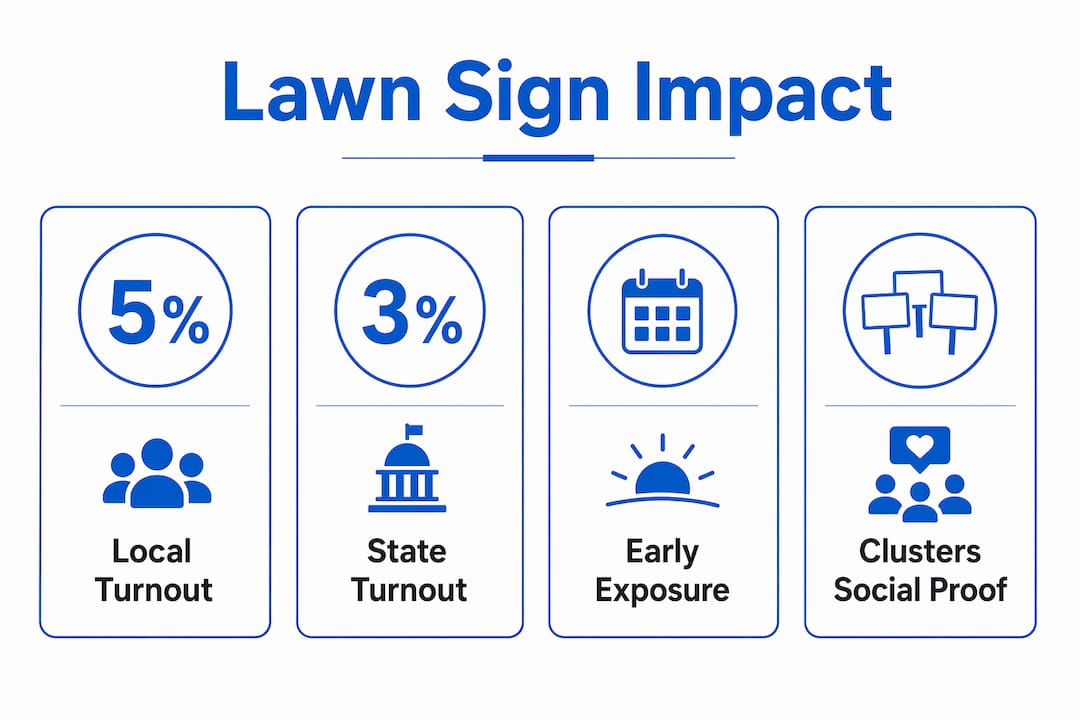
Signs also show campaign presence and can motivate volunteers, but they cannot defend a candidate’s record or persuade informed voters decisively. Campaign managers should calibrate expectations accordingly. Signs are a recognition tool, not a persuasion tool.
What are best practices for designing and placing lawn signs?
Sign design determines whether a voter retains a name or ignores it entirely. Effective political sign design emphasizes the candidate’s last name in large, bold type, the office being sought in smaller text, and nothing else unless a short tagline genuinely adds clarity. Sign clutter and poor color choices reduce voter retention. A driver passing at 35 miles per hour has roughly two seconds to read a sign. Every word beyond the name and office is a risk.
Color choice follows a clear rule: high contrast wins. Navy blue on white, red on white, and black on yellow all perform well at distance. Avoid color combinations that reduce readability for voters with color vision deficiencies, such as red on green. Patriotic palettes work because voters associate them with civic legitimacy, not because they are decorative.
Placement strategy is where most campaigns leave recognition gains on the table. Use these principles:
- Commuter corridors carry the highest daily impression volume. Place signs at intersections where traffic slows or stops.
- Commercial areas near grocery stores, gas stations, and community centers reach a cross-section of the electorate.
- Supportive neighborhoods where you have confirmed voter support create the cluster effect that signals momentum.
- High-visibility corners on arterial roads outperform residential side streets by a wide margin.
- Avoid sign clutter near competing signs. A sign lost in a wall of competing candidates reads as noise, not recognition.
Timing is as critical as placement. Early deployment before absentee and early voting begins maximizes name recognition impact. Campaign managers who wait until the final two weeks lose the compounding benefit of repeated exposure. Signs placed six to eight weeks before Election Day give voters enough time to see the name multiple times before they cast a ballot.
Pro Tip: Pair your sign placement strategy with a volunteer map that tracks which high-traffic intersections are covered. Gaps in coverage on commuter routes are lost impressions you cannot recover.
For deeper guidance on making signs that voters actually remember, the Yardsigns resource on eye-catching political sign design covers layout, typography, and color in practical detail.
How do lawn signs complement other voter recognition strategies?
Lawn signs reach voter demographics that digital outreach misses entirely. Physical signs complement digital campaigns by reaching older and rural voters who are not active on social media and who may not respond to digital advertising. A campaign that runs only digital ads leaves a significant portion of the electorate without any name exposure. Signs fill that gap without requiring any action from the voter.
Offline signage also amplifies digital efforts through cumulative exposure. A voter who sees a candidate’s name on a lawn sign in the morning and then encounters a digital ad in the afternoon receives two separate impressions that reinforce each other. That compounding effect increases the likelihood that the name sticks. Neither channel alone achieves what both channels achieve together.
Signs as a campaign health signal
Signs do more than reach voters. They signal organizational strength to people inside the campaign. Volunteers who see their candidate’s signs spreading across a district feel momentum. Donors who drive through a well-signed neighborhood gain confidence that the campaign is real and active. That internal morale effect is rarely measured but consistently reported by experienced campaign managers.
Integrating signs with direct voter contact
The most effective campaigns treat signs as the first layer of a multi-touch recognition plan. A voter who sees a sign, then receives a door knock, then gets a mailer has encountered the candidate’s name three times through three different channels. Research on voter contact consistently shows that multi-touch outreach produces higher recognition and higher turnout than any single method. Signs set the stage; canvassing and phone banking close the loop.
Broader campaign branding tactics that reinforce name recognition across physical touchpoints follow the same principle. Consistency across every physical impression, from signs to branded materials, builds the familiarity that drives recognition on Election Day.
Key Takeaways
Lawn signs drive voter recognition most effectively when deployed early, designed for instant readability, and integrated with direct voter contact methods across a campaign.
| Point | Details |
|---|---|
| Passive name exposure works | Repeated sign sightings trigger the mere exposure effect, making a candidate’s name feel familiar at the ballot. |
| Local races benefit most | The 3–5% turnout impact is strongest in low-information primaries and local general elections. |
| Design for two seconds | Last name, office, and high-contrast color are the only elements a passing driver reliably reads. |
| Deploy early | Signs placed six to eight weeks before Election Day maximize compounding exposure before early voting begins. |
| Signs complement, not replace | Pair signage with canvassing and digital outreach to build multi-touch recognition across all voter demographics. |
What I’ve learned about signs that most campaigns get wrong
After watching dozens of local campaigns manage their sign programs, the pattern I see most often is this: candidates treat signs as a finishing touch rather than a foundation. They order signs two weeks before Election Day, place them near their own homes, and then wonder why name recognition numbers stay flat.
The campaigns that use signs well do the opposite. They deploy early, they map their placements deliberately, and they treat every high-traffic intersection as a media buy with a daily impression count. A sign at a busy commuter intersection is not a yard decoration. It is a free billboard that reaches the same voters every morning for weeks.
The other mistake I see is over-designing. Candidates want their photo, their slogan, their website, their party affiliation, and their endorsements on a 18-by-24-inch piece of corrugated plastic. None of that survives two seconds of roadside reading. The name and the office. That is the entire message. Everything else is noise that reduces retention.
Signs also do something that digital ads cannot: they tell your volunteers that the campaign is real. I have watched volunteer turnout increase after a strong sign deployment weekend, not because the signs recruited volunteers, but because seeing the name everywhere gave existing volunteers confidence that they were part of something with momentum. That morale effect is real and it compounds.
The limitation is equally real. Signs cannot explain why your candidate is better. They cannot respond to an attack. They cannot turn a hostile voter into a supporter. Campaigns that rely on signs as their primary outreach strategy lose. Signs are the foundation, not the house.
— YardSignGuy
Yardsigns makes it easy to deploy signs when it matters most
Campaign timing is unforgiving. The window between finalizing your design and getting signs into the ground is shorter than most managers expect.
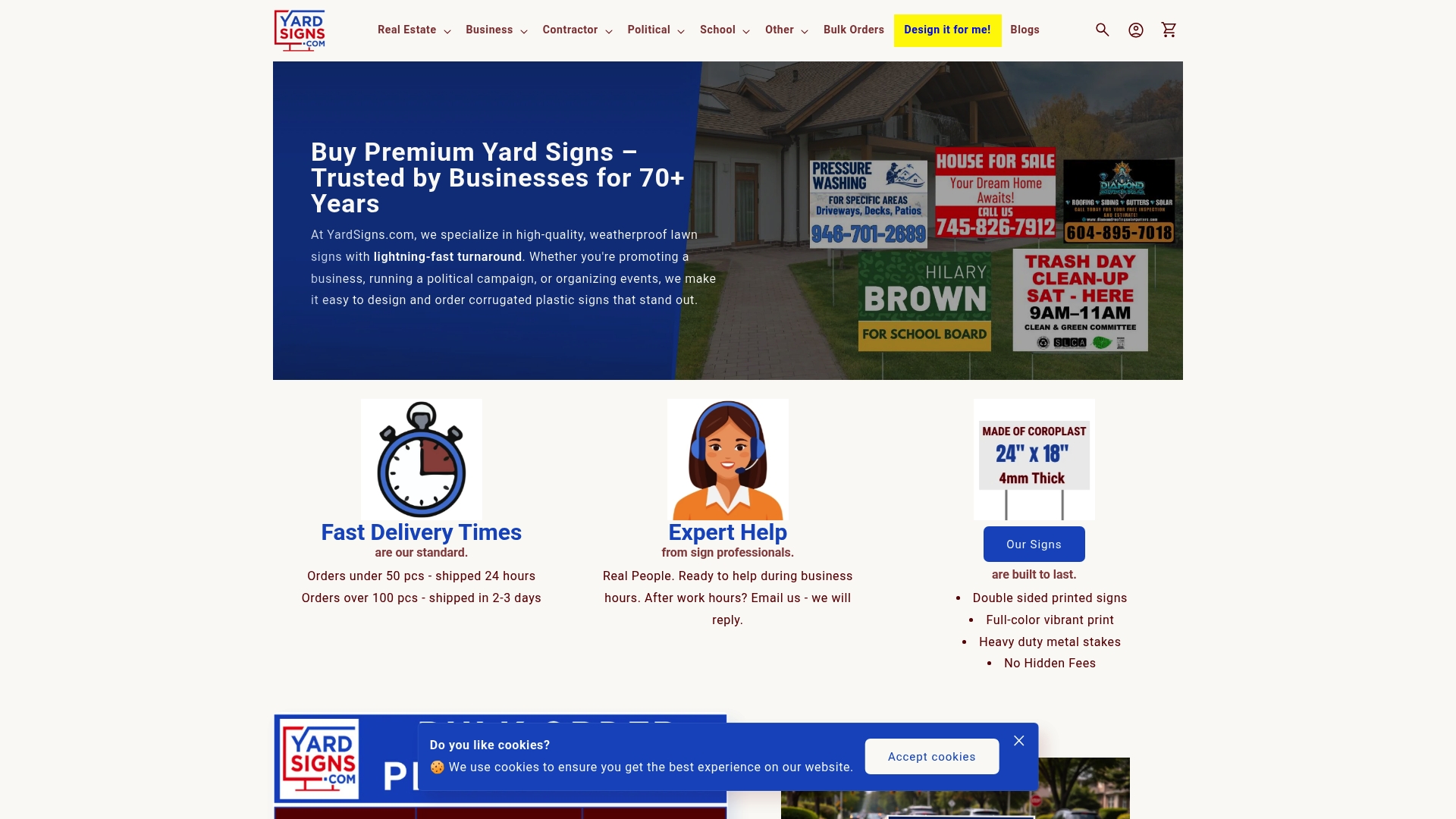
Yardsigns produces customizable political signs built for outdoor durability and high-visibility printing. Orders under 50 pieces ship within 24 hours, which means you can respond to a late design change or a new placement opportunity without losing ground. The materials hold up through rain, wind, and weeks of sun exposure, so signs placed in october still look sharp on Election Day. If you are ready to build a sign program that matches the strategy in this guide, Yardsigns gives you the production speed and print quality to execute it.
FAQ
How much do lawn signs actually increase voter turnout?
Well-placed lawn signs correlate with a 3–5% increase in voter turnout in local elections. That impact is most significant in low-information races where voters have few other sources of candidate information.
When should a campaign put out lawn signs?
Signs should go out six to eight weeks before Election Day to maximize repeated exposure before absentee and early voting begins. Campaigns that deploy signs in the final two weeks lose the compounding benefit of repeated impressions.
Do lawn signs work in high-profile statewide races?
Their impact is minimal in high-profile races where voters already have substantial information about candidates. Signs perform best in local primaries and crowded ballot fields where name familiarity is the deciding factor.
What is the most important element of a political lawn sign design?
The candidate’s last name in large, bold, high-contrast type is the single most important design element. A driver passing at speed has roughly two seconds to read a sign, so every additional element reduces the chance the name is retained.
Can lawn signs replace canvassing and direct voter contact?
Lawn signs cannot replace direct voter contact. They build name familiarity passively but cannot persuade informed voters, defend a candidate’s record, or substitute for face-to-face engagement with the electorate.
