


Why Yard Signs Win Elections: Campaign Manager's Guide
Yard signs are defined as one of the most cost-effective tools for increasing candidate name recognition in competitive local races. Research shows yard signs can boost vote share by approximately 1.7 percentage points on average. That margin is decisive in school board races, city council contests, and state legislative primaries where hundreds of votes separate winners from losers. Why yard signs win elections explained simply: they work through repeated visual exposure, social proof, and low-cost saturation of the physical environment where voters actually live. This guide gives campaign managers the psychological framework, placement tactics, and design principles to get the most from every sign in 2026.
Why yard signs win elections: the psychology behind the numbers
The core mechanism behind yard sign effectiveness is the mere exposure effect. Psychologists define the mere exposure effect as the tendency for people to develop a preference for things they encounter repeatedly, even without conscious awareness. When a voter drives past your candidate’s name six times in a week, repeated exposure builds trust in a way that a single television ad cannot replicate.
This matters most in low-information races. Voters in a congressional primary often research candidates extensively. Voters in a county commissioner race frequently do not. They arrive at the ballot box with only a vague sense of which names feel familiar. Yard signs fill that gap. A candidate whose name appears on 200 lawns feels known, even to voters who never attended a single town hall.
Yard signs also carry a credibility that digital ads cannot manufacture. A Facebook ad is paid placement. A neighbor’s yard sign is a personal endorsement. Voters read that distinction instinctively. The community consensus effect created by dense sign placement makes a candidate feel like the neighborhood’s natural choice rather than an outside voice asking for attention.
Key psychological advantages of yard signs include:
- Name recognition: Repeated sightings create familiarity that transfers directly to ballot recognition.
- Perceived legitimacy: A candidate with signs across multiple precincts reads as organized and serious.
- Neighbor endorsement: Signs feel like personal recommendations, not paid advertising.
- Low resistance: Unlike digital ads, yard signs do not interrupt. Voters absorb them without irritation.
Pro Tip: Place signs at eye level near stop signs and traffic lights where drivers have a natural pause. Those extra seconds of dwell time significantly increase recall.
How yard signs create social proof and campaign momentum
Social proof is the psychological principle that people look to others’ behavior to guide their own decisions. In campaigns, sign density is one of the clearest signals of social proof available. A neighborhood blanketed with one candidate’s signs tells every voter who passes through that this candidate has real support, real organization, and real momentum.
“Yard signs act as proof of presence and a force multiplier in close races by signaling organizational strength and creating momentum.” The Maine Wire
That perception matters beyond the individual voter. Donors evaluate campaign strength before writing checks. Volunteers decide where to invest their weekends. Local party officials weigh endorsements. A visible sign presence signals that a campaign is worth backing. Contrast two neighborhoods: one where a candidate has 40 signs on a single street, and one where a rival has three signs scattered across a mile. The first candidate looks like a movement. The second looks like a long shot.
Yard signs also boost volunteer morale in ways that campaign managers often underestimate. When volunteers drive through a precinct and see their work displayed on dozens of lawns, they feel the campaign is real and growing. That energy feeds back into phone banking, door knocking, and fundraising. Internal cohesion is a genuine competitive advantage, and signs contribute to it directly.
Key social proof benefits for campaigns:
- Donor confidence: Visible sign saturation signals a campaign worth funding.
- Volunteer retention: Seeing signs in the field reinforces that effort is producing results.
- Opponent psychology: Heavy sign presence can discourage rival campaigns from contesting certain precincts.
- Media perception: Local journalists and political reporters use sign density as an informal gauge of campaign strength.
Strategic deployment: how to place yard signs for maximum impact
Placement strategy separates campaigns that waste sign budgets from those that convert signs into votes. The single most effective tactic is using voter density maps to identify precincts with the highest turnout history and concentrating signs there first. A sign in a precinct where 800 voters reliably turn out delivers more value than the same sign in a precinct where 200 show up.

Tiered ordering also protects budget. Order a first wave for your highest-priority precincts, evaluate placement results, then order a second wave for secondary areas. Yardsigns ships orders under 50 pieces within 24 hours, which means you can respond to campaign developments without committing your entire sign budget weeks in advance.
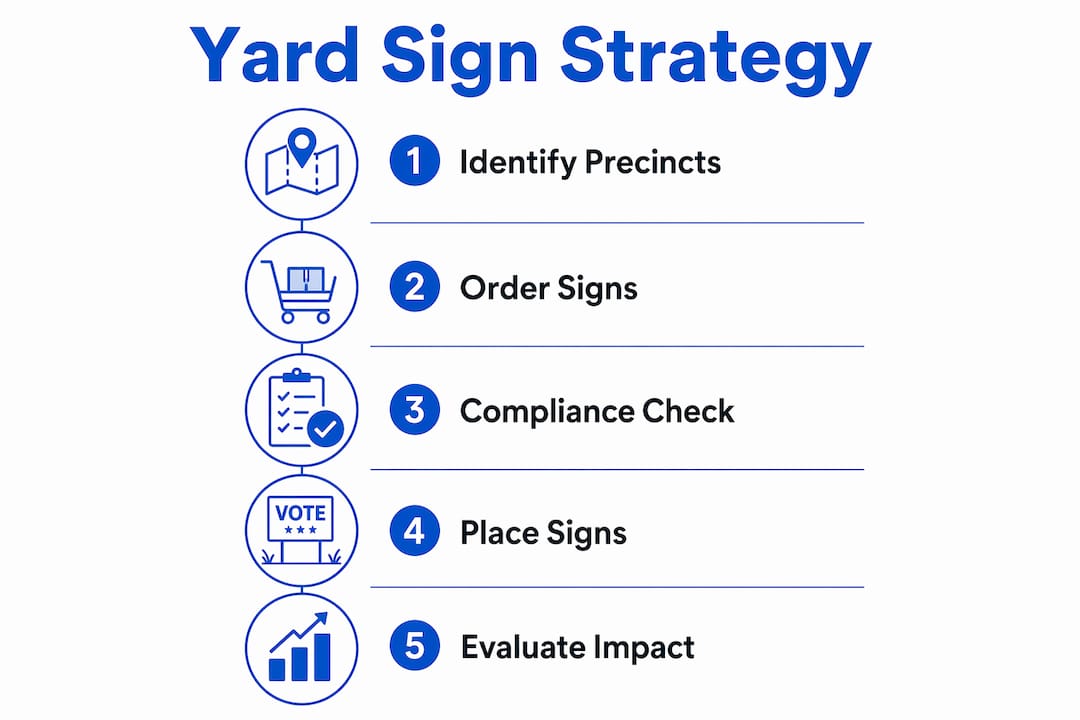
Compliance audits before deployment prevent costly mistakes. HOA rules, municipal right-of-way restrictions, and state election codes vary widely. Signs placed in violation of local ordinances get confiscated. Confiscated signs demoralize volunteers, waste money, and hand opponents a talking point. Audit your district’s rules before your first sign goes in the ground.
Turn sign distribution into a voter database tool by requiring supporters to provide contact information before receiving a sign. This practice, used effectively in Doug Jones’s 2017 Alabama Senate campaign, converts a passive transaction into an active organizing moment. Every sign request becomes a new entry in your volunteer and voter contact list.
| Approach | Benefits | Drawbacks |
|---|---|---|
| Blanket placement | Maximum visibility, strong social proof | Higher cost, risk of wasted signs in low-turnout areas |
| Targeted placement | Cost-efficient, focused on high-value precincts | Smaller visual footprint, less social proof effect |
| Tiered ordering | Flexible, budget-responsive | Requires more logistical coordination |
| Supporter-request only | Builds voter database, high placement quality | Slower rollout, lower total sign count |
Pro Tip: Assign each sign a location ID when distributing. This lets you track which precincts have coverage gaps and which need reinforcement as Election Day approaches.
Common misconceptions about yard signs in political campaigns
The biggest misconception about yard signs is that they win elections on their own. They do not. Signs supplement, not substitute, core voter contact operations. A campaign that spends its entire budget on signs and skips door knocking will lose to a campaign that does the opposite.
Signs also do not persuade undecided voters in the way that a direct conversation does. They build familiarity, not conviction. A voter who is genuinely torn between two candidates will not make a final decision based on which name they saw more often on lawns. That voter needs a phone call, a mailer, or a door knock.
Common yard sign myths that cost campaigns money and time:
- “More signs always means more votes.” Sign volume matters less than sign placement. Ten signs in the right precinct outperform 100 signs in the wrong one.
- “Signs on busy roads are enough.” High-traffic placement builds name recognition but misses the neighbor-endorsement effect. Residential streets matter more than highways.
- “Opponents stealing signs hurts the campaign.” Sign theft is frustrating but rarely decisive. Documenting it for social media often generates more sympathy than the original sign would have produced.
- “Signs work equally well in all races.” The 1.7 percentage point impact is most pronounced in low-information, competitive races. High-profile races with heavy media coverage see smaller marginal gains from signs alone.
The correct role for yard signs is as a visibility stabilizer. They maintain candidate presence between voter contact touchpoints and reinforce the name recognition built through direct outreach.
How to design yard signs that voters actually remember
Effective yard sign design follows one rule: a driver at 35 miles per hour must read your sign in under two seconds. That constraint eliminates most bad design decisions automatically. Three elements of information maximum: candidate name, office sought, and one short tagline or party affiliation. Nothing else belongs on a political yard sign.
Color choice is not aesthetic preference. It is a visibility decision. High-contrast combinations like navy blue on white, red on white, or black on yellow read clearly at distance and in low light. Avoid color combinations that blend into grass, foliage, or the sky. Your sign competes with the entire visual environment of a residential street.
Font size determines whether your sign works or fails. The candidate’s name should occupy at least 60% of the sign’s vertical space. Use a bold, sans-serif typeface. Script fonts and decorative lettering fail at distance. Consistency with your campaign’s other materials, including mailers, website, and social media graphics, reinforces brand recognition across every voter touchpoint.
A practical design checklist for campaign managers:
- Candidate name: Bold, large, takes up the majority of the sign.
- Office sought: Smaller but clearly readable. “For City Council” or “State Senate District 12.”
- Color scheme: High contrast, consistent with all campaign materials.
- Font: Bold sans-serif only. No script, no decorative typefaces.
- Website or social handle: Optional. Include only if it fits without crowding the name.
- Size: 18x24 inches is the standard for residential lawns. Larger formats for high-traffic corridors.
Pro Tip: Order a proof print before your full run. Colors on screen look different from colors on corrugated plastic in direct sunlight. A proof prevents expensive reprints.
For placement ideas that go beyond the basics, the local election sign placement guide from Yardsigns covers precinct-specific tactics worth reviewing before your next order.
Key takeaways
Yard signs win elections by building name recognition through repeated exposure, signaling community support through density, and extending campaign presence between direct voter contacts.
| Point | Details |
|---|---|
| Vote share impact | Yard signs add approximately 1.7 percentage points in competitive, low-information races. |
| Psychological mechanism | The mere exposure effect builds unconscious trust through repeated, non-intrusive sightings. |
| Social proof value | High sign density signals campaign strength to voters, donors, and volunteers alike. |
| Strategic placement | Voter density maps and tiered ordering maximize impact while protecting limited budgets. |
| Design discipline | Candidate name, office, and high-contrast color are the only elements a sign needs to work. |
Yard signs in the 2026 campaign mix: what I’ve actually seen work
Campaigns that treat yard signs as a checkbox item consistently underperform those that treat them as a system. I’ve watched well-funded candidates lose close races because their signs were generic, poorly placed, and disconnected from any broader ground game. I’ve also watched underfunded challengers close significant gaps by saturating three or four key precincts with signs while running a tight door-knocking operation in parallel.
The digital-versus-traditional debate misses the point. Yard signs and digital ads solve different problems. Digital ads reach voters who are already online and already paying attention to political content. Yard signs reach voters who are not. A neighbor who ignores every political Facebook post will still see your sign every morning when they back out of their driveway. Those are different audiences, and you need both.
The most underrated benefit of a strong sign program is what it does to your own team. Volunteers who see their work displayed across a neighborhood show up again. They recruit their friends. They make more calls. The internal morale effect of a visible sign presence is real, and it compounds over the weeks before Election Day.
My honest recommendation: pair your sign program with a grassroots campaign strategy that uses signs as the visible layer of a deeper organizing effort. Signs alone do not win. Signs plus doors plus phones plus data win.
— YardSignGuy
Ready to put your campaign on every block?
Political yard signs work hardest when they are well-made, weather-resistant, and delivered fast enough to respond to campaign momentum. Yardsigns produces political campaign signs with vibrant, durable printing built to hold up through rain, wind, and weeks of outdoor exposure.
Orders under 50 pieces ship within 24 hours, so you can place a targeted first wave, evaluate coverage, and reorder without losing ground. The design process is straightforward, and the materials are built for the conditions your signs will actually face. Whether you need 20 signs for a focused precinct push or 500 for a district-wide saturation campaign, Yardsigns has the capacity and turnaround to keep your campaign moving.
FAQ
How much do yard signs actually affect election results?
Research shows yard signs increase vote share by approximately 1.7 percentage points on average. That impact is most significant in low-information, competitive local races where name recognition drives ballot decisions.
Are yard signs effective without a broader campaign strategy?
Yard signs are not effective as a standalone tactic. They supplement voter contact operations and maintain visibility between direct outreach touchpoints, but they do not replace door knocking, phone banking, or direct mail.
Where should yard signs be placed for the best results?
Concentrate signs in high-turnout precincts identified through voter density maps. Residential streets near stop signs and traffic lights deliver more recall value than high-speed arterial roads.
What are the legal risks of placing yard signs?
Local HOA rules, municipal ordinances, and right-of-way restrictions vary by jurisdiction. A compliance audit before deployment prevents sign confiscations that waste budget and demoralize campaign volunteers.
How can sign distribution help build a voter database?
Requiring supporters to provide contact information before receiving a sign turns each distribution into a voter engagement moment. This tactic, used in the Doug Jones 2017 Senate campaign, builds volunteer lists and expands the campaign’s organizing capacity at no additional cost.
