


2 Second Rule: Choose Landscape Yard Signs for 30 mph Roads
Choose landscape when your message is short and drivers need to read it fast, like real estate listings or roadside promos. Choose portrait when space is tight, viewers are on foot, or your sign carries stacked information such as directions or event details. The deciding factors are viewing distance, message length, and where the sign actually sits.
TL;DR:
- Landscape signs are best for short headlines on moving vehicles, supporting quick horizontal reading, especially at high speeds.
- Portrait signs excel for stacked messages and directional indicators, suitable for pedestrian viewing or narrow spaces.
- The optimal size depends on orientation: 18"×24" for most uses and 24"×36" for wider visibility, with size chosen to match message length and placement.
- Design should match orientation: landscape signs feature prominent headlines across the top, while portrait signs break into horizontal bands for clarity.
- Support hardware must account for wind resistance on large landscape signs, requiring sturdier stakes or frames for stability.
Table of Contents
- Portrait vs Landscape Yard Signs: What’s the Real Difference?
- How Does Orientation Affect Readability at Speed?
- What Yard Sign Sizes Pair With Each Orientation?
- What Design Choices Work Best for Each Orientation?
- How Should You Mount and Angle Each Orientation?
- What Do the Pros Say About Choosing an Orientation?
- Which Orientation Do We Reach for First?
- Ready to Order Your Yard Signs?
- Sources
- FAQ
Portrait vs Landscape Yard Signs: What’s the Real Difference?
Landscape orientation is wider than it is tall, like a widescreen TV. Portrait is taller than it is wide, like a phone held upright. That single difference changes how a passerby’s eyes move across your sign.
Landscape works with horizontal scanning, the natural left-to-right pattern people use when reading a headline or driving past a storefront. Portrait supports vertical scanning, which fits stacked content: a name, an arrow, a phone number, one line under the next.
- Landscape: real estate “For Sale” signs, roadside sale banners, wide business names
- Portrait: directional arrows, open house pointers, event signs with multiple details
Yard sign dimensions matter here too, since orientation and size decisions happen together, not separately.
How Does Orientation Affect Readability at Speed?
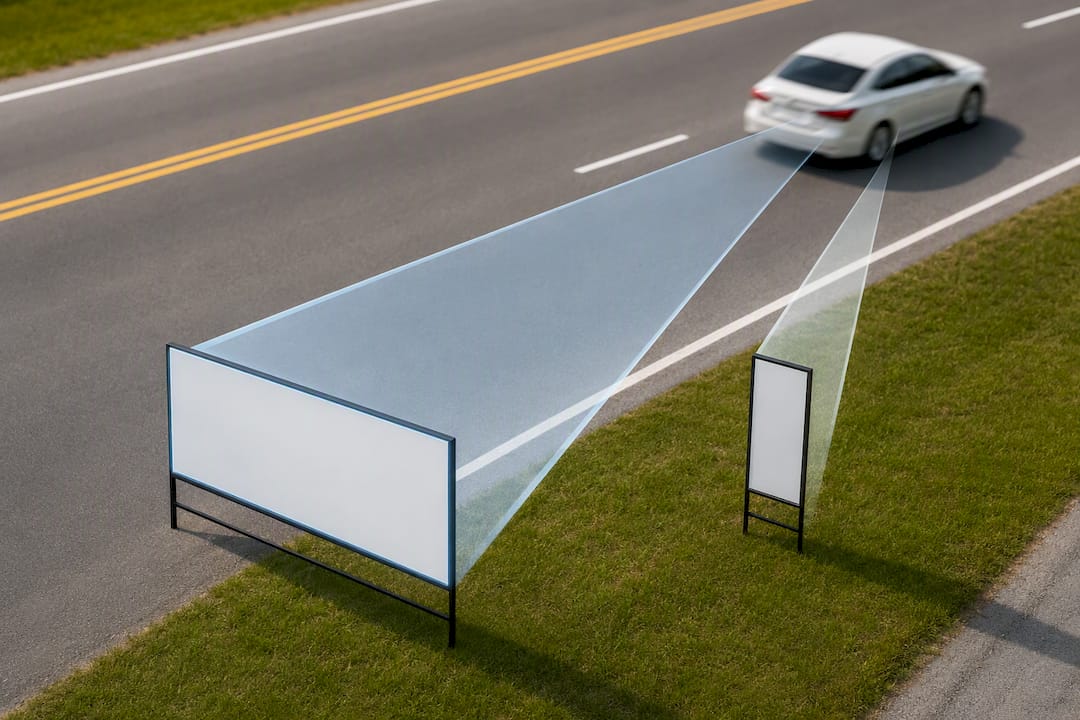
Drivers do not read signs. They glance at them. That’s the whole problem orientation is trying to solve.
The 2-second test: drive the actual route at the posted speed limit and check whether you can read your own headline in two seconds. If you can’t, the sign fails before it ever reaches a customer, according to placement guidance from Image Square Printing. A car going 35 mph covers roughly 100 feet in two seconds, which is not much runway for a wordy sign.
- Landscape orientation supports quick, wide headlines drivers can absorb in a single glance
- Portrait orientation works better when viewers are walking, stopped, or approaching on foot, since portrait framing mimics the phone screens people already scan daily
- Keep headlines to one line where possible, and size type large enough to read at your target distance
If your sign sits on a 30 mph road, landscape with a short headline almost always outperforms a portrait sign packed with paragraphs.
What Yard Sign Sizes Pair With Each Orientation?
Size and orientation are a package deal. Pick one without the other and you end up with a panel that either overwhelms its message or gets lost against the ones next to it.
- 18"×24": the most common size for real estate and campaign signs, typically run in portrait and built for standard H-stakes
- 24"×18": the same panel turned sideways, favored for wide business names or short slogans in landscape
- 24"×36": a step up in size, often chosen for roadside visibility where you need the message read from farther away
- 12"×18": a compact option for driveway markers, open house pointers, or secondary directional signs
Bigger panels earn their size on high-speed roads. On a quiet residential street, an oversized landscape sign can actually look out of place next to smaller portrait signs pointing the way. Check professional sign sizing guidance before committing to a print run.
What Design Choices Work Best for Each Orientation?
Layout follows orientation, not the other way around. Design the panel to match how eyes travel across it, and the message practically reads itself.
- Lead with the headline in landscape. Put your biggest word or phrase across the top third, then let a smaller line and a logo fill the rest.
- Stack modules in portrait. Break the sign into horizontal bands: headline, then image or arrow, then contact info, top to bottom.
- Size your type to the distance. For roadside viewing, aim for lettering equivalent to 72 to 120 point type depending on how far cars are from the sign when they first see it.
- Crop photos to the shape. Landscape signs handle wide shots of a house or product well; portrait signs work better with a single centered image or a tall arrow graphic.
- Place QR codes where hands can reach them, visually. On portrait signs, put the code near the bottom third, close to where a pedestrian’s eye naturally lands last. On landscape signs, keep it to one side so it doesn’t compete with the headline.
- Use high contrast. Black text on white or yellow, or white text on dark green, both hold up better than pastel combinations from a moving car.
Pro Tip: Test your QR code size before you print. A code smaller than 2 inches square often fails to scan from more than a few feet away, which defeats the purpose of putting one on a roadside sign.
For more layout specifics, see this yard sign design breakdown.
How Should You Mount and Angle Each Orientation?
Orientation changes what happens below the panel, not just on it. A wide landscape sign catches more wind than a narrow portrait one, and that changes what hardware you need.
- Landscape panels on roadsides need sturdier support since more surface area means more wind resistance
- Portrait panels fit narrow verges, fence lines, and tight gaps between driveways better than wide landscape signs
- Standard H-stakes work for most 18"×24" and 24"×18" panels, but larger 24"×36" signs may need double stakes or a frame for stability
- Drive the stake into the ground first, then slide the sign down onto it, rather than trying to push panel and stake together
- Angle the sign slightly toward oncoming traffic and elevate it 12 to 24 inches off the ground to widen the reading window
What Do the Pros Say About Choosing an Orientation?
Yardsigns builds both portrait and landscape panels in corrugated plastic and aluminum, and the pattern across thousands of orders is consistent: campaign timing decides orientation as often as message content does.
When a candidate calls three days before an event needing 200 signs, we don’t have time for a design debate. Landscape with a short name and one bold color wins every time, because it’s the format volunteers can plant fast and drivers can read from a moving car.
That practical urgency is exactly why many sign companies aim to ship most small orders quickly, so a last-minute orientation decision doesn’t turn into a missed deadline.
Which Orientation Do We Reach for First?
For open houses, we default to landscape because agents need drivers to catch a name and phone number in one glance. For directional and event signs, portrait wins since arrows and multi-line details read naturally top to bottom. Roadside promos get the landscape upsize when speed limits climb.
— YardSignGuy
Ready to Order Your Yard Signs?
Many sign providers back every orientation choice with suitable hardware and fast turnaround, so once you’ve settled on portrait or landscape, you won’t wait long to see it in your yard.
Panels often come with free design proofs and unlimited revisions, allowing you to test layouts before printing. Signs are typically printed double-sided with UV-resistant inks and include metal H-stakes designed for durability outdoors. Realtors can browse real estate yard signs built for landscape-style listings, while candidates and event organizers running larger drops can check bulk yard signs for volume pricing. Business owners weighing their own layout decisions might also find it useful to see how landscaping companies handle their own signage marketing for comparison.
Start your order at Yardsigns and upload your design, or request a free proof if you’re still deciding between orientations.
Sources
- Landscape digital signage vs. portrait digital signage: Which delivers more effective advertising impact? | SSA Digital
- How to Install a Yard Sign with Stakes | Step-by-Step Guide
- How to Install Yard Signs: The Professional Guide to High-Impact Placement | Image Square Printing
FAQ
Should I Use Landscape or Portrait for My Yard Sign?
Use landscape for short, wide messages read from a moving car, like real estate listings or roadside sales. Use portrait when space is narrow or your message needs stacked lines, like directional arrows or event details.
Can Yard Signs Be Vertical?
Yes, vertical or portrait yard signs are common and work well for directional signage, open house pointers, and narrow placement spots. They pair naturally with standard H-stakes in sizes like 18"×24", one of the most popular corrugated plastic sign sizes.
What Does a Good Yard Sign Look Like?
A good yard sign passes the two-second test: a driver at posted speed can read the headline before passing it, according to installation and placement guidance. It uses high contrast colors, a short headline, and one clear call to action.
What Is the Difference Between Portrait and Landscape?
Landscape is wider than tall and supports horizontal scanning, ideal for short headlines. Portrait is taller than wide and supports vertical scanning, ideal for stacked information like names, arrows, and contact details.
Does Yardsigns Offer Both Orientations?
Yes, Yardsigns prints custom signs in both portrait and landscape across sizes like 18"×24" and 24"×36", with double-sided printing and metal H-stakes included. Current pricing and size options are available directly on the Yardsigns site.
