


Place Campaign Yard Signs Effectively: A Local Candidate's Guide
To place campaign yard signs effectively, start with supporter front yards on high-traffic residential streets, confirm your county’s polling-place buffer distances and municipal sign ordinances, and order 18"×24" 4mm corrugated signs on 9-gauge H-wire stakes for residential placements. Scale up to 24"×36" for arterial roads. Run a phased deployment, track every location, and schedule retrieval before any posted deadline.
Quick-start checklist:
- Get written permission from every property owner before placing a sign
- Confirm your state election code, county election office rules, and any HOA restrictions
- Start with supporter yards and high-visibility corners; avoid public rights-of-way and medians without authorization
- Use 18"×24" signs for residential streets; step up to 24"×36" for faster roads.
- Deploy in phases: core supporters first, high-traffic nodes next, final-week push last
- Log every placement (address, installer, date, permission status) and set a retrieval date
- Check polling-place buffer distances with your county election office before election day
Pro Tip: Order a small proof run before your bulk print. Verify readability from a car at the expected street speed, then finalize your design.
Table of Contents
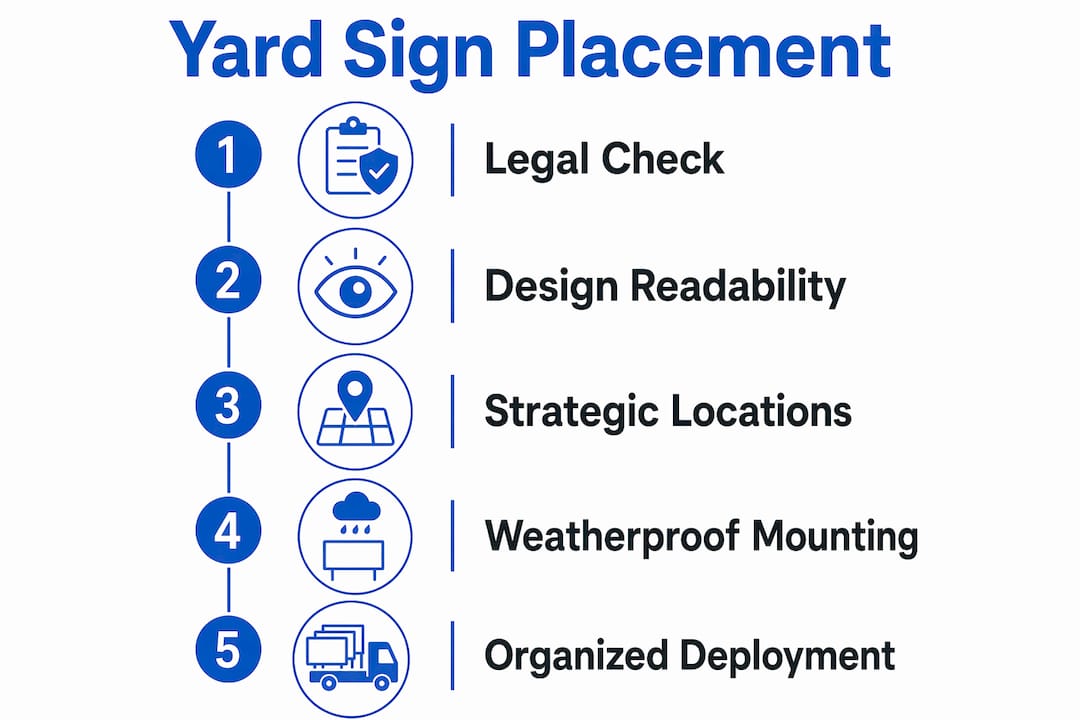
- What legal rules apply before you place campaign signs?
- How do you design a yard sign that voters can read from a moving car?
- Where should you put campaign signs for maximum reach?
- How do you mount signs so they survive weather and repeated handling?
- How do you run a sign program that stays organized from order to retrieval?
- What mistakes do campaigns make that cost them time, money, or legal trouble?
- What are the environmental considerations for campaign signs?
- Key Takeaways
- What campaigns consistently get wrong about yard signs
- Get your campaign signs printed and shipped fast with Yardsigns
- Where to verify rules and order your signs
What legal rules apply before you place campaign signs?
Getting this wrong costs more than a fine. Signs pulled by code enforcement or a property owner who never gave permission are wasted budget and volunteer hours. Campaign signage placement rules vary by state, county, and municipality, so a single national checklist does not cover every case.
The key rule categories to verify:
- Public right-of-way vs. private property. Most jurisdictions prohibit campaign signs in the public right-of-way, which typically runs from the curb to the sidewalk and includes medians, utility strips, and road shoulders. Texas TxDOT, for example, prohibits political signs on state highway right-of-way. Confirm your local definition before placing anything near a road edge.
- Polling-place buffer zones. Many states ban campaign materials within a fixed distance of polling locations on election day. Confirm the exact footage with your county election office. Georgia’s State Election Board, for instance, publishes specific buffer rules that campaigns must follow.
- State election codes. Your state’s election statutes may set size limits, timing windows, or disclosure requirements for political signs. Look these up directly or ask your county election office.
- Municipal sign ordinances. Cities and counties often layer additional rules on top of state law, covering maximum sign size, setback distances, and how long signs may remain posted.
- HOA covenants. Even on private property, HOA rules can limit sign dimensions, quantity, or duration. Get a copy of the relevant covenant and the homeowner’s written permission before placing. Private-property placement and HOA compliance deserve their own review for every neighborhood you target.
Document everything. Keep a shared folder with photos of written permissions, ordinance excerpts, and buffer-zone maps your volunteers can reference in the field.
Pro Tip: Brief volunteers with a one-page legal summary before deployment. A volunteer who knows the curb-to-sidewalk rule avoids the placement that triggers a complaint.

How do you design a yard sign that voters can read from a moving car?
Readability at speed is the only metric that matters. A sign a driver cannot parse in two seconds is a sign that did not work.
- Single-message rule. One headline (3–5 words), the candidate’s name, and a simple visual. Every additional element competes for attention and reduces recall. Name recognition design depends on stripping the sign down, not loading it up.
- Size and letter height. The United States Sign Council established that every 1 inch of capital letter height delivers roughly 10 feet of readable distance. For residential streets at 25–35 mph, 3–5 inch capitals on an 18"×24" sign cover the job. For arterial roads at 35–45 mph, move to 24"×36" with 5–7 inch letters.
- Contrast and color. High-contrast foreground on background, no gradients. One bold sans-serif font for the headline; a second supporting font at most. Low-contrast designs fail at distance even when they look polished on screen.
- Single-sided vs. double-sided. Corner lots, medians, and intersections where traffic approaches from two directions warrant double-sided printing. One-direction roadside placements do not.
- Proof before bulk. Print a proof or use a digital mockup and view it from the expected distance before committing to a full run.
Pro Tip: Limit your sign to the candidate’s name and one supporting word or office title. Passersby register a name on the first glance; they rarely get a second one.
For deeper design tips on maximizing visibility, Yardsigns publishes a 12-point guide covering headline selection, color contrast, and template usage.
Where should you put campaign signs for maximum reach?
Location determines whether a sign earns its cost. The best placements combine high daily traffic volume with legal access and a property owner who is genuinely supportive.
Primary placements:
- Supporter front yards on residential streets with moderate to high foot and vehicle traffic
- Driveways and yard edges that face the primary direction of travel
- Yards near school zones, community centers, and grocery store routes where local voters travel daily
Secondary placements:
- High-visibility corners and intersections where two traffic flows converge
- Commercial frontage with written permission from the business owner
- Commuter corridors where larger 24"×36" signs can reach drivers at higher speeds
Avoid:
- Public sidewalks, medians, and road shoulders without explicit authorization
- Any location that obstructs a driver’s sightline at an intersection
- Polling-place buffer zones on election day
- Locations where the sign faces away from the primary traffic direction
Spacing and density. Spreading signs across multiple routes creates repeated visual impressions for voters who travel different paths. Clustering too many signs on one block produces diminishing returns and can draw complaints. Placement ideas that win local elections include distributing signs to hit the same voter on multiple routes rather than saturating one street.
Research cited by the University of Wisconsin-Madison found that political yard signs in high-visibility placements can increase a candidate’s vote share by 1.7 percentage points, which can decide tight local races.
How do you mount signs so they survive weather and repeated handling?
Material and stake choices made at the order stage determine how many replacements you buy mid-campaign.
- Material. 4mm corrugated polypropylene with UV-resistant inks is the standard for campaign runs. It stays rigid through normal weather, stacks flat in a car trunk, and accepts standard H-wire stakes without modification. Aluminum is an option for long-term commercial placements but adds cost and weight.
- Stakes for residential yards. 9-gauge H-wire stakes insert directly into the corrugated flutes and work well for short-term residential installs. They are fast to deploy and easy to retrieve.
- Stakes for road-facing or long-term placements. Step or spiral stakes provide a wider base footprint that resists the rocking motion caused by wind and passing vehicles. For any longer-term installation, consider a permanent frame.
- Mounting technique. Seat the sign securely on the stake flute, push straight into soil, and angle the face slightly toward the primary approach direction. A sign angled 10–15 degrees toward oncoming traffic catches the eye earlier.
- Weather and lifecycle. Choosing 4mm material and proper stakes up front reduces mid-campaign replacement costs. Thin 3mm corrugated plastic buckles after one windstorm and forces reprints at the worst possible time.
Yardsigns includes metal H-stakes with standard orders and offers rush turnaround for small batches, which is useful when a sign cluster needs a fast reprint after storm damage.
Pro Tip: Pre-stake 20 signs as a ready-to-go volunteer pack. Volunteers deploy faster when the sign is already on the stake, and incorrect installations drop significantly.

How do you run a sign program that stays organized from order to retrieval?
A sign program without tracking is a sign program that loses signs, misses pickups, and generates community complaints.
- Phase your orders. Start with a small run for core supporter placements. Order a larger batch for the final two-week get-out-the-vote push. Phased ordering reduces waste and lets you respond to damaged signs without overcommitting budget early.
- Build a placement log. A shared spreadsheet with columns for address, permission status (with photo link), installer name, stake type, install date, and planned pickup date covers everything you need.
- Equip volunteers with a one-page script. Include placement rules, the permission confirmation step, a note on what constitutes public right-of-way, and the retrieval deadline.
- Map your deployment zones. Divide the district into map slices and assign each volunteer a zone. This prevents duplicate placements and gaps.
- Schedule retrieval before the deadline. Log returned signs, note which are reusable, and arrange recycling for damaged material. Missing a retrieval deadline is one of the most common sources of HOA and municipal complaints.
- Reuse and recycle. Signs in good condition can be restaked for a later race or a different precinct. Corrugated polypropylene is recyclable at facilities that accept #5 plastic.
What mistakes do campaigns make that cost them time, money, or legal trouble?
Most campaign sign problems are avoidable. These are the errors that show up repeatedly:
- Illegal placement. Signs placed in public rights-of-way or inside polling-place buffer zones get pulled by code enforcement or election officials, wasting both the sign and the placement effort.
- Underspecified materials. Thin 3mm plastic bends and fades mid-campaign, forcing reprints at peak cost and time pressure. Starting with 4mm material costs slightly more per sign and far less overall.
- Design overload. Too much text, multiple fonts, or low-contrast color combinations make signs unreadable at typical street speeds. A sign that cannot be parsed in two seconds does not register.
- No placement tracking. Without a log, campaigns lose signs, miss retrieval windows, and cannot respond to complaints with accurate information.
- Timing errors. Placing signs too early in jurisdictions with posting-window rules, or failing to remove them after the election, triggers HOA notices and municipal fines.
Red flags volunteers should report immediately: a sign placed on a median or road shoulder without authorization, a property owner who did not give permission, or a sign within the polling-place buffer zone.
What are the environmental considerations for campaign signs?
Corrugated polypropylene is the dominant campaign sign material for practical reasons, and it does have an environmental profile worth understanding. The material is durable enough to be reused across multiple election cycles when stored flat and kept dry. UV-resistant inks extend the usable life of each sign, reducing the total number of units a campaign needs to print.
When signs reach end of life, corrugated polypropylene (#5 plastic) is accepted at many municipal recycling facilities, though acceptance varies by location. Check with your local recycling program before assuming curbside pickup applies. Some campaigns collect used signs and donate them to community organizations for reuse as garden markers, protective sheeting, or craft materials.
Aluminum signs last longer than corrugated plastic and are more widely recyclable, but they cost more and are heavier to transport. For most local campaigns running a single election cycle, 4mm corrugated polypropylene with a retrieval and reuse plan is the practical middle ground between performance and environmental impact.
Key Takeaways
Placing campaign yard signs effectively requires legal verification, readable design, strategic location choices, and a tracked deployment plan from first placement to final retrieval.
| Point | Details |
|---|---|
| Legal compliance first | Confirm county election office rules, polling-place buffers, municipal ordinances, and HOA restrictions before mass deployment. |
| Right size for the road | Use 18"×24" 4mm signs with H-wire stakes on residential streets; move to 24"×36" for arterial roads above 35 mph. |
| Strategic placement | Prioritize supporter yards and high-traffic corners; avoid public rights-of-way, medians, and polling-place buffer zones. |
| Track every sign | Log address, permission, installer, and retrieval date in a shared spreadsheet to avoid lost signs and missed deadlines. |
| Yardsigns for fast fulfillment | Yardsigns ships small orders (under 50 pieces) within 24 hours, includes metal H-stakes, and offers bulk discounts for phased campaign runs. |
What campaigns consistently get wrong about yard signs
Most campaigns underestimate how much the first two decisions, design and location, determine everything else. A sign with too much text placed on a low-traffic side street does almost nothing for name recognition, regardless of how many you order. The campaigns that get real value from yard signs tend to make the same three moves: they strip the design to a name and one supporting word, they concentrate placements on the routes their voters actually travel, and they track retrieval so they can reuse signs in a later push.
The field tip that gets overlooked most often is the pre-staked volunteer pack. Volunteers who show up with signs already mounted on stakes deploy two to three times faster and make fewer installation errors. That speed matters most in the final week, when every hour of volunteer time is scarce. Test your sign design from a car at street speed before you print 200 of them. What looks clean on a laptop screen often disappears at 30 mph.
Get your campaign signs printed and shipped fast with Yardsigns
When your campaign needs signs quickly, whether for a last-minute supporter push, a final-week get-out-the-vote surge, or a reprint after storm damage, Yardsigns delivers on the timeline that matters. Orders under 50 pieces typically ship within 24 hours. Larger runs of 50 or more go out in 1–3 days. Every order includes metal H-stakes, UV-resistant inks, and free design proofs with unlimited revisions so you can confirm readability before committing to a full run.
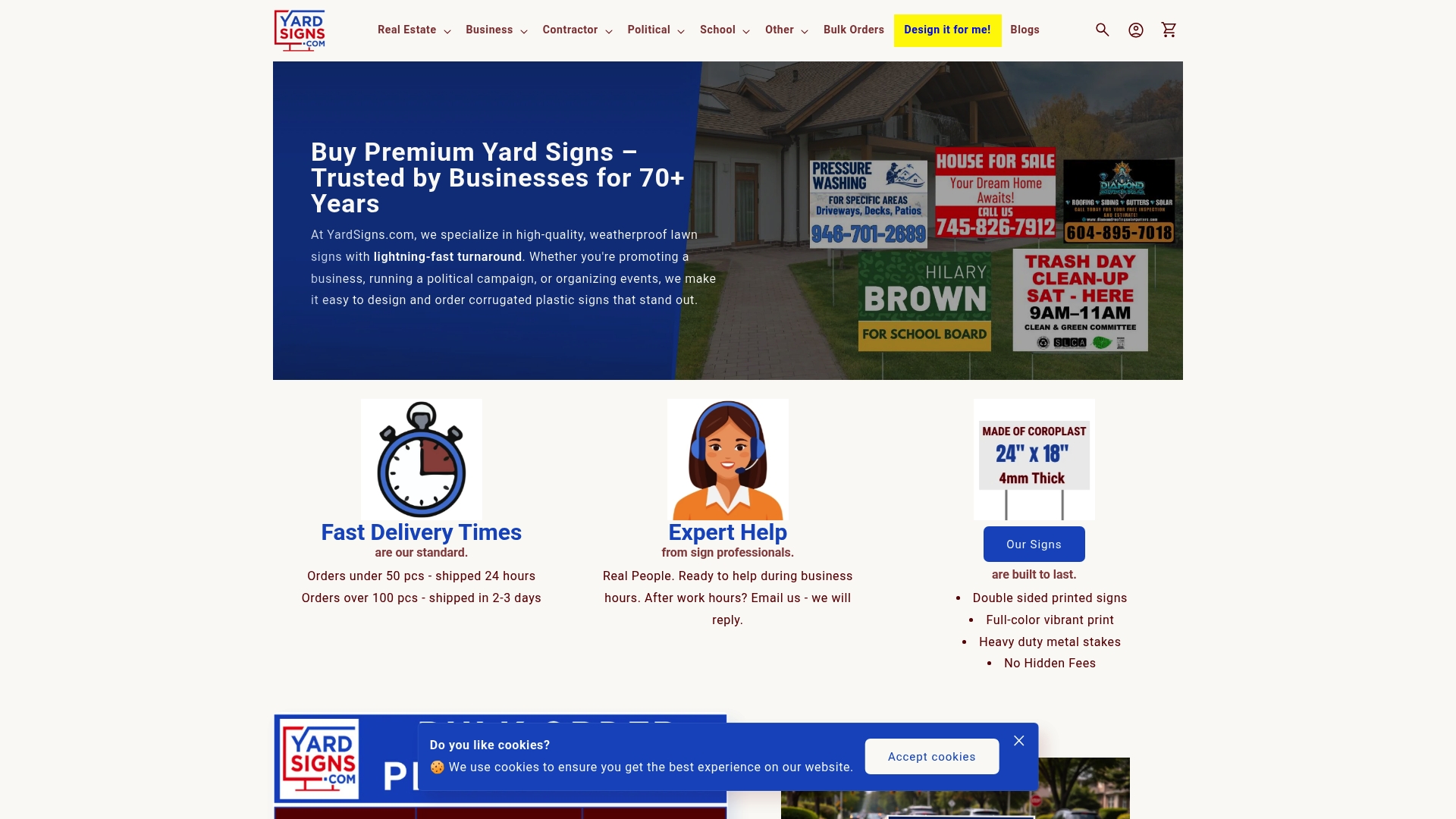
For phased campaign programs, Yardsigns’s bulk pricing tiers make it practical to order a starter run of 50 for core supporters, then scale to 100–200 for the final push without paying a premium for the second order. Double-sided printing is available for corner and intersection placements. The design process is straightforward: upload your artwork or use a template, approve the proof, and your signs move to production. Visit Yardsigns.com to configure your order, check current turnaround times, and get your campaign signs on the way.
Where to verify rules and order your signs
To check state and local rules:
- Your county election office: the primary source for polling-place buffer distances and local election-code requirements
- Your city or county municipal code lookup (most are available online through your local government website)
- Your state election commission website for statewide sign rules, size limits, and timing windows
- HOA covenants for any neighborhood where you plan private-property placements
- Texas TxDOT right-of-way rules (Texas campaigns) and the Georgia State Election Board (Georgia campaigns) as examples of state-level primary sources
For ordering, templates, and placement guidance:
- Yardsigns.com for product specs, bulk pricing, and rush fulfillment
- Placement ideas for local elections for field checklists and volunteer scripts
- Grassroots campaign strategy guide for phased ordering and operational planning
This article provides general informational guidance on campaign yard sign placement. Rules vary by state, county, and municipality. Confirm current requirements with your county election office, municipal code authority, or a qualified legal professional before deployment.
