


The Role of Signs Near Polling Locations: U.S. Guide
Signs near polling locations serve three core functions: guiding voters to the right entrance, signaling a campaign’s organizational strength, and — within strict legal limits — promoting candidates or causes. Before you place a single stake in the ground, though, you need to know your buffer zone. Electioneering restrictions vary by state and county, and violating them carries real penalties.
- Voter guidance: Directional arrows, parking signs, and accessibility markers help voters navigate without confusion.
- Organizational signaling: Visible signage near a polling site tells donors, volunteers, and undecided voters that a campaign is active and well-resourced.
- Promotional limits: Campaign advocacy signs are often prohibited within a defined buffer zone around the polling place entrance.
Compliance reminder: Buffer-zone distances differ by jurisdiction. Always confirm the exact distance and the specific measured door with your county election office before placing signs.
Table of Contents
- Why signs near polling places actually move the needle
- Legal basics: electioneering, buffer zones, and why your state is different
- What’s typically allowed versus prohibited near a polling site
- Design and placement best practices for compliance and visibility
- When to install signs and when to remove them
- Compliance checklist before you place signs
- Choosing durable materials and ordering on a tight timeline
- Key Takeaways
- What sign vendors see that most campaigns miss
- Get durable, fast-turnaround yard signs from Yardsigns
- Authoritative sources and further reading
Why signs near polling places actually move the needle
The mere-exposure effect is the clearest behavioral mechanism at work: repeated exposure to a candidate’s name builds familiarity that influences voter perception, especially in low-information local races where name recognition is scarce. A 2015 study led by Columbia University political scientist Donald Green found that lawn signs increased vote margins by a small but measurable amount on average across four randomized field experiments. Small, but potentially decisive in close contests.
Exterior visibility matters beyond persuasion. Research on polling-place attributes found that exterior visibility linked to an increase in turnout in observed precincts. Signs, flags, and clear exterior markers all contribute to that visibility signal.
Campaign managers read signage as organizational proof, not just advertising. Signage signals momentum to donors and volunteers — a densely signed neighborhood tells supporters the campaign is serious. That changes how smart campaigns budget: targeted directional signs near polling sites often deliver more per dollar than broad neighborhood saturation.
- Mere-exposure builds name recognition fastest in races with little media coverage.
- Exterior polling-place visibility correlates with measurable turnout gains.
- Signs function as morale and momentum signals for staff and volunteers.
Pro Tip: In local races with low voter information, keep your candidate’s name large and your message minimal. Signs without partisan labels have shown stronger recognition effects than those loaded with ideological cues.
Legal basics: electioneering, buffer zones, and why your state is different
Every U.S. state restricts electioneering near polling places, but the specific distances and enforcement mechanisms vary widely. Buffer-zone distances vary widely, typically spanning a moderate to larger range of feet, measured from a specific door that the county board is required to designate and announce before each election.
Two concrete examples show how far apart state rules can be. Texas requires 100-foot distance markers at polling-place entrances and 20-foot markers around curbside voting parking spaces, with official forms available from the Secretary of State. Massachusetts enforces a 150-foot electioneering prohibition that covers any material intended to aid or defeat a candidate during voting hours.
The presiding election officer at each site has authority to enforce the buffer zone on election day. County boards of elections set and publish the rules ahead of time.
- Confirm the exact buffer distance and the measured entrance with your county election office.
- Ask the property owner for permission if signs will be placed on private land adjacent to the polling site.
- When in doubt about a specific placement, consult an election attorney before election day.
Pro Tip: Download your state’s official distance-marker forms before election day. Texas and many other states publish them directly through the Secretary of State’s office — using official markers protects you if a dispute arises.
What’s typically allowed versus prohibited near a polling site
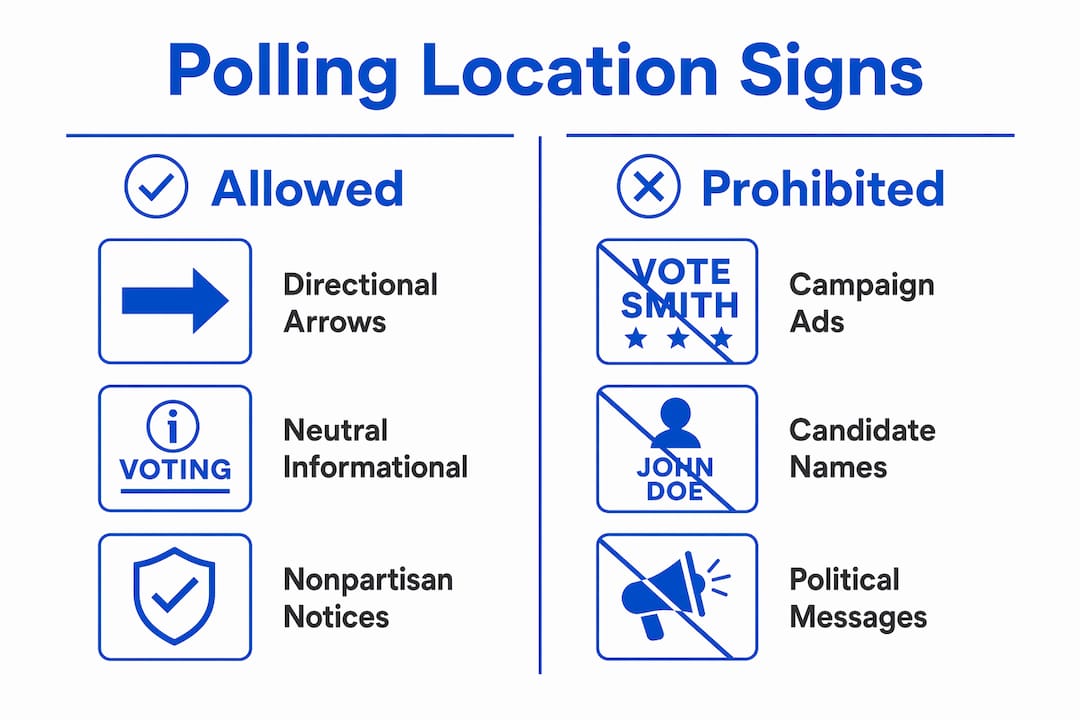
The general rule: neutral directional and informational signs are usually permitted outside the buffer zone; campaign advocacy materials with candidate names or slogans are typically prohibited within it.
| Typically Allowed | Typically Prohibited |
|---|---|
| Directional arrows to parking or entrance | Signs with candidate names or slogans inside the buffer zone |
| Neutral “Polling Place” or “Vote Here” markers | Campaign banners or flags within the restricted area |
| ADA accessibility and curbside voting signs | Signs that endorse or oppose a ballot measure within the buffer |
| Property-owner-approved signs outside the buffer | Signage that blocks ADA ramps, sidewalks, or egress paths |
Violations carry real consequences. Election officers can order immediate removal of non-compliant signs. In some states, leaving prohibited materials within the buffer zone after a warning is a misdemeanor. If you receive a removal order, comply immediately and document the interaction in writing. Disputes about whether a sign falls inside or outside the buffer zone are resolved by the presiding officer on-site, so having your measurements documented in advance is your best protection.
Design and placement best practices for compliance and visibility
Keep signs near polling locations utilitarian. The EAC Field Guide emphasizes icons, arrows, and plain language for interior polling-place signage — the same logic applies to exterior directional signs. A driver approaching a polling site needs to read your sign in under two seconds.
- Size: 18×24 inches is the standard yard sign format and works well for curbside visibility. For street-facing placement, 24×36 inches improves legibility from moving vehicles.
- Color contrast: High contrast (dark text on a light background, or white on deep blue/red) reads fastest at distance. Avoid color combinations that blend with foliage or pavement.
- Font: Sans-serif typefaces at large point sizes. One or two lines of text maximum for directional signs.
- Arrows: A VR polling-place study found that arrow signs were universally easy to read at a distance and gave voters the most navigational confidence.
- Placement: Position signs so they are visible from the driving lane without blocking sidewalks, ADA ramps, or curbside voting spaces. Stake signs perpendicular to traffic flow for maximum face exposure.
Pro Tip: Never place a sign where it forces a voter to walk around it. Blocking an accessible path is both a safety issue and a compliance violation — election officers will remove the sign immediately.
When to install signs and when to remove them
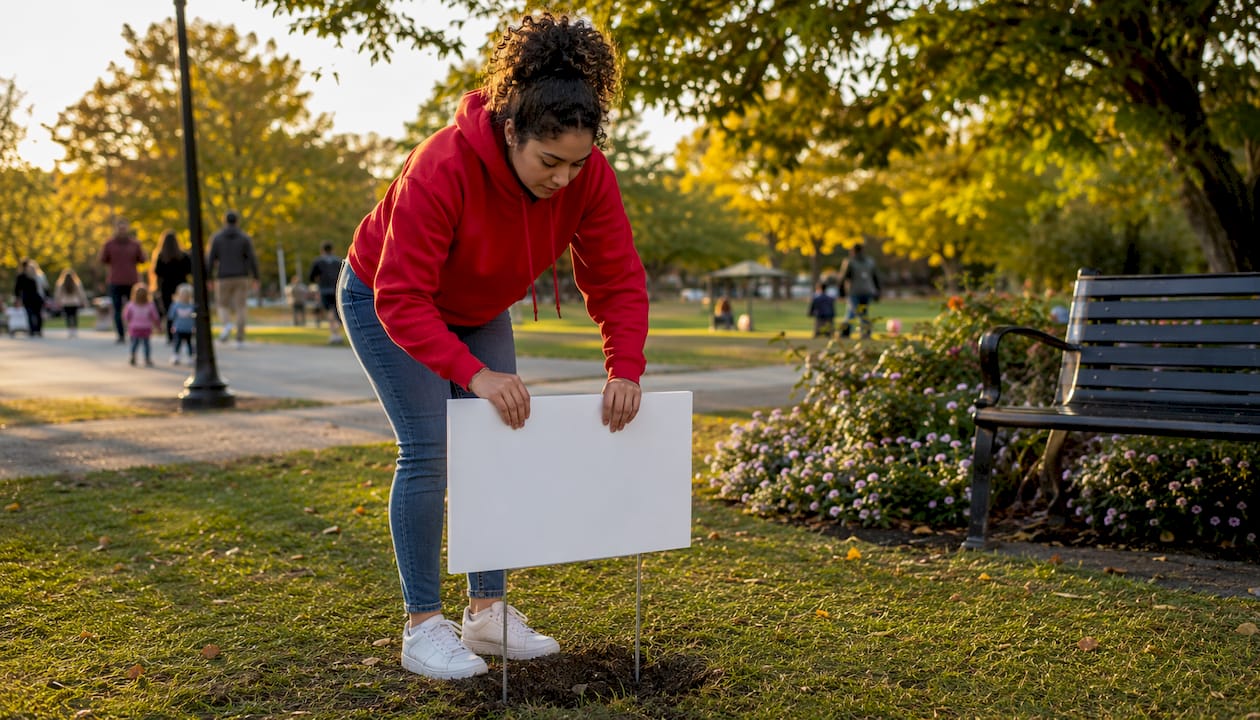
Install campaign signs outside the buffer zone before early voting begins, typically one to two weeks before election day. Remove all signs within 24 hours after polls close, or sooner if your state specifies a deadline.
- Pre-election window: Place signs on approved public or private land outside the buffer zone at least one week before early voting opens.
- Early voting period: Confirm that signs remain compliant throughout the early-voting window — some jurisdictions apply buffer-zone rules to early-voting sites as well as election-day locations.
- Election day: Do not add new signs within the buffer zone on election day. Verify that existing signs outside the zone are still within property-owner permissions.
- Post-election removal: Remove all signs promptly. Many municipalities issue fines for signs left up beyond a defined post-election window, often 24–72 hours after polls close.
Pro Tip: For last-minute sign orders, choose a vendor that ships orders under 50 pieces within 24 hours. That turnaround gives you a realistic window to receive, inspect, and place signs even if your timeline compresses in the final week.
Compliance checklist before you place signs
Confirm your buffer-zone distance, the specific measured door, and any local permit requirements before election day.
- Call your county board of elections and ask for the exact buffer-zone distance and the designated entrance door for each polling site.
- Ask the presiding election officer (or confirm through the county) whether any site-specific rules apply beyond the state statute.
- Verify the distance from the measured door to your planned sign location using a tape measure or mapping tool. Document it with a photo.
- Check local municipal sign codes — some cities require permits for temporary signs on public rights-of-way regardless of election rules.
- Get written permission from any private property owner before placing signs on their land.
- Download and use official distance-marker forms where your state provides them.
- Keep a record of all confirmations (names, dates, distances) in case of a dispute on election day.
Contact script: “Hi, I’m placing campaign signs near [polling site address] for the [election date] election. Can you confirm the buffer-zone distance, which entrance it’s measured from, and whether any local permit is required for temporary signs on the public right-of-way?”
Pro Tip: Make this call at least two weeks before election day. County offices get busy in the final week, and you want written confirmation — not a rushed verbal answer — before you commit to a sign placement plan.
Choosing durable materials and ordering on a tight timeline
For outdoor polling-location use, corrugated plastic (also called coroplast) is the standard choice. It handles rain, wind, and temperature swings without warping or fading. Aluminum signs cost more but are reusable across multiple election cycles.
- Corrugated plastic (4mm): Lightweight, weather-resistant, and compatible with standard H-stakes. Best for single-election use.
- Aluminum: More durable for multi-cycle reuse; heavier and more expensive per unit.
- UV-stable inks: Required for any sign that will be outdoors for more than a few days. Inks that are not UV-stable fade quickly in direct sunlight.
- H-stakes: Standard wire H-stakes work in most soil conditions. For hard or rocky ground, consider post-mount frames.
| Material | Weather Resistance | Reusability | Best For |
|---|---|---|---|
| Corrugated plastic (4mm) | High | Single cycle | Most polling-location uses |
| Aluminum | Very high | Multi-cycle | High-traffic, long-duration placements |
Yardsigns ships orders under 50 pieces within 24 hours, which matters when your timeline compresses in the final week before an election. Customer reviews consistently highlight the durability and color vibrancy of the printed signs — both qualities that hold up through rain and wind at outdoor polling sites. For outdoor sign material options, Yardsigns offers corrugated plastic and aluminum in standard political sizes with H-stakes included.
Pro Tip: Order a small test batch early in your campaign to verify color accuracy and material quality before committing to your full run. A 24-hour turnaround means you can reorder quickly if adjustments are needed.
Key Takeaways
Signs near polling locations guide voters, signal campaign strength, and must comply with state and local buffer-zone rules — compliance comes first, visibility second.
| Point | Details |
|---|---|
| Buffer zones vary by state | Distances range from 25 feet (in some local statutes) to 150 feet (Massachusetts state rule); confirm the exact distance and measured door with your county election office. |
| Visibility affects turnout | Exterior polling-place visibility correlates with measurable turnout gains in observed precincts. |
| Keep design utilitarian | Use large type, arrows, and minimal text — drivers need to read signs in under two seconds. |
| Remove signs promptly | Most jurisdictions require removal within 24–72 hours after polls close; fines apply for late removal. |
| Yardsigns for fast orders | Yardsigns ships orders under 50 pieces within 24 hours, with weatherproof corrugated plastic and UV-stable inks. |
What sign vendors see that most campaigns miss
The most common mistake isn’t a bad design — it’s placing signs before confirming the buffer zone. Campaigns assume the rules are the same as the last election cycle, or the same as a neighboring county. They’re often wrong. Buffer-zone distances change when polling sites move, and county boards don’t always send reminders.
The second mistake is over-designing. A sign crammed with a candidate’s name, slogan, party affiliation, website, and phone number does less work than a sign with just the name and office. The research backs this up: signs without partisan labels showed stronger recognition effects in the Green et al. experiments. Simplicity isn’t laziness — it’s the right brief for a sign that voters will see for two seconds from a moving car.
Material choice is the third area where campaigns cut corners and regret it. A sign that fades after three days of sun or collapses in the first rainstorm doesn’t just look bad — it signals disorganization to the very voters you’re trying to impress. Weatherproof corrugated plastic with UV-stable inks isn’t a premium upgrade; it’s the baseline for any outdoor sign that needs to last through an election cycle.
Work with a vendor who can document order timing and ship quickly. If a dispute arises about when signs were placed, having a timestamped order confirmation and shipping record is worth more than any verbal assurance.
Get durable, fast-turnaround yard signs from Yardsigns
When your election timeline is tight, you need signs that arrive ready to stake — not signs that require a week of back-and-forth on proofs. Yardsigns delivers orders under 50 pieces within 24 hours, using weatherproof corrugated plastic and UV-stable inks that hold up through rain, wind, and direct sun.
Whether you need directional arrows for voter guidance or political yard signs for outside the buffer zone, Yardsigns offers standard political sizes with H-stakes included and a straightforward online design process. Place your order at yardsigns.com and have compliant, durable signs in hand before your next early-voting window opens.
Authoritative sources and further reading
- U.S. Election Assistance Commission — Field Guide Vol. 08: Guiding Voters Through the Polling Place: Official EAC guidance on interior and exterior polling-place signage design and placement.
- Texas Secretary of State — Activities in the Vicinity of the Polling Place: State-specific buffer-zone distances, official marker forms, and curbside voting rules.
- Massachusetts Secretary of State — Election Advisory 24-05: Electioneering and the 150-Foot Rule: Detailed state advisory on what constitutes electioneering within the 150-foot zone.
- North Carolina General Statutes § 163-166.4: Example of state statute requiring county boards to designate and announce buffer-zone distances.
- Green et al. — The Effects of Lawn Signs on Vote Outcomes: Four randomized field experiments on sign effectiveness; the most rigorous published evidence on vote-margin impact.
- Center for Civic Design — Voting in VR: Polling Place Signage: Pilot study on how sign placement and arrow design affect voter navigation confidence.
- Your county board of elections: Always the definitive source for site-specific buffer-zone distances, measured doors, and local permit requirements. Contact them at least two weeks before election day.
