


Single vs Double Sided Sign: What You Need to Know
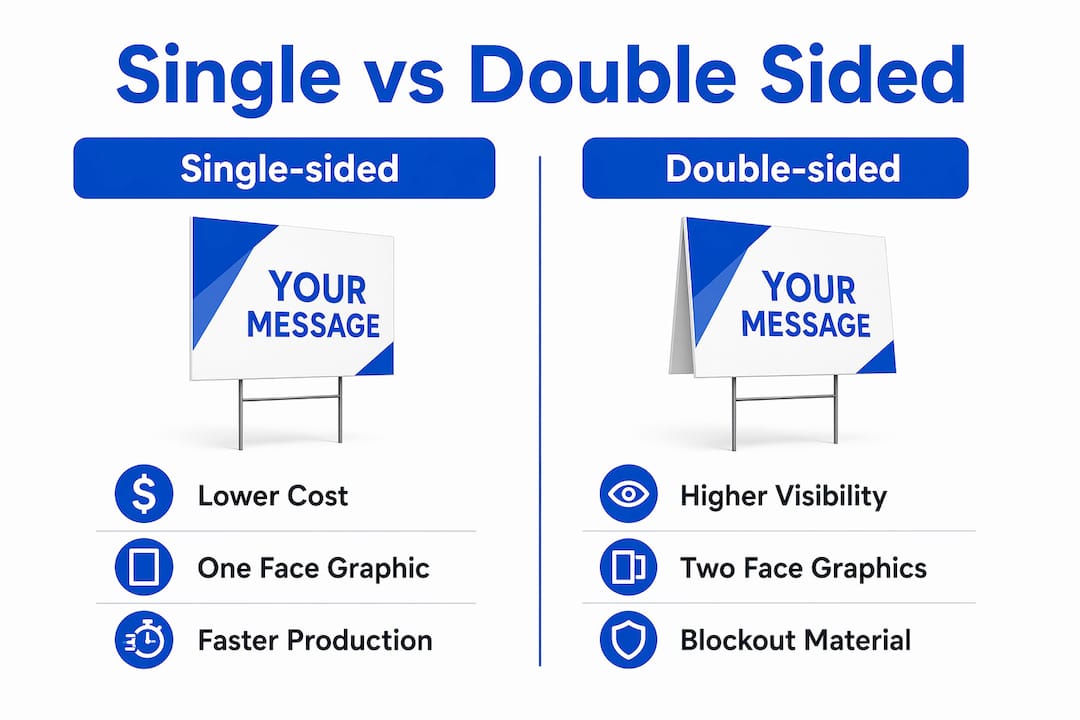
A single-sided sign displays its message on one face only, while a double-sided sign carries printed graphics on both faces, making it readable from two directions. This difference shapes everything from where you can place a sign to how much you pay for it. Yard signs, banners, flags, and road signs all follow this same principle. Choosing the wrong type for your location means wasted budget and missed impressions. Understanding the distinction before you order saves you from a common and costly mistake.
What is single vs double sided sign: the core difference
Single-sided signs are printed on one face, while double-sided signs carry graphics on both faces for visibility from two directions. That definition sounds simple, but the practical implications run deeper than most buyers expect. The type you choose determines your sign’s visibility range, material requirements, production cost, and design workload.
Think of a yard sign staked in front of a house on a one-way street. Drivers approach from one direction, read the message, and move on. A single-sided sign handles that job perfectly. Now place that same sign at an intersection where traffic flows from both directions. Half your audience never sees the message. That is the core problem double-sided signage solves.
This distinction applies across every sign format. Banners hung on a wall need only one printed face. Banners suspended from a ceiling in a trade show hall need two. Flags mounted on a pole at a street corner benefit from double-sided printing because wind rotates them constantly. Road signs at intersections use double-sided construction for the same reason: double-sided road signs improve safety by eliminating blind spots in multi-directional traffic.
How materials and printing differ between sign types
The material difference between single and double-sided signs is more significant than most buyers realize. Single-sided signs use standard lightweight vinyl or banner material. Double-sided signs require a blockout layer, an internal opaque substrate that prevents graphics from bleeding through to the opposite face.
Without blockout material, a double-sided banner becomes unreadable. Light passes through the substrate, and the reverse graphic shows as a ghost image on the front face. Blockout substrates act as an internal opaque layer that blocks light transmission and prevents graphic overlap from opposite sides. This is critical for outdoor and backlit applications where sunlight or artificial lighting would otherwise ruin the image.
Here is what the material and printing differences look like in practice:
- Standard vinyl (single-sided): Lightweight, lower cost, suitable for wall mounting, fences, and one-directional placements
- Blockout vinyl (double-sided): Heavier due to internal opaque layers, higher material cost, required for suspended banners and two-directional placements
- Flags (double-sided): Often use two separate fabric panels sewn back to back with a blockout liner between them
- Yard signs (double-sided): Use two coroplast panels sandwiched together or a single thick panel with printing on both faces
The design process also changes. Double-sided banners require separate artwork for each side to avoid a mirrored or unprofessional appearance. You cannot simply flip one design and call it done. Each face needs its own correctly oriented file, which increases design time and proofing rounds.
Pro Tip: When ordering double-sided signs, submit two separate artwork files labeled “Side A” and “Side B” with clear orientation notes. This prevents production errors and speeds up approval.
When is a single-sided sign the right choice?
Single-sided signs are the right choice whenever your audience approaches from one primary direction. This covers more situations than you might think, and choosing single-sided in these cases saves money without sacrificing any visibility.
Here are the most common scenarios where single-sided signs deliver full value:
- Wall-mounted signs: A sign attached to a building exterior faces outward. No one views it from behind.
- Fence line placements: Signs zip-tied to a chain-link fence along a road have a clear front-facing audience and a blocked reverse side.
- One-way street yard signs: Political campaigns, real estate listings, and event promotions placed on one-way streets reach 100% of their audience from a single direction.
- Storefront windows: Vinyl window graphics face the sidewalk. The interior view is irrelevant to the marketing goal.
- Indoor directional signs: Hallway signs mounted on walls point one way and serve one viewing angle.
The practical heuristic here is straightforward. If fewer than 25% of viewers approach from the reverse side, single-sided signs maximize your return on investment and visual clarity. That threshold matters because it gives you a measurable way to assess your placement before you order.
Single-sided signs also move faster through production. Single-sided signs require less proofing and simpler design approval because only one face needs artwork verification. For campaigns with tight deadlines, that speed advantage is real. Yardsigns ships orders under 50 pieces within 24 hours, and single-sided designs reach that threshold faster because there is only one file to approve.
What benefits do double-sided signs offer and when should you choose them?
Double-sided signs deliver their full value in locations with two-way traffic or open environments where viewers approach from multiple directions. The added cost is justified when both faces generate meaningful impressions.
The strongest use cases for double-sided signage include:
- Intersections and medians: Drivers approaching from both directions see the message. One sign does the work of two.
- Trade show island booths: Attendees walk around all sides of a freestanding display. Double-sided banners capture attention from both aisles.
- Festival and event signage: Open-field events have no fixed viewing direction. Double-sided flags and banners perform significantly better.
- Open house real estate signs: Placed at a corner lot or intersection, a double-sided sign reduces duplicate placement labor by replacing two single-sided signs with one post.
- Hanging ceiling banners: Suspended displays in retail stores or convention centers rotate and sway, exposing both faces to shoppers from every angle.
The efficiency argument for double-sided signs is often underappreciated. One double-sided sign can replace two single-sided signs for opposite-direction traffic, cutting your post count, installation time, and physical footprint in half. For political campaigns covering busy intersections, or real estate agents managing multiple open house locations, that efficiency compounds quickly.
Pro Tip: Before ordering double-sided signs for an event or campaign, visit the placement location at peak traffic time. Count how many people approach from each direction. If the split is close to 50/50, double-sided is clearly worth the investment.
Design coordination matters more with double-sided signs. Each face needs its own artwork, and the two designs must work together as a cohesive set without conflicting visually. A real estate yard sign with a directional arrow, for example, needs the arrow pointing the correct way on each face, which requires two separate files with mirrored directional elements.
How does cost factor into the single vs double-sided decision?
Cost is the most common reason buyers default to single-sided signs, and it is a legitimate factor. Double-sided banners typically cost 40 to 70% more than single-sided versions due to layered blockout materials and the need for two separate graphic designs. That premium is real and should be weighed against actual visibility gains.
| Cost factor | Single-sided | Double-sided |
|---|---|---|
| Material cost | Lower (standard vinyl or coroplast) | Higher (blockout substrate required) |
| Design cost | One artwork file | Two separate artwork files |
| Proofing rounds | Faster, one face to review | Slower, two faces to coordinate |
| Installation | Standard post or mount | Same, but replaces two signs at one location |
| Long-term value | Best when one-direction traffic dominates | Best when both faces generate impressions |
The key insight is that double-sided signs only deliver cost efficiency when both faces are actually seen. Paying 40 to 70% more for a sign placed against a wall, where the reverse face is never visible, produces zero return on that premium. The cost decision and the placement decision are inseparable.
For budget-conscious campaigns, a practical approach is to order single-sided signs for placements with clear one-directional traffic and reserve double-sided signs for confirmed two-way locations. This hybrid strategy controls costs without sacrificing coverage. You can also review local election yard sign placement ideas to see how experienced campaigners balance sign type selection with placement strategy.
How to decide which sign type fits your specific needs
Choosing between single and double-sided signs comes down to four questions you should answer before placing any order.
-
What direction does your audience approach from? Walk or drive the placement location. Note whether traffic flows from one direction or two. If you see consistent two-way flow, double-sided earns its cost. If traffic is one-directional, single-sided is the right call.
-
Is the reverse side physically accessible to viewers? A sign mounted on a wall, fence, or building has a blocked reverse face regardless of traffic patterns. Double-sided printing on a wall-mounted sign is wasted material. Single-sided is always correct for fixed-surface placements.
-
What is your budget and timeline? Single-sided signs cost less and move through production faster. If your campaign has a short window or a tight budget, single-sided signs at more locations often outperform fewer double-sided signs at premium placements.
-
How complex is your message and design? Double-sided signs require two coordinated artwork files. If your design team or design budget is limited, the added complexity of a two-sided layout can slow production and introduce errors. Single-sided designs are faster to approve and easier to get right.
For directional signage, such as arrows pointing toward an open house or event entrance, the side-specific orientation of arrows makes double-sided design especially important. A home sale yard sign with a directional arrow must have the arrow pointing the correct direction on each face, which requires deliberate design coordination rather than a simple copy-and-flip approach.
For outdoor placements exposed to weather, material durability matters as much as print type. Weatherproof signage holds up through rain, wind, and sun regardless of whether it is single or double-sided, but double-sided signs with blockout layers tend to be heavier and may need stronger mounting hardware in high-wind locations.
Key takeaways
The single most important rule in sign type selection is this: double-sided signs only add value when the reverse face receives meaningful viewer traffic, so always assess your placement before choosing.
| Point | Details |
|---|---|
| Core definition | Single-sided signs print on one face; double-sided signs print on both for two-direction visibility. |
| Material requirement | Double-sided signs need blockout substrate to prevent graphic show-through from the opposite face. |
| Cost premium | Double-sided signs cost 40 to 70% more due to materials and two-file design requirements. |
| Placement heuristic | If fewer than 25% of viewers approach from the reverse side, single-sided signs deliver better ROI. |
| Design complexity | Double-sided signs require two separate, correctly oriented artwork files, not a mirrored copy. |
Why I think most buyers overcomplicate this decision
I have seen buyers spend hours debating single versus double-sided signs when the answer was obvious from a five-minute site visit. The most common mistake is assuming double-sided always means better. Double-sided signs only provide more impact when the reverse side has significant visibility. That condition is not met as often as people think.
The second mistake is skipping the site survey entirely. Buyers order based on assumptions about traffic flow and end up with double-sided signs mounted on fences or walls where the back face is completely hidden. That is a 40 to 70% material premium with zero return.
My honest recommendation: spend ten minutes at your placement location before you order anything. Watch traffic. Count directions. If you see consistent two-way flow, go double-sided. If traffic is one-directional or the reverse face is blocked, single-sided is the smarter choice every time. The sign material quality matters just as much as the print type, so do not cut corners on blockout substrate if you do go double-sided. A cheap double-sided sign with poor blockout looks worse than a well-made single-sided sign.
— YardSignGuy
Find the right yard sign for your placement at Yardsigns
Yardsigns offers customizable yard signs built for real-world placements, whether you need a clean single-sided design for a one-way street or a coordinated double-sided setup for a busy intersection. Every sign ships with vibrant, weatherproof printing that holds up through rain and sun. Orders under 50 pieces ship within 24 hours, so you can move fast when timing matters. Explore options like the home sale yard sign to see how directional designs work in practice, or browse the full catalog to find the right format for your campaign, event, or promotion.
FAQ
What is the main difference between single and double-sided signs?
A single-sided sign has printing on one face only, while a double-sided sign has graphics on both faces for visibility from two directions. The choice affects material requirements, cost, and where the sign can be effectively placed.
Do double-sided signs always cost more?
Double-sided signs typically cost 40 to 70% more than single-sided versions due to blockout materials and the need for two separate artwork files. The extra cost is only justified when both faces of the sign receive meaningful viewer traffic.
What is blockout material and why does it matter?
Blockout material is an internal opaque substrate used in double-sided signs to prevent graphics from showing through from the opposite face. Without it, light passes through the sign and creates a ghost image that makes both sides unreadable.
When should I choose a single-sided sign over double-sided?
Choose single-sided when your audience approaches from one direction, when the sign mounts on a wall or fence, or when fewer than 25% of viewers would see the reverse face. Single-sided signs also move through production faster and cost less.
Can I use the same artwork file for both sides of a double-sided sign?
No. Double-sided signs require two separate, correctly oriented artwork files. Simply mirroring one design produces incorrect text orientation and an unprofessional appearance on one face.
