


Beat Permit Deadlines: Temporary Sign Regulations with City Codes
Most U.S. municipalities regulate temporary signs by size, placement, and duration, not by what the sign says. Common trouble spots include the public right-of-way, utility poles, and trees, though many downtown districts carve out sidewalk exceptions. Before you install anything, check your municipal code or call your local planning or building department. That five-minute call can save you a fine and a wasted sign.
TL;DR:
- Most cities regulate temporary signs by size and duration, with frequent limits around 32 square feet for freestanding signs and 45 days annually for display time.
- Placement is typically restricted from the public right-of-way, utility poles, trees, and traffic medians, though exceptions exist in certain districts with proper permission.
- Sign permits are usually required for banners and promotional displays, except for political and standard real estate signs, which are often exempt if they stay within size limits.
- Proper planning involves confirming local rules through the municipal code or department, factoring in production lead times, and ensuring signs are weather-resistant and securely installed.
- The safest approach is to size down or set back signs more than the minimum to avoid enforcement, and to communicate directly with local officials before installation.
Table of Contents
- What Are the Typical Temporary Sign Regulations on Size and Duration?
- Where Can You (and Can’t You) Place a Temporary Sign?
- When Do You Need a Permit, and When Are You Exempt?
- Safety Rules That Can Get Your Sign Removed
- How Do You Check Local Rules and Get a Permit?
- What a Sign Manufacturer Wishes Every Customer Knew
- Get a Compliant Sign Made Fast
- Municipal Codes Worth Checking First
- Sources
- FAQ
What Are the Typical Temporary Sign Regulations on Size and Duration?
Every municipality writes its own numbers, but patterns repeat across the country. Once you’ve seen a handful of city codes, you start noticing the same handful of thresholds showing up again and again, just with different labels attached.
Lawrence, Kansas caps freestanding temporary signs at 32 square feet and 9 feet in height, and limits most business displays to a set number of days per calendar year. Salem, Oregon takes a different approach for lawn signs specifically, holding them to a short height limit while setting separate area and duration rules for banners and pennants. Pierce County breaks temporary signage into categories, with distinct caps for A-boards, banners, and yard signs, each tied to specific display windows.
The pattern that matters most for compliance:
- Size limits usually scale with lot frontage or zoning district, so a sign that’s legal on a highway commercial lot may exceed the cap on a residential corner.
- Height limits commonly sit between 4 and 9 feet for freestanding signs, with lawn and sidewalk signs held to much shorter thresholds.
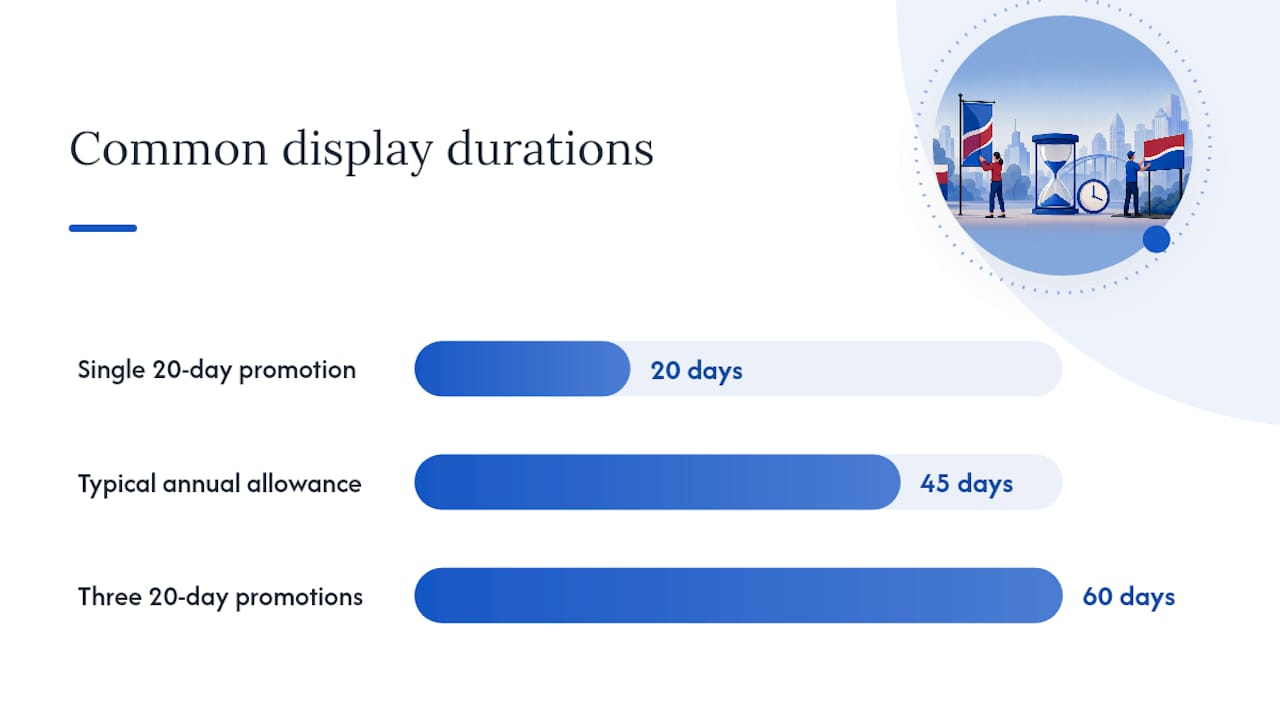
- Display duration is often calculated per calendar year rather than per event, meaning a business that runs three 20-day promotions could exceed a 45-day annual allowance without realizing it.
- Number limits frequently differ for single-tenant properties versus multi-tenant shopping centers, where each business might be allowed one sign rather than one per storefront.
Zoning district matters as much as the sign itself. A content-neutral code regulates the physical object, not the message, so the same banner that’s fine in a commercial zone can violate a residential district’s rules purely on size or placement grounds.
Where Can You (and Can’t You) Place a Temporary Sign?
Placement rules trip up more sign owners than size limits do, mostly because people misjudge where their property actually ends. The strip of grass between the sidewalk and the curb often belongs to the city, not the homeowner. Municipal staff or GIS mapping tools can confirm the right-of-way boundary before you plant a stake somewhere you don’t actually control.
Most jurisdictions draw a hard line around a few consistent no-go zones:
- The public right-of-way, including planter strips, curb areas, and street medians, where signs are prohibited outright in nearly every code we reviewed.
- Utility poles, traffic signs, and trees, which sign codes almost universally protect from attached signage of any kind.
- Traffic islands and median strips, treated as off-limits for safety reasons regardless of sign size.
Downtown and mixed-use districts often break from that pattern. Salem’s guidance permits certain sidewalk signs in designated commercial corridors, and Spokane’s code allows right-of-way placement with owner permission, provided the sign doesn’t obstruct a continuous 6-foot pedestrian path. Portable sandwich boards typically qualify for these exceptions when they meet specific size and setback criteria. If you’re weighing a sidewalk sign, our guide on sandwich board signs walks through what usually qualifies. For a deeper look at right-of-way risk specifically, see can you put yard signs on public property.
When Do You Need a Permit, and When Are You Exempt?
Not every temporary sign requires paperwork, but the exemptions are narrower than most people assume. Getting this wrong is the most common way business owners end up with a removal notice.
- Political signs are typically exempt from permits entirely, though most codes still cap their size and require removal within a set window after an election.
- Real estate signs advertising a property for sale or lease usually skip the permit process too, as long as they stay under the jurisdiction’s standard size cap.
- Grand opening and special event banners often require a one-time permit tied to a specific date range rather than an annual allowance, which matters if you’re timing a launch.
- Minor or internal signs, like a small window notice or a sign that doesn’t face a public street, frequently fall outside permit requirements altogether.
- Everything else, including most freestanding business signs and banners displayed for promotional periods, usually needs a temporary sign permit application submitted before installation.
Cary, North Carolina structures its code around exactly this permit-versus-exempt split, and Worthington, Ohio organizes its ordinance the same way, with separate sections for prohibited locations, exemptions, and numeric caps. Most planning department portals ask for the same basics: sign dimensions, proposed location, display dates, and sometimes a site sketch. If a grand opening is on your calendar, our grand reopening sign guide covers how to line up production with your permit window.
Safety Rules That Can Get Your Sign Removed
Sight-triangle violations account for a large share of temporary sign removals, and they’re almost always accidental. A vision-clearance or sight-triangle rule protects the sightline drivers and pedestrians need at intersections, driveways, and crosswalks. Plant a sign too close to a corner, and code enforcement will flag it even if the sign itself meets every size limit.
Pedestrian access is the second common trigger. Spokane’s code requires a continuous 6-foot clear path on any sidewalk carrying a temporary sign, and ADA-related access rules generally require the same clearance around curb ramps and building entrances. Blocking either invites a quick removal order.
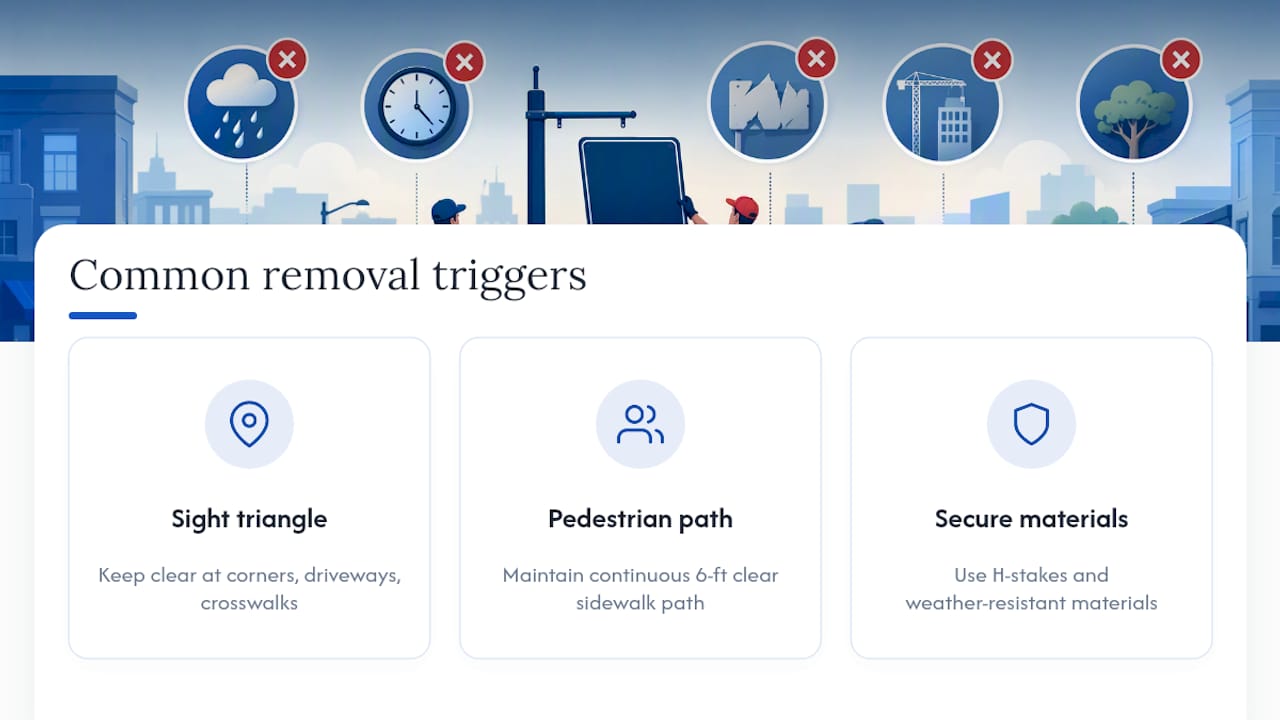
On the material side, a flimsy sign that folds in the wind doesn’t just look bad. It becomes debris in the right-of-way, which is exactly the kind of complaint that triggers enforcement. Secure H-stakes and weather-resistant materials reduce that risk considerably.
How Do You Check Local Rules and Get a Permit?
The process is nearly identical everywhere, even though the numbers differ by city. Working through it in order keeps you from missing a step that costs you a redo later.
- Identify your exact municipality and zoning district, since county and city rules often differ even for adjacent addresses.
- Search the municipal code for “temporary sign” or “sign permit” to find the specific ordinance section.
- Confirm the numeric limits that apply to your sign type: size, height, quantity, and allowed placement.
- Record your intended display dates against the annual allowance so you don’t accidentally exceed it.
- Call or email the planning or building department with your specific sign dimensions and location before you order anything.
- Prepare a site photo or simple sketch showing sign placement relative to the property line and sidewalk for the permit application.
Pro Tip: Call the planning department instead of relying solely on the website. Codes get updated, and a five-minute phone call often surfaces exceptions or recent amendments that the PDF hasn’t caught up to yet.
What a Sign Manufacturer Wishes Every Customer Knew
Permit windows and production timelines fight each other more often than people expect. A city might grant you a 30-day display window, but if your sign takes two weeks to design and ship, you’ve already burned half your legal runway before it’s even in the ground. Building production time into your permit planning, not after it, is the single biggest scheduling mistake we see.
Material choice matters more than people assume, too. A sign rated for outdoor weather with secure H-stakes survives wind and rain long enough to serve its full permitted window, while a cheap print sags or fades within days, inviting complaints and enforcement even before the permit period ends.
When an ordinance reads ambiguously, the safer move is almost always to size down or set back farther than the minimum. Enforcement officers rarely cite a sign for being too conservative.
— YardSignGuy
Get a Compliant Sign Made Fast
Once you know your size and duration limits, the next problem is turnaround. Yardsigns is built for exactly that gap. Most orders under 50 pieces ship within 24 hours, so if your permit gives you a 14 or 45 day window, you’re not losing days of it waiting on production. Our custom yard signs come in corrugated plastic or aluminum with UV-resistant inks and included metal H-stakes, built to hold up for 6 to 12 months outdoors rather than sagging after one storm.
If you’re ordering for a campaign, a store opening, or a property listing, our template collections are already sized close to common municipal limits: check out political yard signs, real estate yard signs, or business signs. Every order includes a free proof with unlimited revisions, so you can confirm your dimensions match your permit before anything prints. Not sure which size clears your local cap? Reach out through the site and get a proof started today.
Municipal Codes Worth Checking First
Start with the ordinances that shaped this guide before searching your own city’s code from scratch:
- Lawrence, Kansas temporary sign regulations
- City of Salem temporary sign guidance
- Spokane Municipal Code, Section 17C.240.244
- Pierce County Code, 18B.10.040
- Worthington, Ohio sign code
Your own city’s planning portal or permit office remains the authoritative source for current, enforceable rules.
Sources
- Lawrence, Kansas temporary sign regs (excerpt)
- City of Salem — Temporary signs guidance
- Spokane Municipal Code — Temporary Signs (Section 17C.240.244)
- Pierce County Code — Temporary signs (18B.10.040)
FAQ
How Long Can a Temporary Sign Legally Stay Up?
Duration limits vary widely, but 30 to 45 days per calendar year is a common range, with Lawrence, Kansas allowing up to 45 days for many business displays.
Do Political Yard Signs Need a Permit?
Most municipalities exempt political signs from permit requirements, though size caps and post-election removal deadlines still apply in nearly every code.
Can I Put a Temporary Sign in the Grass Strip Near the Sidewalk?
That strip is usually public right-of-way, not private property, and most codes prohibit signs there entirely except in designated downtown sidewalk zones.
What Happens if My Sign Gets Cited?
Enforcement typically starts with a removal notice, escalating to fines or impoundment for repeat violations; contacting your planning or code enforcement office directly clarifies the exact process in your city.
Where Can I Order a Sign That Meets Common Size Limits?
Custom yard sign providers often offer prebuilt templates sized close to typical municipal caps, with many small orders shipping quickly to meet tight permit windows.
