


Avoid Cracking Within Months: UV Sign Printing, Match Ink to Substrate
UV printing is one of the strongest choices for full-color, durable signage, provided you match the ink formulation to your substrate. The instant curing process locks in vibrant color and produces low VOCs. The one caveat that trips up buyers most: pick rigid ink for flat boards and flexible ink for anything that bends, wraps, or gets thermoformed, or you risk cracking within months.
TL;DR:
- Rigid inks are best for flat signs and plaques, while flexible inks are necessary for wraps, bends, or thermoformed parts to prevent cracking.
- UV printing onto materials like acrylic, aluminum, and corrugated plastic offers high durability and crisp visuals suitable for outdoor signage.
- Flatbed printers excel at rigid substrates, roll-to-roll handle flexible media, and hybrid systems combine both for high-volume or mixed-material sign production.
- Sign lifespan depends on ink formulation, substrate preparation, and environmental conditions; primer is often needed for plastics and bare metals.
- Choosing a vendor should involve testing for adhesion and weather resistance, verifying white and varnish options, and matching turnaround times to project needs.
Table of Contents
- How Does UV Printing Work for Signs?
- Which Sign Materials Work Best With UV Printing?
- What Types of UV Printers Are Used for Signage?
- Which UV Ink Family Should You Use?
- How Do You Prepare Files for UV Sign Printing?
- What Determines How Long a UV-Printed Sign Lasts Outdoors?
- What Drives Cost and Turnaround for UV Sign Jobs?
- Is UV Printing Right for Your Sign Project?
- How Do You Choose a UV Printing Supplier for Signs?
- Get Weatherproof Signs Without the Guesswork
- Sources
How Does UV Printing Work for Signs?
UV printing for signs works by curing ink the instant it hits the substrate. UV-LED lamps trigger a chemical reaction that hardens the ink on contact, which means there’s no drying time built into production and no wet ink to smear during handling. That single fact reshapes the whole workflow: shops can print directly onto acrylic, aluminum, or PVC and move straight to finishing.
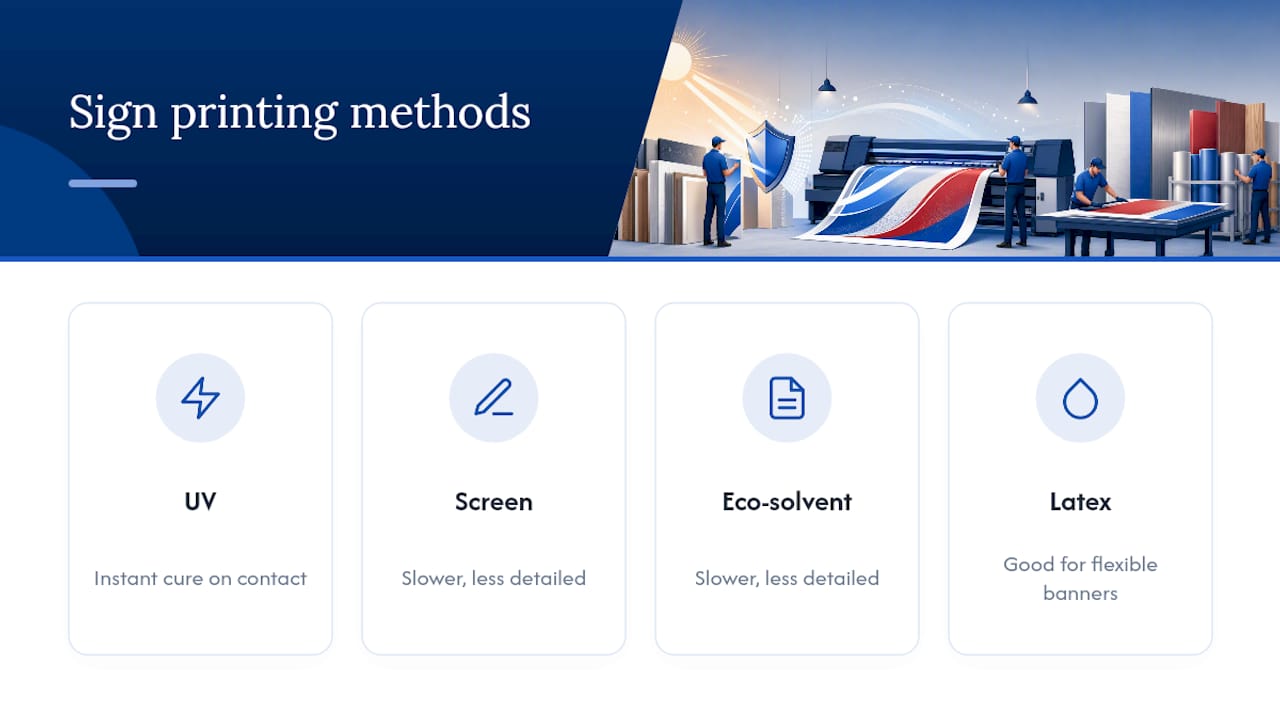
Because curing happens at the point of deposition, UV presses can also lay down white ink and gloss varnish in the same pass, opening up opaque backgrounds on clear substrates and spot-gloss effects on matte boards. Compared to screen printing, eco-solvent, or latex, UV wins on speed and detail for short-to-medium sign runs. Latex still has an edge on some flexible banner jobs, but for rigid signage, UV is usually the more efficient path.
Which Sign Materials Work Best With UV Printing?
Substrate choice drives everything else, from ink family to pricing. UV ink bonds well to rigid substrates like acrylic and metal when curing settings and pretreatment are dialed in correctly.
- Acrylic delivers a premium look for plaques, office signage, and awards. It’s typically available in 1/8 inch to 1/2 inch sheets and holds crisp edges after routing.
- Corrugated plastic is the workhorse for yard signs, lightweight, cheap to ship, and easy to stake into lawns.
- Aluminum and aluminum composite panels hold up longest outdoors, resisting warping and fading better than plastic over multi-year installs.
- Foam board suits short-term indoor displays, but it dents easily and isn’t a fit for outdoor use.
Low-surface-energy plastics and bare, uncoated metals often need a primer pass before printing, or the ink sits on top instead of bonding to it.
What Types of UV Printers Are Used for Signage?
Printer style determines what jobs a shop can realistically handle, and matching machine to job type matters as much as picking the right ink.
- Flatbed printers handle rigid panels directly, laying full-bleed graphics onto acrylic, PVC, wood, or metal without a media roll. They’re the standard choice for one-off plaques and short-run rigid signs.
- Roll-to-roll printers feed flexible film or vinyl continuously, which suits banners, wraps, and any sign material that needs to bend around a frame or vehicle panel.
- Conveyorized or hybrid systems move rigid and flexible substrates through in a continuous line, built for production lines and mixed-media runs where volume matters more than one-off customization.
Small shops usually run flatbed only; industrial operations often own all three to cover the full range of sign formats without turning away jobs.
Which UV Ink Family Should You Use?
Ink family is where most sign failures actually start. Rigid ink cures hard and scratch-resistant, ideal for flat boards that never move. Flexible ink stretches to more than 180 percent without cracking, which makes it the only real option for wraps or thermoformed parts. Hybrid formulations split the difference for shops printing both rigid panels and flexible film on the same equipment, cutting down on ink inventory in the process.
| Ink Family | Best For | Key Trait |
|---|---|---|
| Rigid | Flat boards, plaques, metal signs | High hardness, scratch resistance |
| Flexible | Wraps, thermoformed parts, banners | High stretch, resists cracking |
| Hybrid | Mixed rigid/flexible production | Versatile, reduces ink SKUs |
Pro Tip: If a sign will get routed, bent, or vacuum-formed after printing, request a stretch test on the exact ink and substrate combo before you commit to a full run. A rigid ink that looks fine flat can crack the moment it flexes.
How Do You Prepare Files for UV Sign Printing?
Getting files right before the machine runs saves both time and material. Follow this sequence:
- Submit vector artwork for text and logos; use high-resolution raster files (300 dpi minimum at final size) for photos.
- Build white ink and varnish layers as separate, clearly named channels in your file, since some setups print at up to 1440 dpi and misnamed layers cause opacity errors.
- Confirm your printer’s RIP software and printhead waveform settings match the ink you’re running.
- Run a proof, then a small test print on the actual substrate to check color and adhesion.
- Move to the full run only after the test print clears quality checks.
What Determines How Long a UV-Printed Sign Lasts Outdoors?
Real-world durability isn’t a single ink spec. Ink formulation, substrate, finish, mounting, and installation environment work together to determine lifespan, and skipping any one of them shortens the life of an otherwise well-printed sign.
Bare metals and low-energy plastics often need a primer coat before printing to prevent peeling once the sign faces sun, rain, and temperature swings. Sealing cut edges and choosing stable mounting hardware, rather than tape or improvised stakes, extends life further, as recommended in structural analysis & design for signages, billboards, LED panels, and traffic gantry. YardSigns.com builds around this reality directly: every sign uses UV-resistant inks designed for weather exposure, and orders under 50 pieces ship within 24 hours, so campaigns and events don’t stall waiting on production.
— YardSignGuy
What Drives Cost and Turnaround for UV Sign Jobs?
Substrate and ink choice set the price floor, but several other factors move the number up or down.
- Substrate type and thickness (aluminum costs more than corrugated plastic).
- Ink family, plus any white ink or varnish layers added.
- Sign size, quantity, and finishing steps like routing or laminating.
- Shipping timeline and whether the order needs rush handling.
UV curing removes drying time from the schedule, but cutting, edge finishing, and shipping still add days. Short runs are usually more economical printed on demand, while larger volumes benefit from batch pricing once quantities climb.
Is UV Printing Right for Your Sign Project?
Weighing the trade-offs upfront saves a reprint later.
- Advantages: vibrant color, strong durability outdoors, works across rigid and flexible substrates, low VOCs.
- Downsides: adhesion issues on untreated plastics or bare metal without primer, higher equipment cost for shops printing in-house, ink family must match substrate mechanics exactly.
- Consider an alternative: large soft banners with heavy folding may still do better with latex or eco-solvent printing.
How Do You Choose a UV Printing Supplier for Signs?
Before committing to a vendor or printer, confirm these points:
- Ask for a substrate-specific test print and, ideally, a weathering sample.
- Confirm which ink family they run and whether they’ll perform an adhesion or stretch test on request.
- Check for white ink capability, varnish or spot UV options, and their maximum sheet size.
- Compare turnaround time, minimum order quantities, and their policy on fading or print defects.
Get Weatherproof Signs Without the Guesswork
If you’d rather skip sourcing printers and ink families altogether, you can find services that print signs with UV-resistant inks on weatherproof corrugated plastic or aluminum, double-sided when needed, and ship orders under 50 pieces within 24 hours.
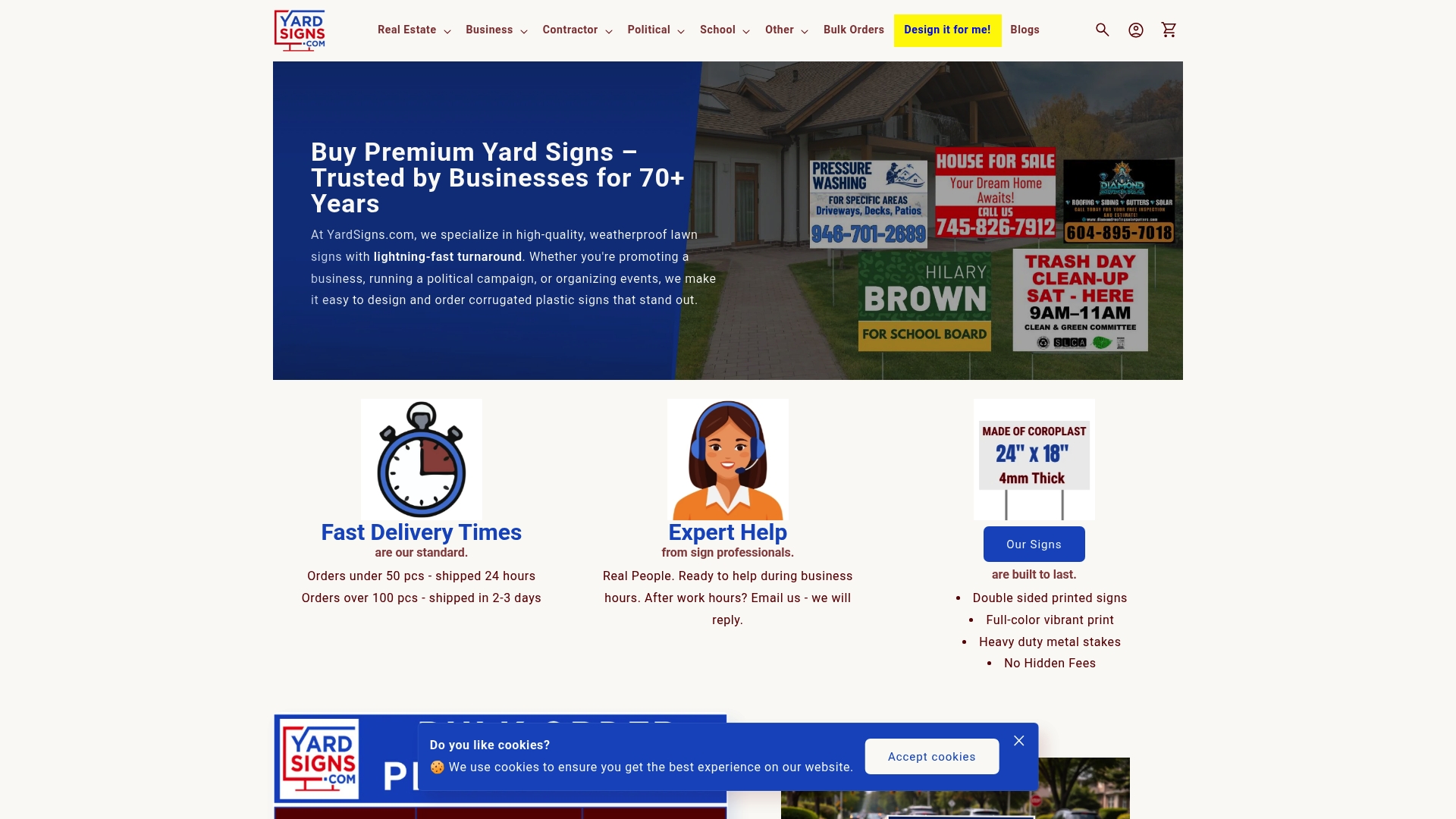
Real estate agents can grab a durable outdoor sign built for the elements, referenced in our guide to real estate signage durability, while offices celebrating milestones can order straight from the employee recognition sign or Employee of the Month product pages. Every order includes a free design proof, unlimited revisions, and metal H-stakes, so there’s no separate hardware to track down. Send your artwork as a high-resolution file, pick your finish, and place your order today to have signs on your lawn or storefront within days.
Sources
- What is UV Printing? Comprehensive Definition — Kornit
- UV-LED Ink for Advertising & Signage: Rigid, Flexible & Large-Format Guide (2026) — INKBANK
- UV Printing Technology Explained | Process, Benefits & Applications — Inkcups
- Guide to UV inkjet printing — Fujifilm Ink (2026)
