


What Does Political Branding on Signs Mean for Campaigns?
Political branding on signs is defined as the coordinated use of visual and verbal elements on campaign signage to identify a candidate, communicate values, and shape voter perception at a glance. The industry term for this practice is campaign visual identity, and it covers everything from name placement and color choice to slogans and logo design. Understanding political signage means recognizing that a yard sign is never just a name on a board. It is a compressed brand statement that works in the two seconds a driver passes it on the street. Campaign strategists who treat signs as an afterthought consistently underperform those who treat them as a frontline branding tool.
What does political branding on signs mean for your campaign?
Political branding is the sum of all impressions shaping voter perception, including name, colors, slogans, behavior, endorsements, and communication style. That definition matters because it tells you a sign is not just decoration. Every design choice either builds or erodes the candidate’s identity in the voter’s mind.
A logo alone does not equal a brand. Campaign visual identity encompasses every impression a candidate makes, enabling recognition and trust with minimal advertising costs. For local races with tight budgets, that efficiency is decisive.

The meaning of campaign branding on signs also carries a time dimension. Campaign brands are designed to expire, which strategically mobilizes urgency and participation. That built-in deadline is why sign design must communicate fast and clearly. There is no time for a voter to decode a cluttered layout.
What elements comprise political branding on signs?
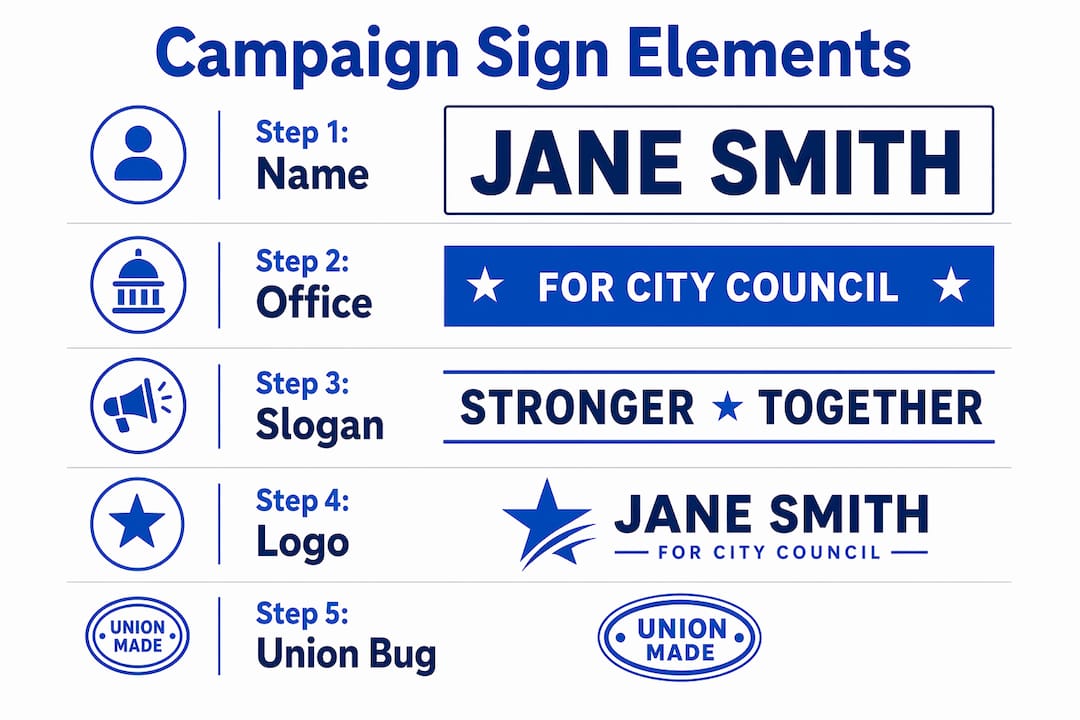
Effective campaign signage combines several components, each carrying a specific job. When they work together, the sign builds instant recognition. When any element fails, the whole message weakens.
- Candidate name. The name is the primary asset. A candidate’s name should occupy 40–60% of the sign face to maximize recognition from passing viewers. Anything less and the sign loses its core function.
- Color palette. Colors carry party associations and cultural signals. Red, white, and blue dominate American political signage because they trigger patriotic recognition. Nontraditional colors can differentiate a candidate but require stronger name recognition to compensate.
- Slogan or tagline. A short phrase of three to five words reinforces the candidate’s core message. “Stronger Together,” “Make It Happen,” and similar constructions give voters a value anchor beyond the name.
- Logo or symbol. A simple graphic mark aids recall across multiple touchpoints, from yard signs to mailers to social media.
- Typography. Bold, sans-serif fonts read fastest at distance and speed. Script or decorative fonts slow comprehension and reduce impact.
- Design consistency. Every sign in a campaign should use the same colors, fonts, and layout. Consistency builds recognition across neighborhoods and reinforces the sense of an organized, credible operation.
Pro Tip: Keep your sign to three elements maximum: name, office sought, and one short slogan. Every additional element cuts readability by a measurable margin when viewed from a moving vehicle.
Reviewing examples of winning campaign signage shows that the most recognized signs in competitive races share one trait: they are simple enough to read in under two seconds.
How does political branding on signs influence voter perception?
The impact of political signage on voter behavior is more concrete than most campaigns expect. Yard signs boost candidate vote share by about 1–2 percentage points, especially in areas with high sign density and engaged voters. In a close local race, that margin decides the outcome.
“Visual cues on signs convey campaign credibility. Voters in low-information races use sign quality as a proxy for candidate competence. A poorly printed, faded, or cluttered sign signals disorganization. A clean, bold, well-placed sign signals a candidate who is serious and prepared.”
That credibility signal operates below conscious awareness. Voters do not think, “This sign is well-designed, so the candidate is competent.” They simply form a positive impression and move on. The sign has done its job.
Signs also function as community endorsement markers. When a voter sees the same sign in ten yards on their street, they receive a social proof signal. Their neighbors support this candidate. That peer influence is especially powerful in local races where voters have little other information to draw on.
The table below summarizes the key perception cues that different sign elements send to voters.
| Sign element | Voter perception cue |
|---|---|
| Large, bold candidate name | Candidate is organized and serious |
| High-contrast color scheme | Easy recall; professional presentation |
| Consistent design across signs | Well-funded, credible campaign |
| Short, clear slogan | Candidate has a defined message |
| Union bug present | Endorsed by labor; values working people |
| Faded or damaged sign | Campaign lacks resources or attention |
Understanding the role of endorsement signs in campaigns adds another layer. When a recognized community figure or organization places a sign, the candidate borrows that person’s credibility. The sign becomes a trust transfer, not just a name display.
What legal and regulatory considerations affect signage in electoral campaigns?
Legal compliance is not optional in political signage. Violations result in fines, forced removal, and reputational damage that can undercut the branding effort entirely.
The most fundamental rule is property type. Legal protections allow political signs on private property, but many municipalities restrict placement on public property, citing safety and traffic visibility. The Supreme Court has upheld private property sign rights, but public rights-of-way remain regulated.
Time windows are equally strict. Legal restrictions typically allow signs 45–60 days before an election and require removal within 7–15 days after. Campaigns that miss the removal deadline face fines and create a negative impression with neighbors and local officials.
Legal sign regulations must be content-neutral and narrowly tailored, focusing on time, place, and manner restrictions to comply with constitutional protections. That means a city cannot ban political signs while allowing commercial signs of the same size. Any restriction must apply equally to all sign types.
A practical compliance checklist for campaigns:
- Confirm local ordinances on sign size limits before ordering materials.
- Obtain written permission from every private property owner before placing a sign.
- Avoid public rights-of-way, medians, utility poles, and traffic signs.
- Log placement dates and schedule removal before the post-election deadline.
- Check HOA rules for any residential area where you plan to place signs.
- Review state laws, since several states have recently passed legislation limiting HOA restrictions on political signage.
Pro Tip: Review your county or city’s municipal code under “temporary signs” or “election signs” before your first print run. Rules vary significantly by jurisdiction, and ordering non-compliant sizes wastes budget.
For a detailed breakdown of residential display rules, the Yardsigns guide on political signs in yards covers placement and compliance considerations in practical terms.
How to design political signs that maximize branding impact
Design decisions made before printing determine whether a sign builds recognition or gets ignored. The principles below apply to every race, from school board to statewide office.
Name prominence is non-negotiable. The 40–60% name rule is the single most validated guideline in campaign sign design. If the name does not dominate the sign, the sign fails its primary purpose.
Color contrast drives readability. High-contrast combinations, such as dark blue on white or black on yellow, read clearly at 30 miles per hour. Low-contrast designs, such as red on orange, blur together at distance. Test your color combination by viewing a printed proof from 20 feet away before approving a full run.
Typography must be simple. Bold, sans-serif typefaces like Impact, Arial Black, or Franklin Gothic read fastest at distance. Avoid decorative fonts entirely. The sign has one job: deliver the name and message before the viewer moves on.
The union bug matters in labor-heavy districts. The union bug on political signs signals compliance with labor printing standards, influencing endorsement credibility among union members. If your campaign targets union households, the absence of this small insignia can cost endorsements.
Limit information to three elements. Name, office, and one short phrase. Adding a website, phone number, or social handle dilutes the primary message and reduces readability. Those details belong on mailers and digital ads, not yard signs.
Consistency across all materials builds cumulative recognition. The same colors, fonts, and logo on yard signs, door hangers, and social graphics create a unified identity. Voters who see the same visual system repeatedly develop stronger recall. For detailed guidance on applying these principles, the Yardsigns resource on designing eye-catching political yard signs covers typography, color, and layout in depth.
Key Takeaways
Political branding on signs works because it combines name prominence, consistent visual identity, and strategic placement to build voter recognition and signal campaign credibility.
| Point | Details |
|---|---|
| Name occupies 40–60% of sign face | Maximizes recognition from passing vehicles and anchors the entire design. |
| Signs lift vote share by 1–2 points | Concentrated sign placement in competitive precincts can decide close races. |
| Visual quality signals competence | Voters use sign appearance as a proxy for candidate organization and resources. |
| Legal windows are strict | Signs typically go up 45–60 days before election and must come down within 7–15 days after. |
| Consistency builds cumulative recall | Matching colors and fonts across all materials strengthen voter recognition over time. |
Why sign branding is the most underrated tool in local campaigns
Most campaigns I have watched lose close races made the same mistake: they treated yard signs as a logistical task rather than a branding decision. They ordered the cheapest option, crammed in too much text, and placed signs without a plan. The result was a visual presence that communicated disorganization rather than competence.
The campaigns that win local races understand something the others miss. Physical signs do something digital ads cannot. They show up in the voter’s actual neighborhood. They signal that real people, neighbors, and community members, support this candidate. That social proof is worth more than a thousand impressions on a social feed.
The digital-versus-physical debate misses the point entirely. Signs and digital ads serve different psychological functions. Digital ads reach voters when they are distracted. Signs reach voters when they are in their own community, in a receptive mental state. The two channels reinforce each other when the visual identity is consistent across both.
The mistake I see most often in local races is inconsistency. A candidate uses one color scheme on signs and a different one on social media. Voters who see both get a fragmented impression. The brand never accumulates. Every touchpoint should feel like the same campaign.
Quality matters more than quantity in tight geographic areas. Ten well-placed, professionally printed signs in a target precinct outperform fifty cheap, faded signs scattered randomly. Voters notice the difference, even if they cannot articulate why.
— YardSignGuy
Political yard signs built for campaign branding at Yardsigns
Yardsigns produces high-quality, weatherproof yard signs built for the demands of active campaigns. Every order benefits from vibrant, fade-resistant printing that holds up through rain, wind, and weeks of outdoor display.
Orders under 50 pieces ship within 24 hours, so campaigns can respond fast when a race tightens or a new precinct opens up. The design process is straightforward, and the product options cover the full range of sizes and materials that campaign branding requires. Explore the full selection of customizable yard signs and find the format that fits your race, your budget, and your brand.
FAQ
What does political branding on signs mean?
Political branding on signs is the coordinated use of visual and verbal elements, including name, color, logo, and slogan, to identify a candidate and shape voter perception. It is the physical expression of a campaign’s visual identity.
How much of a sign should the candidate’s name cover?
A candidate’s name should occupy 40–60% of the sign face to maximize recognition from passing viewers. Anything less reduces the sign’s primary function as a name-recognition tool.
Do yard signs actually affect election results?
Yard signs boost candidate vote share by about 1–2 percentage points, particularly in areas with high sign density and engaged voters. In close local races, that margin is often decisive.
Where can political signs legally be placed?
Political signs are legally protected on private property under Supreme Court rulings, but public property placement is restricted in most municipalities. Campaigns should verify local ordinances before placing any signs outside private yards.
How long can political signs stay up?
Most jurisdictions allow signs to go up 45–60 days before an election and require removal within 7–15 days after. Campaigns that miss the removal deadline risk fines and damage to community relationships.
