


The Role of Endorsement Signs in Campaigns
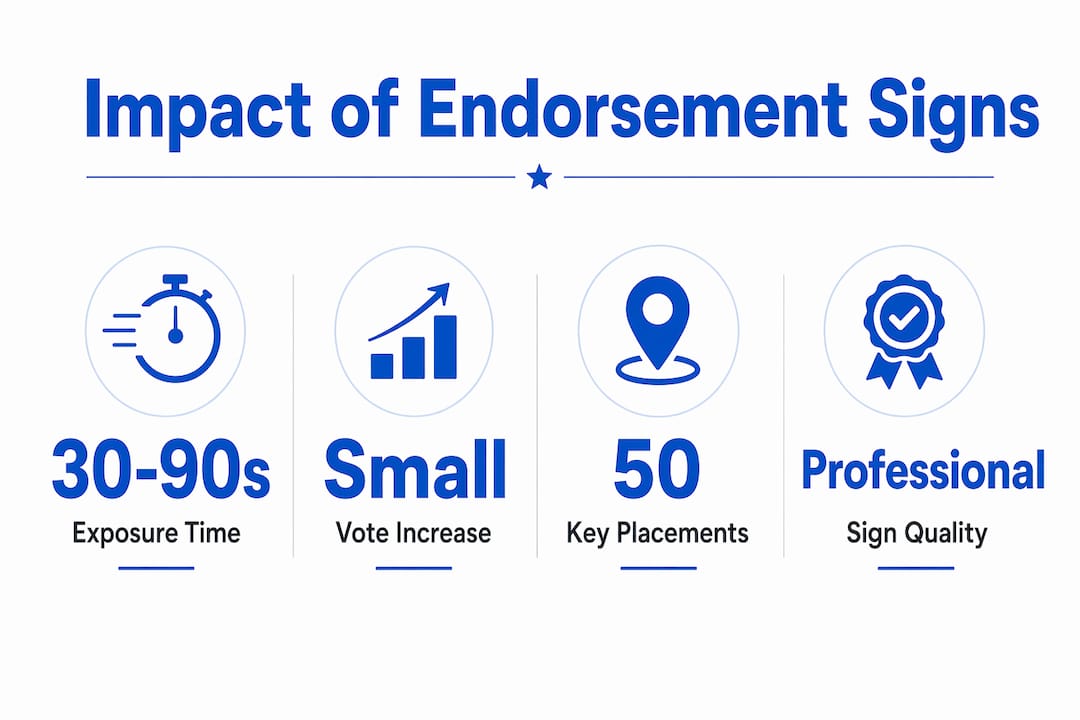
Endorsement signs are defined as physical displays placed in public spaces to signal support for a candidate, cause, or organization. The role of endorsement signs in campaigns extends well beyond simple decoration. They build name recognition, signal organizational strength, and create the social proof that shapes how undecided voters perceive a race. Research confirms that signs produce small but meaningful vote share increases that matter most in close contests. For campaign managers working local and regional races, understanding how to deploy these tools correctly is the difference between a visible campaign and an invisible one.
How do endorsement signs increase candidate visibility and name recognition?
Repeated exposure is the core mechanism behind sign effectiveness. When voters see a candidate’s name consistently across their neighborhood, that name becomes familiar. Familiarity, in turn, generates trust. Cognitive psychology calls this the “mere exposure effect,” and political campaigns have relied on it for decades without always naming it.
Signs fill a specific coverage gap in local and non-partisan races. Yard signs often serve as the primary information source in areas where digital outreach is limited and local media coverage is thin. A city council candidate may receive zero television coverage but can still reach thousands of voters through well-placed lawn signs on high-traffic streets. That reach is not trivial.
The benefits of endorsement signs compound when volume and location work together. A single sign on a quiet side street does little. A cluster of signs near a school, a grocery store, and a community center creates the impression of broad support. That impression influences how voters assess a candidate’s viability before they ever read a policy position.
- Signs increase name recall through repeated visual exposure across daily commutes and errands.
- They reach voters who ignore digital ads, mailers, and phone calls.
- In low-information races, a sign may be the only contact a voter has with a candidate’s name before election day.
- Consistent sign placement across a district signals geographic reach and organizational capacity.
Pro Tip: Place signs at intersections with stop signs or traffic lights. Drivers stopped at red lights have 30–90 seconds of uninterrupted attention, making those locations far more effective than mid-block placements.
What psychological and social factors make endorsement signs effective?
Endorsement signs work through social proof. When a voter sees a neighbor’s yard displaying a candidate’s sign, that display communicates a personal endorsement from someone in the community. That signal carries more weight than a television ad because it comes from a peer, not a campaign. The credibility of endorsements depends on identification, meaning voters respond most strongly to endorsers they perceive as similar to themselves.
Signs also function as reassurance tools for existing supporters. A campaign with visible signage across a district tells its own base that the effort is real, organized, and gaining momentum. That reassurance motivates volunteers to stay active and donors to contribute. Without visible signs, even a well-funded campaign can feel stalled to the people inside it.
“Signs function more as tools of presence than persuasion. They signal campaign activity and reassure supporters, building momentum perception and visibility rather than decisively converting undecided voters.”
The distinction between visibility and persuasion matters for how you allocate resources. Signs rarely flip a committed opponent. Their power lies in reinforcing existing leanings, motivating soft supporters to show up, and making a campaign look credible to genuinely undecided voters who are still forming impressions. Campaigns that treat signs as persuasion tools misuse them. Campaigns that treat them as presence tools use them correctly.
Signage quality also signals campaign quality. Voters associate the appearance of a sign with the professionalism of the candidate behind it. A faded, poorly printed sign communicates carelessness. A crisp, high-contrast sign communicates competence. That association is subconscious but consistent.
Which strategies optimize placement and design of endorsement signs?
Sign design and placement are not aesthetic choices. They are functional decisions that determine whether a sign gets read or ignored. The International Sign Association recommends one inch of letter height per 25 feet of viewing distance. A sign placed along a road where traffic moves at 45 miles per hour needs significantly larger text than one placed in a pedestrian zone.
Placement priorities
- High-traffic intersections where vehicles stop or slow down, giving drivers time to read.
- Community anchors such as schools, places of worship, and community centers where residents gather regularly.
- Supporter properties along arterial roads rather than quiet residential streets, maximizing impressions per sign.
- District entry points to create an immediate sense of presence when voters enter a neighborhood.
- Polling place perimeters where legally permitted, to reinforce name recognition at the moment of decision.
Design and material standards
| Design Element | Recommendation |
|---|---|
| Letter height | 1 inch per 25 feet of viewing distance (ISA standard) |
| Color contrast | Dark text on light background or light text on dark background |
| Message length | Candidate name and office only; no slogans on primary signs |
| Material | Weatherproof corrugated plastic for outdoor durability |
| Branding consistency | Same font, colors, and logo across all sign formats |
Strategic placement consistently outweighs sheer quantity. Fifty signs at the right locations outperform five hundred signs scattered randomly. Campaign managers who treat sign distribution as a numbers game miss the point. The goal is maximum impressions among likely voters, not maximum signs in the ground.
Large-format yard signs and banners perform particularly well in local campaigns because they draw attention from a distance and suggest grassroots depth. A single large banner on a supporter’s fence along a busy road can generate thousands of impressions per day at zero recurring cost.
What measurable impacts do endorsement signs have on campaign outcomes?
The evidence on sign effectiveness is consistent but measured. Campaign signs rarely decide elections alone, but they produce a small increase in vote share that becomes decisive in close races. That finding matters most for campaign managers running in competitive districts where margins are thin.
The retail signage parallel is instructive. Approximately 17% of customers make unplanned stops triggered by signage alone. That figure represents passive traffic converted to active engagement through a single visual prompt. The mechanism in political campaigns is similar. A voter who had not planned to research a local race may form a positive impression of a candidate simply through repeated sign exposure during their daily routine.
Key findings on sign performance:
- Signs provide the greatest lift in low-information races where voters have few other data points.
- They are most effective for lesser-known candidates who lack name recognition at the start of a race.
- Signs reinforce existing voter preferences more reliably than they convert opponents.
- Their impact is cumulative. One sign does little. Consistent coverage across a district builds recognition over weeks.
The limitation is equally clear. Signs do not replace direct voter contact, strong messaging, or ground-level organizing. A campaign that invests heavily in signs while neglecting canvassing and phone banking will underperform. Signs amplify a campaign’s other efforts. They do not substitute for them.
How can campaigns integrate endorsement signs within a broader outreach strategy?
Signs work best as one layer in a coordinated campaign, not as a standalone tactic. Campaign signs are indicators of organizational health, signaling to voters, volunteers, and donors that a campaign is active and serious. That signal reinforces every other outreach effort running in parallel.
The connection between signs and volunteer energy is direct. When a supporter places a sign in their yard, they make a public commitment to the campaign. That commitment increases the likelihood they will volunteer, donate, and turn out on election day. Sign distribution events double as volunteer recruitment opportunities. Campaigns that treat sign requests as logistical tasks miss a mobilization opportunity.
Effective integration looks like this:
- Use signs to establish name recognition before digital ads launch, so voters already recognize the name when they see it online.
- Coordinate sign placement with canvassing routes so door-knockers enter neighborhoods where the candidate’s name is already visible.
- Align sign design with mailer and social media graphics to create a unified visual identity across every touchpoint.
- Use sign density maps to identify under-covered precincts and direct volunteer resources accordingly.
For campaigns exploring advocacy-style endorsement strategies, the same principles apply. Physical presence in a community builds credibility that digital channels alone cannot replicate. Signs tell a story about where a campaign has roots and where it is investing its energy.
Key Takeaways
Endorsement signs are most effective when treated as presence and recognition tools, not persuasion devices, and when placed strategically in high-traffic, high-visibility locations.
| Point | Details |
|---|---|
| Signs build name recognition | Repeated exposure creates familiarity, which voters translate into trust and credibility. |
| Social proof drives influence | Neighbor-placed signs carry more weight than ads because they signal peer endorsement. |
| Design follows ISA standards | Use one inch of letter height per 25 feet of viewing distance for functional readability. |
| Placement beats volume | Fifty signs at high-traffic locations outperform hundreds placed randomly across a district. |
| Signs amplify other efforts | Signs work best alongside canvassing, digital outreach, and direct voter contact, not instead of them. |
Why I think campaigns underestimate the sign’s real job
Most campaign managers I talk to treat signs as a morale tool or a donor perk. They are not wrong, but they are missing the bigger picture. Signs are your campaign’s physical proof of existence. In a local race, a voter who has never heard of your candidate will form their first impression from a sign on their neighbor’s fence. That impression happens in under three seconds. It either registers or it does not.
The biggest mistake I see is prioritizing quantity over location. A campaign floods a district with signs on quiet residential streets where the only people who see them are the households that already received a mailer. Meanwhile, the four intersections that carry 80% of the district’s daily traffic have nothing. That is a resource allocation failure, not a sign problem.
The second mistake is treating sign design as a cost to minimize. A thin, faded sign on a wire stake tells voters the campaign is underfunded and disorganized. A thick, weatherproof sign with bold contrast and clean branding tells voters the campaign is serious. That perception costs almost nothing extra per unit but changes how voters read the signal.
Signs in local elections carry weight that campaign managers trained in digital tactics often dismiss. I have seen well-placed yard signs shift the perceived momentum of a race in the final three weeks. That shift is real. Do not leave it on the table.
— YardSignGuy
Campaign-ready signs from Yardsigns
Your endorsement signs need to hold up through rain, wind, and weeks of outdoor exposure while staying sharp enough to make the right impression at a glance.

Yardsigns produces weatherproof campaign signs with vibrant, fade-resistant printing and fast turnaround. Orders under 50 pieces ship within 24 hours, so you can respond to last-minute placement opportunities without losing ground. The design process is straightforward, and the materials are built for the conditions your signs will actually face. Browse custom campaign signs and get your order placed before your next canvassing push.
FAQ
What is the role of endorsement signs in campaigns?
Endorsement signs build candidate name recognition, signal organizational strength, and create social proof through community-level visibility. They are most effective in local and non-partisan races where voters have limited access to other information about candidates.
Do yard signs actually change how people vote?
Signs rarely decide elections on their own, but they produce a small, measurable increase in vote share that matters in close races. Their primary value is reinforcing existing support and making a campaign appear credible and active.
How should campaigns prioritize sign placement?
Campaigns should place signs at high-traffic intersections, community anchors, and district entry points rather than distributing them randomly. Strategic placement at locations with high daily impressions consistently outperforms high-volume, low-visibility distribution.
What design standards make endorsement signs most readable?
The International Sign Association recommends one inch of letter height per 25 feet of viewing distance. Signs should use high-contrast colors, limit text to the candidate’s name and office, and maintain consistent branding across all formats.
How do endorsement signs complement digital campaign outreach?
Signs establish name recognition before digital ads launch, so voters already recognize a candidate when they encounter online content. Coordinating sign placement with canvassing routes and social media timing creates a unified, reinforcing campaign presence.
