


Examples of Winning Campaign Signage That Drive Results
Winning campaign signage is defined as physical display advertising that builds name recognition, creates social proof, and motivates community action through clear messaging and strategic placement. The best examples of winning campaign signage share three traits: they are readable in under three seconds, they feel authentic to the local community, and they appear where voters already travel. Physical signage reaches demographics that digital ads miss entirely, making it one of the few tools that builds rapid, visible support across a neighborhood. Whether you are running for city council or coordinating a local event, the principles behind successful campaign signage are the same.
1. What key elements define examples of winning campaign signage?
Every piece of successful campaign signage starts with one rule: less is more. A sign read at 35 miles per hour can carry a name, a short slogan, and a color. Anything beyond that competes with itself.
The core elements of effective campaign signs include:
- Clear, minimal text. Three to five words is the standard. A name plus one benefit beats a paragraph every time.
- High contrast colors. Dark text on a light background, or a bold color combination, reads faster than muted tones.
- Authentic local design. Signs that reflect the neighborhood’s character feel personal, not corporate.
- Durable materials. Weatherproof construction keeps signs looking sharp through rain, wind, and sun.
- Strategic placement. Sign placement along daily routes builds daily recognition and social proof.
Authenticity matters as much as readability. Voters and event attendees respond to signs that feel like they belong in the community, not like they were shipped from a national ad agency. A sign that mirrors local values and language creates an immediate connection.
Pro Tip: Order your signs with a 10–15% buffer above your planned quantity. Theft, vandalism, and weather damage are predictable losses in any competitive campaign, and running out of signs mid-race is a problem you can avoid entirely.

2. How do localized and customized signage strategies drive voter engagement?
Generic slogans lose to specific ones. A sign that says “Lower Taxes for Riverside Families” outperforms “A Better Tomorrow” in Riverside every time. Specificity signals that a candidate actually knows the community.
Highly localized signage using neighborhood names and tailored policy messages outperforms generic slogans in local elections. A campaign in Gangwon Province demonstrated this at scale, deploying customized banners across all 187 districts with messaging specific to each area. The result was measurable attention and engagement that generic signage could not replicate.
| Signage type | Messaging approach | Engagement level |
|---|---|---|
| Generic macro signs | Broad slogans, no location reference | Low local resonance |
| District-level custom signs | Neighborhood names, local policy focus | High local resonance |
| Hybrid signs | Candidate name plus one local issue | Moderate to high |
The table above shows why customization pays off. Voters respond to candidates who speak their specific language, not a one-size-fits-all message. Even adding a single neighborhood name to a standard sign design lifts its relevance significantly.
“The most effective local campaign signs feel like they were made by a neighbor, not a consultant.” — Field observation from regional election campaigns
Pro Tip: When designing district-level signs, pull one specific local issue per area. A school funding message works in a neighborhood with three elementary schools. A road repair message works better near a stretch of damaged pavement. Match the message to the mile.
For practical guidance on where to put these localized signs, the local election sign placement resource from Yardsigns covers high-impact zones in detail.
3. Creative and authentic design tactics that make campaign signs stand out
Creativity in campaign signage does not mean complexity. It means making a sign that people remember and talk about. The most memorable winning marketing displays often use a single unexpected element.
The “larrikin factor” is a real design principle in regional campaigning. Humor and local cultural references in signage increase voter engagement and trust, especially in regional areas where voters have a sharp sense for inauthentic corporate messaging. A crocodile billboard in Rockhampton ahead of the 2032 Olympics generated widespread local buzz precisely because it was unexpected and locally grounded. People photographed it, shared it, and talked about it. That is earned media from a physical sign.
Minimalism works for a different reason. The STAMMA campaign used intentional blank space in outdoor signage to stand out in a crowded visual environment and reinforce its behavioral message. In a landscape full of busy, text-heavy signs, a sign with breathing room commands attention.
Key creative tactics that work in practice:
- Use one unexpected visual element. A local landmark, a recognizable symbol, or a piece of local humor creates instant recall.
- Leave white space deliberately. A sign that does not fill every inch of space reads as confident, not incomplete.
- Avoid the corporate polish trap. Over-polished signage triggers voter skepticism, particularly in smaller communities where voters recognize PR-speak immediately.
- Match the tone to the community. A formal design works in a business district. A warmer, more conversational design works in a residential neighborhood.
“Regional voters have a finely tuned detector for corporate PR. A sign that feels like it came from a focus group gets ignored. A sign that feels like it came from the block gets shared.” — Grassroots campaign observation
The grassroots campaign strategy guide from Yardsigns covers how to apply these principles to real-world sign design and placement.
4. Practical considerations for sign production and placement to maximize impact
Good design means nothing if your signs go up too late, come down too early, or run out before election day. Production and placement planning is where campaigns win or lose on the ground.
Timing your signage deployment:
- Check local regulations before ordering. Candidates should put up signs no earlier than 45 days before an election and remove all signs within 10 days after. Violating these timelines creates legal liability and damages credibility.
- Deploy your first wave of signs at the start of the permitted window. Early visibility builds name recognition before your opponents establish theirs.
- Refresh damaged or stolen signs within 48 hours. A missing sign in a high-traffic zone is a gap in your social proof.
- Plan your removal logistics before election day. Assign volunteers to specific zones so post-election removal happens on schedule.
Placement priorities:
| Placement zone | Why it works |
|---|---|
| Commercial corridors | High daily traffic from a broad voter base |
| Residential entry points | Seen by residents every time they leave and return |
| School and community center routes | Reaches engaged, civic-minded voters |
| Intersections with stop signs | Forced pause gives voters time to read |
Buffer stock planning is a financial and logistical reality in competitive races. Order a 10–15% surplus above your target quantity. Signs disappear. Weather damages them. A buffer means you never run short during the final push when visibility matters most.
For campaigns ordering in volume, bulk sign ordering through Yardsigns reduces per-unit cost and supports the buffer strategy without breaking the budget.
Key Takeaways
Winning campaign signage combines localized messaging, authentic design, strategic placement, and disciplined production planning to build visible community support.
| Point | Details |
|---|---|
| Localize your message | Use neighborhood names and specific local issues to outperform generic slogans. |
| Design for authenticity | Grassroots-style signs outperform polished corporate designs in voter engagement. |
| Plan your buffer stock | Order 10–15% more signs than needed to cover theft, weather, and vandalism losses. |
| Follow timing regulations | Deploy no earlier than 45 days before the election and remove within 10 days after. |
| Place signs on daily routes | Commercial corridors and residential entry points build consistent name recognition. |
What I have learned from watching campaigns get signage right and wrong
I have watched candidates spend thousands on beautifully designed signs that sat in storage too long, went up in the wrong locations, and came down before anyone noticed them. I have also watched a first-time candidate with a simple, bold sign and a smart placement map outperform a well-funded opponent on name recognition alone.
The single biggest mistake I see is treating signage as a box to check rather than a visibility system. You do not just order signs. You deploy them with intention, refresh them when they disappear, and pull them on schedule. The candidates who treat signage as an ongoing operation, not a one-time purchase, are the ones who build the kind of neighborhood presence that translates into votes.
The second mistake is chasing polish over authenticity. A sign that looks like it belongs in a national ad campaign feels out of place in a local race. Voters in tight-knit communities notice the difference between a candidate who speaks their language and one who hired someone to approximate it. The social proof that yard signs create comes from density and authenticity together, not from production quality alone.
My honest advice: spend less on design complexity and more on quantity, placement, and timing. A simple sign in the right place, seen every day by the right people, does more work than a beautiful sign seen by no one.
— YardSignGuy
Your campaign signs, ready when you need them
Running a campaign means moving fast. Yardsigns ships orders under 50 pieces within 24 hours, so you can respond to a tight timeline without sacrificing quality. Every sign is printed on weatherproof materials with vibrant, fade-resistant color that holds up through the full campaign season.
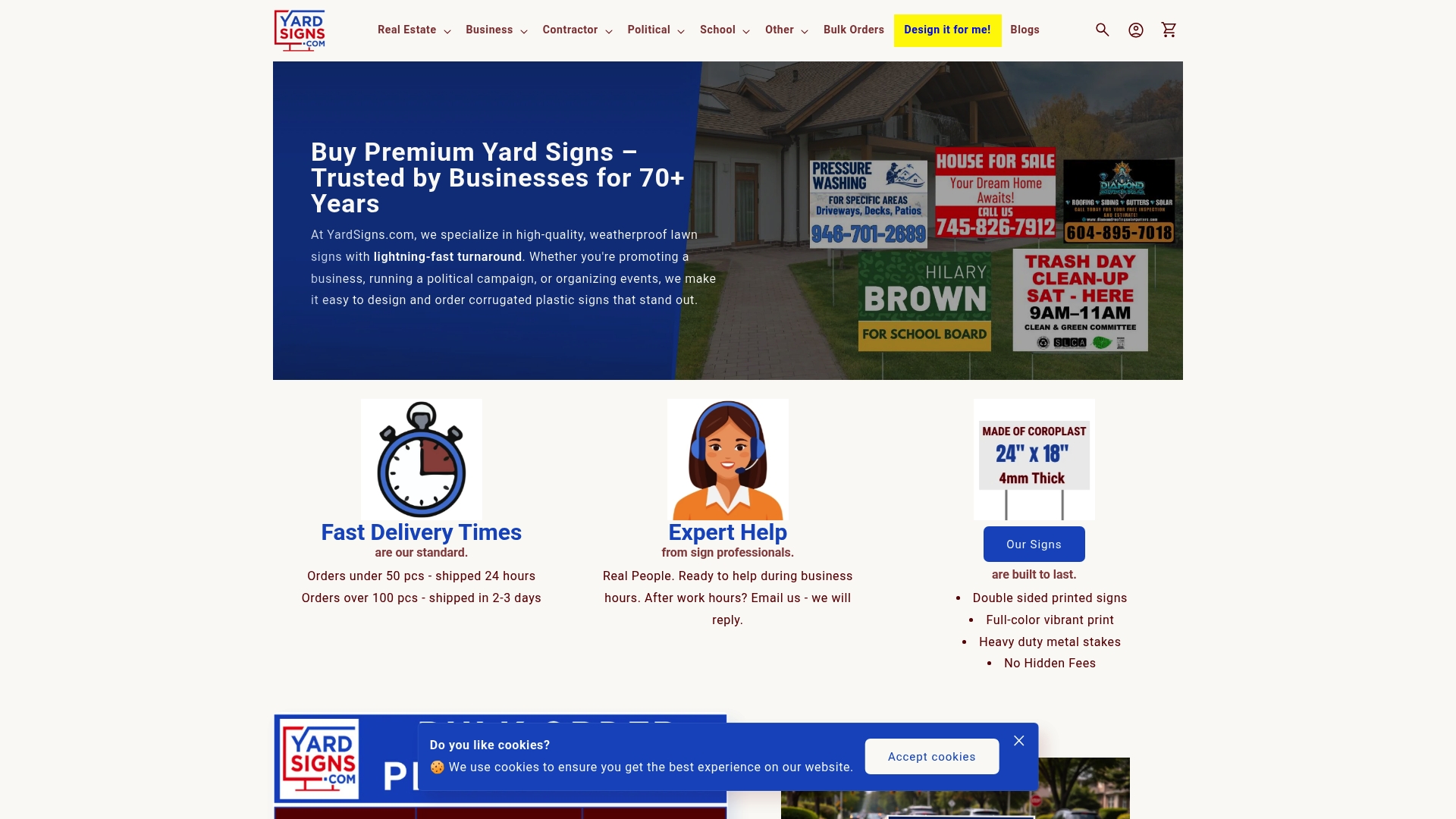
Yardsigns offers fully customizable designs built for political campaigns, community events, and fundraisers. Whether you need a charity fundraising event sign or a full run of localized campaign signs, the ordering process is straightforward and the turnaround is fast. Browse the full catalog at Yardsigns.com and get your signs in the field before your competition does.
FAQ
What makes campaign signage effective?
Effective campaign signage uses minimal text, high contrast colors, and authentic local messaging. Signs placed along daily voter routes build name recognition and social proof faster than digital ads alone.
How early should I put up campaign signs?
Most regions require signs to go up no earlier than 45 days before an election. Check your local regulations before deploying, and plan to remove all signs within 10 days after the election.
How many extra signs should I order?
Order a 10–15% buffer above your planned quantity. Theft, vandalism, and weather damage are predictable losses, and running short during the final weeks of a campaign costs you visibility at the worst possible time.
Do localized signs really outperform generic ones?
Yes. Campaigns using neighborhood names and district-specific policy messages consistently outperform those using broad slogans. The Gangwon Province example, with customized banners across 187 districts, demonstrates the measurable impact of localization.
Should campaign signs look professional or grassroots?
Grassroots-style signs outperform over-polished designs in local and regional races. Voters in smaller communities respond better to signs that feel authentic and locally made than to signs that look like national advertising.
