


Why Outdoor Signs Outperform Digital Ads for Business
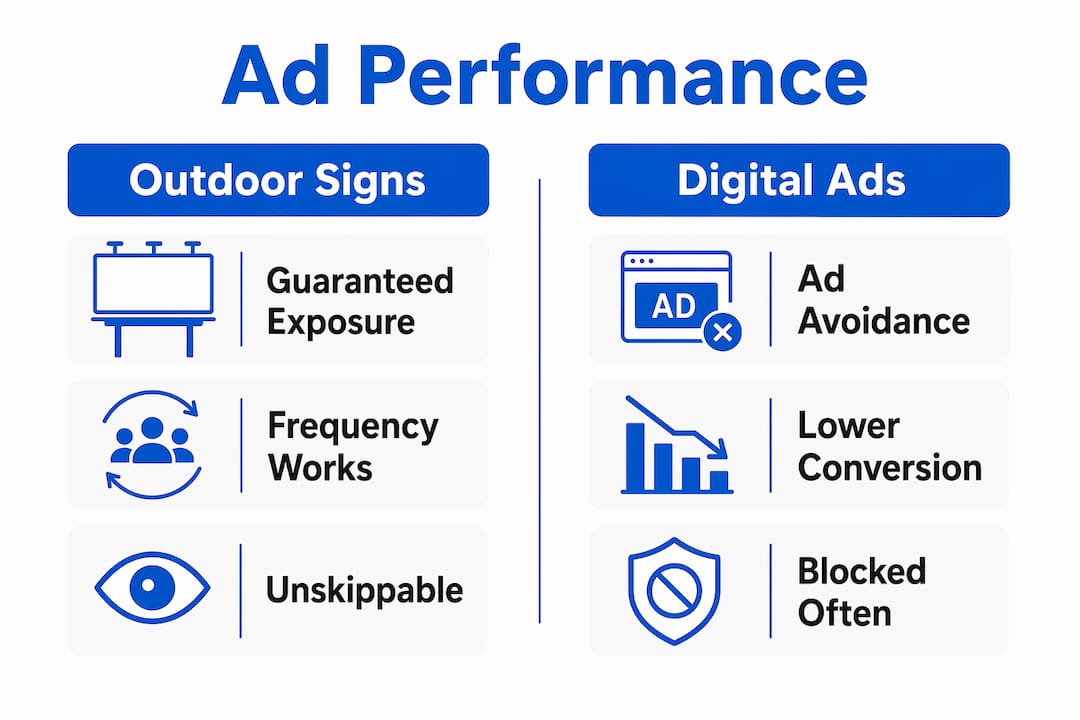
Outdoor signage, known in the industry as out-of-home (OOH) advertising, is the single most exposure-guaranteed advertising format available to marketers today. While digital campaigns fight for fractions of a second of attention, physical signs stand in the path of consumers with no skip button, no ad blocker, and no algorithm deciding whether to show them. A 2026 OAAA and Kochava study confirmed that OOH delivers a median 20% lift in in-person outcomes, outpacing connected TV and broadcast TV by a factor of two. For marketing professionals and small business owners weighing outdoor vs digital advertising, the data now makes a clear case for physical signs.
Why outdoor signs outperform digital ads: the performance data
OOH advertising’s performance advantage is measurable, not theoretical. The OAAA and Kochava study tracked real-world consumer behavior across media channels and found that OOH campaigns deliver twice the lift of TV in both physical and digital outcome metrics. That means a well-placed billboard or yard sign drives more store visits and online searches than a television spot of comparable spend.
Frequency is where outdoor signs truly separate themselves. When OOH ad exposures increase from one to ten, the OOH-to-digital conversion rate rises by 7.1 times. No other measured media channel shows a steeper frequency curve. This means repeated exposure to a physical sign does not just remind consumers; it compounds their likelihood of taking action.
The table below shows how OOH compares to other media on performance lift metrics:
| Media type | In-person outcome lift | Digital outcome lift |
|---|---|---|
| Out-of-home (OOH) | 20% median | 14% median |
| Connected TV | ~10% | ~10% |
| Broadcast TV | ~10% | ~10% |
OOH performance is now measured by real-world outcomes, not just brand awareness, which repositions it as a direct-response channel rather than a passive branding tool. That shift matters enormously for small business owners who need every advertising dollar to produce a traceable result.
Pro Tip: When planning an OOH campaign, think in weekly cycles. The OAAA research shows that consumer conversions resurface on a weekly repeated cycle, meaning your sign keeps working long after the initial impression.
How audience engagement differs between outdoor and digital ads
Digital advertising’s core vulnerability is consumer avoidance. A striking 93% of consumers skip or block digital ads, with 55% skipping whenever they have the option and 37% simply ignoring ads entirely. That figure, reported by Clutch and cited by eMarketer, means the majority of your digital ad budget is spent on impressions that never register.

Outdoor signs carry none of that baggage. Physical signage is unskippable and ad-block-proof by nature. A consumer driving past a storefront sign or walking by a yard sign cannot install an extension to remove it from their field of vision. The exposure is guaranteed by geography, not by an algorithm.
The psychological mechanism behind this is well understood. Outdoor ads work through peripheral processing, a concept explained by the Elaboration Likelihood Model, where repeated low-effort exposures build familiarity and preference without requiring active attention. This is why a simple yard sign seen daily on a commute route can outperform a targeted social media campaign for local brand recall.
Here is what makes outdoor engagement structurally different from digital:
- Passive but guaranteed exposure: Consumers do not choose to see a physical sign. Presence in their environment is the exposure.
- No fatigue-driven avoidance: Unlike digital banner blindness, physical signs benefit from environmental novelty and placement variety.
- Frequency without intrusion: Repeated outdoor exposures feel natural rather than invasive, which protects brand sentiment.
- QR code integration: QR codes combined with mobile phones now allow marketers to measure actual engagement with outdoor ads directly, closing the attribution gap that once made OOH harder to justify in performance-focused budgets.
The combination of guaranteed exposure and measurable engagement through QR tracking gives outdoor signage a profile that digital formats simply cannot replicate.
Does creative quality affect outdoor sign effectiveness?
Creative quality is the variable that separates a high-performing outdoor campaign from a forgettable one. A Clear Channel Outdoor and Super Optimal analysis found that creative quality aligned with brand performance in 70% of measured OOH campaigns. That figure means the sign’s design is not a secondary concern; it is a primary performance driver.
The mistake most marketers make is repurposing digital creative for outdoor formats. A Facebook ad designed for a 1080x1080 pixel feed, loaded with body copy and multiple calls to action, fails completely when scaled to a 4x8 foot yard sign or a roadside billboard. Outdoor consumption is rapid. A driver has roughly three seconds to absorb a message at highway speed, and a pedestrian gives a storefront sign only slightly more.
Effective outdoor creative follows a different set of rules than digital. Creative designed for outdoor media relies on high contrast, simple fonts, brief messages of five words or fewer, and contextual relevance to the physical location. Color contrast and legibility at distance systematically predict campaign success more than brand guidelines or visual complexity.
Pro Tip: Test your outdoor creative by viewing it as a thumbnail at arm’s length before printing. If you cannot read the core message in under two seconds, simplify it. This quick check mirrors the real-world viewing conditions your sign will face on a busy street.
Practical creative testing for outdoor formats does not require a large budget. Print a proof at full scale, photograph it from 20 feet away, and assess legibility. For custom yard sign design, this step alone can prevent costly reprints and lost impressions from signs that simply do not communicate fast enough.
How small businesses can leverage outdoor signage over digital ads
For small businesses, the advantages of physical signs over digital campaigns come down to three factors: continuous visibility, cost structure, and location precision. Outdoor signage delivers ongoing 24/7 visibility without ongoing ad spend. A digital campaign stops the moment the budget runs out. A yard sign or storefront display keeps working through nights, weekends, and holidays with zero additional cost.
The cost efficiency of billboards and physical signs is particularly relevant for businesses with limited marketing budgets. A single well-placed yard sign near a high-traffic intersection can generate thousands of impressions per week at a fraction of the cost per impression of paid social or search advertising. The outdoor signs ROI calculation is straightforward: one-time production cost divided by weeks of active use, with no click fraud, no bidding wars, and no platform fees.
Location and sightline are the biggest performance drivers for local storefront signage. Placement and sightline often determine whether a sign drives footfall or gets ignored. A sign positioned at eye level on the approach side of a storefront outperforms one placed above the door where pedestrians rarely look. OOH campaigns optimized for location and frequency deliver especially strong lifts in retail and quick service restaurant categories, which maps directly to the needs of local small businesses.
Here is a practical framework for deploying outdoor signs effectively as a small business:
- Identify your highest-traffic approach routes. Place signs where consumers are moving toward your location, not past it.
- Prioritize frequency over single placements. Multiple signs along a route outperform one large sign at a single point.
- Keep the message to one action. A phone number, a URL, or a single offer. Not all three.
- Use weatherproof materials from the start. Signs that fade or warp after one season destroy brand credibility. Durable weatherproof signage pays for itself in extended impression life.
- Add a QR code for attribution. Link it to a landing page with UTM tracking so you can measure how many digital actions the physical sign drives.
For businesses launching or reopening, yard signs placed around the neighborhood before an event can generate local awareness faster than any paid digital campaign at the same budget level. The impact of outdoor marketing in these scenarios is immediate and geographically precise in a way that digital targeting rarely achieves at the hyperlocal level.
Key takeaways
Outdoor signs outperform digital ads because they guarantee exposure, compound in effectiveness with frequency, and deliver measurable lifts in both in-person and digital consumer actions at a lower sustained cost.
| Point | Details |
|---|---|
| OOH delivers double the lift of TV | Median 20% in-person lift outpaces connected TV and broadcast TV by 2x. |
| Frequency multiplies conversions | Increasing exposures from 1 to 10 produces a 7.1x rise in digital conversion rate. |
| Digital ads face mass avoidance | 93% of consumers skip or block digital ads, making guaranteed OOH exposure a structural advantage. |
| Creative quality drives 70% of outcomes | Outdoor-specific design with high contrast and brief messaging predicts campaign success. |
| 24/7 visibility at zero recurring cost | Physical signs keep working after budgets stop, making outdoor signs ROI superior for small businesses. |
What I’ve learned from watching outdoor signs outperform digital budgets
I have watched businesses pour money into digital campaigns that generated clicks but no foot traffic, while a single well-placed yard sign near the parking lot entrance drove more walk-ins than a month of Facebook ads. The pattern repeats often enough that it is no longer surprising.
The insight most marketers miss is that frequency planning for outdoor signs requires a different mindset than digital scheduling. You do not set a flight date and move on. You think about how many times a person on a specific route will see your sign in a week, and you design the creative for the fifth viewing, not the first. The first viewing builds awareness. The fifth viewing drives action.
QR codes on physical signs are underused and often used wrong. Placing a QR code on a sign is not the point. Connecting that QR code to a mobile landing page with proper tracking, then using that data to understand which physical locations drive the most digital engagement, is the point. That is how you complement digital campaigns with outdoor placements rather than treating them as separate channels.
One caution: bigger is not automatically better. A 4x8 sign with a clear message outperforms a 10-foot banner with cluttered design every time. The research from Clear Channel Outdoor and Super Optimal confirms this. Spend your budget on better creative before you spend it on larger formats.
The businesses that get the most from outdoor signage treat it as a precision tool, not a fallback. They choose locations deliberately, test creative before committing to large print runs, and measure results through QR attribution. That approach turns a simple physical sign into a performance channel that holds its own against any digital format.
— YardSignGuy
Get your outdoor signs working harder with Yardsigns
Physical signs deliver results when they are built to last and designed to be seen. Yardsigns produces custom yard signs with vibrant, weatherproof printing that holds up through every season, so your message keeps working long after a digital campaign would have gone dark.
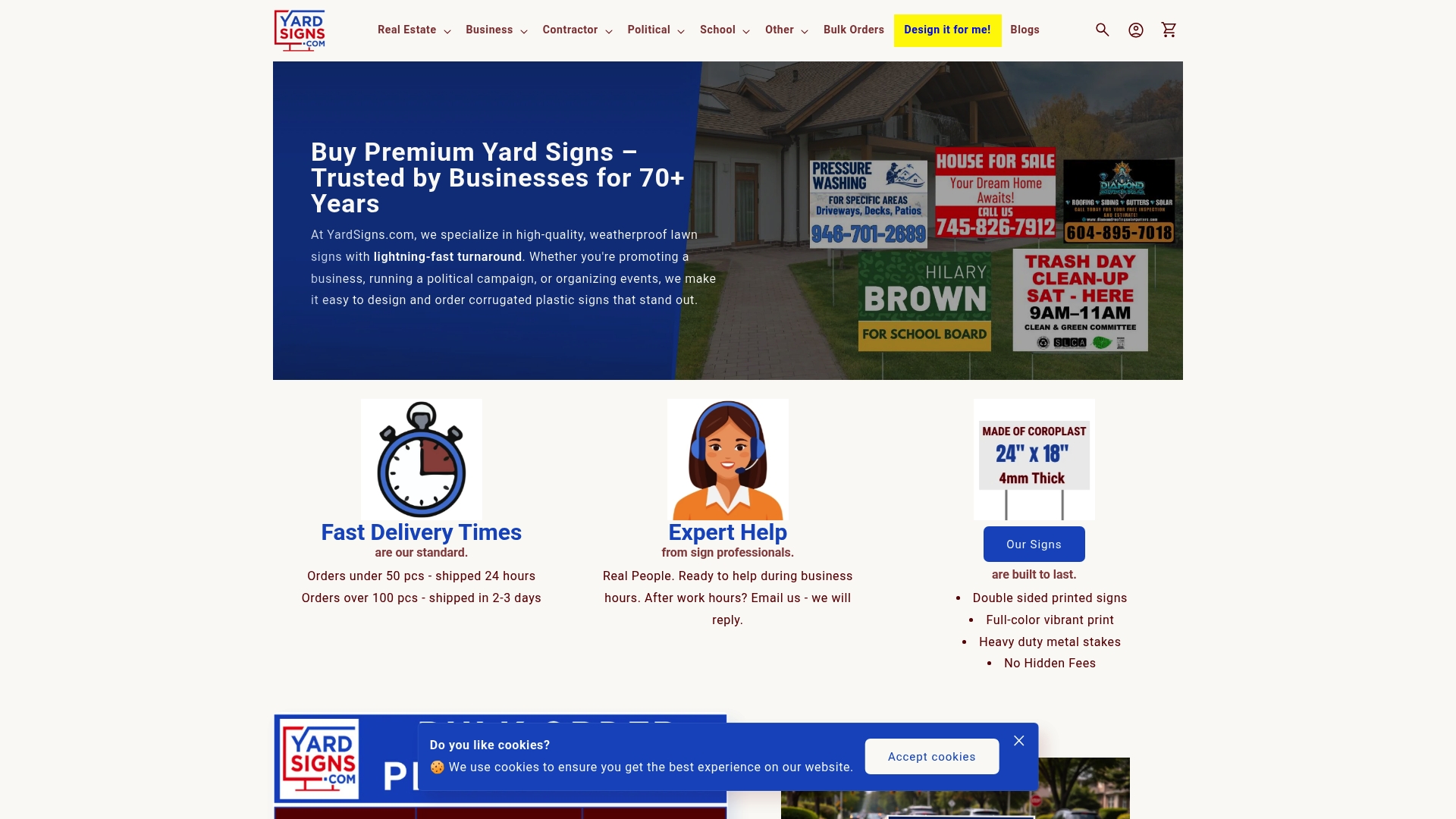
Orders under 50 pieces ship within 24 hours, which means you can respond to a local opportunity, a grand reopening, or a seasonal promotion without waiting weeks for production. Every sign is built from premium materials that customers consistently cite for durability and color quality. Whether you need directional signs for a sales event, storefront displays, or neighborhood awareness campaigns, Yardsigns gives you the tools to put your message exactly where your customers are. Visit yardsigns.com to configure your order and get your signs in the field fast.
FAQ
Why do outdoor signs outperform digital ads in local marketing?
Outdoor signs guarantee exposure through physical presence, while 93% of consumers skip or block digital ads. For local businesses, a sign placed on a high-traffic approach route reaches the same audience repeatedly without any recurring ad spend.
What is the ROI difference between outdoor signs and digital advertising?
OOH advertising delivers a median 20% lift in in-person outcomes compared to roughly 10% for TV and digital formats. Physical signs also carry no ongoing cost after production, making their cost-per-impression lower over time than paid digital campaigns.
How does frequency affect outdoor sign performance?
Increasing OOH ad exposures from one to ten produces a 7.1x increase in digital conversion rate, the steepest frequency curve among all measured media. Placing multiple signs along a consumer’s regular route compounds this effect significantly.
Can you measure the effectiveness of outdoor signs like digital ads?
Yes. QR codes linked to mobile landing pages with UTM tracking allow marketers to measure direct engagement from physical signs. This closes the attribution gap that previously made outdoor advertising harder to compare against digital performance metrics.
What makes outdoor sign creative more effective than repurposed digital ads?
Creative designed specifically for outdoor media, using high contrast, simple fonts, and messages of five words or fewer, aligned with better brand performance in 70% of measured OOH campaigns. Digital creative repurposed for outdoor formats consistently underperforms because it is not built for rapid three-second consumption.
