


Why Yard Signs Boost Local Visibility for Every Campaign
Yard signs are defined as hyper-local, physical advertising tools that place your name, brand, or message directly in the path of the people most likely to act on it. That geographic precision is exactly why yard signs boost local visibility more reliably than most alternatives at a fraction of the cost. A well-placed sign on a busy corner generates thousands of impressions from the same neighbors, commuters, and potential customers day after day. Businesses, political candidates, and event organizers all use them for the same reason: repeated physical exposure builds recognition, and recognition drives decisions. The psychology, the placement strategy, and the return on investment all point to one conclusion. Yard signs work.
How do yard signs increase visibility compared to other local marketing tools?
Yard signs occupy a fixed physical location where your audience already travels. A digital ad disappears the moment someone scrolls past it. A yard sign on a main road stays visible for weeks, delivering impressions every time a driver or pedestrian passes by. That staying power is one of the clearest benefits of yard signs over short-lived digital formats.
The visual mechanics matter too. Bold colors, high-contrast text, and a simple message are designed to register in under three seconds, which is roughly the time a driver has to absorb roadside content. Signs that follow this formula do not require the viewer to stop or engage. Recognition happens automatically, and that is precisely the point.
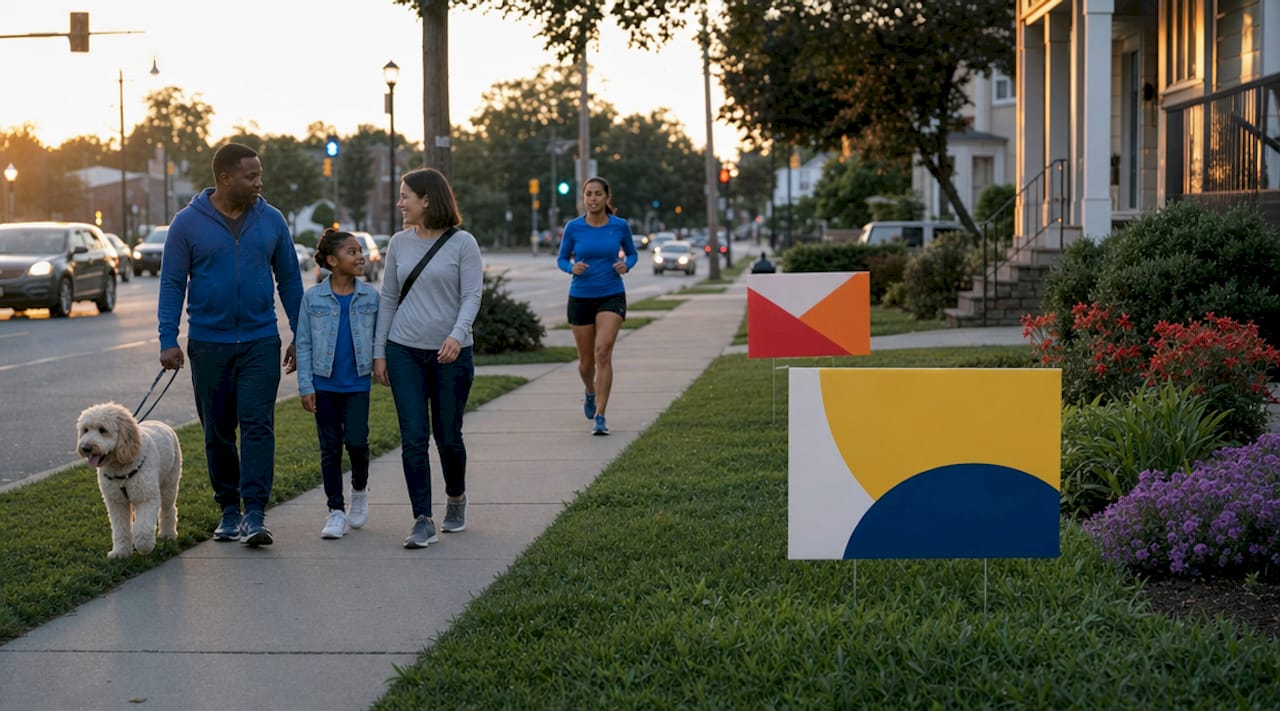
Cost efficiency sets yard signs apart from nearly every other local advertising method. At a typical cost of $3 to $8 per sign, a $1,200 investment can blanket an entire suburban district with thousands of daily impressions. No pay-per-click budget delivers that kind of geographic saturation at that price point.
Key visibility advantages yard signs hold over competing formats:
- Impression lifespan: A single sign generates repeated views from the same audience over days or weeks, compounding recognition without additional spend.
- Zero scroll-away: Unlike social media ads, physical signs cannot be skipped, muted, or blocked.
- Hyper-local targeting: Precise, relevant exposure reaches only the people physically present in your target area, not a broad demographic approximation.
- Offline reach: Yard signs reach voter and customer demographics that digital ads often miss, particularly older residents and low-information voters who are less active online.
- Credibility signal: A sign in a neighbor’s yard carries implicit endorsement that a banner ad never can.
Pro Tip: Pair your yard sign campaign with a complementary digital presence to capture the audience that sees your sign and immediately searches for you online. Read more about how signs and digital work together to reinforce each other.
What strategic placements maximize yard sign effectiveness?
Placement determines whether a sign generates 200 views a day or 2,000. The location you choose is as important as the design itself.
- Corner lots. Corner lots offer dual-street exposure, meaning one sign reaches traffic from two directions simultaneously. For political campaigns and contractor marketing alike, a corner placement doubles the impression count without doubling the cost.
- Neighborhood entrances and exits. Every resident passes these points multiple times daily. A sign here reaches the entire neighborhood with near-perfect frequency.
- Near competitor locations. Placing a sign close to a competitor signals that you are a credible alternative in the same market. Buyers already in a decision-making mindset see your name at exactly the right moment.
- Community anchors. Parks, schools, community centers, and houses of worship draw consistent foot traffic from engaged, locally invested residents. These are the people most likely to vote, hire a contractor, or attend an event.
- Active job sites. For contractors in roofing, landscaping, and painting, a sign at a visible job site turns every project into a live advertisement. Neighbors watching the work unfold are already pre-sold on the quality.
Legal and permission considerations are non-negotiable. Always secure written permission from property owners before placing signs on private land. For public right-of-way placements, check local municipal codes, since many jurisdictions restrict sign size, timing, and proximity to intersections. Ignoring these rules risks fines and sign removal, which wastes your investment and can generate negative community attention. Demographic targeting and legal permission adherence are required for maximum impact without regulatory pushback.
For politicians specifically, read the detailed guidance on local election sign placement to avoid common compliance mistakes that cost candidates votes and credibility.
Pro Tip: Cluster signs in the same neighborhood rather than spreading them thin across a wide area. Neighborhood clustering creates compounding momentum, as one visible job or campaign presence builds recognition that makes the next placement even more effective.
What psychological and social factors make yard signs so effective?
The effectiveness of yard signs is not just logistical. It is deeply psychological, and understanding that distinction helps you deploy them more deliberately.
The mere exposure effect is the cognitive mechanism at the center of yard sign impact. Repeated exposure to a name or image increases a person’s preference for it, even when they do not consciously remember seeing it. Yard sign repetition builds familiarity that influences decisions subconsciously. A voter who has driven past your candidate’s sign twenty times will feel a sense of recognition at the ballot box without being able to explain why. That feeling translates directly into votes.
Social proof amplifies this effect at scale. When multiple signs appear throughout a neighborhood, they stop functioning as individual advertisements and start functioning as community consensus.
When many yard signs appear in a neighborhood, it signals community endorsement and transforms advertising into perceived social consensus, elevating campaign legitimacy and energizing volunteers and donors.
This dynamic is why political campaigns prioritize sign density in competitive precincts. A street lined with signs for one candidate does not just inform voters. It tells them that their neighbors have already decided, and social psychology shows that people are strongly influenced by what they perceive their community to believe.
Authenticity plays a role that digital advertising simply cannot replicate. A sign in a real neighbor’s yard carries the implicit endorsement of that household. Yard signs feel less intrusive than digital ads because they exist in familiar, chosen environments, making repeated exposure feel organic rather than forced. That organic quality builds trust at a speed that paid media rarely achieves.
For businesses, this trust translates directly into leads. When a homeowner sees a roofing company’s sign at three houses on their street, the social proof is immediate and concrete. Those neighbors chose that company. That is a more powerful endorsement than any five-star review on a platform they have never visited.
How do yard signs deliver measurable ROI for businesses, politicians, and event organizers?
The return on investment from yard signs is documented across multiple audiences, and the numbers are specific enough to inform real budget decisions.
Political campaigns provide the clearest data. A 2026 case study found that 300 yard signs contributed to an 8-point win, with 67% of surveyed voters recognizing the candidate primarily through signage. Yard sign strategy increased vote share by 1.7 percentage points on average across measured races. That margin decides most local elections.
| Audience | Primary benefit | Documented impact |
|---|---|---|
| Political candidates | Name recognition and voter recall | 67% of voters recognized candidate through signs; 1.7-point average vote share increase |
| Contractors and home services | Job site lead generation | 73% of customers influenced by neighbor-to-neighbor trust signals |
| Real estate agents | Local buyer engagement | 35 to 49% of buyers say signs influenced their home search |
| Event organizers | Community awareness and attendance | Neighborhood buzz drives word-of-mouth before and during events |
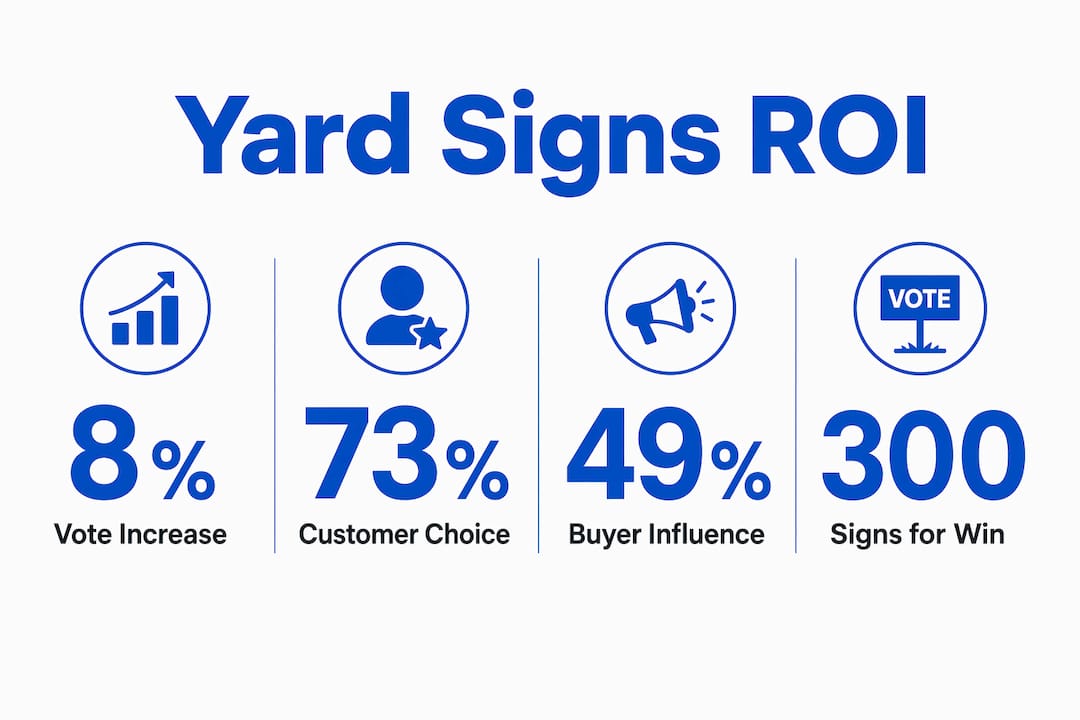
Contractors see some of the strongest ROI because the product is visible at the point of delivery. 73% of customers selecting home service contractors are influenced by word-of-mouth, and a job site sign taps that neighbor-to-neighbor trust without requiring a direct referral. The effect compounds when signs are combined with branded vehicles and uniformed crews, creating a full brand impression that sticks in the memory of every neighbor who watches the job progress.
Real estate professionals benefit from a different mechanism. 35 to 49% of buyers say yard signs influenced their home search, and physical signs deliver local micro-market targeting that digital listings cannot match. A sign in front of a listing reaches impulse buyers who are already driving through the neighborhood because they want to live there. That is the highest-quality lead a real estate agent can generate. Explore purpose-built options like realtor yard signs designed specifically for this use case.
Event organizers gain from the urgency and buzz that physical signs create in a defined geographic area. Unlike a social media post that reaches a diffuse audience, a sign near a community center or school targets the exact residents most likely to attend a local event. The combination of repeated exposure and geographic relevance drives attendance in a way that email newsletters and paid posts rarely replicate.
Pro Tip: Track your yard sign ROI by adding a unique phone number or QR code to your signs. This gives you concrete data on how many calls or web visits originated from your physical signage campaign, making it easier to justify and scale your investment.
Key takeaways
Yard signs remain one of the highest-ROI local marketing tools available because they combine hyper-local targeting, repeated physical exposure, and social proof in a format that costs less than most digital alternatives.
| Point | Details |
|---|---|
| Cost efficiency is unmatched | At $3 to $8 per sign, a modest budget delivers thousands of daily impressions across a targeted area. |
| Placement drives performance | Corner lots, neighborhood entrances, and active job sites multiply impression counts without additional spend. |
| Psychology amplifies reach | The mere exposure effect and social proof turn repeated sign sightings into subconscious preference and community consensus. |
| ROI is audience-specific | Politicians gain vote share, contractors generate leads, realtors attract local buyers, and event organizers build attendance. |
| Multi-channel integration multiplies results | Signs combined with branded vehicles, digital presence, and consistent branding deliver stronger recall than signs alone. |
What I’ve learned after watching thousands of sign campaigns play out
I have seen campaigns spend thousands on beautifully designed signs and get almost nothing back, and I have seen a contractor place 15 signs in the right neighborhood and book out their schedule for three months. The difference is almost never the sign itself. It is the thinking behind where it goes and what it connects to.
The most common mistake I see is treating yard signs as a standalone tactic. A sign that points to a phone number with no voicemail, or a website that loads slowly on mobile, wastes every impression it generates. The sign is the first touchpoint. What happens next determines whether that impression converts. Integrating signs with digital campaigns is not optional if you want measurable results.
The second mistake is underestimating the social dynamics of sign density. One sign in a neighborhood is an advertisement. Ten signs in the same neighborhood is a movement. I have watched political campaigns flip precincts simply by saturating a few key streets rather than spreading signs evenly across an entire district. Concentration beats distribution almost every time at the local level.
What I find most interesting is how yard signs perform differently depending on who is reading them. A homeowner watching a roofing crew work next door reads a job site sign as a direct recommendation. A commuter passing a candidate’s sign for the fifteenth time reads it as community consensus. An event attendee spotting a sign near a park reads it as a reminder and a social invitation. The same physical object carries different persuasive weight depending on context. That is rare in advertising, and it is worth designing your campaign around.
Measure what you can. Add QR codes. Use unique phone numbers. Ask new customers how they heard about you. The data will almost always surprise you, and it will make your next campaign sharper.
— YardSignGuy
Get your yard signs in front of the right people, fast
Yardsigns makes it straightforward to go from idea to installed sign without the usual delays. Whether you are a contractor looking to turn job sites into lead generators, a candidate working to maximize voter recognition, or an event organizer building community buzz, Yardsigns has a product line built for your specific goal. Orders under 50 pieces ship within 24 hours, so you can respond to a campaign opportunity or a new job site without waiting a week for materials. Every sign is printed on weatherproof material with vibrant, fade-resistant color that holds up through rain, heat, and wind. Explore restaurant and business signs or browse the full catalog at Yardsigns.com to find the right format for your next campaign.
FAQ
Why do yard signs work better than digital ads for local marketing?
Yard signs deliver repeated impressions to a geographically fixed audience without competing for screen time or ad budget. They reach offline demographics that digital ads miss and carry the implicit social endorsement of the property owner displaying them.
How many yard signs do you need to make an impact in a local election?
A documented case study shows that 300 signs contributed to an 8-point win in a local race. Concentration in key precincts outperforms even distribution across a wide area.
What is the best placement for a yard sign to maximize visibility?
Corner lots and neighborhood entrances deliver the highest impression counts because they expose the sign to traffic from multiple directions and reach every resident who enters or exits the area daily.
How do yard signs help contractors get more local customers?
A job site sign taps neighbor-to-neighbor trust at the moment a homeowner is already watching the work being done. Combined with branded vehicles and crew uniforms, the full brand impression significantly increases recall and inbound leads from nearby properties.
Can yard signs work for events and not just elections or businesses?
Yes. Yard signs placed near community anchors like parks, schools, and community centers reach the exact residents most likely to attend a local event, creating neighborhood buzz and urgency that broad digital outreach cannot replicate with the same precision.
