


Ballot Measure Awareness With Lawn Signs: A Working Playbook
The highest-impact way to build ballot measure awareness with lawn signs is a simple, nonpartisan “Yes/No on [Measure ID]” message, placed in targeted precincts on durable panels, deployed on a clear timeline. That’s it. Everything else is execution detail.
Before you order a single sign, run through this:
- Keep the message to a vote direction, a measure ID, and nothing else.
- Concentrate signs in specific precincts instead of spreading them thin citywide.
- Check your municipality’s posting window and setback rules before printing.
- Confirm permit or right-of-way restrictions near polling places.
- Order weatherproof, double-sided panels with stakes included.
Pro Tip: If you’re organizing for a 501©(3) or civic group, log your sign spending as lobbying activity now, not after the election. It saves a headache during tax season.
One caveat before you go further: nonprofits face real limits on ballot measure advocacy, and cities regulate where and when you can post. Both get their own section below.
Key Takeaways
Simple, nonpartisan messaging concentrated in targeted precincts on weatherproof materials, deployed on a compliance-checked timeline, drives the most effective ballot measure lawn sign campaigns.
| Point | Details |
|---|---|
| Message discipline wins | Limit copy to vote direction and measure ID; anything longer hurts comprehension at driving speed. |
| Check local rules first | Confirm posting windows, right-of-way limits, and polling-place buffers before printing signs. |
| Nonprofits must track lobbying | Ballot measure advocacy counts toward 501©(3) lobbying limits under federal tax law. |
| Concentrate density in precincts | 10 to 30 signs per precinct near main streets beats thin coverage spread citywide. |
| Yardsigns supports fast rollouts | Orders under 50 pieces ship within 24 hours with free proofing and included stakes. |
Table of Contents
- Lawn Signs for Voting: Timing, Legal Limits, and Compliance Basics
- Design Best Practices for Election Awareness Signs
- Placing Signs Where They’ll Actually Move Voters
- Choosing Materials That Survive a Full Campaign Season
- A Sample Rollout Plan You Can Copy Into a Calendar
- What Actually Moves the Needle on Ballot Measures
- Getting Your Signs From Plan to Front Lawn
- Frequently Asked Questions
- Sources
Lawn Signs for Voting: Timing, Legal Limits, and Compliance Basics
Municipalities set their own windows for posting yard signs, and those windows are not universal. Some cities, like Albuquerque, run coordinated public awareness campaigns with specific posting and removal dates tied to election day. Others allow signs 60 to 90 days before an election and require removal within a week after. You need to check your own city or county clerk’s page. Never assume last year’s rules still apply.
Location matters as much as timing. Most jurisdictions ban signs in the public right-of-way, meaning the strip between sidewalk and street often belongs to the city, not the adjacent homeowner. Polling places typically carry a buffer zone, commonly 100 feet, where no campaign material can appear on election day. Homeowners associations can add their own restrictions on top of municipal code, so a sign that’s legal on the street can still violate a covenant.
If you’re organizing through a 501©(3), the rules get more specific. Ballot measure advocacy is legal, but the Alliance for Justice is clear that it counts as lobbying under federal tax law, and it applies toward your lobbying limit under either the insubstantial-part test or the 501(h) expenditure election. Some states also trigger disclosure or registration requirements once you spend above a threshold promoting a measure, so check your state’s campaign finance office, not just federal guidance.
Before printing anything, run this checklist:
- Confirm your city or county’s posting and removal window in writing.
- Verify right-of-way, HOA, and polling-place buffer rules for every precinct you’ll cover.
- If you’re a nonprofit, document the activity as lobbying and track it against your limit.
- Check whether your state requires campaign finance disclosure for ballot measure spending.
Design Best Practices for Election Awareness Signs
A driver going 35 miles per hour gets about two seconds to read your sign. That’s the entire design brief. The core rule: strip the message down to the vote direction and the measure identifier, full stop. “Yes on Measure 7” or “No on Prop C” works. A paragraph explaining the fiscal impact does not.
Do include large, high-contrast type, since dark lettering on a light background (or vice versa) reads fastest from a moving car. Do prioritize the vote direction first, the measure ID second, and an optional short benefit line third, only if there’s still room. Don’t add small URLs nobody can read at speed, and don’t use colors or symbols associated with a political party since that undercuts the nonpartisan framing many campaigns rely on. NPR’s reporting on campaign signage backs this up: signs mostly work by building name and issue recognition, and cluttered signs work against that.
A QR code linking to a plain-language explainer can help, but keep it small and in a corner, never competing with the main message. Before you approve final artwork, ask: can someone read this from a car at normal speed? If not, cut copy until they can.
Placing Signs Where They’ll Actually Move Voters
Precinct-level targeting beats blanket coverage every time. Start with high-traffic corridors, precincts with historically low awareness of local ballot measures, and areas near civic anchors like libraries, community centers, or grocery stores where foot and car traffic naturally cluster.
Pooled randomized field experiments found lawn signs produce a real but modest lift, roughly 1.7 to 2.5 percentage points in pooled estimates, with some spillover exposure into neighboring precincts. A separate household-level study found similar territory, with sign presence associated with 1.5 to 3.4 percentage-point increases in vote share, though returns diminish once density gets too high on a single block.
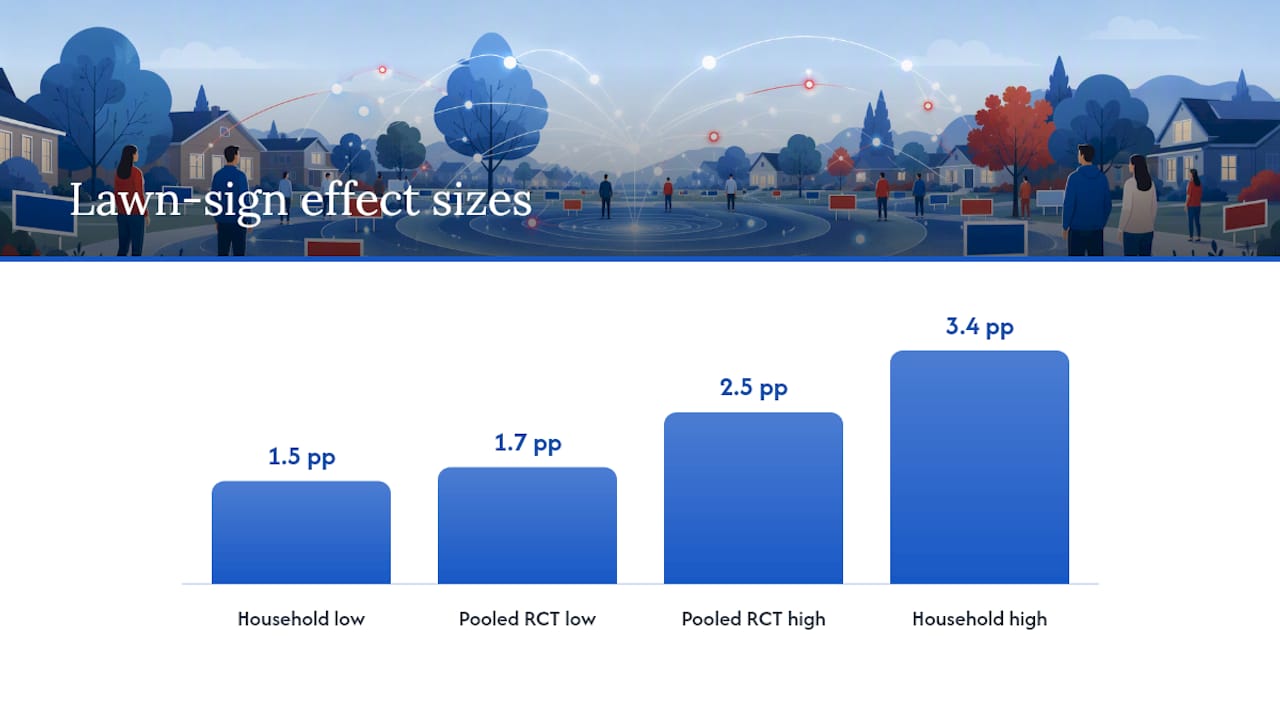
That diminishing-returns pattern matters for planning. Ten to 30 household signs concentrated near main streets and civic nodes in a precinct tends to outperform the same number scattered across a much wider area. Once you’ve saturated the visible corridors, additional signs in that precinct add less value, so redirect them to a lower-awareness precinct instead.
A few tactics keep this organized:
- Track placements in a shared spreadsheet or a free mapping tool like Google My Maps, noting address, precinct, and install date.
- Assign one volunteer per precinct as a point of contact for maintenance checks.
- Revisit high-density precincts weekly to replace fallen or removed signs.
Pro Tip: Map your precincts by prior voter turnout data if your county publishes it. Low-turnout, low-awareness precincts often give you the most lift per sign.
Choosing Materials That Survive a Full Campaign Season
Corrugated plastic is the standard choice for a reason: it’s lightweight, cheap in bulk, and holds up fine for a single election cycle, typically eight to twelve weeks outdoors. Aluminum costs more but survives high-wind areas, repeated reuse, or placement near busy intersections where signs take more abuse from weather and passing traffic.
Standard 18x24 inch corrugated panels work for most residential lawns. For high-wind corridors or commercial rights-of-way (where allowed), step up to a heavier gauge or aluminum, paired with double-leg metal H-stakes rather than single wire stakes, which bend or pull loose in soft or wet ground.
Order timing matters more than most organizers expect. A small batch under 50 signs can often ship within 24 hours once artwork is approved, while larger bulk runs typically need one to three days. Build in a proofing round before you commit to full production. Once signs are in the field, plan for a standing reserve, since 10 to 15 percent of deployed signs typically get knocked down, stolen, or weather-damaged over a multi-week campaign and need quick replacement.
Pro Tip: Keep 10 extra signs and five spare stakes on hand per precinct captain so replacements don’t wait on a new production run.
A Sample Rollout Plan You Can Copy Into a Calendar
Here’s a simple week-by-week structure that scales up or down depending on your precinct count.
| Week | Activity |
|---|---|
| — | Finalize message, submit artwork for proof, confirm municipal posting window |
| — | Approve final proof, place bulk order, recruit precinct volunteers |
| 3 weeks out | First delivery staged, begin distribution to highest-priority precincts |
| 2 weeks out | Complete placement in remaining precincts, start weekly maintenance checks |
| Election week | Final visibility sweep, replace damaged signs, confirm no polling-place buffer violations |
| Post-election | Remove all signs within municipal deadline, log final counts for compliance records |
As a rule of thumb, plan 10 to 30 signs per precinct depending on size and traffic, scaling up in swing or low-awareness areas. Give volunteers a one-page checklist covering placement verification, weekly condition checks, and a phone number for reporting stolen or damaged signs. On the vendor side, lock in your proof deadline early. A vendor offering a 24-hour turnaround on small runs gives you room to fix a placement problem in week two without blowing your timeline.
What Actually Moves the Needle on Ballot Measures
Most ballot measures start with close to zero public awareness, which is exactly why the simplest signs tend to outperform the clever ones. A sign trying to explain a tax formula loses to one that just says “Yes on Measure 12” in bold letters, over and over, block after block.
Pro Tip: Assign one volunteer to walk each precinct every Sunday. A five-minute check catches fallen signs before they cost you a full week of visibility.
Getting Your Signs From Plan to Front Lawn
Once your rollout plan is set, the bottleneck becomes production speed, and that’s where Yardsigns fits into a ballot measure campaign. Orders under 50 pieces typically ship within 24 hours, which means you can approve a proof on Monday and start placing signs by midweek instead of waiting out a standard print queue.
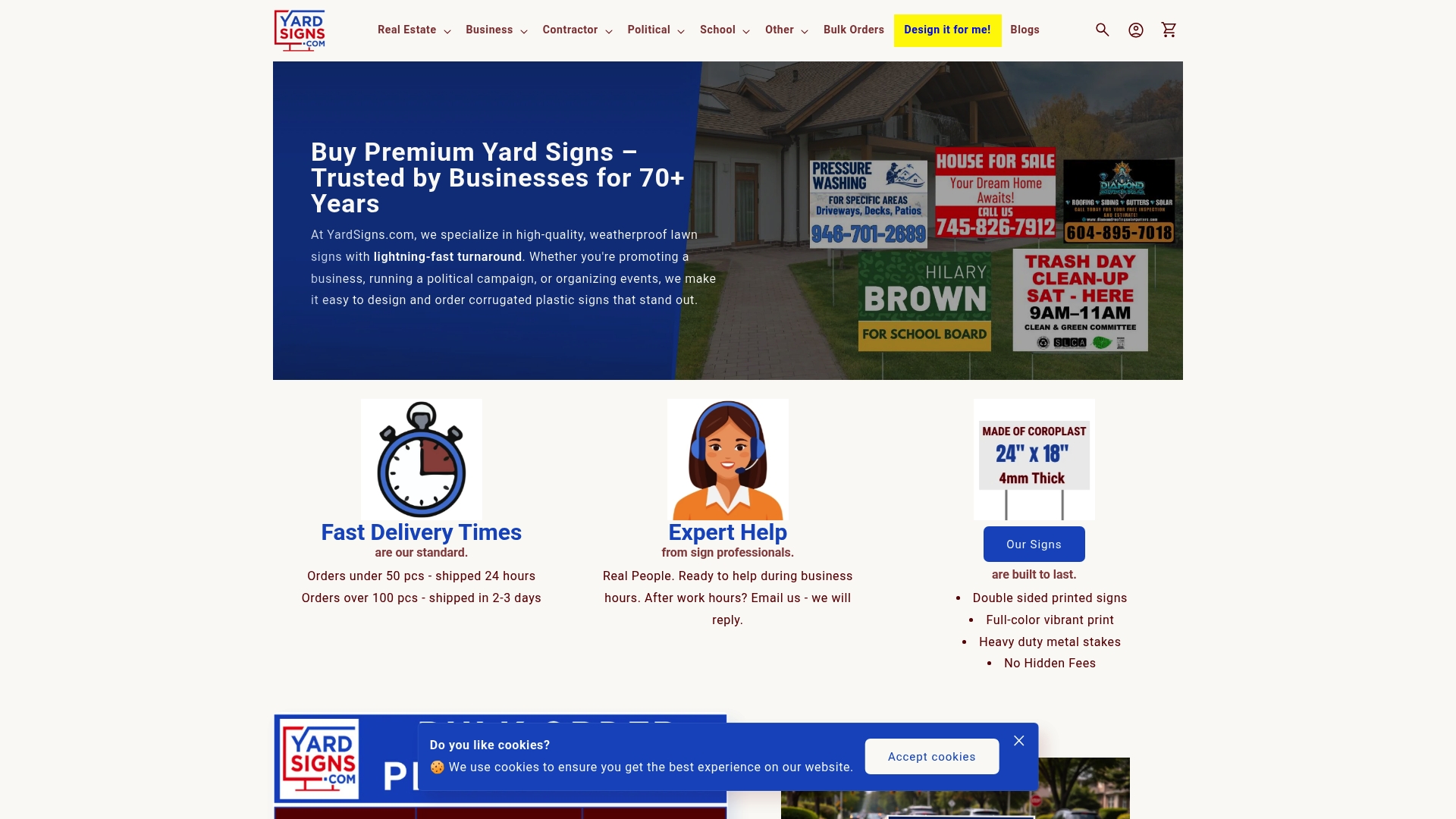
Every sign comes with free design proofing and unlimited revisions, so a volunteer team without a designer can still get a clean, readable “Yes/No on Measure” layout right on the first try. Signs print double-sided on weatherproof corrugated plastic or aluminum with UV-resistant ink, and metal H-stakes ship included, so there’s no separate hardware order slowing down your precinct rollout. If you’re coordinating a multi-precinct campaign, bulk ordering also brings the per-sign cost down as your volunteer count and precinct list grow.
Hand your rollout plan to Yardsigns and get a design proof back the same day. Start your order at Yardsigns.
Frequently Asked Questions
How early can I put up lawn signs for a ballot measure? It depends entirely on your municipality. Some cities allow signs 60 to 90 days before an election, while others set narrower windows. Check your city or county clerk’s site before ordering, since posting too early can result in a forced removal.
Do lawn signs actually change how people vote? Pooled field experiments show a modest lift, roughly 1.7 to 2.5 percentage points, and a separate household study found comparable results in the 1.5 to 3.4 percentage-point range. Signs work best at building name recognition rather than changing minds outright.
Can a nonprofit organization legally promote a ballot measure with signs? Yes, a 501©(3) can engage in ballot measure advocacy, but that activity counts as lobbying and applies toward your organization’s lobbying limit. Track the spending and stay nonpartisan in your messaging.
How many signs do I need per precinct? A reasonable starting point is 10 to 30 signs concentrated near main streets and civic anchors, scaling up in low-awareness or swing precincts. Adding more signs beyond that density in a single area tends to produce diminishing returns.
What should a ballot measure sign actually say? Keep it to the vote direction and measure ID, such as “Yes on Measure 7.” Anything longer reduces readability for someone passing at driving speed, and partisan colors or symbols work against a nonpartisan awareness campaign.
Sources
- 501©(3) Public Charities and Ballot Measures - Alliance for Justice
- Green et al., Electoral Studies (pooled experiments on lawn signs)
- Campaign signs may be old school, but they can have a big influence : NPR
- Maurice et al., S0008423923000501jra 832…847 (household signs study)
Consult the legal sources for compliance questions and the research studies for realistic expectations about how much a sign campaign will actually shift awareness.
