


Yard Signs in Grassroots Campaigns: 2026 Strategy Guide
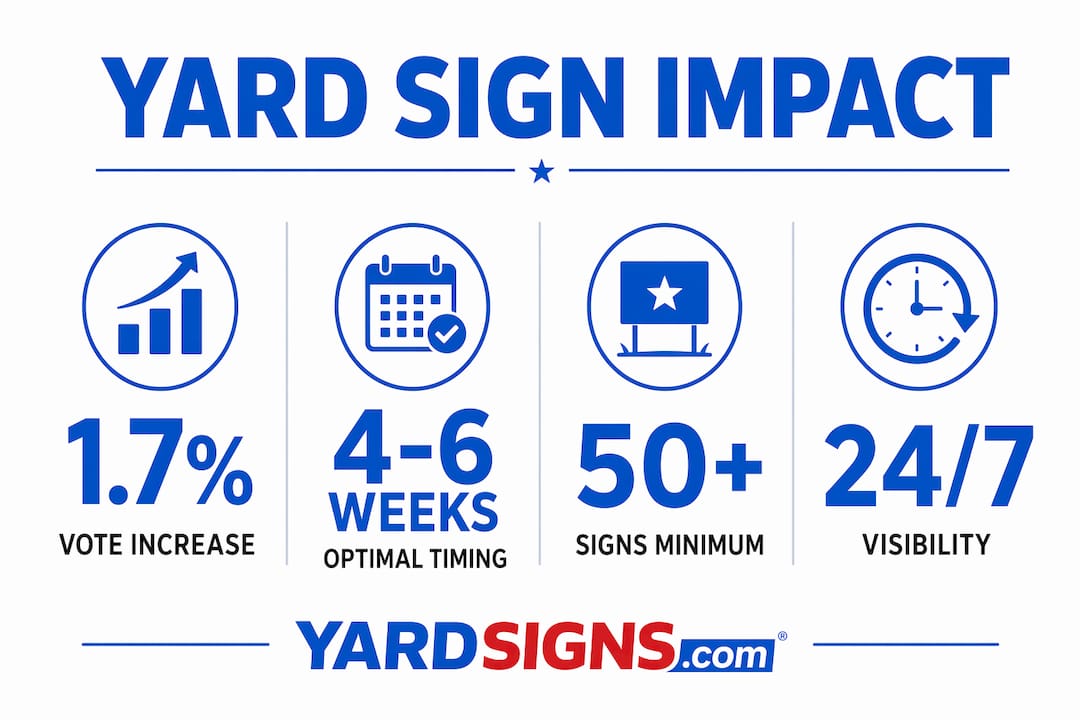
Yard signs are defined as the most cost-effective physical tool for building candidate name recognition in local, low-information races. The role of yard signs in grassroots campaigns goes far beyond decoration. A well-placed sign acts as a public endorsement, signals community momentum, and reaches voters that digital ads simply cannot touch. Research confirms that strategic yard sign placement increases vote share by approximately 1.7 percentage points, a margin that decides most city council, school board, and state legislative races.
How yard signs influence voter behavior and community perception
Yard signs work through a well-documented psychological mechanism called the mere exposure effect. The more a voter sees a candidate’s name, the more familiar and trustworthy that name feels, even without any additional information. This is why sign density matters as much as sign count. A single sign on a block is easy to ignore. Ten signs on the same street create the impression of a community consensus.
Sign density signals momentum to both voters and campaign volunteers. When supporters see their neighborhood covered in signs for a candidate, they feel part of a winning effort. That feeling motivates them to donate, knock doors, and recruit others. The psychological loop between visibility and volunteer energy is one of the most underappreciated benefits of yard signs in any local campaign.
Physical signage also reaches a voter segment that digital advertising consistently misses. Older voters, rural residents, and low-digital-engagement households are harder to reach digitally and more likely to respond to what they see in their physical environment. For a school board race or a county commissioner contest, that demographic often represents the decisive voting bloc.
“When voters see your signs everywhere they drive, they don’t just remember your name. They start to assume you’re the candidate everyone supports.”
The social proof effect is particularly powerful in races where voters have little other information to guide their decision. With no incumbent record to evaluate and no major media coverage, a yard sign becomes a shorthand signal of legitimacy. Campaigns that understand this use signage not just to inform, but to shape perception.
Key psychological drivers behind yard sign effectiveness include:
- Mere exposure effect: Repeated visibility builds familiarity and trust without active engagement from the voter.
- Social proof: Dense sign placement implies broad community endorsement, nudging undecided voters toward the perceived frontrunner.
- Offline reach: Physical signs meet voters in their daily environment, independent of screen time or algorithm.
- Volunteer morale: Visible sign saturation energizes campaign staff and supporters, reinforcing their belief in the campaign’s viability.
Strategic placement and timing for maximum grassroots impact
Placement strategy separates campaigns that use yard signs from campaigns that use them well. Random distribution across a large geography dilutes impact. Concentrated placement in targeted precincts, particularly competitive or high-turnout neighborhoods, creates what researchers describe as a hyper-local ad network that amplifies word-of-mouth far beyond what individual signs achieve alone.
Follow this placement sequence for maximum effect:
- Map your target precincts first. Identify the three to five neighborhoods where your race will be decided. Concentrate your initial sign inventory there before spreading outward.
- Prioritize high-traffic corridors. Intersections near schools, grocery stores, and commuter routes generate the highest daily impressions per sign.
- Create block-level clusters. Placing three to five signs on the same block triggers neighborhood conversations. Residents notice, talk, and form opinions based on what they see around them.
- Expand to secondary areas after saturation. Once your core precincts are covered, move outward to reinforce the impression of broad support.
- Integrate with door-knocking routes. Place signs the same week your volunteers canvass a neighborhood. The combination of a personal conversation and a visible sign dramatically increases voter recall.
Timing is equally critical. Deploying signs too late reduces their psychological impact because undecided voters have already formed impressions of the race. Signs need to be visible during the window when voters are paying attention, typically four to six weeks before Election Day for local races.
Pro Tip: Order your signs at least six weeks before your target deployment date. Yardsigns ships orders under 50 pieces within 24 hours, but building in lead time lets you stage deployment strategically rather than scrambling to get signs out the door.
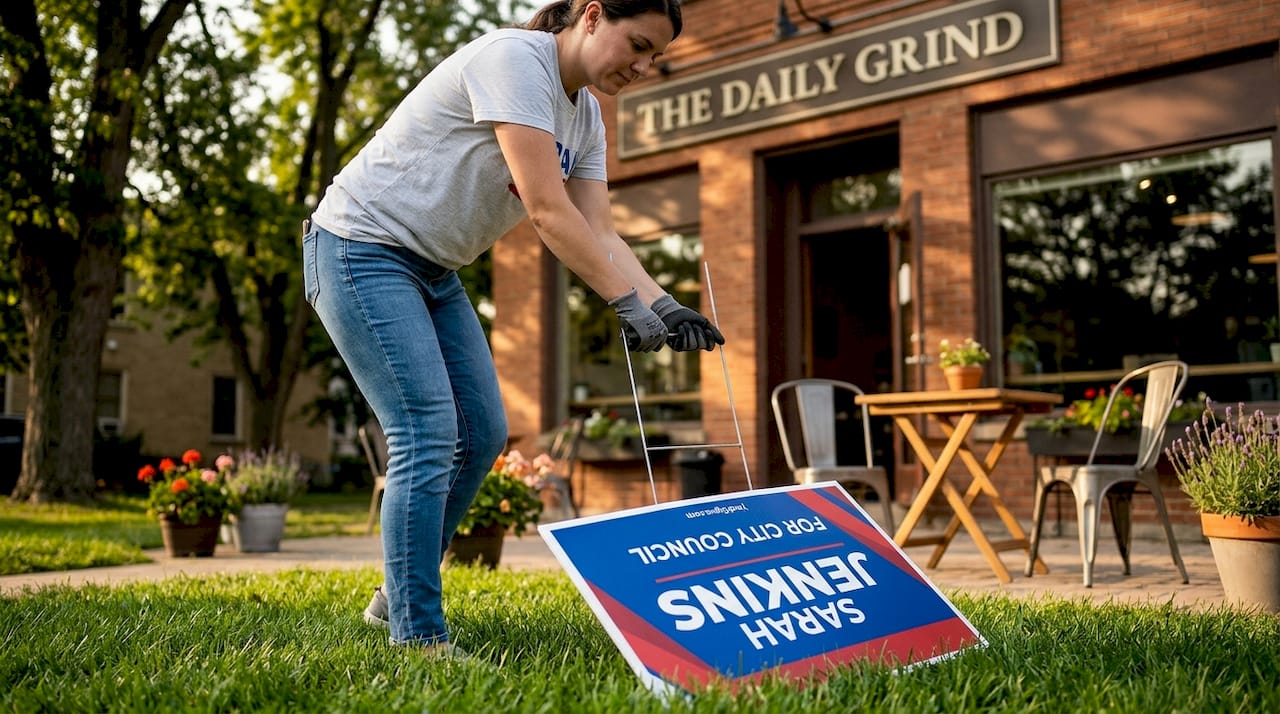
Effective campaigns also integrate yard signs with digital outreach to reinforce voter memory across channels. A voter who sees your sign on their commute and then encounters your Facebook ad that evening is far more likely to remember your name on Election Day than a voter who only sees one or the other.
Legal considerations and protecting your signs from interference
Sign theft and removal are real operational risks in competitive races. Wisconsin law prohibits removing or defacing legally placed political signs, and violations can escalate into public conflicts and legal disputes. One high-profile Wisconsin case involved a gubernatorial candidate who filmed himself stealing signs for two state representatives, turning a local signage dispute into a statewide news story.
Most states have similar protections. In Texas, Election Code Chapter 259 prohibits cities and HOAs from banning political signs outright on private property, though they may regulate size, timing, and placement within limits. Understanding your state’s specific rules before deployment protects both your signs and your campaign from unnecessary legal exposure.
Build these practices into your campaign protocol from day one:
- Document every placement. Photograph each sign location with GPS-tagged images. This creates a legal record if signs are removed and supports any complaint or police report.
- Train volunteers on legal boundaries. Volunteers should know they cannot place signs on public right-of-way, utility poles, or private property without permission. One misplaced sign can trigger removal orders for an entire batch.
- Track sign inventory. Assign sign numbers or use a simple spreadsheet to log locations. When signs disappear, you’ll know exactly where to follow up.
- Report theft promptly. File a police report for documented theft. Even if no action is taken, the report creates a paper trail and signals to opponents that your campaign is paying attention.
Documenting sign placement also helps you identify patterns. If signs disappear repeatedly in the same precinct, that tells you something about the competitive dynamics in that area and where to redeploy resources.
How do yard signs compare to other grassroots campaign tools?
Yard signs occupy a specific and irreplaceable niche in the campaign toolkit. They are not a substitute for door-knocking or digital advertising. They work best as a force multiplier that makes every other tactic more effective.
| Tool | Strengths | Limitations |
|---|---|---|
| Yard signs | Offline social proof, 24/7 visibility, reaches non-digital voters | Passive medium, no direct message delivery |
| Digital ads | Precise targeting, measurable reach, scalable budget | Invisible to low-digital voters, no physical presence |
| Door-knocking | Personal contact, direct persuasion, high conversion | Labor-intensive, limited scale, weather-dependent |
| Direct mail | Household-level targeting, tangible format | High cost per contact, easily discarded |
| Social media | Shareable content, volunteer activation, low cost | Algorithm-dependent, reaches existing supporters more than undecided voters |
The multi-channel approach consistently outperforms any single tactic. Yard signs establish the offline social proof that digital ads lack. Digital ads deliver the specific message that yard signs cannot carry. Door-knocking converts the familiarity built by signs into actual votes. Each tool reinforces the others.
For campaigns with limited budgets, yard signs offer the best cost-per-impression ratio of any physical medium. A standard 18"x24" corrugated plastic sign with a metal stake costs roughly $12 to $15 per unit at volume, and it generates impressions every day for weeks. No other local campaign advertising format delivers that kind of sustained visibility at that price point. You can explore placement ideas that win to get the most out of every sign you deploy.
Key takeaways
Yard signs increase vote share by approximately 1.7 percentage points in local races, making strategic placement and early deployment the two highest-leverage decisions any grassroots campaign manager can make.
| Point | Details |
|---|---|
| Vote share impact | Yard signs increase vote share by about 1.7 points, decisive in most local races. |
| Psychological mechanism | The mere exposure effect and social proof make sign density more powerful than sign count alone. |
| Timing matters | Deploy signs four to six weeks before Election Day to capture undecided voters during their decision window. |
| Legal protection | Document every sign placement with GPS-tagged photos and train volunteers on state-specific sign laws. |
| Multi-channel integration | Pair yard signs with door-knocking and digital ads to reinforce voter memory across all touchpoints. |
What I’ve learned after watching hundreds of campaigns get signage wrong
Most campaigns treat yard signs as a logistical afterthought. They order signs two weeks before Election Day, scatter them randomly across the district, and wonder why the impact feels thin. I’ve watched well-funded campaigns lose close races because their signs went up after voters had already made up their minds.
The campaigns that use signage most effectively treat it as a strategic asset from day one. They map precincts before they order signs. They brief volunteers on placement protocols before the first sign goes in the ground. They track inventory and redeploy quickly when signs disappear. That level of discipline is rare, and it shows in the results.
The other mistake I see constantly is treating yard signs as a standalone tactic. A sign that goes up in a neighborhood your volunteers never canvass is doing half the work it could. When a voter gets a knock on their door and then sees your sign on their way to work the next morning, the combination creates a recall effect that neither tactic achieves alone. That pairing is where the real brand awareness from yard signs gets built.
One more thing: don’t underestimate the morale effect. When your volunteers drive through a neighborhood and see your signs everywhere, they feel like they’re part of something real. That energy is contagious and it keeps people showing up through the hard weeks of a campaign.
— YardSignGuy
Get your campaign signs ready before the window closes
Timing your sign order is as important as timing your deployment. Yardsigns produces weatherproof, vibrantly printed campaign signs built to stay visible through rain, wind, and weeks of outdoor exposure. Orders under 50 pieces ship within 24 hours, so you can respond quickly when a new precinct opens up or a batch goes missing.

Whether you’re running for city council, school board, or state legislature, Yardsigns has the materials and turnaround speed to keep your campaign visible when it counts. Browse ready-to-customize Democrat signs and Republican signs designed for maximum visibility, or build your own design from scratch. Visit yardsigns.com to get started and get your signs in the ground before the decision window closes.
FAQ
Do yard signs actually increase votes?
Yes. Research shows that yard signs increase vote share by approximately 1.7 percentage points in local races. That margin is often the difference in city council, school board, and state legislative contests.
When should I put out yard signs for a local campaign?
Deploy signs four to six weeks before Election Day to maximize exposure during the window when undecided voters are forming their opinions. Late deployment reduces impact because voters have already made preliminary decisions by the final two weeks.
Can someone legally remove my campaign yard signs?
No. Most states prohibit removing or defacing legally placed political signs. In Texas, for example, Election Code Chapter 259 protects signs on private property from HOA or municipal removal orders, though size and timing regulations still apply.
How many yard signs do I need for a local race?
The answer depends on your district size and target precincts, but concentrated placement outperforms wide distribution. Saturating three to five key neighborhoods creates stronger social proof than spreading the same number of signs thinly across an entire district.
Are yard signs worth the cost compared to digital ads?
Yard signs deliver the best cost-per-impression ratio of any physical campaign medium and reach voter segments that digital ads miss entirely. The most effective approach pairs both: signs build offline recognition while digital ads deliver your specific message to the same voters across multiple channels.
