


Best Printing for Political Signs: Campaign Manager's Guide
For most local campaigns, 4mm corrugated plastic (coroplast) printed with UV-resistant or UV-cured inks is the best printing choice for political signs. It balances cost, outdoor durability, and fast turnaround in a way no other substrate matches at campaign scale. Order double-sided for corner placements and intersections, single-sided for yard-facing positions. The immediate next step: send your printer a spec of 18" x 24", 4mm coroplast, double-sided, UV-resistant inks, full-bleed, with included H-stakes, and request a digital proof before production begins.
Three reasons this combination wins:
- Legibility in the field. Coroplast holds a flat, rigid surface that keeps type readable from a moving vehicle, and UV-cured inks produce sharp edges and vivid color that hold up under direct sun and rain.
- Durability through a full campaign season. A 4mm panel resists wind flex, handles repeated installation and removal, and won’t delaminate in wet conditions the way paper-faced materials can.
- Reliable, fast turnaround. Coroplast is the most widely stocked substrate at political sign printers, so production queues move faster than for specialty materials.
Table of Contents
- How do you design a sign that reads from a moving car?
- Which materials and finishes hold up through a campaign season?
- How many signs should you order, and where should you place them?
- What does political sign printing cost, and how fast can you get it?
- Legal and compliance checklist before you print and install
- How do you choose the right political sign printer?
- What printing processes actually matter for outdoor political signs?
- Key Takeaways
- Why a campaign-specialist printer changes the outcome
- Yardsigns: fast, campaign-ready political sign printing
- Useful sources and production references
How do you design a sign that reads from a moving car?
The single most important design rule: high contrast, large type, and no more than three words of headline copy. A driver at 35 mph has roughly two seconds to read your sign. Everything else is secondary.
Effective political sign design starts with font choice. Bold sans-serif typefaces, specifically the Helvetica, Arial, and Futura families, are the standard recommendation because their uniform stroke weight stays legible at distance. Avoid script fonts, condensed weights, and decorative typefaces entirely. The headline (candidate name or core message) should occupy most of the sign’s vertical space.
Color discipline matters just as much. Research on political yard sign design recommends limiting your palette to 2–3 high-contrast colors. Medium-value colors on medium-value backgrounds wash out in field conditions, particularly under overcast skies or at dusk when headlights alter perceived contrast. Navy on white, red on white, and black on yellow are proven combinations. Avoid green-on-blue or any pairing where the foreground and background share similar brightness values.
Prepress checklist before you send files to print:
- Headline letter height: minimum 3" for an 18" x 24" sign (readable from roughly 50 feet)
- File format: PDF or high-resolution TIFF, CMYK color mode
- Bleed: 0.125" on all sides
- Safe zone: keep all critical text and logos 0.25" inside the trim edge
- Proof: request a digital proof and approve it before production begins
Photos and logos are optional, not required. A candidate headshot can build recognition, but only if it is large enough to be identifiable at distance. A small logo in the corner adds nothing at 40 mph. When in doubt, cut it.
Pro Tip: Never judge your color palette only on screen. Print a physical proof or request a printed sample from your vendor before approving a large run. Outdoor lighting, especially overcast conditions and evening headlights, compresses contrast in ways a monitor cannot replicate.
Which materials and finishes hold up through a campaign season?
The right substrate depends on how long the sign needs to last, where it will be installed, and how much you can spend per unit.
4mm coroplast is the default for most campaigns. It is the industry-standard gauge for political yard signs, balancing stiffness and cost for a single campaign season. Industry guidance confirms that 4mm handles typical outdoor conditions well, while 6mm is worth the upgrade for multi-season use or locations with high wind exposure.
Aluminum and ACM panels offer the longest outdoor life of any common sign substrate. Substrate research from the sign industry notes that solid aluminum outperforms ACM in raw durability, while premium ACM provides excellent surface flatness for UV and vinyl printing. Both are significantly heavier and more expensive than coroplast, making them impractical for high-volume campaign deployments. Use them for permanent or semi-permanent placements where the sign will stay in one location for months.
| Feature | 4mm Coroplast | Aluminum / ACM | Vinyl Banner | Rigid PVC |
|---|---|---|---|---|
| Best for | Yard signs, volume campaigns | Long-term / illuminated placements | Events, fencing, large format | Short-term indoor/event display |
| Durability | 1–2 seasons outdoors | Multi-year | Season-long with grommets | Weeks outdoors |
| Typical cost shape | Lowest per unit | Highest per unit | Mid-range | Low-mid |
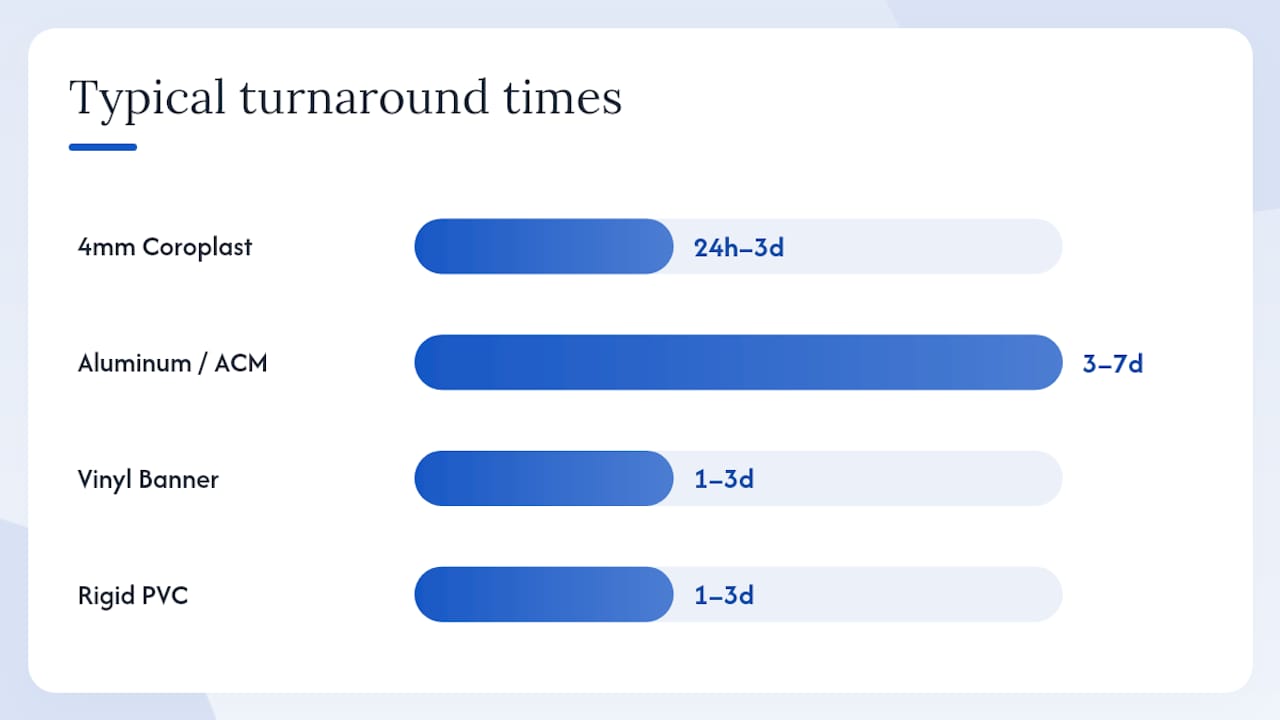
| Typical turnaround | 24 hrs–3 days | 3–7 days | 1–3 days | 1–3 days |
| Included hardware | H-stakes (most vendors) | Post mounts (varies) | Grommets standard | None standard |
UV-resistant and UV-cured inks are the finish that matters most for outdoor political signage. NUtec Digital’s guidance on election signage confirms that UV-cured inks dry immediately on press, resist smudging and abrasion during packing and deployment, and retain vivid color through extended outdoor exposure. Always ask your printer to confirm UV-cured or UV-resistant inks specifically for coroplast jobs.
Overlaminates add another layer of protection but are rarely necessary for a single-season coroplast sign when UV inks are used. For aluminum panels or high-end event banners, a gloss or matte overlaminate can extend print life and improve appearance.
How many signs should you order, and where should you place them?
A practical starting point for local campaigns: one sign per 100–150 registered voters in your district, plus a 20–30% reserve for theft, damage, and late-cycle placements. A race covering a few thousand registered voters might start with a modest number of signs and increase supply towards the final weeks.
Prioritize placements in this order:
- Corner lots and busy intersections (maximum impressions per sign)
- Main arterials and commuter routes through the district
- Neighborhood entrances and high-foot-traffic areas
- Volunteer and supporter yards (builds perceived momentum)
Practical placement checklist:
- Map your district and identify the top 10–15 high-traffic intersections before ordering
- Confirm property owner permission before installation on private land
- Check local ordinances for setback requirements from intersections and rights-of-way (see the compliance section below)
- Stage a reserve supply (10–15% of total order) for rapid replacement of stolen or damaged signs
- Plan a pickup and removal schedule for the 48 hours after election day
Double-sided signs are worth the added cost at intersections where traffic flows in both directions. Guidance on sign placement economics notes that single-sided signs are the economical choice for yard placements facing one direction, where the second side would never be seen.
What does political sign printing cost, and how fast can you get it?
Price is driven by five variables: quantity, substrate, single vs. double-sided, hardware inclusion, and shipping speed. Understanding each one lets you compare quotes accurately.
Main pricing drivers:
- Quantity: The largest single lever. Per-unit cost drops significantly as you move from 25 to 100 to 500 signs. Bulk ordering makes sense when you have confirmed placements for the volume.
- Single vs. double-sided: Double-sided typically adds 30–40% to the per-unit cost but doubles impressions at intersections.
- Substrate: Coroplast is the lowest-cost option. Aluminum and ACM panels cost significantly more per unit.
- Hardware: H-stakes are often included with coroplast orders but confirm this before comparing quotes. A vendor quoting a lower base price without stakes may not be cheaper after hardware is added.
- Rush production and shipping: Standard production for small runs (under 50 pieces) is 24 hours at most campaign-focused vendors. Larger runs of 500–5,000 signs typically require 1–3 business days in production, plus shipping transit time.
Questions to ask every vendor before placing an order:
- Are H-stakes included, or are they priced separately?
- Is a digital proof included, and is there a fee for revisions?
- Do you use UV-cured or UV-resistant inks for coroplast?
- What is the production time for my quantity, and what are the rush options?
- How is freight calculated — flat rate, weight-based, or by zone?
- What is your policy for defective or misprinted signs?
Staggered ordering often makes more sense than a single large run early in a campaign. Order enough for your initial placements, then reorder as you confirm additional supporter locations. Most political printers can turn a reorder of under 50 signs in 24 hours, so you are not locked into a single large commitment.
Legal and compliance checklist before you print and install
Two items campaigns cannot skip: required paid-for-by disclaimers and local placement ordinances. Missing either can result in fines, forced removal, or lost endorsements.
| Compliance item | What to confirm | Where to check |
|---|---|---|
| Paid-for-by disclaimer | Required language, size, and placement on the sign face | Your state’s campaign finance authority |
| Local sign ordinances | Setbacks from intersections, size limits, permit requirements | City/county municipal code |
| HOA restrictions | Whether signs are permitted and for how long | HOA governing documents |
| Right-of-way rules | Whether signs may be placed in public right-of-way | Local public works or elections office |
| Banner permits | Whether large banners require a temporary sign permit | City planning or zoning department |
| Union bug | Required if pursuing labor endorsements | Your printer’s union shop certification |
On the union bug: campaigns seeking endorsements from labor organizations need printed materials produced in a certified union print shop, with the union bug printed on the sign. Online commercial vendors that are not union shops cannot provide a legitimate union bug. If labor endorsements are part of your strategy, confirm union shop status with your printer before placing any order.
Pro Tip: Keep timestamped digital proofs and order receipts for every print run. If a sign placement is challenged or a disclaimer is questioned, a dated proof showing the approved artwork is your fastest path to resolution.
How do you choose the right political sign printer?
The most important criterion is campaign experience with verifiable production specs. A printer who regularly handles political orders understands election-cycle timelines, knows the standard coroplast gauges, and can confirm UV ink specifications without being asked twice.
Ordered checklist for evaluating vendors:
- Confirm they print on 4mm coroplast with UV-cured or UV-resistant inks
- Verify turnaround time for your specific quantity (not just their advertised headline time)
- Ask whether H-stakes are included or priced separately
- Request a digital proof process with at least one free revision
- Confirm double-sided printing capability if you need it
- Ask about rush production options and their lead-time guarantee
- Check whether they can provide a union bug if your campaign needs one
- Get a fully itemized quote including freight and handling
Exact spec block to send on your order form:
- Size: 18" x 24"
- Substrate: 4mm coroplast
- Printing: double-sided, full-bleed
- Inks: UV-resistant or UV-cured
- Bleed: 0.125"
- Safe zone: 0.25" inside trim
- Hardware: metal H-stakes included
- Proof: digital proof required before production
Vendor questions to ask during a quote call:
- “Do you use UV-cured inks for coroplast, and what outdoor life do you rate them for?”
- “Can you provide a sample or a weathering spec sheet?”
- “What is your defect policy, and how do you handle a reprint request?”
- “Is your shop union-certified?”
A vendor who hesitates on the ink question or cannot confirm the gauge is a risk for a time-sensitive campaign order.
What printing processes actually matter for outdoor political signs?
UV-cured and UV-resistant inks are the right choice for coroplast yard signs. NUtec Digital’s research on election signage substrates confirms that UV-cured inks cure immediately under UV light on press, which means signs can be handled, stacked, and packed within seconds of printing. That matters during a high-volume campaign run where thousands of signs move from press to packing to shipping in hours.
The three main processes and when each applies:
- UV-cured digital printing: Best for coroplast yard signs in any quantity. Fast cure, sharp detail, excellent color vibrancy, and strong abrasion resistance. The standard for most political sign printers today.
- Latex inkjet printing: A water-based alternative that also performs well outdoors. Slightly longer drying time than UV-cured but produces flexible prints suited to vinyl banners. Good color gamut and no solvent odor.
- Screen printing: The traditional method for very large runs (typically 5,000+ units) or when spot colors need to match a specific Pantone standard exactly. Setup costs are higher, but per-unit cost drops at extreme volumes. Less common for small and mid-size campaign orders.
Verification steps to validate a vendor’s ink claims:
- Ask for a technical spec sheet or ink data sheet for the product they use on coroplast
- Request a printed sample of a recent coroplast job under outdoor lighting before committing to a large order
- Ask specifically: “Are these UV-cured or UV-resistant inks, and what is the rated outdoor life?”
- Check whether the sample shows clean edges and no ink spread at the letter strokes — UV-cured inks should produce sharp, defined edges
If a vendor cannot provide a sample or a spec sheet, treat that as a signal to keep looking.
Key Takeaways
For most campaigns, 4mm coroplast with UV-cured inks, ordered at 18" x 24" with H-stakes included, is the fastest, most cost-effective path to high-quality outdoor political signage.
| Point | Details |
|---|---|
| Default spec | Order 18" x 24", 4mm coroplast, UV-cured inks, double-sided for intersections, H-stakes included. |
| Design rules | Bold sans-serif type, 2–3 high-contrast colors, headline letter height minimum 3" for an 18x24 sign. |
| Top vendor question | Ask: “Do you use UV-cured inks for coroplast, and what is the rated outdoor life?” before placing any order. |
| Compliance | Confirm paid-for-by disclaimer language and local placement ordinances before printing or installing. |
| Yardsigns | Yardsigns offers UV-resistant inks, included H-stakes, double-sided printing, and ships most orders under 50 pieces within 24 hours. |
Why a campaign-specialist printer changes the outcome
Most campaigns underestimate how much the printer’s experience affects the final product. A vendor who handles political orders regularly already knows that a campaign manager needs a proof turned around in hours, not days. They stock 4mm coroplast as a standard item, not a special order. They understand that a sign arriving two days after election day is worthless, and they build their production queue accordingly.
What I find most overlooked in campaign printing decisions is the proof step. Campaigns routinely skip it to save time, then discover on delivery that a color shifted, a name was misspelled, or the disclaimer text was too small to meet state requirements. A digital proof costs nothing at most reputable vendors and takes minutes to review. The reprint costs days and real money.
Yardsigns’s design resources for political campaigns and free proof process exist precisely because these mistakes are common and preventable. Fast turnaround only matters if the signs are correct. Require the proof, track the shipment, and build two extra days into your timeline for any run over 100 pieces. The campaigns that run out of signs in the final week almost always skipped one of those three steps.
Yardsigns: fast, campaign-ready political sign printing
Campaigns that need high-quality signs fast, with no guesswork on specs, get a direct path to results with Yardsigns. Every order comes with UV-resistant inks on weatherproof coroplast, included metal H-stakes, and free design proofs with unlimited revisions. Orders under 50 pieces ship within 24 hours. Larger runs of 500 to 5,000 signs move in 1–3 business days. Double-sided printing, bulk discounts, and political sign templates are all available through the same straightforward ordering process.
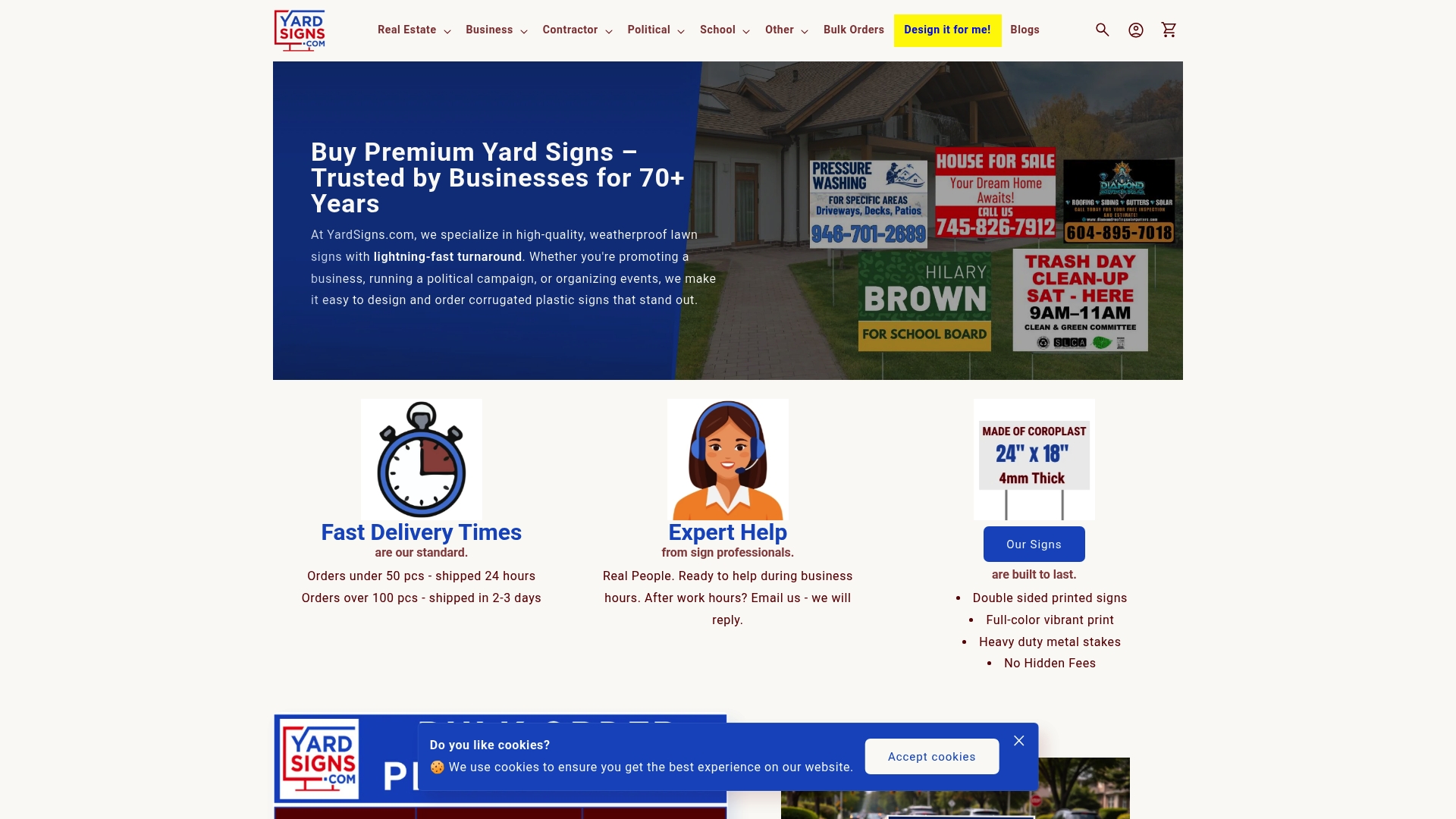
You get transparent pricing, no hidden stake fees, and a proof before a single sign goes to press. When your campaign timeline is tight and the signs have to be right the first time, order your campaign signs at Yardsigns.com and get your proof started today.
Useful sources and production references
- Ink for Election Signage on Corrugated Plastic | NUtec
- Political Yard Signs: Effective Design and Union Compliance
- Sign Substrates: Complete Guide for the UK sign industry (ACM, aluminium, acrylic, foamex/PVC foam, MDF, plywood)
- Yard Sign Printing Guide 2026: Sizes, Materials, Stakes & Design Tips That Get Results | EDDM Printing Insights
- How to Design Eye-Catching Political Yard Signs – YardSigns.com
