


Campaign Messaging Sign Types: Your 2026 Strategy Guide
The most effective campaign signs do one thing well: put your name in front of voters so clearly and repeatedly that they remember it at the polls. Every decision about campaign messaging sign types flows from that single goal. Your name and the office you’re seeking belong on every sign, in that order of prominence. The rest is optional, and often counterproductive.
Here’s what works for 2026 campaigns:
- Candidate name: largest element on the sign, occupying 40–60% of the sign face
- Office sought: directly below or beside the name, roughly half the type size
- Five-second rule: a passing driver must read your name and office within five seconds
- Text limit: name and office only; skip phone numbers, social media handles, and lengthy slogans
- Optional elements: a short slogan in secondary type is acceptable; QR codes are not
- Common sign types: yard signs, hand fans, die-cut signs, banners, and rally signs
- Materials: corrugated plastic (coroplast) for outdoor durability; cardboard for indoor or wall use
- Legal requirements: paid-for-by disclaimer and, where applicable, a union bug
- Outreach integration: signs reinforce door-knocking, mailers, and digital ads — they don’t replace them
Table of Contents
- What makes campaign messaging land with voters?
- Design elements that make your signs readable and memorable
- Types of campaign signs and which situations they serve
- How to keep your campaign materials visually consistent
- What the research says about political signage effectiveness
- Where to place signs for maximum voter exposure
- When to deploy signs and when to take them down
- Yardsigns makes it easy to get campaign-ready signs fast
- Key Takeaways
What makes campaign messaging land with voters?
Plain language outperforms policy-heavy messaging on signs and every other voter contact material. Voters respond to words they already use, tied to concerns they already feel: jobs, schools, public safety. Abstract policy language on a sign does not register from a moving car, and it barely registers in a mailer.
According to Portside Advertising, the most effective signs join conversations already happening in the community. A candidate running in a district worried about school funding does not need to explain the funding formula. They need their name associated with the issue, clearly and repeatedly.
Tailoring your message to the race type matters too. A name-recognition campaign in a low-information local race calls for a different sign strategy than a mobilization push in a competitive state legislative district. Messaging experts at Portside Advertising note that campaigns often conflate these goals, producing signs that are too cluttered for name recognition and too vague for mobilization.
- Keep slogans short and subordinate to the name
- Avoid endorsement lists on yard signs — save those for mailers
- Tie your message to one concrete voter concern, not a platform summary
- Plan your messaging calendar around filing deadlines, early voting, and Election Day
Design elements that make your signs readable and memorable
The five-second rule is the practical standard for outdoor political signage: a driver must be able to read your name and office within a few seconds. That constraint shapes every design decision.

Typography is where most campaigns go wrong first. Bold sans-serif fonts like Helvetica or Arial are the proven choice for signs read from 30–50 feet away. Script fonts, condensed typefaces, and decorative lettering all fail under field conditions.
Color contrast is equally critical. Dark text on a light background, or light text on a dark background, reads clearly at distance. Low-contrast combinations (navy on black, yellow on white) disappear in outdoor light.
Photos and QR codes both reduce sign effectiveness. A headshot on an 18" x 24" sign forces your name into a smaller type size, which directly undermines recall. QR codes require the viewer to stop, take out a phone, and scan — a sequence that never happens from a moving vehicle.
| Design Element | Do | Don’t |
|---|---|---|
| Candidate name | 40–60% of sign face, largest type | Shrink it to fit a photo or slogan |
| Font style | Bold sans-serif (Helvetica, Arial) | Script, condensed, or decorative fonts |
| Color contrast | High contrast (dark/light) | Low-contrast color pairings |
| Slogan | Short, in secondary type | Competing size with the name |
| Photos | Palm cards, mailers | Yard signs |
| QR codes | Digital ads, mailers | Any outdoor signage |
| Phone numbers | Nowhere on yard signs | Added as “just in case” |
Types of campaign signs and which situations they serve
Choosing the right sign format is as important as the message on it. Each material and format fits a specific context.
Yard signs are the workhorse of any campaign. The standard size is 18" x 24", fitting a wire H-frame, with 24" x 36" used for higher-visibility placements. Three materials dominate:
- Corrugated plastic (coroplast): weather-resistant, cost-effective for repeat campaigns, slides over a metal frame. The most durable outdoor option, though light-colored versions can be slightly translucent and are the most frequently stolen.
- Plastic bag signs: affordable and easy to ship, slipped over U-shaped wire frames. They tend to sag over time and don’t work as wall signs.
- Double-sided cardboard: versatile, works as a wall sign, comes in varied shapes. Less weather-resistant than plastic, but effective indoors or in covered locations.
Beyond yard signs, campaigns have several other formats worth knowing:
- Hand fans: printed on card stock, handed out at rallies and outdoor events. High personal contact, short lifespan.
- Die-cut signs: custom shapes (stars, arrows, candidate silhouettes) that stand out in high-traffic areas. Higher cost per unit, but strong visual differentiation.
- Banners: vinyl or fabric, used at campaign headquarters, events, and debates. Fixed-display function; not a substitute for yard signs.
- Rally signs: lighter card stock or foam board, designed for holding and photographing at events. Coroplast yard signs are not appropriate for this use.
Pro Tip: Order corrugated plastic signs if you plan to run again in two or four years. Reusing the same design and material saves money and builds visual familiarity with voters across election cycles.
| Sign Type | Best Use | Material | Weather Resistance |
|---|---|---|---|
| Standard yard sign | Residential lawns, roadsides | Coroplast | High |
| Plastic bag sign | Budget campaigns, quick deployment | Plastic sleeve | Low |
| Cardboard yard sign | Wall mounting, indoor display | Cardboard | Low |
| Hand fan | Rallies, outdoor events | Card stock | Low |
| Die-cut sign | High-traffic differentiation | Coroplast or foam | Medium |
| Banner | HQ, events, debates | Vinyl or fabric | Medium–High |
| Rally sign | Events, photo opportunities | Card stock or foam board | Low |

How to keep your campaign materials visually consistent
Consistency across all your voter outreach materials is what turns individual sign sightings into name recognition. A voter who sees your yard sign on Monday, receives your mailer on Wednesday, and spots your banner at a community event on Saturday should see the same colors, the same typeface, and the same name treatment every time.
Your campaign’s visual system should lock in three elements before any material goes to print: a primary color palette (two to three colors maximum), a single typeface family, and a consistent name treatment. Every sign, door hanger, palm card, and digital ad draws from that same system.
- Match the font on your yard signs to your website header and mailer headlines
- Use the same color hex codes across print and digital to avoid visible mismatches
- Place the paid-for-by disclaimer in the same position and type size on every printed piece
- If you’re seeking union endorsements, union bug placement must be consistent and verifiable across all printed materials
- Coordinate sign deployment with your door-knocking schedule so canvassers follow signs already in yards
Order yard signs and door hangers 6–8 weeks before you need them in the field. Political mailers need 4–6 weeks for design approval, printing, and mail processing. Rushing any of these adds cost and risks errors that undermine your brand consistency.
What the research says about political signage effectiveness
The evidence on yard signs is clear and worth knowing before you budget for them. Yard signs raise a candidate’s vote share by approximately 1–2 percentage points, with the effect concentrated in areas of high sign density and among voters already modestly engaged with the race.
The National Democratic Institute’s Campaign Skills Handbook reinforces this: your campaign message should be the foundation of all communications, from volunteer training to sign design. Signs that contradict or diverge from your core message create voter confusion, not recognition.
Compliance matters as much as design. A missing paid-for-by disclaimer is a legal exposure. A missing union bug signals to labor endorsers that your campaign doesn’t have its basics covered. Neither failure is recoverable after the signs are already in the field. Get both right before you approve the print file.
Where to place signs for maximum voter exposure
Sign placement determines whether your investment in printing translates into actual voter impressions. High-traffic intersections, commuter routes, and neighborhood entry points deliver the most repeated exposure to the broadest audience. A sign seen by the same 500 drivers every weekday morning for three weeks does more for name recognition than 50 signs scattered across low-traffic side streets.
Cluster signs in areas where you already have supporter density. Sign placement in clusters significantly amplifies impact, both visually and psychologically. A voter who sees three of your signs in a single block perceives broader community support than one sign alone conveys.
Always get permission before placing signs on private property. For public right-of-way placement, check your municipality’s rules on size, setback distance from the road, and permitted locations. Many jurisdictions allow signs on the public strip between sidewalk and curb but restrict placement near polling places or intersections. For practical guidance on local sign placement, review your county or city’s campaign sign ordinance before your first deployment.
When to deploy signs and when to take them down
Timing your sign deployment to align with voter attention cycles is one of the most underused advantages in local campaigns. Signs that go up too early lose their novelty before Election Day. Signs that go up too late miss the early-voting window entirely.
A practical deployment schedule for most races: place your first wave of signs 6–8 weeks before Election Day to establish name presence. Add a second wave 2–3 weeks out, concentrating on high-traffic areas and precincts where your voter data shows competitive opportunity. If your state has early voting, signs should be fully deployed before that window opens.
For 2026 campaign outreach, coordinate your sign schedule with your digital and mail calendar. A voter who sees your yard sign and receives your mailer in the same week gets a reinforcing impression that neither channel delivers alone. Remove signs promptly after Election Day. Most jurisdictions require removal within a set number of days, and leaving signs up past that deadline creates fines and reflects poorly on your campaign’s organization.
Yardsigns makes it easy to get campaign-ready signs fast
When your campaign needs signs that hold up through rain, wind, and a full election season, Yardsigns delivers the print quality and speed that campaigns actually depend on. Orders under 50 pieces ship within 24 hours, so you can respond to a last-minute canvassing push or a new endorsement without waiting weeks for production.
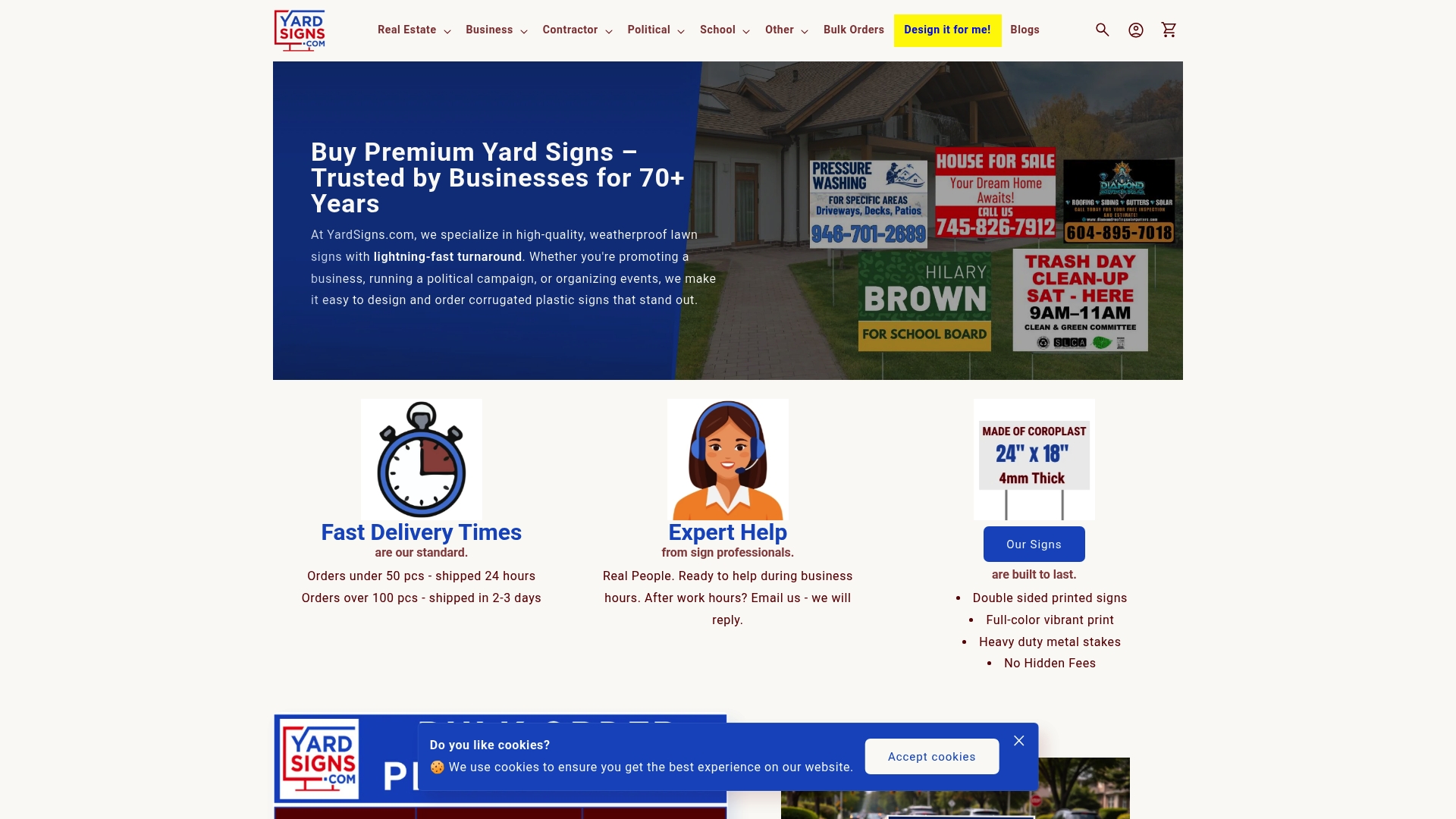
Yardsigns produces weatherproof corrugated plastic yard signs with vibrant, full-color printing that customers consistently highlight for durability and color accuracy. The design process is straightforward: upload your artwork, choose your size, and get signs in the field fast. Whether you need campaign fundraising signage for an upcoming event or a full yard sign run for your district, Yardsigns handles both without long lead times or minimum-order headaches. Get your quote at yardsigns.com and have signs ready before your next canvassing weekend.
Key Takeaways
The single most important rule in campaign sign design is this: your name must dominate the sign face, with the office you’re seeking directly below it, and nothing else competing for a passing voter’s attention.
| Point | Details |
|---|---|
| Name prominence is non-negotiable | Your name should occupy 40–60% of the sign face — the foundational rule of yard sign design. |
| Five-second rule governs all design | A driver at 30 mph must read your name and office within five seconds; bold sans-serif fonts make that possible. |
| Yard signs move vote share | Yard signs raise vote share by approximately 1–2 percentage points where sign density is high. |
| Order 6–8 weeks in advance | Planning ahead avoids rush fees and ensures signs are in the field before early voting begins. |
| Yardsigns ships in 24 hours | For orders under 50 pieces, Yardsigns ships within 24 hours, keeping your campaign on schedule. |
