


Make Yard Signs Survive Wind: 3 Tiers for Campaigns & Small Businesses
The fastest way to stop yard signs from blowing over is to combine a heavier panel (4mm or thicker corrugated plastic, or aluminum) with stronger anchoring like step or spiral stakes, then add ballast such as a sandbag or weighted base. This combination cuts your failure risk dramatically, though no setup survives every storm. Take signs down when a major windstorm is forecast, and treat your panel, stakes, and ballast as a system, not three separate purchases. Yardsigns builds signs with these materials specifically in mind.
TL;DR:
- Using a thicker panel of 4mm or more significantly improves wind resistance compared to thinner 3mm signs, especially for multi-week campaigns.
- Combining heavier panels with proper anchoring, such as spiral ground anchors or deep stakes, reduces failure risks in exposed sites.
- Proper placement tactics, like angling stakes and choosing sheltered locations, can greatly enhance sign stability without extra costs.
- Upgrading stakes and bases is most effective when matched with the sign’s exposure duration and environmental conditions, not just hardware alone.
- Removing signs before severe storms, especially when high winds or tornado warnings occur, prevents safety hazards and damage.
Table of Contents
- Priority Yard Sign Wind Protection Methods, From Quick Fixes to Permanent Setups
- Which Yard Sign Materials Hold Up Best in Wind?
- Choosing the Right Stakes and Ground Anchors
- How Wind-Deflecting Frames and Ballast Work Together
- Installation and Placement Tactics That Cut Wind Load
- Storm Protocol: When to Take Signs Down
- Repairing and Weatherproofing Signs After Wind or Rain
- Why Yardsigns Recommends This Approach
- Do Flexible or Aerodynamic Sign Designs Reduce Wind Drag?
- How Different Wind Conditions Affect Sign Stability
- The Real Problem With How People Protect Yard Signs
- Ready to Order a Wind-Resistant Yard Sign?
- Sources
Priority Yard Sign Wind Protection Methods, From Quick Fixes to Permanent Setups
Not every sign needs the same defense. A weekend garage sale sign and a six-month political campaign sign face completely different wind exposure, so your protection budget should scale accordingly. Think of it as three tiers, each solving a different problem.
Tier 1: Quick, low-cost fixes. These work for short campaigns (a few days to two weeks) in moderate wind areas.
- Push your H-wire stakes deeper into the ground than the sign came with, even if it means bending or trimming the wire legs.
- Angle the stakes slightly instead of driving them straight down, which gives the sign more resistance against sideways gusts.
- Add a sandbag or a couple of bricks at the base to weigh down the frame.
- Reinforce loose corrugated panels to the stake with zip ties at two or three points instead of relying on the factory slots alone.
Tier 2: Mid-cost solutions. These make sense for campaigns running several weeks to a few months, or for locations with regular wind exposure, like open lots or corner intersections.
- Switch to step stakes or spiral ground anchors, which grip soil far better than thin wire legs.
- Cross-brace two stakes per sign instead of one, especially on double-sided signs that catch wind from both directions.
- Use a water or sand-fill base if the sign sits on pavement, a sidewalk, or a spot where staking isn’t an option.
Tier 3: Permanent or semi-permanent installs. Reserve this tier for signs that need to survive an entire season or multiple seasons, such as real estate signs in exposed subdivisions or business directional signs near busy roads.
- Mount aluminum panels to fixed posts set in concrete or a deep-driven metal post.
- Use rigid frames rated for continuous outdoor exposure rather than lightweight wire frames.
- Combine a heavier panel with a semi-permanent mount so the whole unit resists both wind and casual removal.
Match the tier to your actual exposure and timeline. A sign in a sheltered front yard for one weekend doesn’t need aluminum and concrete. A directional sign on a windy commercial corridor for six months absolutely does.
Which Yard Sign Materials Hold Up Best in Wind?
Panel thickness changes how a sign behaves in wind more than almost any other factor, because a thin panel flexes and catches gusts like a sail, while a rigid one sheds wind more predictably. Thicker corrugated polypropylene in 4mm and 6mm gauges holds its shape under gusts that would fold or fold-and-tear a thinner 3mm sheet.
Here’s how the common gauges compare for outdoor durability and wind performance:
| Material | Typical weight | Outdoor lifespan | Best use case |
|---|---|---|---|
| 3mm corrugated polypropylene | Lightest | A few weeks to a couple months | Short garage sale, open house, or one-time event signs in calm areas |
| 4mm corrugated polypropylene | Moderate | Several weeks to a few months | Political campaigns, real estate listings, seasonal promotions |
| 6mm corrugated polypropylene | Heaviest of the corrugated options | Multiple months, often a full season | High-wind corridors, multi-season campaigns, repeated reuse |
| Aluminum panel | Heaviest overall | Multiple years with proper mounting | Permanent business signage, fixed-post installs, long-term directional signs |
For campaigns lasting a single weekend in a sheltered yard, 3mm is fine and keeps costs down. Once you’re running a campaign for weeks in an open area, or reusing the same sign across a full election cycle, 4mm becomes the safer baseline. Reserve 6mm or aluminum for the toughest conditions: highway frontage, coastal wind, or anywhere the sign has to survive a full season without replacement.
Ink matters too, though less dramatically than gauge. UV-cured inks resist fading and don’t lift or crack the way lower-grade prints can after months of sun exposure. Corrugated plastic itself is inherently waterproof, so lamination or additional waterproofing rarely adds value unless the sign will face heavy abrasion, like repeated handling or roadside grit kicked up by traffic. Save the extra cost for gauge and mounting, where it actually moves the needle on wind survival.
Choosing the Right Stakes and Ground Anchors
Your panel can be perfect and still end up face down in the mud if the stake underneath it can’t hold. Stakes are the part of the system most people underspend on, and it’s usually the first thing that fails.
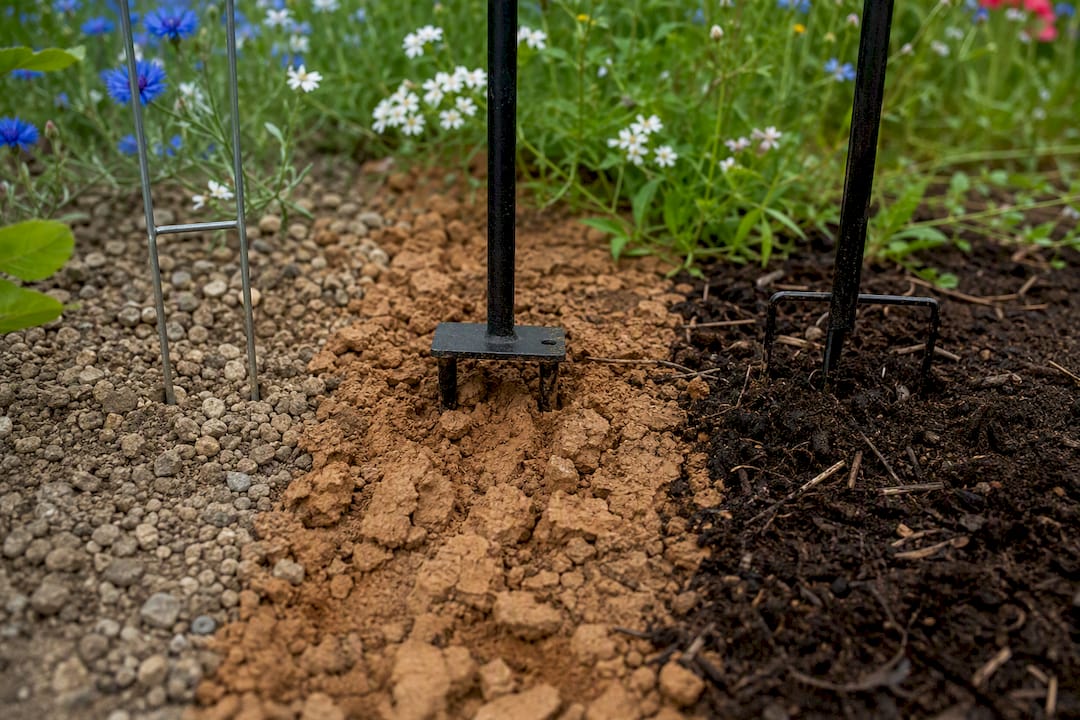
H-wire stakes are the standard included option, and for good reason. They install in seconds, work well in soft or average soil, and cost almost nothing to produce at scale. Their limit shows up in sustained wind above moderate levels or in loose, sandy, or recently tilled soil, where the thin wire legs simply don’t grip enough to resist a sign trying to pivot or lift.
Step stakes and welded-base stakes solve that gap. The wider base and reinforced construction give you more resistance in harder or compacted soil, and they hold up better across a multi-week or multi-month campaign where you’re not out there resetting the sign every few days.
Spiral ground anchors are the strongest option for exposed, open sites, corner lots, medians, or anywhere wind hits from multiple directions. Their threaded design offers far superior pull-out resistance compared to a straight stake, because the soil has to shear along the entire spiral rather than just release around a flat blade. Some heavy-duty commercial stakes also add wide stabilizing wings and corrosion-resistant coatings, features worth looking for if you’re buying stakes separately rather than using what ships with the sign.
Installation technique matters as much as the stake you pick:
- Drive H-wire stakes at least 8 to 12 inches into the ground, deeper in loose soil.
- Angle the stake slightly rather than driving it perfectly vertical, which helps spread wind load more evenly.
- Use two stakes per sign and cross-brace them for wider panels, helping resist wind forces.
- In hard or rocky soil, pre-loosen the spot with a screwdriver or auger before setting a spiral anchor to improve anchoring.
Heavier stakes combined with ballast also make signs harder to knock over accidentally or remove without effort, which matters for political and business signage in high-traffic areas.
Pro Tip: If you’re staking into ground that’s been recently watered or is naturally sandy, drive the stake in wet and let the soil dry around it. Loose, dry soil never grips a stake as well as soil that’s compacted while damp.
How Wind-Deflecting Frames and Ballast Work Together
A rigid sign facing a gust acts like a sail. It catches the full force of the wind and transfers all of that load straight to the stake. Spring-return and flex-mount frames solve this differently: they let the panel sway or tilt under a gust, absorbing the load instead of fighting it, then return the sign upright once the wind passes.
Ballast tackles the same problem from the other direction, by making the whole unit too heavy to lift or tip regardless of what the panel does. Common options:
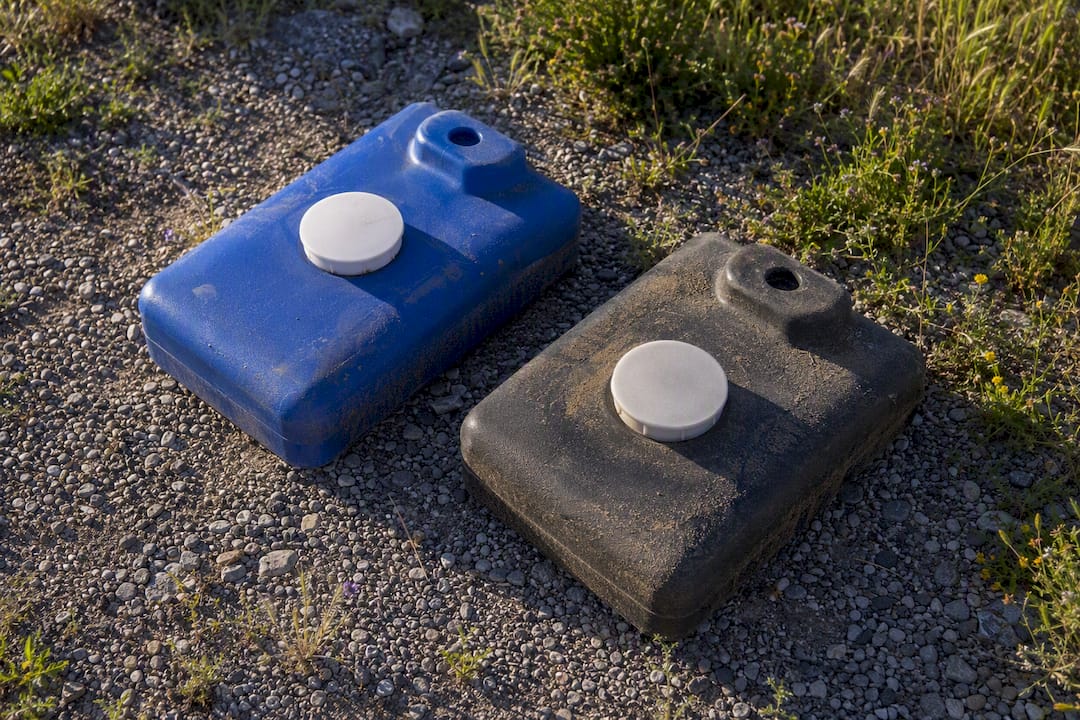
- Sand-filled bases are the most portable choice and won’t freeze, making them reliable in cold climates.
- Water-filled bases are lighter to transport empty and easy to fill on-site with a garden hose, but they can crack if left full through a hard freeze.
- Sandbags or weighted stakes work as a low-cost add-on to an existing frame rather than a full base replacement.
A wind-deflecting frame paired with a heavier 4mm or 6mm panel and a ballasted base is about as close as you get to a complete system for a fixed-location sign, since the frame handles gust energy, the ballast handles overall stability, and the thicker panel resists the flex fatigue that eventually cracks thinner plastic.
Maintenance is minimal but not zero. Check fill levels on water bases seasonally, since evaporation happens faster than you’d expect over a summer. Secure lids tightly on sand bases to keep moisture and debris out, and drain water bases before the first hard freeze if you’re in a region that gets one.
Installation and Placement Tactics That Cut Wind Load
Where you put a sign changes how much wind it actually experiences, sometimes more than any hardware upgrade can compensate for. A few placement and setup habits reduce load before wind ever becomes a problem:
- Avoid low spots, drainage dips, and sprinkler zones. Wet, saturated soil loses its grip on a stake almost immediately, and frost-heave areas will slowly push a stake back out over a freeze and thaw cycle.
- Use buildings, fences, and hedges as windbreaks. Placing a sign in the lee of a solid structure cuts direct wind exposure substantially compared to an open, unobstructed yard or median.
- Place signs in pairs or small groups where the layout allows it. Signs positioned close together, angled slightly toward each other, create a wind-shadowing effect where the front sign blocks some gust force from reaching the one behind it.
None of these tactics cost anything beyond a few extra minutes at install time, and they compound with every hardware choice covered above. A well-placed sign on a mediocre stake often outlasts a poorly placed sign on premium hardware.
Storm Protocol: When to Take Signs Down
Every safeguard on this list has a limit, and severe weather is where that limit gets tested. Knowing when to pull signs down entirely, rather than trust them to ride out a storm, protects both your investment and anyone nearby.
Watch for these triggers:
- A wind advisory, high wind watch, or high wind warning issued for your area.
- Sustained winds forecast above roughly 25 to 30 mph, or gusts forecast well above that.
- Any severe thunderstorm or tropical storm watch/warning, since these often bring sudden, unpredictable gusts far stronger than the steady wind a sign might otherwise handle fine.
When one of those triggers hits, move fast:
- Unclip or remove the graphic panel from the frame if your setup allows it, separating the sail from the stake.
- Add temporary ballast, extra sandbags or bricks, to anything you’re leaving in place.
- Pull vulnerable signs entirely and store them flat indoors until conditions pass.
Store panels flat, dry, and out of direct sun rather than leaning them against a wall, where uneven pressure over time can cause warping. Moisture trapped against a stacked panel can also encourage mildew on the print surface.
One more thing worth saying plainly: a sign torn loose in high wind becomes a projectile, and a sign down near a roadway during a storm is a real hazard to drivers. Taking signs down early isn’t overcautious. It’s basic liability management for anyone running signage near traffic.
Repairing and Weatherproofing Signs After Wind or Rain
A sign that took a hit in a storm isn’t automatically a write-off. Most wind damage is fixable with a few dollars in hardware and ten minutes of work, and knowing which fixes are worth doing saves you from reordering signs more often than necessary.
- Bent or wobbling stakes: Straighten the metal by hand or with pliers, then reinforce with a second stake driven in at a slight cross-angle for added support.
- Split flutes or edge delamination on corrugated panels: Small rivets or grommets at the damaged edge stop a tear from spreading, and edge tape can seal a fluted cut that’s starting to peel.
- Loose panel-to-stake connections: Fresh zip ties at multiple points almost always solve this faster than buying new hardware.
- Moisture inside a fluted panel: Corrugated plastic is waterproof at the surface, so standing water usually means a puncture or torn flute letting water seep in. Patch the entry point rather than assuming the whole panel is compromised.
Replace rather than repair when the damage is structural (a fully snapped panel, a stake sheared off below ground) or when the sign is central to an active campaign where a visibly damaged sign undercuts the message you’re trying to send. For low-stakes signage, a patched repair that holds for the remaining campaign length is often the smarter call.
Pro Tip: Keep a small repair kit, zip ties, a few grommets, and edge tape, with any signage you install for more than a few weeks. A five-minute fix on-site beats a special trip home for supplies.
Waterproofing rarely needs to be added after the fact. UV-cured inks and standard corrugated plastic already resist water damage on their own; lamination only earns its cost when a sign faces heavy handling or abrasive conditions, not simple rain exposure.
Why Yardsigns Recommends This Approach
Every recommendation in this guide traces back to how signs actually get built and how they actually fail in the field. Yardsigns manufactures in corrugated polypropylene across multiple gauges and in aluminum, prints with UV-cured inks for outdoor longevity, and includes metal H-stakes with standard orders, so the starting hardware is never the weak link.
Orders under 50 pieces ship within 24 hours, and larger runs move in one to three days, which matters when a storm damages signage mid-campaign and you need replacements fast rather than waiting weeks. Free design proofs and unlimited revisions mean you’re not locked into a layout before confirming it will hold up to your intended use case.
For readers who want to go deeper on any single piece of this system, Yardsigns has published dedicated guides on high wind yard sign options and on building a durable real estate sign that survives all weather. Both expand on the material and mounting decisions covered here with use-case-specific detail.
This article was written by YardSignGuy, drawing on manufacturing knowledge of how corrugated and aluminum signage behaves under real outdoor conditions.
Do Flexible or Aerodynamic Sign Designs Reduce Wind Drag?
A sign’s shape and rigidity change how much wind force it actually absorbs, separate from panel thickness or stake strength. A flat, rigid panel presents its entire surface area to a gust head-on, which is exactly the sail effect that topples poorly anchored signs.
Some frame designs counter this by allowing controlled flex, letting the panel tilt or rotate slightly under load instead of resisting it rigidly. That flex dissipates gust energy across a fraction of a second rather than transferring the full force instantly into the stake and soil below. It’s the same principle that lets a tall building sway slightly in wind rather than crack under a static load it wasn’t designed to absorb.
Rounded or slotted frame edges, where available, also reduce turbulence compared to sharp, boxy frame corners that create small pressure pockets and eddies. This matters more for larger format signs and less for a standard small yard sign, where the panel-to-frame ratio limits how much aerodynamic shaping can realistically help.
For most yard sign use cases, though, the practical trade-off still favors a rigid, thicker panel paired with strong anchoring over a flexible design alone. Flex helps at the margins. It doesn’t replace the fundamentals of gauge, stake depth, and ballast covered earlier in this guide.
How Different Wind Conditions Affect Sign Stability
Not all wind behaves the same way, and understanding the difference changes how you should prepare. Gusts are short, sharp spikes in wind speed, often lasting only a few seconds, that hit with far more force than the surrounding steady wind. A forecast calling for “15 mph winds with gusts to 35 mph” means your sign spends most of the day under mild load and then gets hammered periodically by something more than double that speed.
Sustained winds are the steady, continuous baseline, and while less dramatic than a gust, they matter more for fatigue. A stake that survives a single 35 mph gust fine can still loosen gradually under six hours of constant 20 mph pressure, as the repeated small movements slowly widen the hole around it in the soil.
This distinction explains why some signs fail in what looks like moderate weather. A day with a modest sustained wind speed and one unexpected strong gust can topple a sign that would have handled either condition alone without issue. Simulation and field-trial research on temporary signage backs this up directly, showing that combined loading, a baseline wind plus an added force, is what pushes an unstabilized design past its stability threshold, while adding mass near the base kept test signs stable even under that combined load.
Practically, this means you should plan for gusts even on a day the general forecast looks calm, since the average wind speed for a day tells you very little about the peak load your sign will actually face.
The Real Problem With How People Protect Yard Signs
Most advice on this topic treats stakes, panels, and ballast as separate decisions, and that’s the core mistake. People upgrade one piece, usually the stake, because it’s cheap and visible, and assume the job is done. It isn’t. A combination approach consistently outperforms any single upgrade, because wind failure is rarely caused by one weak point. It’s caused by the weakest link in a chain nobody bothered to strengthen.
The other overlooked piece is timing. Business owners tend to buy signage reactively, after a storm has already destroyed the last batch, rather than specifying the right gauge and stake combination up front based on how long the campaign will run and how exposed the location is. A little planning at order time, thicker panel for a multi-month run, step stakes for anything beyond two weeks, saves the cost of a full reorder later.
What should change first isn’t the stake or the panel alone. It’s asking how long this sign needs to survive and how exposed the site actually is, then buying the whole system to match. Skip that question, and you’re gambling on weather instead of engineering around it.
— YardSignGuy
Ready to Order a Wind-Resistant Yard Sign?
Now that you know what actually holds up outdoors, choosing the right sign comes down to two decisions: gauge and anchoring. For a standard campaign running a few weeks, 4mm corrugated plastic handles typical residential wind exposure without the added cost of heavier material. For high-wind corridors, multi-season runs, or anywhere the sign needs to survive repeated reuse, step up to 6mm corrugated or an aluminum panel built for permanence.
Every order includes metal H-stakes standard, so you’re not scrambling to source hardware separately, and free design proofs with unlimited revisions mean your layout gets locked in correctly before printing starts. Orders under 50 pieces ship within 24 hours, which matters when you need replacement signage fast after a storm rather than waiting out a long production queue.
The process is simple: pick your gauge based on campaign length and exposure, add step stakes or ballast if your site is windy or open, then place the order. If you’re prepping signage for an upcoming event or recognition campaign, the employee recognition sign templates are ready to customize now and ship on the same fast turnaround as every other order.
Sources
For more detail on the specific systems covered in this guide, these resources dig deeper into individual topics:
- Custom Yard Signs and Lawn Signs: The Complete Buyer’s Guide - Custom Ink Blog
- Study on temporary road sign stability under vehicle-induced and wind loading — Journal of Road Safety
- Wind Sign Quick-Change Frame — Plasticade
