


Yard Signs in Festival Layouts: A Planner's Guide
The role of yard signs in festival layouts is to provide clear, physical guidance that moves thousands of attendees safely and confidently through complex event spaces. A 2026 industry study found that 75% of people encountering well-placed signs at events successfully navigate or engage with the event. That number reflects something every experienced festival coordinator already suspects: when signage fails, crowds stall, frustration spikes, and the entire attendee experience suffers. Wayfinding signage, the industry term for directional and informational sign systems, is not a decorative afterthought. It is a core operational tool that shapes crowd behavior from the moment attendees arrive.
How do yard signs improve attendee navigation and crowd flow at festivals?
Yard signs function as pre-emptive decision tools. The goal is to answer an attendee’s question before they even realize they have one. Placing navigation signs roughly 30 meters before forks, intersections, or entry points gives people time to read, process, and choose their route without stopping. When attendees stop to figure out where they are, everyone behind them stops too. That chain reaction is how bottlenecks form.
The most effective yard signs at festivals share three characteristics:
- High contrast color combinations. Yellow on black or white on dark blue are empirically the easiest color pairings to read from a distance in variable outdoor light. Both combinations work in bright sun and overcast conditions.
- Universal iconography alongside text. Major festivals like Tomorrowland and Ultra Music Festival use icon-based, multi-language signage to serve international attendees who may not read the primary language on the sign. A restroom icon communicates instantly regardless of language.
- Consistent visual identity across all signs. When every official sign shares the same font, color, and format, attendees learn to recognize guidance quickly. A single inconsistent sign breaks that trust and causes hesitation.
Crowd psychology also plays a direct role here. Attendees who feel oriented and informed move with confidence. Those who feel lost slow down, cluster, and create unintentional congestion zones. Well-designed yard signs reduce attendee anxiety and create a sense of care and organization that measurably improves overall festival satisfaction.
Pro Tip: Walk the entire festival route yourself before the event opens. Stand at every major intersection and ask: “If I had never been here before, would I know where to go?” If the answer is no, add a sign.
What design principles make yard signs most effective in festival layouts?
Design is where most festival signage fails. Organizers often prioritize aesthetics over legibility, or they crowd too much information onto a single sign. The result is a sign that looks great in a design file and becomes unreadable at 20 feet in afternoon sun.
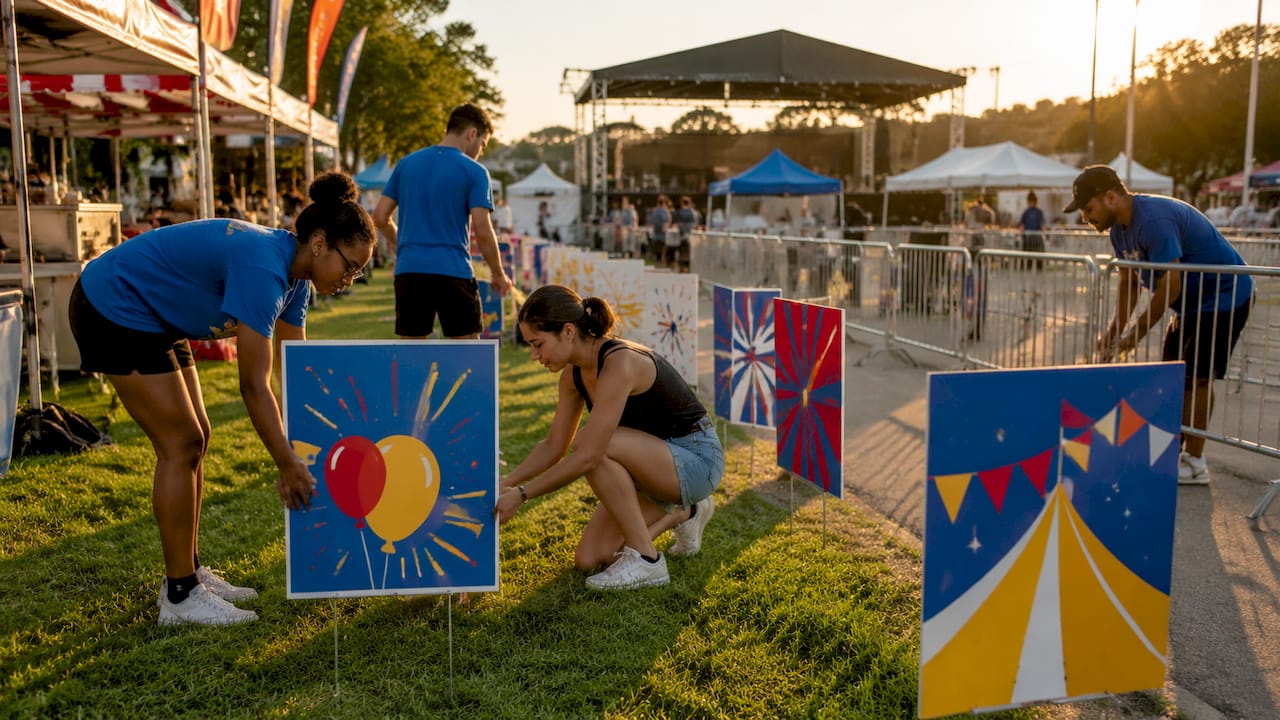
The table below compares high-performing design choices against common mistakes:
| Design element | What works | What fails |
|---|---|---|
| Color contrast | Yellow on black, white on dark blue | Light gray on white, red on green |
| Text volume | 3 to 5 words maximum per sign | Full sentences or paragraphs |
| Font style | Bold sans-serif (Arial, Helvetica) | Decorative or script fonts |
| Height placement | 10 feet high for crowd visibility | Ground level, obscured by people |
| Material | Vinyl or outdoor-rated plastic | Paper, cardboard, or thin foam |
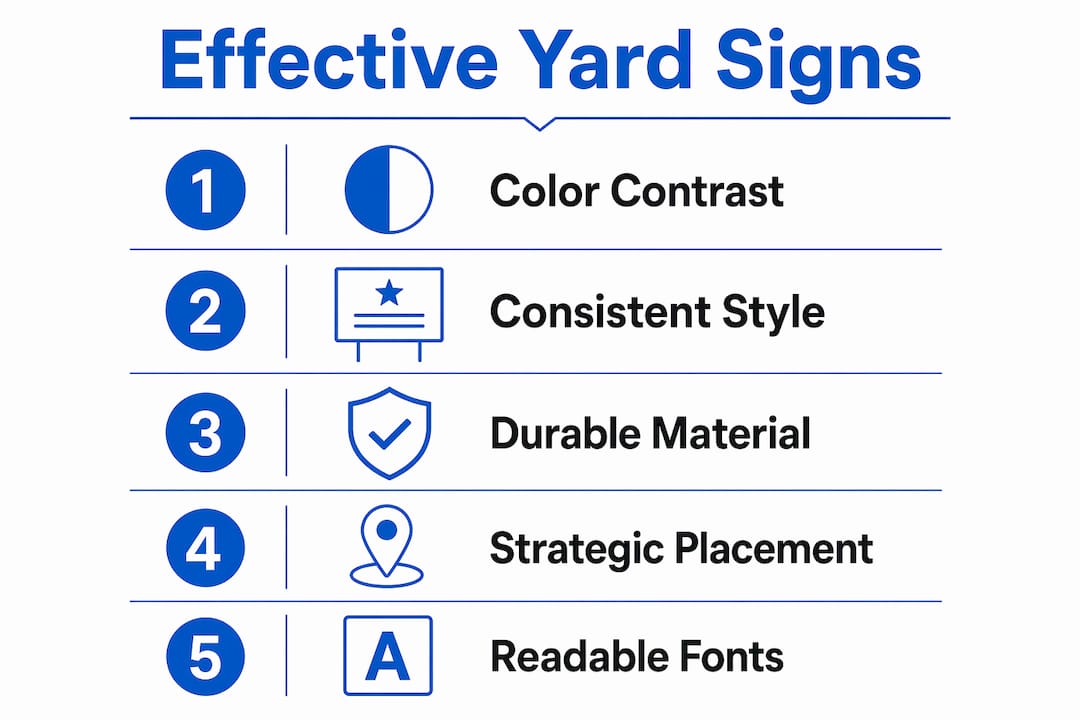
Consistent style guides across all signage are non-negotiable for large festivals. When your parking signs, stage direction signs, and vendor area signs all share the same visual language, attendees build a mental map of what “official” looks like. That recognition speeds up navigation and reduces the number of questions your staff fields throughout the day.
Material choice directly affects how long your signs stay effective. Vinyl and outdoor-rated plastics prevent fading and physical damage from wind, rain, and humidity. A sign that starts the day crisp and ends it warped or unreadable is worse than no sign at all. It signals disorganization to attendees who notice the deterioration.
Pro Tip: Order a small test batch of your sign designs and physically mount them at the distance attendees will read them from. What looks clear on a screen often needs larger text or bolder contrast when viewed outdoors at 25 feet.
How do yard signs contribute to festival marketing and community engagement?
Yard signs are not only tools for the day of the event. In the weeks before a festival, they function as hyperlocal advertising that builds visible community consensus. Physical yard signs provide non-intrusive, organic exposure compared to digital ads, resulting in higher subconscious brand recall because exposure happens along familiar daily routes rather than in an ad slot people have trained themselves to ignore.
The psychology behind this is straightforward. When a person drives past the same festival sign three times in a week on their regular commute, the event feels familiar and credible before they have read a single word about it online. Multiple signs in a neighborhood create an impression of collective support and community trust. That social proof effect is difficult to replicate with digital advertising alone.
Consider what yard signs accomplish that a Facebook ad cannot:
- They occupy physical space in the community, which signals real-world investment in the event.
- They reach people who are not on social media or who use ad blockers.
- They create repeated, passive impressions without requiring the viewer to take any action.
- They build a sense of local momentum that encourages fence-sitters to commit to attending.
“Signage should never be an afterthought but a core part of the event site design, with focus on real human traffic patterns.” — Ticket Fairy, 2026 Festival Planning Guide
This principle applies equally to pre-event marketing signs placed in surrounding neighborhoods and to wayfinding signs placed inside the festival grounds. Both serve the same underlying function: they tell attendees and potential attendees that this event is organized, credible, and worth their time.
What are best practices for integrating yard signs into festival layout planning?
The single most common mistake festival planners make with signage is treating it as a logistics task to complete the day before the event. Signage planning belongs in the earliest stages of site design, alongside stage placement, vendor zones, and emergency access routes. Integrating yard signs into early festival layout planning improves crowd flow and reduces last-minute errors that are expensive and stressful to fix on-site.
Here is a practical sequence for building signage into your planning process:
- Map the attendee journey from the outside in. Start at the nearest public transit stop or parking area and trace every decision point an attendee will encounter before reaching the main stage. Each decision point needs a sign.
- Identify congestion zones before the event opens. Entry gates, food vendor clusters, restroom banks, and first-aid stations are predictable bottlenecks. Place directional signs 30 meters before each one, not at the point of congestion.
- Build a sign inventory with location assignments. Every sign should have a designated location, a responsible staff member for placement, and a backup sign in case of damage. This prevents the scramble that happens when a sign goes missing on event day.
- Schedule signage sweeps during the event. Maintenance crews performing signage sweeps during events preserve visibility and attendee confidence. A fallen or obscured sign creates confusion and, in emergency scenarios, a genuine safety risk.
- Layer static signs with human guides. Combining static yard signs with human staff holding directional signs enhances guidance and attendee reassurance, especially during peak entry and exit periods or when unexpected disruptions occur.
Creative signage formats add both function and personality to a festival layout. LED arrow signs work well for nighttime events where printed signs lose visibility. Color-coded markers tied to wristband zones allow attendees to self-sort without reading. Balloon signs mounted above vendor booths are visible from across a crowded field. Each of these builds on the same foundation: clear, consistent, well-placed physical communication. For practical setup guidance, the approach used in charity event sign planning translates directly to festival environments.
Pro Tip: Color-code your signage system by zone. Assign one color to food and beverage areas, another to stages, and a third to exits and emergency services. Attendees learn the system within the first 15 minutes and navigate independently for the rest of the event.
Key takeaways
Yard signs are the most cost-effective crowd management and marketing tool available to festival planners, provided they are designed with contrast, placed before decision points, and integrated into site planning from the start.
| Point | Details |
|---|---|
| Place signs before decision points | Position wayfinding signs 30 meters ahead of forks and intersections to prevent crowd stalling. |
| Use proven color contrasts | Yellow on black and white on dark blue deliver the best legibility in outdoor festival conditions. |
| Plan signage early | Integrate sign placement into initial site design, not as a last-minute logistics task. |
| Maintain signs during the event | Schedule crew sweeps to reset fallen or obscured signs and preserve attendee confidence. |
| Layer physical signs with staff | Human guides at peak congestion points reinforce static signage and reduce attendee anxiety. |
Why I think most festivals are still getting signage wrong
After years of watching festival layouts succeed and fail, the pattern I keep seeing is the same: signage gets the budget and attention that is left over after everything else is decided. Stage production gets a line item. Catering gets a line item. Signage gets whatever is left, ordered two days before the event from whoever can ship fastest.
The result is signs that are too small, placed too late, and designed without any understanding of how people actually move through a space. I have seen six-figure production budgets undermined by $200 worth of poorly placed signs that sent 3,000 people in the wrong direction at the same time.
The festivals that get it right treat signage as infrastructure, not decoration. They hire a wayfinding consultant or assign a dedicated staff member to own the sign system from site design through teardown. They test their signs on-site before the event opens. They build in redundancy so that one fallen sign does not create a cascade of confused attendees. And they use materials that hold up. Durable outdoor signs are not a luxury for large festivals. They are a baseline requirement for any outdoor event that runs longer than a few hours.
The creative opportunity here is also underused. Your signage system is a brand touchpoint. A festival with a strong visual identity can carry that identity through every sign on the grounds, turning wayfinding into an extension of the attendee experience rather than a utilitarian afterthought. That is the standard worth aiming for.
— YardSignGuy
Get festival-ready signs from Yardsigns
Planning a festival layout means solving dozens of logistical problems at once. Your signage should not be one of them. Yardsigns offers custom directional arrow signs and a full range of weatherproof event signs built for outdoor conditions, with orders under 50 pieces shipped within 24 hours.
Whether you need wayfinding markers for a multi-stage music festival, parking signs for a community fair, or zone markers for a food and vendor area, Yardsigns delivers vibrant, durable prints that hold up through a full event day. The design process is straightforward, the materials are outdoor-rated, and the turnaround fits real event timelines. Explore the full range of event and special occasion signs at Yardsigns.com and get your layout signage ordered before your next planning deadline.
FAQ
What is the role of yard signs in festival layouts?
Yard signs serve as the primary wayfinding and crowd management tools in festival layouts, guiding attendees through decision points, marking zones, and reducing congestion. A 2026 study found that 75% of people encountering well-placed event signs successfully navigate or engage with the event.
How far in advance should festival signs be placed?
Signs should be positioned as part of initial site design planning, not the day before the event. Placement at least 30 meters before every major decision point or congestion zone is the standard practice for effective crowd flow.
What colors work best for outdoor festival signs?
Yellow text on black and white text on dark blue are the most legible color combinations for outdoor festival environments. Both perform well across variable light conditions, including direct sun and overcast skies.
Do yard signs help with festival marketing before the event?
Yes. Yard signs placed in surrounding neighborhoods build social proof and repeated passive impressions that increase attendance intent. Physical signs reach audiences who ignore digital ads and create a sense of local momentum that digital channels cannot replicate.
What materials should festival yard signs be made from?
Vinyl and outdoor-rated plastics are the standard for festival yard signs. These materials resist fading, wind damage, and moisture, keeping signs legible from the start of the event through teardown.
