


Lawn Signs Business Promotion Explained for 2026
Lawn sign marketing is defined as the use of compact, outdoor coroplast or aluminum signs placed on residential and commercial properties to build local brand awareness and drive neighbor-to-neighbor referrals. This form of signage promotion costs as little as $5–$30 per sign, making it one of the most affordable tools in any local advertising budget. For business owners, political candidates, and event organizers, lawn signs business promotion explained simply means putting your name in front of the right neighborhood at the right time. Done correctly, a well-placed sign works around the clock without recurring fees. Yardsigns supplies weatherproof, vibrant signs built to hold up through every season.
What design principles make lawn signs effective for business promotion?
Effective lawn sign design follows one non-negotiable rule: the 3-second rule. Viewers passing in a car or on foot have roughly 2–3 seconds to read your sign. If your message does not land in that window, it is wasted.
The core elements of a high-impact sign
A strong sign carries one bold headline, one clear call to action, and a high-contrast color combination. That is it. Every additional line of text cuts your read rate. Less is more in yard sign design. Overcrowding a sign with multiple offers dilutes the message and reduces recall.

Letter size matters more than most people realize. Each inch of letter height extends legibility by approximately 30 feet. A 4-inch letter is readable from 120 feet. A 2-inch letter disappears at highway speed. For a standard 18x24 inch sign, aim for a headline no smaller than 3 inches tall.
Color contrast is your fastest attention tool. Black on yellow, white on red, and dark blue on white all perform well in outdoor conditions. Avoid gradients, drop shadows, and multiple font styles. Campaign signs that skip gradients and multiple fonts consistently outperform cluttered alternatives in voter recall studies.
Pro Tip: Test your sign design by printing a thumbnail at 10% size. If you can still read the headline clearly at that scale, it will work at street distance.
Sign materials compared
Choosing the right material affects both your budget and how long the sign holds up in the field.
| Material | Best For | Cost Range | Durability |
|---|---|---|---|
| Coroplast (corrugated plastic) | Short campaigns, residential use | $5–$20 per sign | 3–6 months outdoors |
| Aluminum | Long-term commercial placement | $30–$45 per sign | 2+ years outdoors |
| Foam board | Indoor events, short-term display | $3–$10 per sign | Not weatherproof |
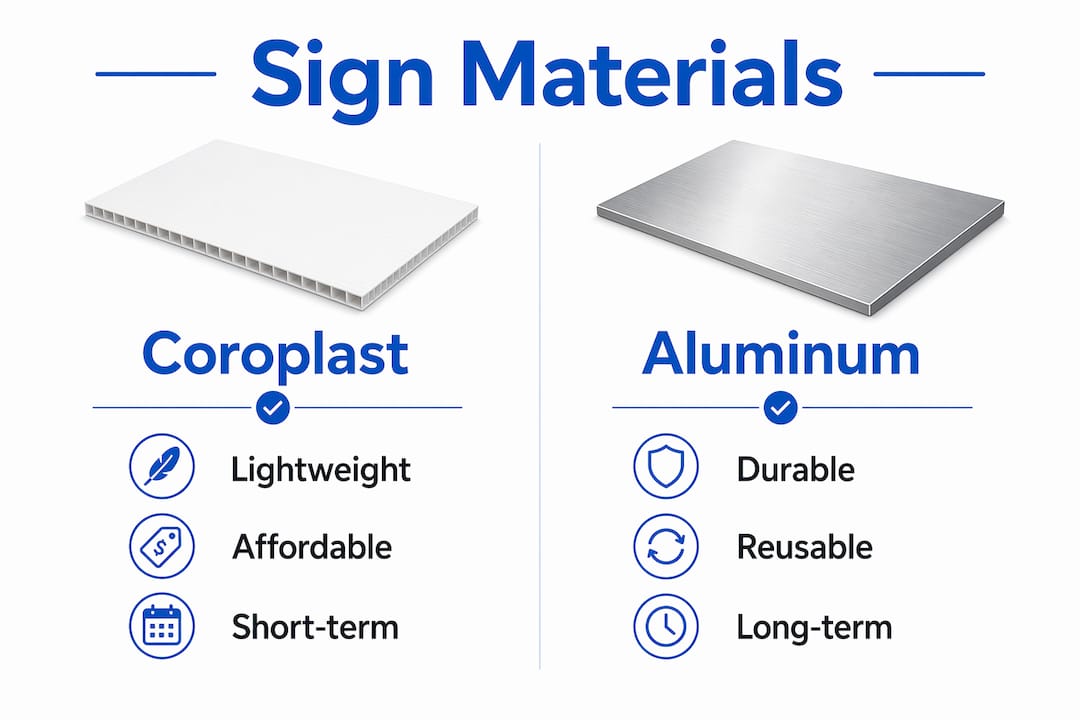
Coroplast is lightweight and affordable for short campaigns, while aluminum provides long-term durability for commercial use. For most contractors and small businesses running seasonal promotions, coroplast hits the right balance of cost and performance.
How and where to place lawn signs for maximum local impact
Placement strategy separates a forgettable sign campaign from one that actually moves the needle. Scattering 10 signs across a city produces almost no measurable effect. Concentrating those same 10 signs in two or three blocks creates visible social proof.
The corridor clustering strategy
The most effective placement method is corridor clustering: deploying 40–80 active signs within a 1–3 block radius. When neighbors see the same business name repeatedly on their street, it triggers familiarity and trust. That trust converts to calls months later, long after the original job is done.
Securing permission is the first step, and it pays to make asking part of your standard process. Offering a $25–$50 service credit at contract signing increases homeowner permission rates from 38% to 72%. That single change more than doubles your sign inventory without any extra outreach effort.
Placement dos and don’ts
Follow these rules to stay visible, legal, and on good terms with your community:
- Do place signs at high-traffic corners where pedestrian and vehicle traffic intersect.
- Do position signs perpendicular to the road so drivers see the full face, not the edge.
- Do check local ordinances before placing signs on public right-of-way strips.
- Do remove or replace signs every 90 days to prevent faded, weathered signs from hurting your brand.
- Don’t place signs without explicit homeowner permission.
- Don’t stack multiple signs in one yard. One clean sign per property reads better.
- Don’t ignore HOA restrictions. Violating them creates community friction and gets your signs pulled.
- Don’t leave signs up after a job or event ends. Stale signage signals neglect, not professionalism.
Pro Tip: Map your active sign locations in Google Maps or a simple spreadsheet. This makes 90-day rotation checks fast and prevents signs from going stale unnoticed.
For retail-specific placement guidance, the outdoor sign placement strategies resource from Yardsigns covers high-visibility positioning in detail.
How do lawn signs compare to other marketing channels?
Lawn signs are passive brand awareness tools, not direct response channels. Understanding that distinction prevents frustration and sets realistic expectations.
A digital ad on Google or Facebook delivers a clickable call to action the moment someone sees it. A lawn sign plants a seed. Yard signs act as passive brand awareness assets that influence customers 6–18 months after initial exposure. That timeline feels slow until you realize the cost per impression is a fraction of paid digital.
Where lawn signs excel
- Trade services with visible work. Roofing, painting, and landscaping contractors benefit most because the work itself is the proof. A sign next to a freshly painted house tells the whole story. 30–50% of new business for these trades comes from neighborhood referrals enhanced by signage.
- Local political campaigns. Name recognition is the primary goal in most local races. A clean sign with a candidate’s name in large, bold type accomplishes that goal at minimal cost.
- Event promotion. Directional signs along event routes solve a practical problem and double as brand impressions for sponsors and organizers.
Where lawn signs fall short
Lawn signs cannot target by demographic, time of day, or search intent. They also present real tracking challenges. The standard ROI formula, calculated as ((Revenue from Signage minus Cost of Signage) divided by Cost of Signage) x 100%, requires clean attribution data. Unique phone numbers or QR codes on signs help, but many customers still call the main number after seeing a sign.
Experts recommend integrating yard signs with digital campaigns to fully cover local territories. In HOA neighborhoods where physical signs are restricted, digital campaigns like geo-targeted display advertising fill the gap. The two channels work better together than either does alone.
Practical applications for businesses, candidates, and event organizers
The right sign count and budget depend entirely on your use case. Here is how the numbers break down across the three main audiences.
Tailored strategies by audience
Contractors and service businesses should treat every completed job as a sign placement opportunity. Ask at contract signing, offer the service credit, and deploy a sign within 24 hours of job completion. The sign stays visible while the work is fresh in neighbors’ minds.
Political candidates running for local office need volume and simplicity. Typical political campaigns deploy 25–200+ signs depending on district size. The design rule is strict: name, office, and one short tagline. Nothing else. Voters make snap judgments, and a cluttered sign reads as disorganized.
Event organizers use signs in two ways. Directional signs guide attendees to the venue. Promotional signs placed along high-traffic routes build awareness in the weeks before the event. Both applications benefit from a short production window. Yardsigns ships orders under 50 pieces within 24 hours, which matters when your event date is fixed.
Sign count and budget by use case
| Use Case | Typical Sign Count | Estimated Budget | Key Design Priority |
|---|---|---|---|
| Single storefront | 1–4 signs | $20–$120 | Brand name and address |
| Open house or event route | 4–12 signs | $60–$360 | Directional arrows and date |
| Contractor neighborhood campaign | 20–50 signs | $200–$750 | Service name and phone/QR |
| Local political campaign | 25–200+ signs | $375–$3,000+ | Candidate name and office |
Add 10–15% to your order for replacements and layout adjustments. Signs get damaged, stolen, or moved. A small buffer prevents gaps in your coverage at critical moments.
For a step-by-step ordering walkthrough, the lawn sign ordering checklist from Yardsigns walks beginners through every decision from size to material to quantity.
Key takeaways
Lawn sign marketing delivers its strongest results when design is simple, placement is concentrated, and signs are managed throughout their full lifecycle.
| Point | Details |
|---|---|
| Design for 3 seconds | Use one headline, one call to action, and high-contrast colors to capture attention fast. |
| Cluster signs tightly | Deploy 40–80 signs within 1–3 blocks to build social proof and neighborhood recognition. |
| Secure permission early | Offer a $25–$50 service credit at contract signing to raise permission rates from 38% to 72%. |
| Rotate every 90 days | Remove or replace faded signs on a 90-day cycle to protect your brand’s perceived quality. |
| Combine with digital | Use geo-targeted digital ads to cover HOA zones where physical signs are not permitted. |
What i’ve learned after years of watching sign campaigns succeed and fail
Most businesses treat lawn signs as a one-time tactic. They order a batch, scatter them around, and wonder why the phone does not ring. That is the wrong mental model entirely.
The campaigns I have seen work best treat signs as a long-term asset with a managed lifecycle. The permission process is scripted. The 90-day rotation is scheduled. The sign condition is checked on every service visit. That level of discipline turns a $15 piece of coroplast into a silent salesperson that compounds over months.
The biggest beginner mistake is spreading signs too thin. Twenty signs across a city is invisible. Twenty signs on four blocks is a presence. Density creates the social proof that makes neighbors call you instead of searching online.
Political candidates make a different mistake. They try to say too much. A yard sign is not a brochure. It is a name tag. The candidates who win local races on signage alone are the ones who trusted the process: big name, clean font, one color combination, and volume.
For event organizers, the timing mistake is ordering too late. A sign that arrives two days before your event does half the work of one that goes up two weeks out. Build your sign lead time into your event planning calendar the same way you book the venue.
The local visibility benefits of a well-run sign campaign are real. But they require patience, process, and the willingness to manage the details most people skip.
— YardSignGuy
Get your signs ordered and working for you
Whether you are a contractor building neighborhood recognition, a candidate running for local office, or an organizer promoting your next event, the right sign makes your message impossible to miss.
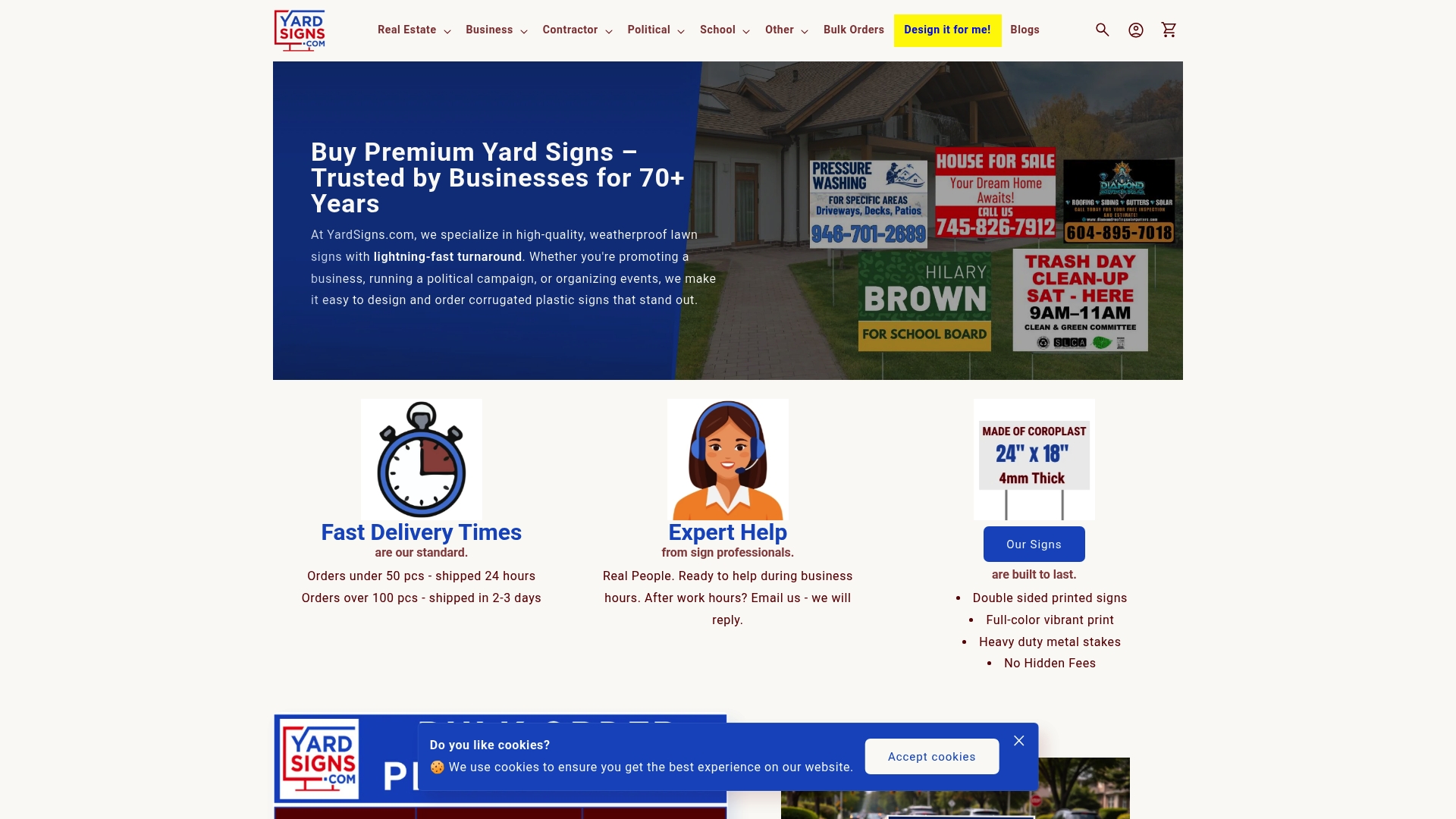
Yardsigns offers durable, weatherproof signs in a full range of sizes and materials, from lightweight coroplast for short campaigns to aluminum for long-term placements. Orders under 50 pieces ship within 24 hours, so you never miss a critical window. Browse ready-to-customize options including political campaign signs and event celebration signs to find the right fit for your promotion. The design process is straightforward, and the results speak for themselves.
FAQ
How much do lawn signs cost for business promotion?
Standard 18x24 inch coroplast signs cost $5–$30 each depending on volume and material quality. Contractors typically budget $10–$20 per sign for short-term residential use and $30–$45 for durable aluminum signs for long-term commercial placements.
How many lawn signs do i need for a local campaign?
Sign counts range from 1–4 for a single storefront to 25–200+ for a political campaign. The most effective approach concentrates signs in a tight geographic corridor rather than spreading them across a wide area.
How do i track ROI from lawn sign advertising?
Use unique phone numbers or QR codes on your signs to attribute leads directly to signage. Calculate ROI using the formula: ((Revenue from Signage minus Cost of Signage) divided by Cost of Signage) x 100%.
What is the best material for outdoor lawn signs?
Coroplast is the standard choice for campaigns lasting up to six months. Aluminum is the better option for permanent or long-term commercial placements where durability outweighs the higher upfront cost.
Can lawn signs work in neighborhoods with HOA restrictions?
In HOA communities where physical signs are prohibited, pair your sign campaign with geo-targeted digital advertising to cover those zones. The two channels together deliver broader local coverage than either approach alone.
