


Why Yard Signs Promote Community Events Effectively
Yard signs are defined as low-cost, physical advertising displays that generate repeated local impressions by staying visible in the everyday paths of your neighbors. They cost between $3 and $8 per sign for a standard 18x24 inch format, making them one of the most affordable tools in community event marketing. Unlike digital ads that disappear when a budget runs out, a yard sign keeps working around the clock for weeks. For church picnics, neighborhood block parties, school fundraisers, or local elections, the reason why yard signs promote community events so reliably comes down to three factors: visibility, repetition, and trust.
Why yard signs promote community events through repeated exposure
The marketing principle known as the Rule of Seven holds that a person needs to encounter a message roughly seven times before they take action. Yard signs placed along pedestrian routes and slow-traffic residential streets deliver exactly that kind of repeated, low-pressure contact. Each time a neighbor walks the dog past your sign, that impression stacks. No algorithm decides whether to show it. No subscription lapses.
Physical signage also carries a psychological weight that digital ads rarely achieve. A sign planted in someone’s front yard signals personal endorsement, not just paid promotion. That distinction matters enormously in tight-knit communities where residents trust their neighbors more than they trust a sponsored post. Yard signs build familiarity through contextual presence in a way that a Facebook event invitation simply cannot replicate.
The numbers back this up. A grassroots campaign that deployed 300 yard signs across a local district achieved 67% voter name recognition and an 8-point win. That result was not driven by a large ad budget. It was driven by saturation. When residents see the same message at the entrance to their subdivision, outside the coffee shop, and three houses down the street, the event or candidate starts to feel like a community consensus rather than a single voice asking for attention.
“A neighborhood full of yard signs stops being advertising. It becomes a signal of what the community already believes.” This shift from promotion to social proof is the core reason yard sign advertising outperforms its modest price tag.
Key mechanisms that drive this effect include:
- Eye-level placement along walking and driving routes maximizes natural sightlines without requiring active attention from the viewer.
- Contextual trust from residential settings makes the message feel endorsed by neighbors rather than broadcast by a stranger.
- Cumulative impressions build recognition over days and weeks, not just during a single scroll session.
- Non-intrusive format means residents do not feel interrupted, which reduces resistance and increases receptivity.
What materials and design choices make yard signs work best
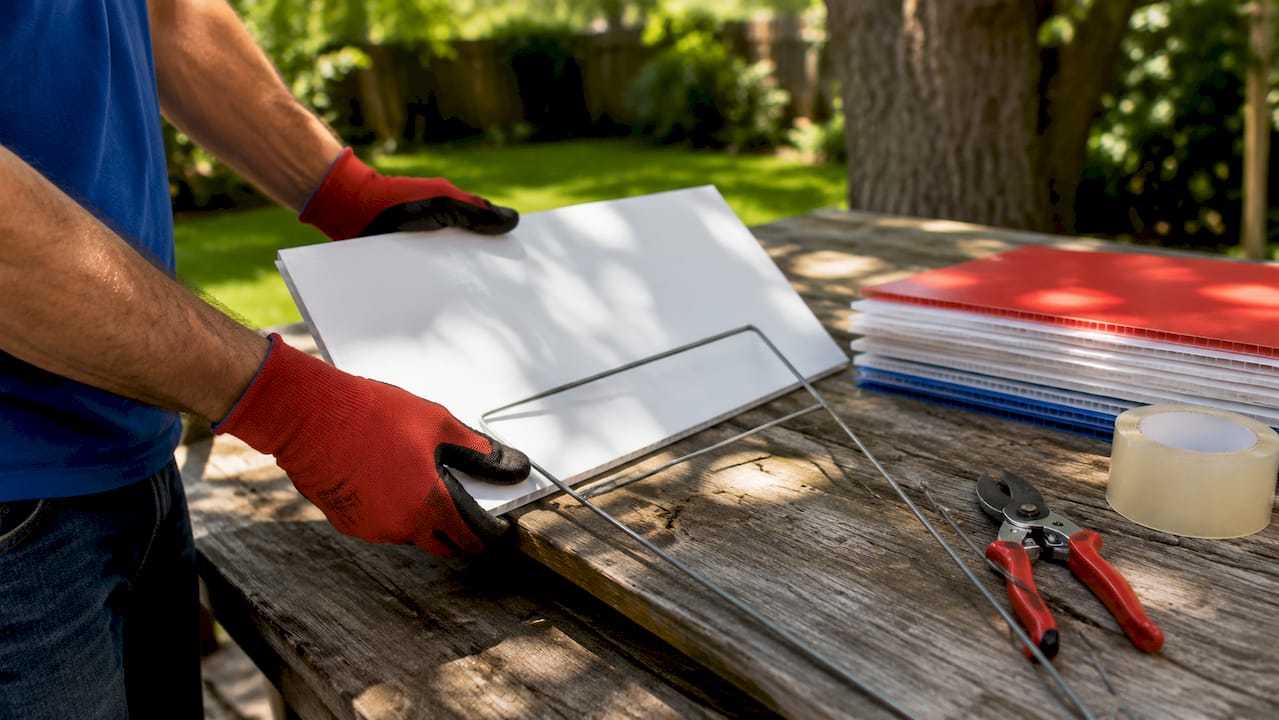
A yard sign that fades after three days of rain does not promote anything. 4 mil corrugated plastic is the standard minimum for outdoor durability. Thinner plastic warps in heat, cracks in cold, and loses color within a week of direct sun exposure. Aluminum is the premium option for longer campaigns, holding up through multiple seasons without degrading. For most community events running two to four weeks, 4 mil corrugated plastic with UV-resistant ink is the practical choice.
Design is where most organizers lose impact. Drivers passing at 25 miles per hour have roughly 2 to 3 seconds to read a sign. That window demands a strict hierarchy: one bold headline, one supporting detail, and one call to action. Nothing more. A sign advertising a church fall festival that lists the date, time, address, website, phone number, and a decorative border is a sign that communicates nothing. Strip it down to the event name, the date, and a single action like “All Welcome.”
Here is a practical design sequence that works for community events:
- Headline first. Use the event name or a short phrase in the largest font on the sign. “Fall Festival” or “Block Party” should be readable from 30 feet away.
- One proof point. Add the date and location in a secondary font size. Keep it to one line.
- Single call to action. A website URL or a short phrase like “Free Admission” closes the message without cluttering it.
- Color contrast. Dark text on a light background, or white text on a bold color, reads faster than subtle palettes. Red, blue, and black on white are proven combinations.
- No decorative noise. Clip art, borders, and multiple font styles slow reading speed and reduce retention.
Pro Tip: Place your signs at neighborhood entrances and near existing sign clusters. Locations where other signs already appear have proven foot and vehicle traffic, and your sign benefits from the attention those locations already attract.
The 18x24 inch size remains the default for good reason. It is large enough to read from a moving car, small enough to fit standard wire stakes, and priced affordably for bulk orders. Larger formats like 24x36 work well for high-speed roads, but for residential community event promotion, 18x24 hits the right balance of visibility and cost.
How yard signs compare to other community event marketing tools
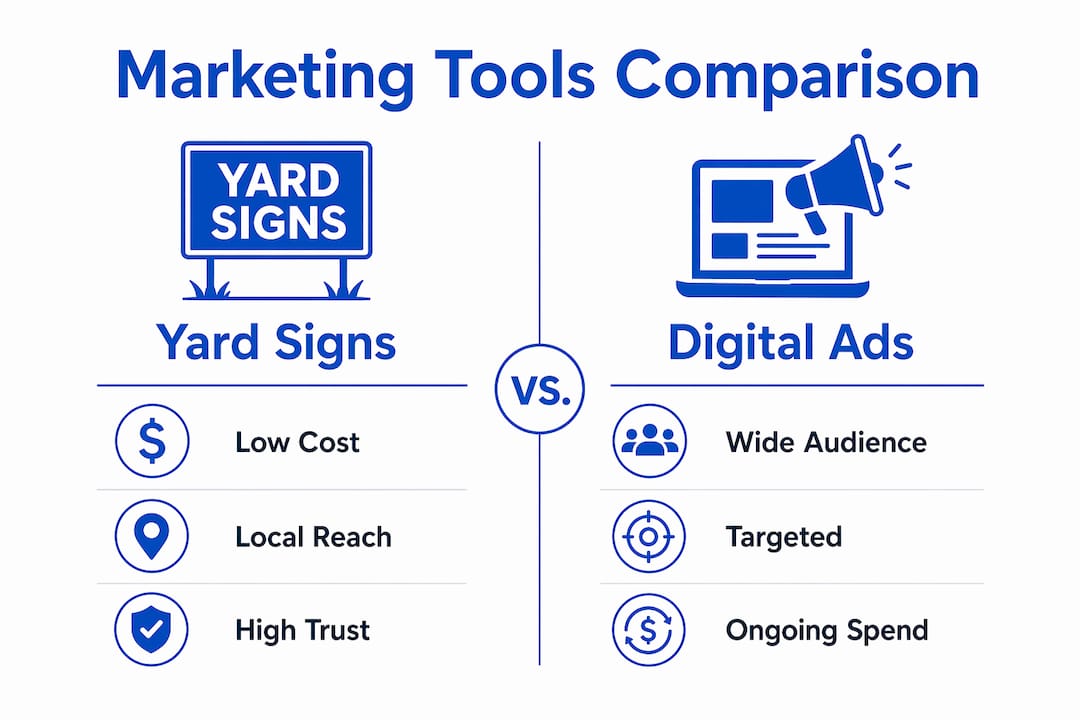
Outdoor signage delivers impressions at approximately $3.38 per thousand views, which is a fraction of what most digital ad platforms charge for comparable local reach. That cost advantage compounds when you consider that a yard sign runs continuously for weeks without requiring daily budget management or creative refreshes.
| Marketing tool | Cost per 1,000 impressions | Local targeting precision | Trust level | Requires ongoing spend |
|---|---|---|---|---|
| Yard signs | ~$3.38 | Very high (neighborhood-level) | High (physical, neighbor-endorsed) | No |
| Facebook/Instagram ads | $5–$15+ | Medium (zip code or interest-based) | Low to medium | Yes |
| Flyers | Variable | High (hand-distributed) | Medium | No |
| Billboards | $14–$20+ | Low (corridor-based) | Medium | Yes |
The table above shows that yard signs occupy a unique position. They combine the hyper-local targeting of flyers with the passive, always-on visibility of billboards, at a cost that beats both. For community organizers working with limited budgets, that combination is difficult to match.
Digital ads do offer advantages yard signs cannot. They reach people who are not physically near the event location, they allow real-time adjustments, and they can link directly to registration pages. The strongest event promotion strategy uses yard signs alongside digital campaigns rather than treating them as alternatives. Signs build neighborhood awareness and social proof. Digital ads extend reach and drive online action. Together, they cover both the physical and virtual attention of your community.
One limitation worth acknowledging: yard signs do not work well for audiences outside the immediate geographic area. If your event draws attendees from across a city or region, signs alone will not carry the promotion. That is where digital channels earn their place in the mix. But for events rooted in a specific neighborhood, school district, or congregation, outdoor signs outperform digital ads on cost, trust, and sustained visibility.
Practical strategies for community organizers using yard signs
Effective deployment starts before you order a single sign. Check local city or county regulations on sign placement in public right-of-way. Many municipalities prohibit signs on medians, utility poles, or within a set distance of intersections. Violating these rules results in fines or sign removal, which wastes your budget and reduces your coverage at the worst possible time.
Once you know the rules, build your placement strategy around saturation. A neighborhood ad network effect kicks in when residents see the same message repeatedly across multiple locations. Ten signs spread randomly across a large area produce far less recognition than ten signs concentrated along the two or three routes your target audience uses daily. Identify the roads leading to the event venue, the entrances to nearby subdivisions, and the parking areas of local churches or schools. Those are your priority placements.
Engage community members directly in the process. Ask neighbors, congregation members, or local business owners to host a sign in their yard or window. Each person who agrees becomes a visible endorser of the event. This approach is especially effective for charity fundraiser signage, where community trust directly influences participation and donations.
Timing matters as much as placement. Deploy signs two to three weeks before the event to allow the Rule of Seven to work. Pulling signs too early wastes the investment. Leaving them up too long after the event date damages credibility and may violate local ordinances. A clean removal plan is part of a professional campaign.
Pro Tip: After the event, survey attendees on how they heard about it. If yard signs consistently rank in the top two or three sources, that data justifies your next sign order and helps you refine placement for future events.
Additional practices that improve results:
- Use consistent colors and fonts across all signs in a campaign so the visual identity builds recognition across multiple sightings.
- Include a QR code only if the sign has enough white space to keep the design clean. A cluttered QR code is worse than no QR code.
- Coordinate with neighboring organizations for co-promotion when events serve overlapping audiences, such as a church festival and a school fundraiser scheduled the same weekend.
Key takeaways
Yard signs promote community events effectively because they combine low cost, repeated physical exposure, and neighbor-level trust in a format no digital channel can replicate at the same price point.
| Point | Details |
|---|---|
| Repetition drives recognition | The Rule of Seven means multiple sign sightings convert passive awareness into active attendance. |
| Material quality protects your investment | Use 4 mil corrugated plastic or aluminum to keep signs readable through rain, heat, and wind. |
| Design simplicity wins | Limit each sign to a headline, one proof point, and one call to action for maximum readability in 2 to 3 seconds. |
| Cost per impression is unmatched | At roughly $3.38 per thousand views, yard signs beat most digital and traditional media on local reach. |
| Regulation compliance is non-negotiable | Always verify local ordinances before placing signs to avoid fines and unexpected removal. |
What I’ve learned from watching signs work in real neighborhoods
I have spent years watching community organizers make the same two mistakes. The first is under-ordering. They buy 15 signs for a neighborhood of 400 households, scatter them randomly, and wonder why attendance was flat. The second is over-designing. They cram every detail onto the sign because they are afraid of leaving something out, and the result is a sign that communicates nothing to a driver passing at 30 miles per hour.
The campaigns that work are almost boring in their simplicity. A bold event name. A date. One color combination that pops. And enough signs to make the message feel like it belongs to the neighborhood, not just one organizer with a staple gun. When you reach that saturation point, something shifts. Residents start asking each other about the event before they have even read the details carefully. The sign becomes a conversation starter, and that is worth more than any paid impression.
I also think the digital-only crowd underestimates what physical presence does for credibility. A yard sign in a neighbor’s front yard carries an implicit endorsement that no sponsored post can manufacture. For church events, school fundraisers, and neighborhood gatherings, that trust is the whole game. Spend your budget on quality materials, keep the design clean, and put enough signs out to create genuine saturation. The results will speak for themselves.
— YardSignGuy
Get your community event signs ready fast
When your event date is set and you need signs that hold up through rain and sun without losing their color, Yardsigns delivers. Community organizers can order bulk custom yard signs designed specifically for local events, with vibrant printing and included stakes so you can get them in the ground the same day they arrive. Orders under 50 pieces ship within 24 hours, which means you can react quickly even when planning timelines get compressed.
Yardsigns offers weatherproof 4 mil corrugated plastic signs in the standard 18x24 format that community events rely on. The design process is straightforward, and the materials are built to last through your full campaign window. Whether you are promoting a church festival, a neighborhood block party, or a school fundraiser, you can explore ready-to-customize event promotion signs and get your order moving today.
FAQ
Why do yard signs work better than flyers for local events?
Yard signs stay visible 24 hours a day for weeks without requiring anyone to pick them up or read them actively. Flyers depend on distribution and are often discarded before the message registers.
How many yard signs do you need for a community event?
Saturation matters more than total count. Concentrate signs along the two or three routes your audience uses most rather than spreading them thinly across a large area. For a single neighborhood, 20 to 30 well-placed signs typically outperform 50 scattered ones.
Why do yard signs work for church events specifically?
Church events rely on community trust and personal endorsement, and yard signs placed by congregation members in their own yards signal that trust visibly. The physical presence of a sign in a neighbor’s yard carries more credibility than a digital ad from an unknown source.
What size yard sign is best for promoting a community event?
The 18x24 inch format is the standard for residential community event promotion. It is large enough to read from a passing car, fits standard wire stakes, and is priced for bulk orders without straining a typical event budget.
Do you need permission to place yard signs in your neighborhood?
You need permission from the property owner for any sign placed on private land, and you must verify local ordinances before placing signs in public right-of-way. Local regulations vary significantly by city and county, so check before you deploy.
