


Coming Soon Yard Sign Tactic: A Marketer's Guide
The coming soon yard sign tactic is a pre-launch marketing method that places teaser signage at high-traffic locations to build public curiosity before a business, product, or event goes live. Known in the signage industry as teaser signage or pre-launch yard sign marketing, this approach works across real estate, retail, restaurants, and community events. 61% of real estate agents used yard signs to promote property listings effectively, which shows how deeply physical signage is embedded in professional marketing practice. When you apply the same logic to any upcoming launch, the result is a low-cost, high-visibility campaign that starts working the moment the sign goes in the ground.
How does the coming soon yard sign tactic build anticipation?
The coming soon yard sign tactic works by triggering curiosity before your audience has any reason to act. That gap between “something is happening” and “I don’t know what yet” is where attention lives. Teaser marketing exploits that gap deliberately.

The psychology behind this is straightforward. People notice incomplete information and want to resolve it. A sign that says “Something Big Is Coming” with a bold logo and a date creates a mental loop that your audience carries with them until launch day. That mental loop is free advertising.
Design experts compare effective teaser signs to movie trailers: their job is to spark curiosity and prompt action, not to deliver every detail. That comparison holds up in practice. The signs that perform best share three traits:
- Minimal text. Five words or fewer on the main message. Your audience reads a yard sign in motion.
- High contrast visuals. Dark text on a light background, or vice versa, reads at distance without effort.
- A single call to action. One URL, one phone number, or one date. Never all three.
- Brand identity. Your logo and brand colors should appear so the sign builds recognition even before launch.
- An intrigue hook. A phrase like “Opening Soon” or “Watch This Space” invites curiosity without giving everything away.
Yard signs are viewed briefly by drivers and pedestrians, so their message must be clear and readable within 3–5 seconds for maximum effect. That constraint is not a limitation. It is a creative discipline that forces you to say only what matters.
“Coming soon signage is more than placeholder advertising. It builds brand identity and invites community curiosity.” — Visual Creative
Pro Tip: Test your sign message by reading it aloud in under four seconds. If you cannot finish it, cut it down.
What are best practices for designing and placing coming soon yard signs?
Strong design and smart placement are the two variables you control most directly. Getting both right multiplies the return on every sign you install.
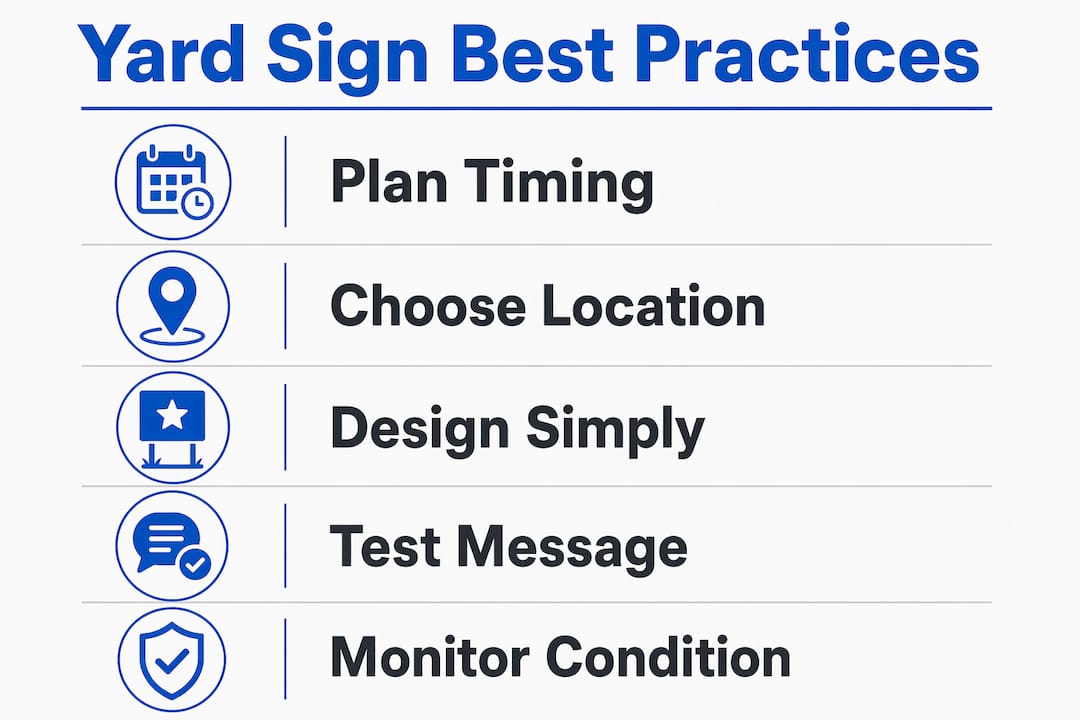
Design standards that hold up in the field
Follow these steps to produce a sign that performs from day one:
- Choose the right dimensions. The standard 18x24 inch corrugated plastic panel is the industry baseline. It fits most wire stake frames, ships flat, and reads clearly from a moving vehicle.
- Use bold, sans-serif fonts. Fonts like Impact, Arial Black, or similar weights read at distance. Script fonts fail in outdoor conditions.
- Limit your color palette. Two to three colors maximum. Every additional color adds visual noise and reduces legibility.
- Include your brand mark. Place your logo in the upper third of the sign so it registers before the reader processes the text.
- Add a single contact point. One URL or one QR code. QR codes work well when pedestrian traffic is high and dwell time allows a phone scan.
- Print on weatherproof material. Corrugated plastic (also called Coroplast) resists rain, wind, and UV fading. Standard corrugated plastic yard signs measuring 18x24 inches cost between $50 and $150 each, with turnaround often as fast as 24 hours.
Placement principles that drive results
Location determines whether your sign gets seen or ignored. The table below summarizes the key placement variables.
| Placement factor | Best practice |
|---|---|
| Intersection type | High-traffic decision corners where drivers slow or stop |
| Height | Driver eye-level, typically 36–48 inches from ground |
| Angle | Face oncoming traffic, not parallel to the road |
| Obstructions | Check for parked vehicles, hedges, and utility boxes at driver height |
| Density | One sign per approach direction; avoid clustering |
Effective sign placement prioritizes decision corners with high-contrast directional arrows to guide traffic and increase engagement. That principle applies equally to retail launches, restaurant openings, and community events.
Timing matters as much as location. Marketing professionals should plan for a 3–5 business day delivery window for custom sign panels and install them 1–2 weeks before the event for maximum impact. Installing too early risks sign fatigue. Installing too late wastes the anticipation window entirely.
Pro Tip: Walk the placement site at the same time of day your audience travels it. Morning commute lighting and afternoon sun angles affect readability in ways that a midday site visit will not reveal.
For retail businesses, the outdoor sign placement guide from Yardsigns covers specific foot traffic patterns and sightline considerations worth reviewing before you finalize your locations.
How to integrate coming soon yard signs with digital marketing?
Physical signs and digital channels reinforce each other when you run them simultaneously. A yard sign plants a seed. Your digital presence waters it.
Combining physical signage with digital marketing elements like social media teasers, countdowns, and pop-ups enhances overall campaign impact. The mechanism is simple: your sign creates awareness, and your digital touchpoints convert that awareness into follows, email signups, or pre-orders.
Practical ways to connect the two channels include:
- QR codes on signs. Link directly to a landing page with a countdown timer or email capture form. Track scan volume by location to measure which placements perform best.
- Matching social media teasers. Use the same visual language on Instagram and Facebook that appears on your physical signs. Consistency builds recognition faster than novelty.
- Geo-targeted digital ads. Run paid social ads targeting the zip codes where your signs are installed. Someone who sees your sign on the way to work and then sees your ad that evening is far more likely to act.
- Countdown posts. Schedule weekly posts counting down to launch day. Each post gives your audience a reason to check back and share.
- Email list pre-launch sequences. Capture emails through your QR code landing page and send a short sequence building toward launch day with exclusive previews or early access offers.
The metric that ties both channels together is pre-launch engagement: email signups, social follows, and QR code scans. Track these numbers weekly. If engagement drops, refresh your sign message or adjust your digital content to match.
Evolving the message on coming soon signs keeps the audience engaged as the launch nears, shifting from teasers to calls to action. Apply the same logic digitally. Move from “Something is coming” to “Opening in 7 days” to “We’re live. Visit us today.”
What are common pitfalls when using coming soon yard sign tactics?
Most coming soon sign campaigns fail for predictable reasons. Knowing them in advance saves you time, money, and missed opportunity.
- Cluttered design. Adding too much text or too many graphics turns a sign into a puzzle. Drivers will not solve puzzles at 35 miles per hour. Cut your message to its core.
- Poor placement. A sign behind a utility pole or below a hedge line is invisible to drivers. Testing placement at driver eye-level sightlines before installation prevents this. What looks clear on foot often disappears behind obstructions at vehicle height.
- Ignoring local regulations. Municipalities regulate sign size, placement distance from roads, and permit requirements. Violating these rules results in fines or forced removal. Check with your local planning department before installation.
- MLS and Clear Cooperation compliance for real estate. The coming soon tactic must comply with local MLS and Clear Cooperation policies to avoid legal complications. Misuse can require immediate listing status changes, which disrupts your entire pre-launch strategy.
- Static messaging throughout the campaign. A sign that reads the same in week one and week three loses its power. Rotate messages as the launch date approaches to maintain interest.
- Leaving signs up after launch. A “Coming Soon” sign still standing two weeks after you open sends the wrong signal. Remove or replace signs on launch day.
Pro Tip: Assign one person on your team to own sign condition and messaging updates. Signs that fade, fall over, or go stale reflect directly on your brand before it even opens.
For businesses planning a reopening or new location launch, the grand reopening yard sign guide from Yardsigns covers messaging transitions and removal timing in practical detail.
Key takeaways
The coming soon yard sign tactic generates pre-launch momentum when you combine clear teaser messaging, precise placement, and coordinated digital follow-through.
| Point | Details |
|---|---|
| Lead with simplicity | Limit sign text to five words or fewer and one call to action for maximum readability. |
| Time your installation | Install signs 1–2 weeks before launch after accounting for a 3–5 day production window. |
| Place at decision corners | Position signs at high-traffic intersections at driver eye-level to maximize visibility. |
| Connect to digital channels | Pair physical signs with QR codes, social teasers, and geo-targeted ads to convert awareness into action. |
| Evolve your message | Shift sign copy from teaser to countdown to call to action as launch day approaches. |
What I’ve learned after watching hundreds of coming soon campaigns play out
Most marketers treat the coming soon sign as a placeholder. They order one, stick it in the ground, and wait for launch day. That approach wastes the most valuable window in any campaign.
The signs that actually move the needle share one quality: they treat the pre-launch period as a campaign in itself, not a waiting room. I’ve seen small restaurant operators generate a line out the door on opening day simply because their signs changed every week, their QR code led to a genuine preview, and their social content matched the physical sign’s visual language exactly. The sign was the anchor. Everything else orbited it.
The other thing most marketers underestimate is placement testing. Reading a site on a map and standing at that corner during rush hour are two completely different experiences. Obstructions that do not exist at 9 a.m. on a Tuesday appear at 5 p.m. on a Friday when parked delivery trucks block your sightline entirely.
My honest advice: treat your sign budget as a media buy, not a printing cost. The physical sign is the impression. The message, placement, and timing are the targeting. Get those three right, and a $100 sign does the work of a much more expensive channel. Yard signs promote community events and local launches with a credibility that digital ads simply cannot replicate at the neighborhood level.
— YardSignGuy
Ready to put your coming soon campaign in the ground?
Yardsigns prints weatherproof corrugated plastic signs with vibrant, fade-resistant color that holds up through rain, wind, and direct sun. Orders under 50 pieces ship within 24 hours, so you can move fast when your launch timeline shifts.
Whether you are promoting a retail opening, a fundraising event, or a real estate listing, Yardsigns gives you the design flexibility and turnaround speed to get signs installed before your window closes. Browse ready-to-customize options including special event signs and niche formats built for specific campaigns. Visit Yardsigns.com to configure your coming soon signs and get them shipped before your competition notices.
FAQ
What is the coming soon yard sign tactic?
The coming soon yard sign tactic is a pre-launch marketing method that uses teaser signage at high-traffic locations to build public curiosity and anticipation before a business, product, or event launches.
How early should I install coming soon yard signs?
Install signs 1–2 weeks before your launch date. Factor in a 3–5 business day production window when placing your order to avoid delays.
What size yard sign works best for coming soon campaigns?
The standard 18x24 inch corrugated plastic panel is the most widely used format. It fits standard wire stake frames, ships flat, and reads clearly from a moving vehicle.
Do coming soon yard signs work for real estate listings?
Yes, and 61% of real estate agents use yard signs to promote listings. Real estate professionals must also verify compliance with local MLS and Clear Cooperation policies before installing coming soon signs.
How do I combine yard signs with digital marketing?
Add a QR code to your sign that links to a landing page with a countdown or email capture form. Run geo-targeted social ads in the same zip codes where your signs are installed to reinforce the message across channels.
