


Farm Area Marketing with Yard Signs: 2026 Guide
Farm area marketing with yard signs is the practice of placing printed, weatherproof signs near farm properties, road intersections, and high-traffic rural routes to attract local customers and generate qualified leads. A single strategically placed sign generates 3–5 qualified leads over its effective lifetime of two to four weeks. That number compounds fast when you deploy a cluster of signs across a farm’s key access routes. This guide covers the exact sizes, materials, design principles, and placement tactics that farm business owners use to get real results from physical signage in 2026.
What is farm area marketing with yard signs?
Farm area marketing with yard signs is a form of hyperlocal advertising. The industry term is point-of-sale signage when signs appear at the farm itself, and directional signage when placed along roads to guide customers in. Both types work together to build awareness and drive foot traffic.
The core advantage over digital ads is immediacy. A driver passing your farm stand at 30 mph sees your sign before they ever open a browser. Signs require no algorithm, no ad budget, and no click. They work around the clock, seven days a week, in any weather, as long as the materials hold up.
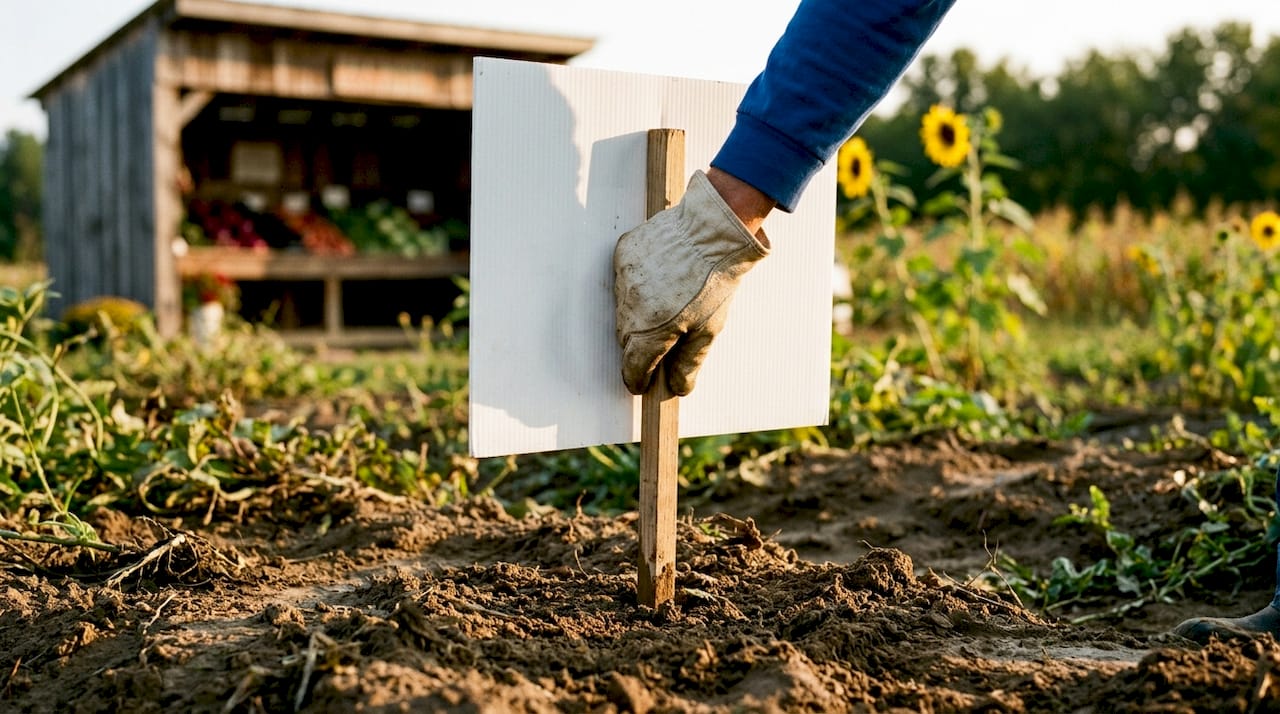
Yard signs boost local visibility because they meet customers exactly where they already are: on the roads near your farm. That proximity is the entire point. A sign two miles away from your stand is a billboard. A sign fifty feet from your entrance is a conversion tool.
What are the optimal yard sign sizes and materials for farms?
Size and material are the two decisions that determine whether your sign gets read or ignored. Get them wrong and you waste every dollar spent on design and printing.
Choosing the right sign size
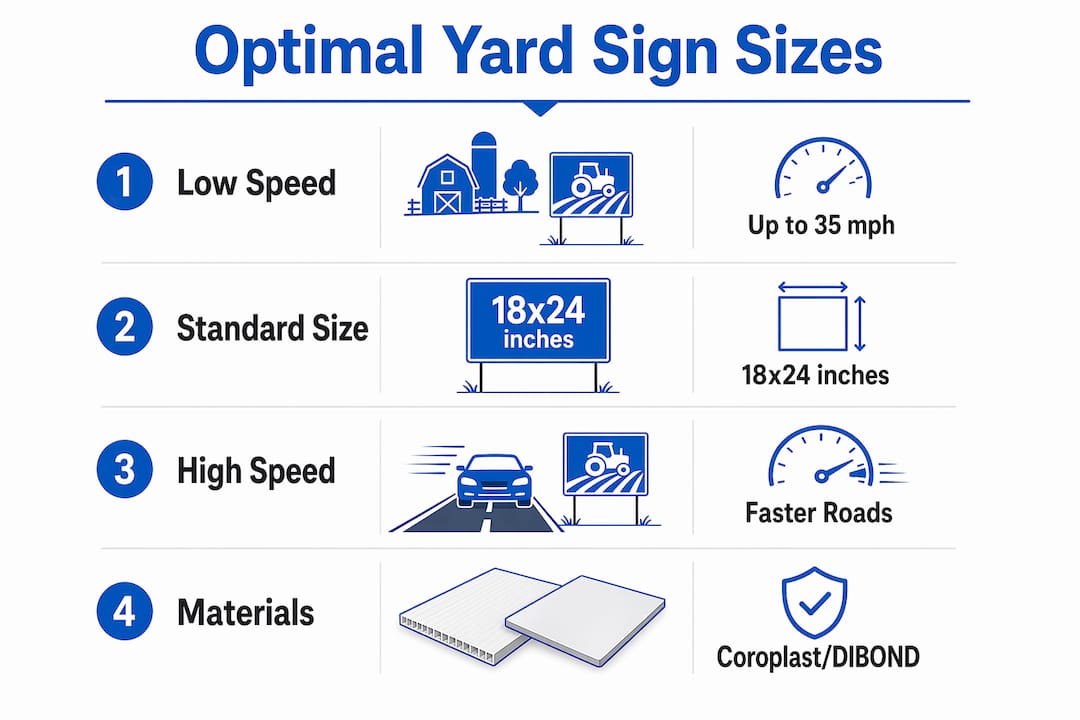
Standard 18x24 inch signs work well for roads with speed limits up to 35 mph. They fit a five-word headline with 4–5 inch letter height, which is the minimum for legibility at that speed. For roads with limits above 35 mph, step up to a 24x36 inch sign. The larger format gives drivers enough time to read your message before they pass.
| Road Speed | Recommended Size | Headline Capacity |
|---|---|---|
| Up to 35 mph | 18x24 inches | 5 words at 4–5 inch letters |
| 35+ mph | 24x36 inches | 6–7 words at 5–6 inch letters |
| Farm entrance | 24x36 inches | Name + product + call to action |
Selecting the right material
Corrugated plastic (coroplast) costs $2–$10 per sign at volume and suits seasonal promotions like strawberry picking or pumpkin sales. It is lightweight and easy to stake, but it warps and fades within one season of direct sun and rain. Serious farm businesses prefer 6mm aluminum composite, sold under the brand name DIBOND. Double-sided DIBOND signs resist warping, UV degradation, and moisture year-round, keeping your visuals sharp and your brand looking professional through every season.
Pro Tip: Order coroplast for short seasonal campaigns and DIBOND for permanent entrance signs. The cost difference pays for itself within one growing season when you avoid reprinting faded signs.
How to design yard signs for maximum visibility on farms
Design is where most farm signs fail. A cluttered sign with small text and low contrast does not get read. It gets ignored at 40 mph.
Core design principles for farm signage
- Headline first. Your sign’s top line should name what you sell or where to turn. “Fresh Eggs” or “Pick-Your-Own Berries” beats your farm’s name every time for first-time visitors.
- Letter height matters. Use 4–5 inch capital letters for 18x24 signs. Drop below that threshold and legibility drops sharply at road speed.
- High contrast colors. Black on yellow, white on green, and red on white are the three highest-contrast combinations for outdoor reading. Avoid light text on light backgrounds.
- Limit your message. Five words or fewer on the main line. One supporting line with a phone number or cross-street reference. Nothing else.
- Add a QR code. QR codes on yard signs achieve an 8–12% scan rate in 2026 when paired with a clear, value-driven call to action. That is a significant jump from 2% in 2019. Link the code to a landing page with your hours, directions, and current product availability.
Pro Tip: Place the QR code in the lower right corner with the text “Scan for hours + map” directly beneath it. That single instruction doubles scan rates compared to a bare code with no label.
For a deeper look at letter sizing and layout standards, the yard sign design tips from Yardsigns cover the full breakdown by sign size and viewing distance.
Where and how to place yard signs around farm properties
Placement determines whether your signs convert or collect dust. Location is not about quantity. It is about concentration.
The route density method
Most practitioners endorse a “route density” approach rather than random distribution. The principle is simple: cluster your signs along the specific roads your most likely customers already travel. For a farm stand, that means the two or three roads connecting your property to the nearest town center, grocery store, or school.
- Start at your entrance. Place a 24x36 sign at your farm driveway with your name, primary product, and hours. This sign does the final conversion for customers who are already looking.
- Work outward in 500-foot increments. Signs placed within 500 feet of an active farm stand or recent job site show 4x higher conversion rates than randomly placed signs. Cluster three to five signs within that radius before expanding further.
- Hit key intersections. Place directional signs at every turn a customer must make to reach you from the main road. A sign that says “Farm Stand → 0.3 miles” at a turn removes all hesitation.
- Rotate every two to four weeks. Signs lose impact after prolonged exposure in the same spot. Swap locations on a regular schedule to maintain attention and avoid what marketers call “neighborhood fatigue.”
| Placement Zone | Sign Type | Purpose |
|---|---|---|
| Farm entrance | 24x36 permanent | Final conversion, hours, products |
| Within 500 feet | 18x24 coroplast | Lead capture, directional |
| Key road intersections | 18x24 directional | Navigation, awareness |
| High-traffic rural routes | 24x36 coroplast | Brand awareness, new customers |
For more on physical placement best practices, the outdoor sign placement guide from Yardsigns applies directly to farm stand contexts.
How to integrate yard signs into a broader farm marketing system
Yard signs work best as part of a connected system, not as a standalone tactic. Agricultural marketing experts recommend aligning physical signage with your digital presence so customers recognize your farm across every platform they encounter.
- Match your messaging. The headline on your sign should match the first line of your Google Business Profile description and your social media bio. Consistent positioning statements across signs, Google Business Profiles, and social media multiply your marketing impact and build a unified brand impression.
- Use tracking phone numbers. Tracking numbers on signs placed in different neighborhoods cost about $2–$5 per month per number. They tell you exactly which road or zone generates the most calls. That data lets you double down on what works and pull signs from areas that underperform.
- Connect signs to a landing page. The QR code on your sign should go to a mobile-optimized page, not your homepage. Build a single page with your current products, hours, and a one-tap call button. Update it weekly during peak season.
- Announce sign campaigns on social media. Post a photo of your new sign placement on Instagram or Facebook with your farm’s location tagged. Local followers share it, and you get digital reach from a physical asset.
The lawn signs business promotion guide from Yardsigns covers how to coordinate sign campaigns with broader promotional calendars, which is especially useful for farms with seasonal product rotations.
What are the most common mistakes in farm yard sign marketing?
Most farm sign campaigns fail for the same three reasons. Recognizing them early saves you time and money.
- Random placement. Scattering signs across unrelated roads dilutes your message and wastes inventory. Concentrate signs along the specific routes your customers use. Density beats distribution every time.
- Ignoring sign fatigue. A sign that stays in the same spot for two months becomes invisible to local drivers. Rotate your signs every two to four weeks. Fresh placement in a familiar area reactivates attention.
- Weak calls to action. “Visit us!” is not a call to action. “Fresh eggs, open daily, turn left at Oak Rd” is. Every sign needs a specific next step. If a driver cannot act on your sign’s message within five seconds of reading it, rewrite the sign.
Pro Tip: Photograph each sign placement with your phone and log the GPS location. After four weeks, compare call volume from your tracking numbers against each location. You will quickly identify your two or three highest-performing spots and concentrate future campaigns there.
Key Takeaways
Farm area marketing with yard signs delivers the highest return when signs are sized correctly, placed in dense clusters near your farm, and connected to a consistent digital presence.
| Point | Details |
|---|---|
| Size to road speed | Use 18x24 signs for roads up to 35 mph and 24x36 for faster roads. |
| Material matches duration | Choose coroplast for seasonal campaigns and DIBOND aluminum for year-round signs. |
| Cluster placement wins | Signs within 500 feet of your farm stand convert at 4x the rate of randomly placed signs. |
| QR codes add measurability | A value-driven QR code achieves an 8–12% scan rate and connects physical signs to digital follow-up. |
| Integrate with digital channels | Matching sign messaging to your Google Business Profile and social media multiplies total marketing impact. |
What I’ve learned from watching farm sign campaigns succeed and fail
I have seen farm owners spend real money on a dozen signs and get almost no response. I have also seen a single well-placed 24x36 sign at a rural intersection drive a farm stand’s busiest Saturday on record. The difference was never the sign itself. It was always the thinking behind the placement.
The farms that get results treat their signs as a system. They pick two or three roads, saturate those routes with consistent messaging, and refresh the signs on a schedule. The farms that struggle treat signs as a one-time purchase. They stake them randomly, forget about them, and wonder why the phone does not ring.
The other thing I have noticed is that durable materials signal credibility. A warped, faded coroplast sign tells a passing driver that your farm is a side project. A sharp, double-sided DIBOND sign at your entrance tells them you are a real business worth stopping for. That first impression happens in under two seconds. Invest accordingly.
The integration piece is where most farm marketers leave money on the table. Your sign gets someone’s attention. Your Google Business Profile closes the deal when they search your name ten minutes later. If those two things say different things, you lose the customer at the finish line.
— YardSignGuy
Yardsigns has the right signs for your farm marketing goals
Farm marketing moves with the seasons, and your signage needs to keep up. Yardsigns offers fully customizable, weatherproof yard signs built for outdoor conditions, with orders under 50 pieces shipped within 24 hours so you can respond to peak harvest windows without delay.
Whether you need a bold entrance sign to anchor your farm stand or a set of directional signs to guide customers from the main road, Yardsigns makes the design process straightforward. Their signs use UV-stable inks and premium materials that hold up through rain, heat, and wind. If you want to highlight farm-fresh products with a sign that actually gets noticed, Yardsigns has ready-to-customize options built for exactly that purpose. Visit yardsigns.com to get started.
FAQ
What size yard sign works best for a farm stand?
An 18x24 inch sign works for roads up to 35 mph, while a 24x36 inch sign is the better choice for faster rural roads. Both sizes support a clear headline with 4–5 inch letters for easy reading at road speed.
How long does a yard sign stay effective before needing replacement?
A strategically placed yard sign generates leads for about two to four weeks before familiarity reduces its impact. Rotating sign locations on that schedule keeps your campaign fresh.
What material should I use for outdoor farm signs?
Corrugated plastic (coroplast) suits short seasonal promotions and costs $2–$10 per sign at volume. For year-round farm entrance signs, 6mm aluminum composite (DIBOND) resists warping, UV damage, and moisture far better than lighter materials.
How do I measure which yard signs are generating the most leads?
Use a unique tracking phone number on signs placed in different zones. Tracking numbers cost about $2–$5 per month per number and show you exactly which location or road is driving calls.
Should I add a QR code to my farm yard sign?
Yes. QR codes paired with a clear call to action achieve an 8–12% scan rate in 2026. Link the code to a mobile page with your current hours, products, and directions for the best conversion results.
