


Why Door Knocking Pairs with Yard Signs: Campaign Guide
Door knocking and yard signs work harder together than either does alone. When you saturate a block with signs the morning before a canvass, voters already recognize the candidate’s name before a volunteer ever knocks. That name recognition lowers resistance, shortens the pitch, and makes the conversation feel like a follow-up rather than a cold call. Start here: drop signs in your target blocks the day before each canvass shift and record every sign request at the door for same-day fulfillment.
- Field research shows candidate door-to-door canvassing can increase vote share by roughly 3 percentage points.
- Yard signs can increase vote share by an average of about 1.7 percentage points in low-information races through passive name recognition.
- Running both in the same blocks compounds those effects through the mere exposure effect and social proof.
Table of Contents
- Why door knocking and yard signs amplify each other
- How to run signs and canvassing as one coordinated motion
- Where to place signs and when to install them
- How to align sign messaging with your canvasser scripts
- How to measure the combined impact of signs and canvassing
- Volunteer checklist for a sign-integrated canvass shift
- Why fast, durable signs make the coordinated tactic work
- Key Takeaways
- The tactic most campaigns underestimate
- Get your signs ready before the next canvass shift
- Useful sources and further reading
Why door knocking and yard signs amplify each other
The behavioral mechanics here are straightforward. Yard signs create continuous passive exposure that builds name recognition in spaces where digital ads simply cannot follow. Every time a neighbor drives past a sign on their commute, the candidate’s name registers a little more firmly. That repetition is the mere exposure effect at work: familiarity breeds comfort, and comfort lowers the barrier to a “yes” at the door.
Social proof amplifies this further. When a voter sees three or four signs on their street, they read it as a signal that their neighbors have already made a choice. A volunteer who knocks that same day steps into a conversation that has already been warmed. The pitch becomes a confirmation rather than an introduction.
The empirical case for combining both tactics is solid:
- Candidate canvassing produces roughly a 3-percentage-point vote-share gain in field experiments.
- Doorstep conversations average around 90 seconds versus roughly 30 seconds for phone calls, producing larger persuasion effects.
- Signs placed before a canvass give volunteers a ready-made conversational anchor: “You’ve probably seen our signs on this block — here’s what the campaign is actually about.”
A hybrid approach that pairs passive visibility with personal contact consistently outperforms either channel run in isolation.
Pro Tip: Brief your volunteers on the sign density in each block before they head out. A volunteer who knows “we have six signs on Oak Street” can open with that fact and immediately sound credible.
How to run signs and canvassing as one coordinated motion
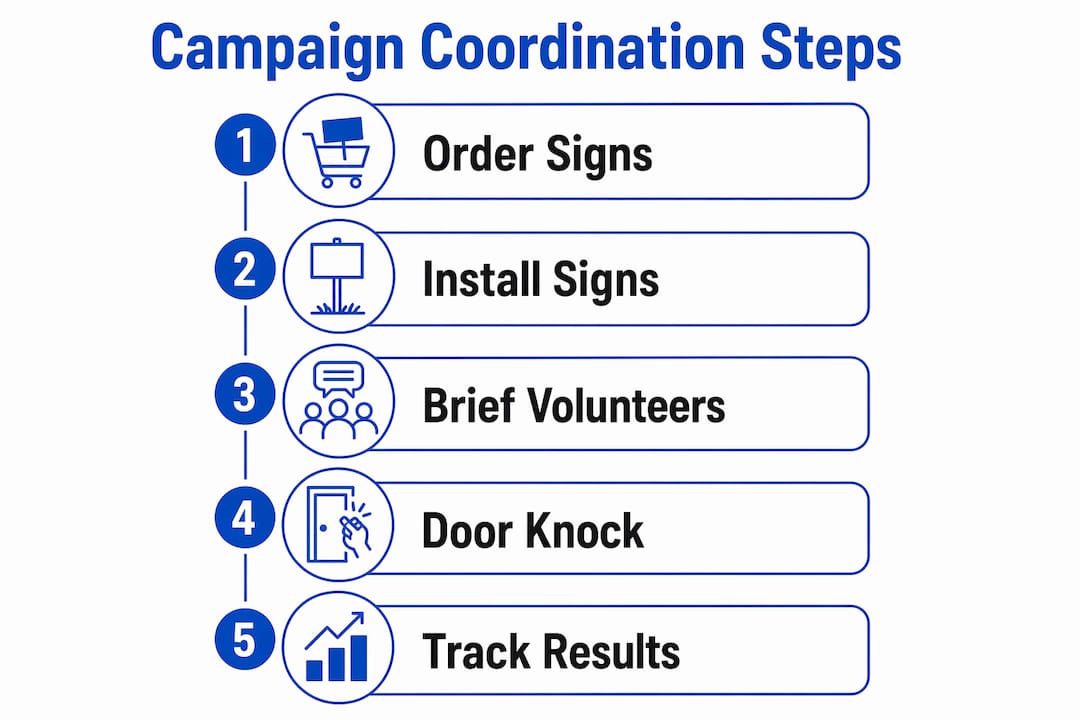
The goal is a single, synchronized operation: signs go up, then volunteers follow the same route within 24–48 hours.
- Select your territory. Use voter data to identify persuadable precincts. Prioritize blocks with higher foot traffic and visible corner lots where signs will get maximum exposure.
- Map sign clusters to canvass routes. Assign sign placement zones that mirror your walk-list segments. Every block a volunteer will knock should already have at least one sign visible before they arrive.
- Schedule the sign drop. Send a small crew to install signs the morning before the canvass shift. Aim for at least one sign per block face, with extras at neighborhood entrances and corner lots.
- Canvass within 24–48 hours. Volunteers follow the same route, using sign visibility as an opener. The script anchor: “You may have seen our signs on [Street Name] — I wanted to stop by and tell you what this campaign is actually about.”
- Capture sign requests at the door. When a voter says “I’d like a sign,” log it immediately on the walk-list with address and contact. This is a high-value outcome: a sign request is a soft commitment.
- Fulfill sign requests same-day or next-day. Feed the list to your logistics crew before the end of the shift. A fulfilled sign request within 24 hours converts a warm contact into a visible supporter.
- Avoid duplicate coverage. Use a mobile CRM or territory mapping tool to track which blocks have been canvassed and which sign requests are pending. Overlapping routes waste volunteer time.
For the canvass conversation itself, keep the sign reference short and specific:
- “We put signs up on your block this week — I’m here to answer any questions about [Candidate Name]'s position on [local issue].”
- “Did you happen to see the signs on [Street Name]? I can leave you a flyer with more detail.”
- “Would you be open to putting a sign in your yard? It helps your neighbors know where the community stands.”
Pro Tip: Print a simple one-page route sheet that shows sign locations alongside the walk-list. Volunteers who can see where signs already stand are far more confident opening a conversation.
Where to place signs and when to install them
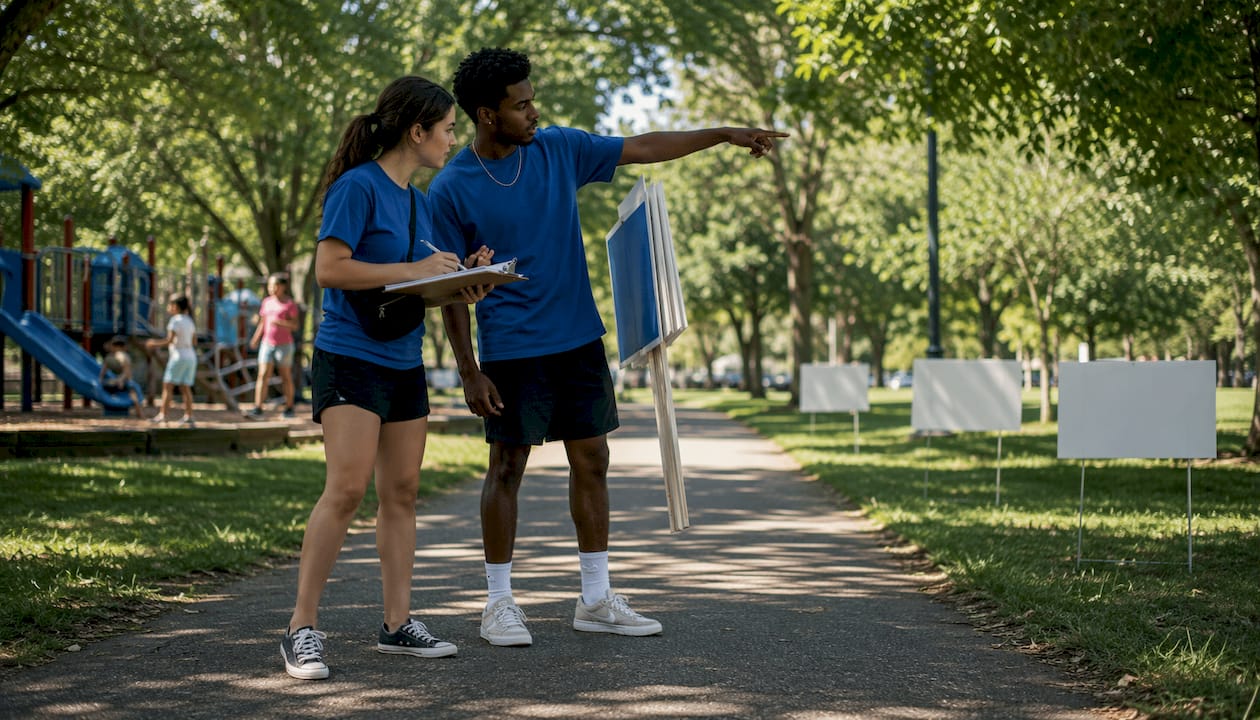
Placement determines whether a sign gets seen once or dozens of times. The highest-return locations share one trait: they sit along paths people travel repeatedly.
- Neighborhood entrances and exits. Every resident passes these points daily. A sign here registers on every trip in and out.
- Commuter corridors. Streets with steady weekday traffic give signs repeated exposure along daily routes, which is exactly the repetition the mere exposure effect requires.
- High-foot-traffic commercial corners. Near coffee shops, grocery stores, and transit stops, signs reach pedestrians who have a moment to actually read them.
- Supporter front yards on visible streets. A sign in a supporter’s yard carries implicit social proof that a roadside placement does not.
For local election placement ideas that go deeper on high-impact locations, the Yardsigns blog has a dedicated guide.
Timing matters as much as location. Late sign installs in the final week reduce return on investment. A practical timeline:
- 8–10 weeks out: Order your first production run. Build in a buffer of 10–15% extra for sign requests captured at doors.
- 6–8 weeks out: Install signs in high-visibility locations before early voting and absentee windows open.
- 2–4 weeks out: Deploy the bulk of your neighborhood signs, timed to precede your main canvass push.
- Election night + 3 days: Remove all signs promptly. Most municipal ordinances require removal within a few days of the election.
Before any installation, run a quick compliance check:
- Confirm setback distances from the road per your municipal sign ordinance.
- Get written or verbal permission from every private property owner.
- Note any HOA restrictions in your walk-list before sending crews.
- Check whether your city requires a permit for temporary political signs (most do not, but verify).
For a full breakdown of compliance and placement rules, consult local municipal codes and the Yardsigns placement guide before a large-scale install.
How to align sign messaging with your canvasser scripts
Your sign and your volunteer’s opening line should feel like two parts of the same sentence. If the sign reads “Smith: Safe Streets,” the volunteer’s pitch should open with safe streets, not a different issue. Voters who hear a message that matches what they already saw on a sign are more likely to remember it and trust it.
A practical framework for message alignment:
- Translate your slogan into a 15–30 second pitch. “Safe Streets” becomes: “Hi, I’m with the Smith campaign. We’re focused on fixing the intersection at Oak and Main — three accidents there this year. Can I leave you some information?”
- Reference the sign explicitly when it fits. “You may have seen our signs on Maple Street — that ‘Safe Streets’ message is about [specific local issue]. Here’s what the plan actually looks like.”
- Keep the visual identity consistent. The same colors, candidate name, and short URL or QR code should appear on signs, leave-behinds, and any digital follow-up. Voters who see the same visual cues across channels register the message faster.
Dos and don’ts for sign copy versus canvasser language:
- Do keep sign copy to 3–5 words maximum. Signs are read at 30 mph.
- Don’t put multiple slogans or issues on one sign. Pick one message and repeat it.
- Do train volunteers to mirror the sign’s exact language in their opening line.
- Don’t let volunteers improvise a different message in the field. Inconsistency erodes the recognition effect signs have already built.
- Do include a short URL or QR code on the sign so curious voters can self-qualify before the knock.
How to measure the combined impact of signs and canvassing
Tracking outcomes turns a good tactic into a repeatable system. The metrics worth capturing for a combined sign-plus-canvass operation:
- Sign density per precinct: total signs installed divided by total households. Aim for at least one sign per block face in priority precincts.
- Canvass contact rate: doors answered divided by doors knocked. A well-planned canvass typically targets a contact rate in the range of 20–40%, depending on time of day and neighborhood type.
- Sign-request conversion: sign requests captured at the door divided by total contacts. This is a leading indicator of supporter enthusiasm.
- Time-to-fulfillment: hours between a sign request logged and the sign installed. Under 24 hours is the operational target.
- Pledge-to-vote conversions: voters who committed to voting during a canvass, tracked against actual turnout in your voter file post-election.
To approximate the impact of pre-installed signs, run a simple A/B comparison: canvass two comparable precincts, one with signs pre-installed and one without. Compare contact rates, conversation length, and sign-request rates across both. The difference gives you a working estimate of the sign effect in your specific community.
For data capture, a mobile CRM or territory mapping tool keeps sign requests from falling through the cracks. A simple spreadsheet works for smaller campaigns: columns for address, contact outcome, sign request (yes/no), and fulfillment date cover the essentials.
Volunteer checklist for a sign-integrated canvass shift
Pre-shift
- Confirm your route sheet includes sign locations already installed on your blocks.
- Pack leave-behinds (flyers or door hangers) that match the sign’s visual identity.
- Bring extra sign stakes and at least two pre-assembled signs for on-the-spot placement when a voter says yes.
- Charge your phone and load the walk-list or CRM app before leaving.
- Carry water, a charged battery pack, and your volunteer ID.
At the door
- Lead with a 15-second pitch that references the sign message by name.
- Ask one qualifying question before going deeper: “Have you had a chance to learn about [Candidate Name]'s position on [issue]?”
- If a voter requests a sign, log the address immediately. Do not rely on memory.
- Ask permission before placing a sign on private property. A verbal yes is enough; note it on the walk-list.
- Safety: knock or ring once, step back from the door, and keep your hands visible. If a resident seems hostile, thank them and move on.
Post-shift
- Submit all sign requests to your logistics coordinator before the end of the shift.
- Update your walk-list with contact outcomes: answered, not home, refused, sign request, pledge to vote.
- Flag any objections that reference sign messaging (e.g., “Your sign says safe streets but the candidate voted against the traffic bill”) so the campaign can address them in follow-up.
Dos and don’ts for volunteers:
- Do stay on the approved message. If a voter asks a question you cannot answer, offer to follow up.
- Don’t place signs on public property, medians, or utility poles. It violates ordinances and reflects poorly on the campaign.
- Do knock during golden hours — roughly 4:00 to 7:00 PM on weekdays when residents are most likely to be home.
- Don’t knock after 8:00 PM or before 9:00 AM.
- Do carry a printed leave-behind for every door, answered or not.
Why fast, durable signs make the coordinated tactic work
The single coordinated motion only works if your signs arrive on time and hold up in the field. A sign that fades after one rainstorm or arrives three days late breaks the sequence.
Yardsigns prints on corrugated plastic with UV-resistant inks, which means colors stay sharp through weeks of sun and rain. Every order includes metal H-stakes, so volunteers can install signs without hunting for hardware. For campaigns running a rapid-response sign drop tied to a canvass shift, the 24-hour turnaround on orders under 50 pieces is the operational detail that makes same-week deployment realistic. Larger runs ship within 1–3 days.
Pro Tip: Order double-sided signs for high-traffic roadside placements. Drivers approaching from both directions see the message, effectively doubling the impressions from a single stake.
For grassroots campaign strategy that goes deeper on production planning and field coordination, the Yardsigns blog covers the full operational arc from design to deployment.
Key Takeaways
Pairing door knocking with yard signs in a single coordinated motion produces stronger name recognition, higher volunteer credibility, and more sign-request conversions than running either tactic separately.
| Point | Details |
|---|---|
| Deploy signs before canvassing | Install at least one sign per block face the day before volunteers knock to warm the conversation. |
| Use signs as a script anchor | Open with “You may have seen our signs on [Street]” to build instant credibility and shorten the pitch. |
| Capture sign requests at the door | Log every request on the walk-list and fulfill within 24 hours to convert warm contacts into visible supporters. |
| Track sign density and contact rate | Measure signs per precinct and doors answered per doors knocked to identify which blocks respond best. |
| Order early with Yardsigns | Yardsigns ships orders under 50 pieces within 24 hours, with UV-resistant inks and included H-stakes for rapid field deployment. |
The tactic most campaigns underestimate
Most campaigns treat signs and canvassing as two separate line items on a budget spreadsheet. Signs go to the sign committee; canvassing goes to the field director. They rarely talk. That siloed approach wastes the most valuable thing signs actually do: they pre-sell the candidate before a volunteer ever knocks.
The campaigns that get this right treat the sign drop as the first act of the canvass, not a parallel activity. They brief volunteers on exactly which blocks have signs, they train the opening line around the sign message, and they treat a sign request at the door as a conversion metric worth tracking. The result is a field program where every element reinforces the next.
There is also a practical argument for this approach that has nothing to do with behavioral psychology. Volunteers are more confident when they know the neighborhood already recognizes the candidate’s name. Confidence produces longer conversations. Longer conversations produce more pledges. The neighborhood canvassing guide from Yardsigns lays out the operational details for running this kind of coordinated program at the block level.
One more thing worth saying plainly: the timing of your sign order determines whether any of this is possible. A sign that arrives the week before Election Day does not have time to build the repetition that makes canvassing easier. Order early, build a buffer, and treat the sign drop as a scheduled campaign event with a crew, a route, and a deadline.
Get your signs ready before the next canvass shift
Yardsigns gives campaigns a faster path from strategy to field deployment. Orders under 50 pieces ship within 24 hours, larger runs within 1–3 days, and every order includes free design proofs with unlimited revisions so your sign matches your campaign’s visual identity before a single stake goes in the ground. UV-resistant inks keep colors sharp through the full campaign season, and included metal H-stakes mean your crew can install signs without a separate hardware run.
For campaigns running a rapid sign-plus-canvass push, the practical steps are straightforward: use a campaign sign template to build your design, order a buffer stock above your initial estimate, and schedule your sign drop as a dedicated crew event the day before each canvass shift. Double-sided printing is available for high-traffic roadside placements where visibility from both directions matters. Place your order at yardsigns.com and have signs in the field before your next volunteer shift.
Useful sources and further reading
- 3 Surprising Ways Yard Signs Win Votes — Evidence on sign placement, name recognition, and vote-share effects in low-information races.
- Does personal door-to-door campaigning influence voters? — Field experiment measuring the vote-share impact of candidate canvassing.
- Door Knocking vs Phone Banking Effectiveness — Research comparing in-person and phone contact rates and conversation quality.
- The complete guide to door-to-door sales in 2026 — Practitioner guidance on coordinated sign deployment and canvassing as a single motion.
- Door-to-door campaign guide — Volunteer-level operational guide covering walk-lists, leave-behinds, and sign-request capture.
- The return of door-to-door sales in a privacy-first world — Territory mapping, mobile CRMs, and route optimization for field teams.
- Lawn Signs and Voter Recognition: A 2026 Campaign Guide — Research-oriented post linking sign density to voter recognition; useful for campaign managers building the case internally.
- Political Signs in Yard: Placement and Compliance Guide — Practical guidance on local ordinances, setback rules, and HOA considerations before a large-scale install.
- Why Yard Signs Win Elections: Campaign Manager’s Guide — Manager-focused evidence and case examples for the combined sign-and-canvass approach.
